
Consecutive Numbers: Rules, Formulas, and Examples
Consecutive numbers follow one another in order with a constant step, usually one unless a different sequence is named. They are numbers that appear right after each other without any gaps, much like the page numbers in a book.
Understanding how to identify and represent consecutive numbers algebraically is essential for solving word problems, exploring number patterns, and making sense of mathematical sequences.
What Is Consecutive Numbers?
Consecutive numbers, sometimes called successive numbers, are numbers that follow each other in order from smallest to largest with a fixed difference between them. When we talk about standard consecutive numbers, we are referring to natural numbers or integers that increase by exactly each time.
For example, the numbers and are consecutive because they follow one another continuously across the types of numbers we use for counting.
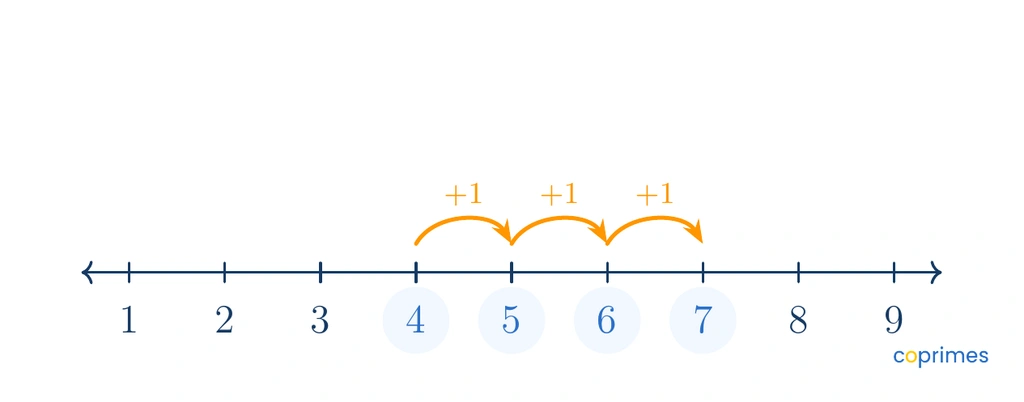
Key Ideas and Vocabulary
When working with consecutive numbers, mathematicians use variables to represent unknown sequences within the real numbers. If we let the letter represent the starting integer, we can build algebraic formulas for different sequences.
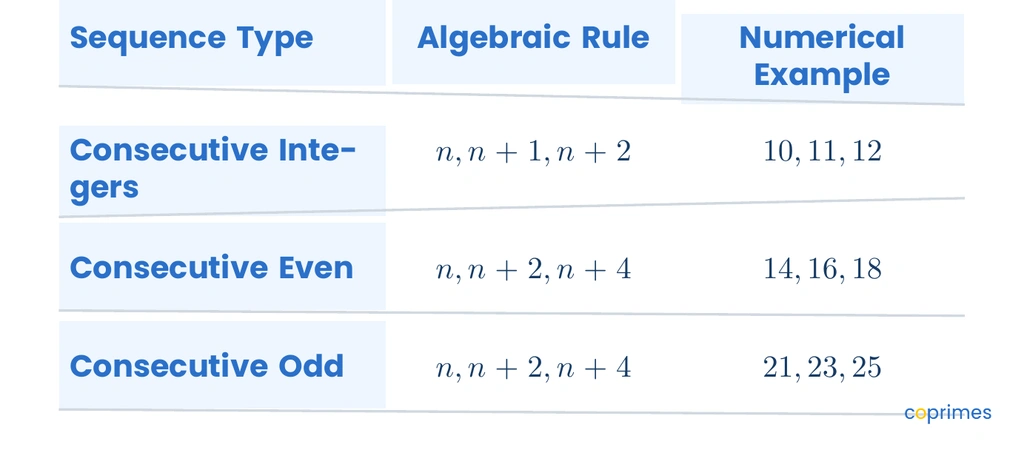
- Consecutive integers: Numbers that increase by . If the first number is , the sequence is
- Consecutive even numbers: Even numbers that follow each other. Because every even number is exactly units away from the next, the sequence increases by . If is an even number, the sequence is
- Consecutive odd numbers: Odd numbers that follow each other. Just like even numbers, odd numbers are separated by exactly units. If is an odd number, the sequence is
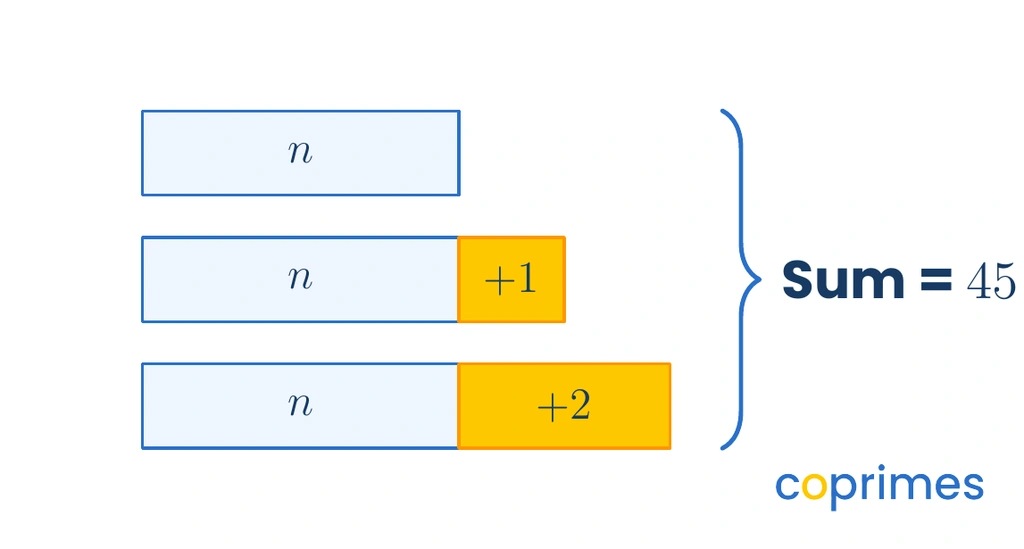
Visual Explanation
When a word problem states a total sum, we can visualize the consecutive numbers as blocks. Because each consecutive integer is exactly unit larger than the previous one, we can build a bar model to find the missing starting number.
Suppose three consecutive integers sum to . The first number is one block. The second number is that same block plus . The third number is that same block plus . If we remove the extra and from the total, we are left with three identical blocks that equal the remaining amount.
A learning plan shaped by your child, not the class
State-aligned Math plus our own Logic and English curriculum. An adaptive baseline test finds the gaps and fills them.
Worked Examples
Algebraic equations provide a reliable way to solve problems involving consecutive numbers. Let the smallest number be and express the others in terms of .
Example 1: Using the algebraic formula for a sum
Question: The sum of three consecutive integers is . What are the numbers?
Method:
- Let the three numbers be , , and .
- Write an equation showing their sum: .
- Combine the like terms: .
- Subtract from both sides: .
- Divide by : .
- Find the next two numbers by adding and to .
Answer: The numbers are and .
Check: . The sum is correct and the numbers follow each other in sequence.
Example 2: Consecutive even numbers
Question: The sum of two consecutive even numbers is . Find the numbers.
Method:
- Let the first even number be . Because even numbers are two units apart, the next even number is .
- Write the sum equation: .
- Combine the terms: .
- Subtract from both sides: .
- Divide by : .
- Find the next even number: .
Answer: The numbers are and .
Check: and are consecutive even numbers, and .
Example 3: Consecutive odd numbers
Question: The sum of two consecutive odd numbers is . What are the numbers?
Method:
- Let the first odd number be . Just like even numbers, odd numbers are separated by exactly two units, so the next odd number is .
- Set up the equation: .
- Combine terms: .
- Subtract : .
- Divide by : .
- Add to find the next odd number: .
Answer: The numbers are and .
Check: and are odd, they are consecutive, and .
Common Mistakes and Non-Examples
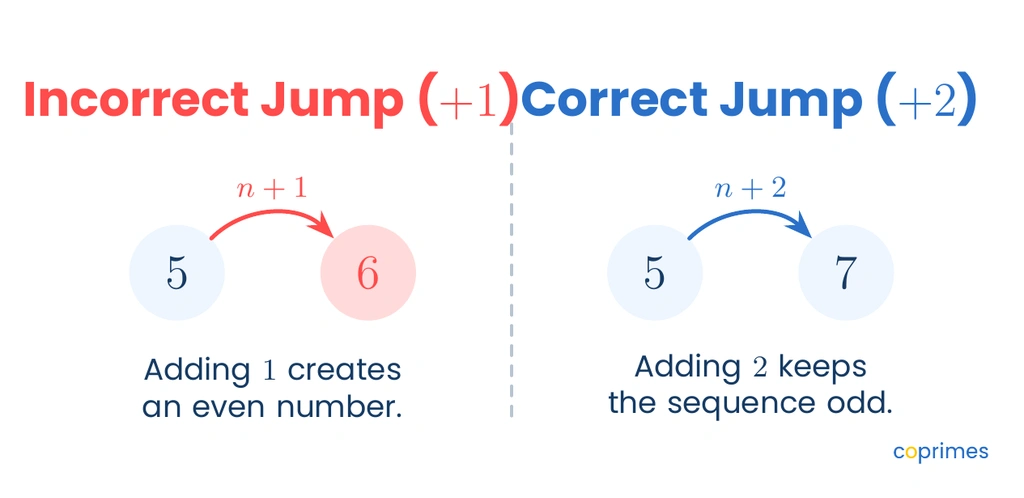
A common mistake occurs when setting up formulas for consecutive odd numbers. Many students assume that because the numbers are odd, the formula must use odd additions, like and or and .
However, the gap between any two odd numbers, such as and , is always . Therefore, the correct rule for consecutive odd numbers is always and . Adding to an odd number creates an even number, breaking the sequence entirely.
Another non-example is a sequence like . Although the numbers are increasing, the step between them is constantly changing (). Because the step is not constant, they are not consecutive numbers.
Note that while consecutive numbers are built through addition, the closure property tells us that adding any two integers always gives another integer, though the result will not necessarily be adjacent to the original numbers.
Real-World Connections
Consecutive numbers appear constantly in everyday life. The pages of a book are numbered consecutively. If you are reading page , the next page will be exactly one higher, which is .
House numbers on a residential street are another excellent example. Usually, one side of the street features consecutive even numbers (such as ) while the opposite side features consecutive odd numbers (such as ). This predictable pattern helps mail carriers navigate efficiently.

Practice questions
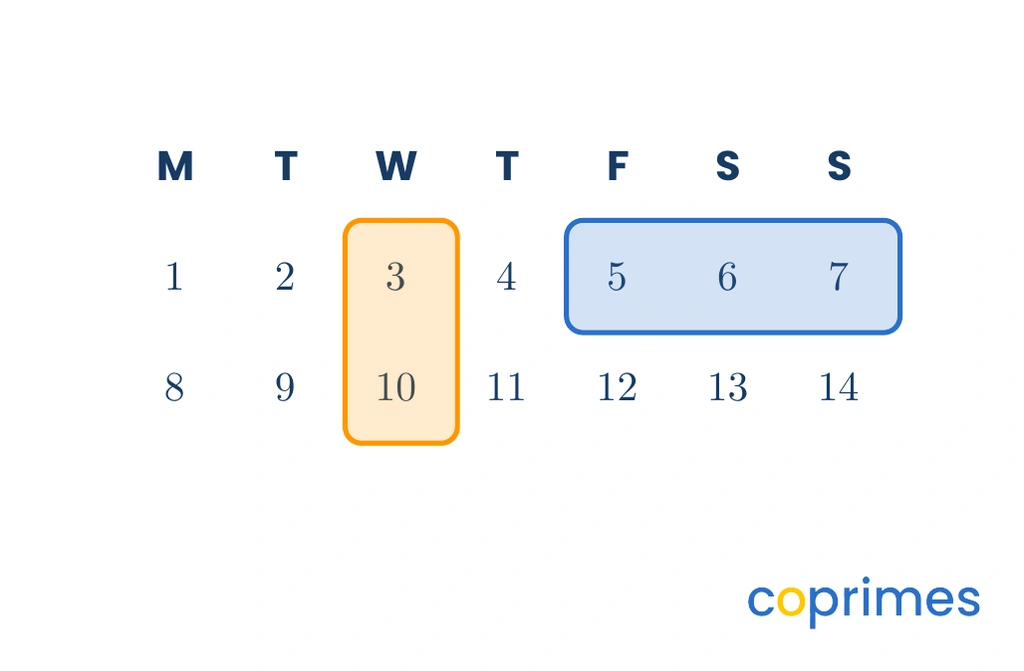
Based on the calendar provided, which highlighted group represents a sequence of consecutive numbers?
The orange vertical column only.
The blue horizontal row only.
Both the blue row and the orange column.
Neither group represents consecutive numbers.
The blue horizontal row only.
Which of the following sets represents consecutive even numbers?
If represents an odd integer, which algebraic expression correctly represents the next two consecutive odd integers?
Why does the set NOT represent consecutive numbers?
Because the sequence includes both odd and even numbers.
Because the sequence stops at instead of continuing infinitely.
Because the difference between the numbers is , not .
Because the sequence starts with an odd number.
Because the difference between the numbers is , not .
The sum of two consecutive integers is . What are the two integers?
and
and
and
and
and