
Coprime Numbers: Guide and Examples
Two integers are coprime when their greatest common factor is , even though either number may be composite.
This means that if you list all the factors of both numbers, the only factor they share is .
What Is Coprime Numbers?
To determine how to check coprime numbers, you must look at their individual factors.
Two numbers are coprime if no positive integer other than divides evenly into both of them.
These number pairs are also frequently called relatively prime integers or mutually prime numbers.
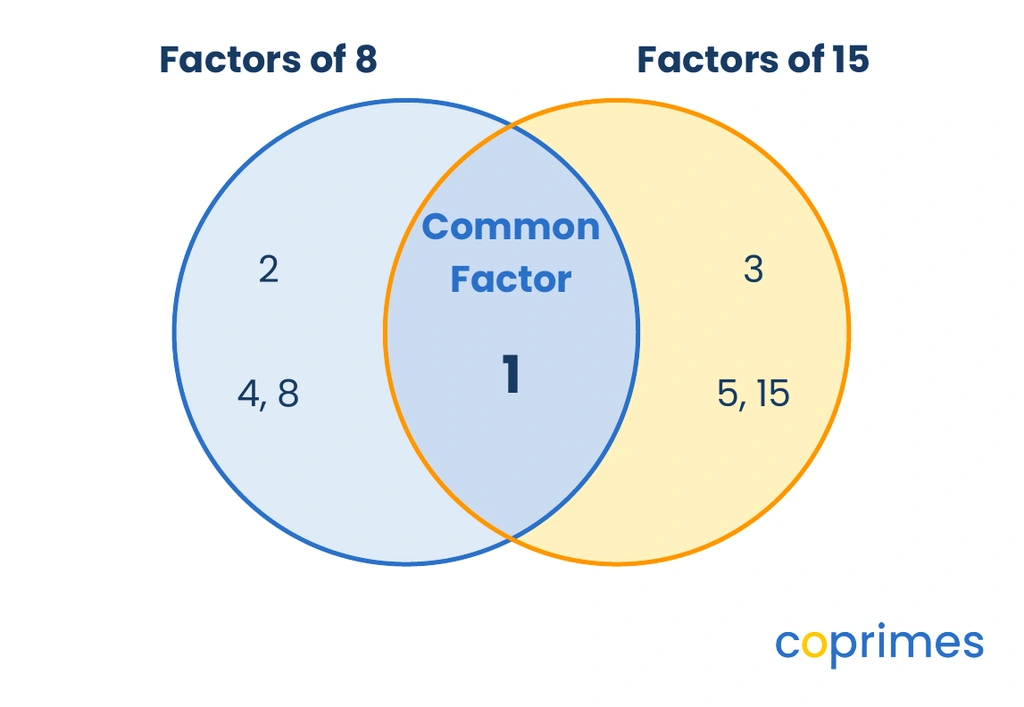
In the diagram, and are both composite numbers because they have several factors.
However, because their only shared factor is , they are coprime to each other.
Key Ideas and Vocabulary
There are several reliable rules that can help you identify coprime numbers quickly.
- Consecutive integers: Any two consecutive integers, such as and , are always coprime.
- Prime numbers: Any two different prime numbers are always coprime because their only factors are and themselves.
- The number 1: The integer is coprime to every other integer.
When analyzing properties like the GCF and LCM, coprime numbers have a unique relationship.
Because their greatest common factor is , you cannot divide both numbers by any larger integer to simplify them.
Visual Explanation
Fractions provide a perfect visual representation of coprime numbers.
A fraction is in its simplest form if, and only if, its numerator and its denominator are coprime.
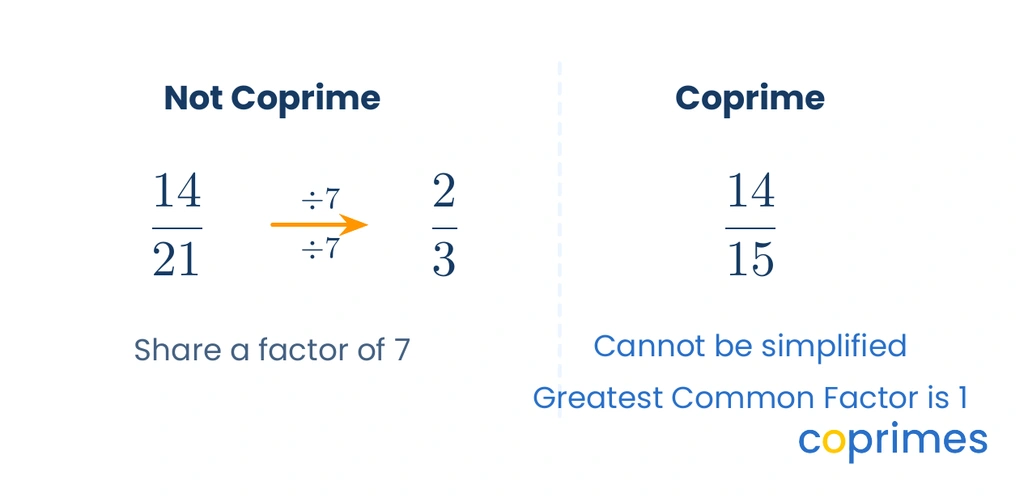
In the first fraction, and share a factor of , meaning they are not coprime, so the fraction can be simplified.
In the second fraction, and share no factors other than , meaning they are coprime, so the fraction is already in simplest form.

Worked Examples
These coprime numbers examples demonstrate how to verify relationships using different methods.
Example 1: Checking with factor lists
Question: Are the numbers and coprime?
Method:
- List all factors of .
- List all factors of .
- Compare the lists to find the greatest common factor.
Factors of : , ,
Factors of : , , , , ,
The only number that appears in both lists is .
Answer: Yes, and are coprime.
Check: Neither number can be evenly divided by any prime number that divides the other.
Example 2: Identifying non-coprime numbers
Question: Are and coprime?
Method:
- List the factors of .
- List the factors of .
- Compare the lists.
Factors of : , , ,
Factors of : , ,
Both lists share the factor , meaning their greatest common factor is , not .
Answer: No, and are not coprime.
Check: Since and , both numbers are divisible by .
Example 3: Using prime factorization
Question: Are and coprime?
Method:
- Use the fundamental theorem of arithmetic to find the prime factorization of each number.
- Check if they share any prime factors.
Prime factorization of :
Prime factorization of :
The prime factors for are and . The prime factors for are and .
They share no prime factors.
Answer: Yes, and are coprime.
Check: The greatest common factor of any two numbers with no shared prime factors is always .
Common Mistakes and Non-Examples
A widespread mistake is assuming that a pair of coprime numbers must consist of actual prime numbers.
The word "prime" in "relatively prime" describes the relationship between the two numbers, not the numbers themselves.
For example, is composite and is composite, but together they are coprime because they share no common factors other than .
Additionally, finding the least common multiple of two coprime numbers is straightforward: simply multiply them together. If they are not coprime, multiplying them will give a common multiple, but not the least one.
Non-Example: Numbers with shared prime factors
Consider and . Both are divisible by and .
Because their greatest common factor is , they are a non-example of coprime numbers.
Real-World Connections
Coprime numbers are essential in mechanical engineering, especially when designing gears.
If a small gear with teeth drives a large gear, engineers often give the large gear a coprime number of teeth, such as .
Because and are coprime, the exact same teeth will rarely meet, which prevents the gears from wearing out in one specific spot.
In computer science, coprime numbers form the foundation of encryption algorithms that secure digital communications. For extremely large numbers used in cryptography, computers often use the Euclidean algorithm to verify if two numbers are coprime quickly without listing every factor.
A learning plan shaped by your child, not the class
State-aligned Math plus our own Logic and English curriculum. An adaptive baseline test finds the gaps and fills them.
Practice questions
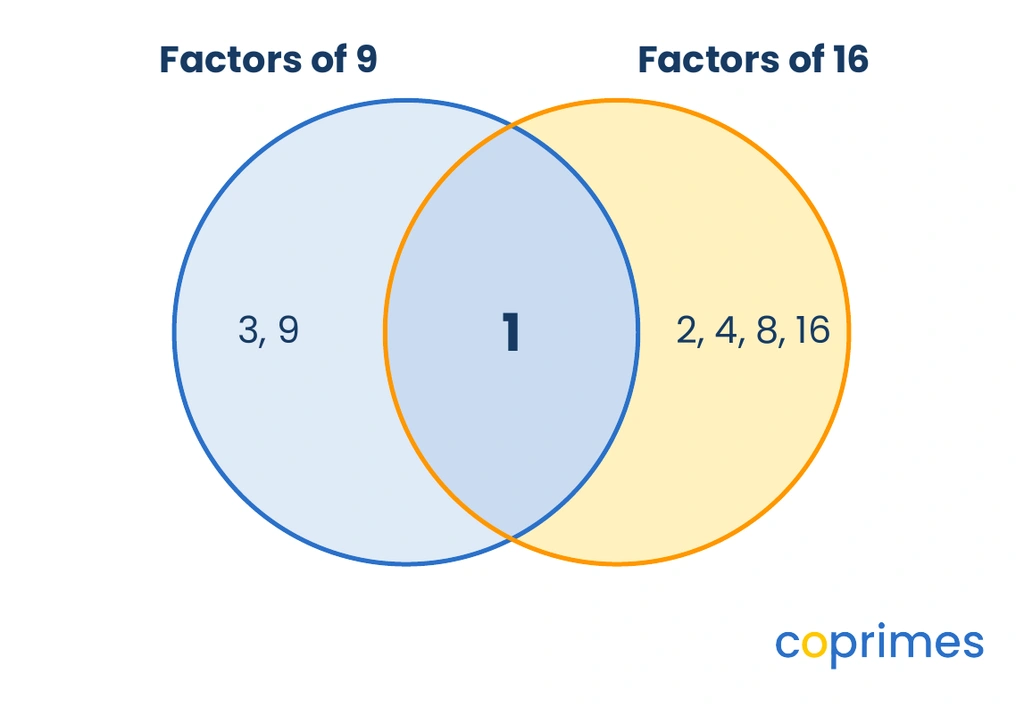
Based on the visual, what is the mathematical relationship between and ?
They are not coprime because both numbers are composite.
They are coprime because their only shared factor is .
They are coprime because they share multiple prime factors.
They are not coprime because is an even number.
They are coprime because their only shared factor is .
Which of the following pairs of numbers are coprime?
and
and
and
and
and
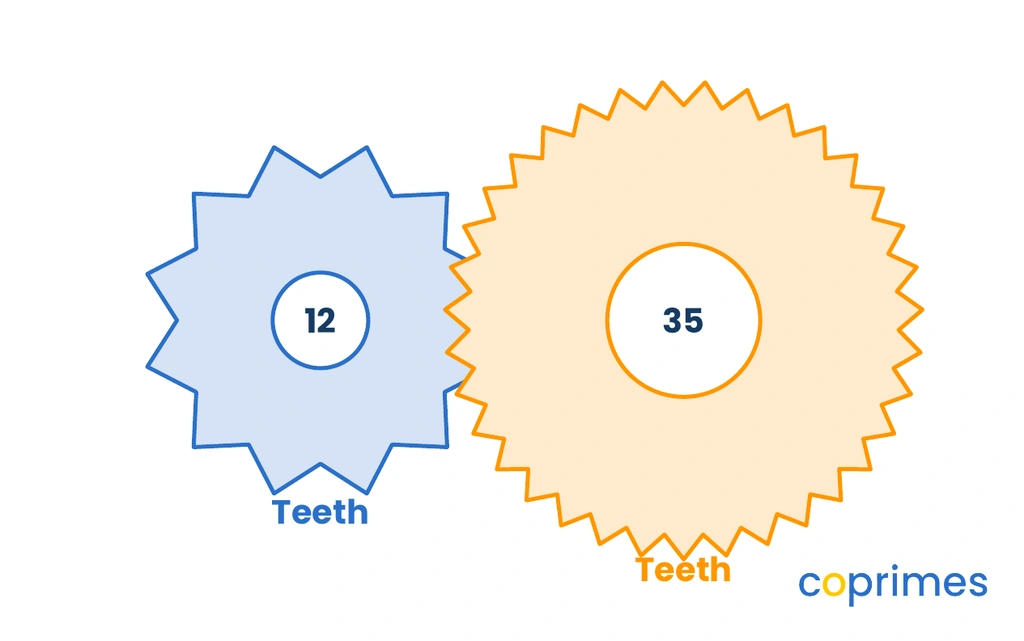
An engineer wants to ensure two gears wear evenly. Are the numbers of teeth on these gears coprime?
No, because is an even number and is an odd number.
No, because both numbers can be factored into smaller prime numbers.
Yes, because their prime factorizations share no common prime numbers.
Yes, because is a prime number.
Yes, because their prime factorizations share no common prime numbers.
If and are consecutive positive integers, which of the following statements must be true?
Both and must be prime numbers.
The numbers and are always coprime.
The numbers and will always share a factor of .
The greatest common factor of and is the larger of the two numbers.
The numbers and are always coprime.
Which of the following fractions is already in simplest form because its numerator and denominator are coprime?