
Ordering Decimals
To order decimals, align their decimal points, compare the same place values from left to right, add trailing zeros when helpful, then list the values from least to greatest or greatest to least. This procedure helps you accurately arrange measurements, data, and values in the correct decimal order.
What does ordering decimals mean?
Ordering decimals means arranging a set of decimal numbers in a specific sequence based on their value. To sort decimal numbers accurately, you must understand how to determine which number is larger or smaller.
This process relies heavily on comparing decimals, which is the step where you look at two numbers and decide their relationship. Once you can compare any two decimals, arranging decimals in a complete list becomes a step-by-step sorting task.
Choose ascending or descending order
Before you begin sorting, you must identify the direction of the required sequence. Mathematics uses specific vocabulary for ascending descending decimals.
Ascending order means ordering from the least value to the greatest value.
Descending order means ordering from the greatest value to the least value.
Always double-check the question to see whether you need to arrange the numbers in an ascending or descending sequence. Writing the correct sequence in reverse is a common avoidable error.
Align place values
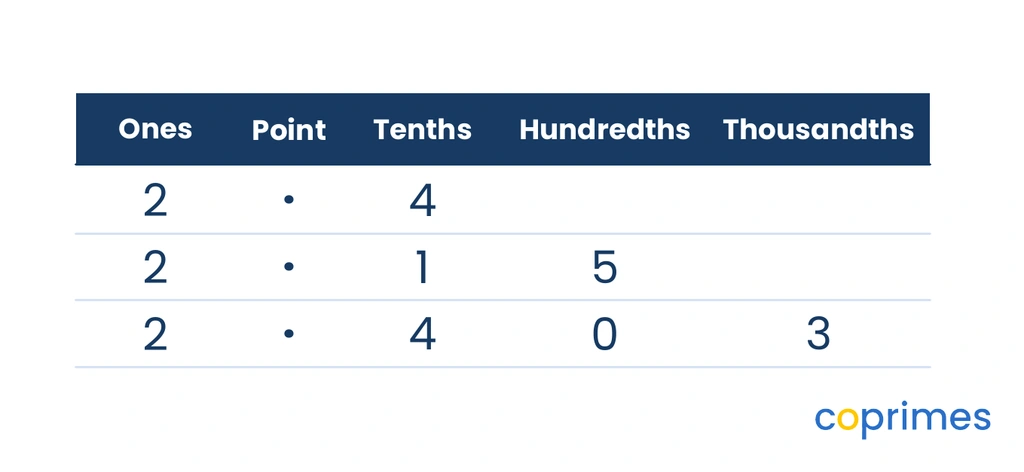
The most reliable method for comparing multiple decimals is to stack them vertically. You must align the decimal points directly underneath one another.
When the decimal points are aligned, the digits in each column share the exact same decimal place value. This guarantees that you are comparing tenths with tenths, and hundredths with hundredths.
Once aligned, read the numbers from left to right. Look at the greatest place value column first (such as the ones or tens). If the digits in that column are identical, move one column to the right and compare the next digits.

Use trailing zeros
Numbers often have different lengths after the decimal point. Empty spaces in your aligned list can make comparison difficult. To fix this, write zeros at the far right end of the shorter decimals until every number has the same number of decimal digits.
Adding trailing zeros to the right of the final decimal digit does not change the value of the number. It simply expresses the same value using smaller fractional pieces. For example, is identical to .
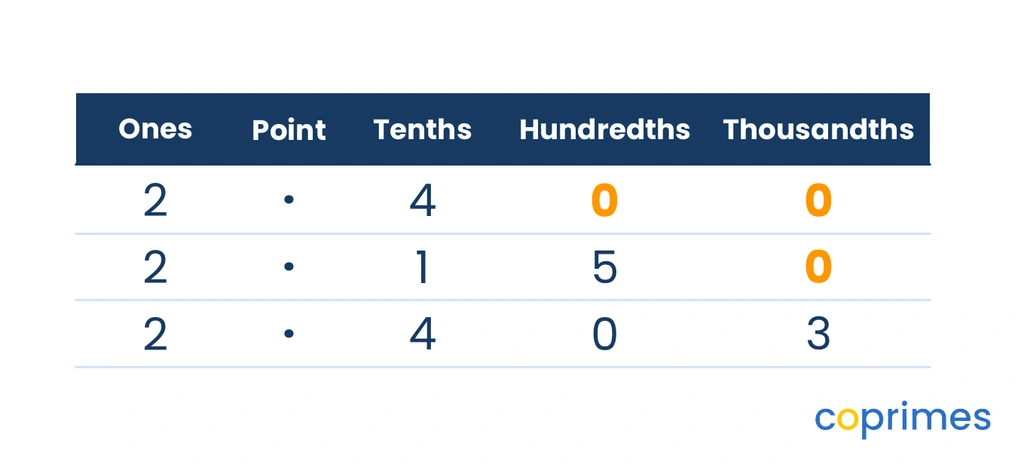
By comparing , , and vertically, the order becomes obvious. The smallest is . Between and , the value is smaller.
Order decimals on a number line
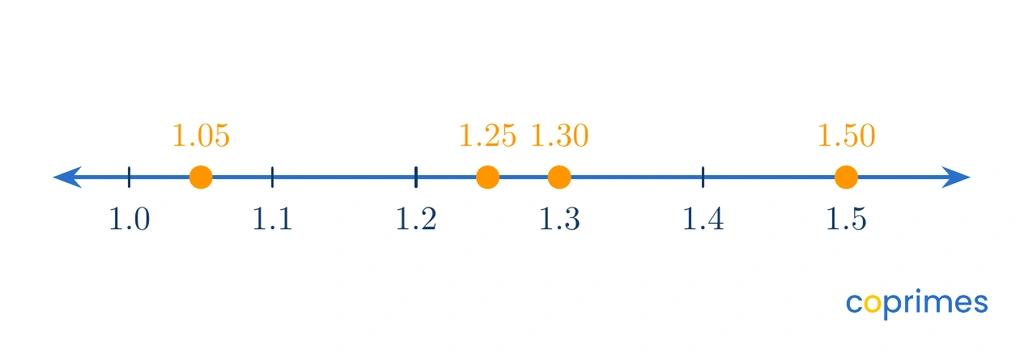
A visual way to check your order is to plot the decimals on a number line. The number line provides a spatial representation of value.
Values further to the left are smaller. Values further to the right are greater. If you plot a set of decimal numbers on a number line, reading the points from left to right automatically generates the ascending order.
Worked examples
Practice the method by ordering sets with different numbers of decimal places, including values both below and above one.
Example 1: Ascending order with varying lengths
Question: Order the following set of decimals from least to greatest: , , , .
Method:
- Stack the decimals vertically, aligning the points.
- Add trailing zeros so all numbers have three decimal places.
- Compare from left to right.
4. The ones digit is zero for all. Moving to the tenths, is the smallest, making the least. Next is .
5. Both remaining numbers have in the tenths column. Compare their hundredths: has a , while has a . Therefore, is smaller than .
Answer: The ascending order is , , , .
Check: Plotting these on a number line would show furthest to the left and furthest to the right.
Example 2: Descending order with mixed whole numbers
Question: Order the following values in descending order: , , , .
Method:
- Identify the required sequence. Descending means greatest to least.
- Look at the whole numbers first. The numbers and are clearly larger than and .
- Compare and . Pad with zeros: and . The tenths digit is greater than , so is the greatest.
- Compare and . Pad with zeros: and . The tenths digit is greater than , so is larger.
- List from greatest to least based on the comparisons.
Answer: The descending order is , , , .
Check: Ensure the sequence moves strictly from the largest total value down to the smallest total value.
A learning plan shaped by your child, not the class
State-aligned Math plus our own Logic and English curriculum. An adaptive baseline test finds the gaps and fills them.
Common mistakes
The most common mistake when arranging decimals is treating the digits after the decimal point as if they were a whole number.
A student might incorrectly claim that is larger than because is larger than . This happens when you ignore place value and count the total number of decimal digits instead.
To avoid this, remember that is equivalent to . When you compare to , it is clear that tenths represent a larger quantity than tenths. The length of a decimal never determines its size.
Frequently asked questions
How does ordering decimals relate to rounding?
Sometimes you may be asked to sort values based on an estimate. Rounding decimals simplifies complex numbers to their nearest whole number or tenth, making a rapid mental comparison easier before verifying the exact order.
Can you combine decimals and fractions in the same list?
Yes. When a sequence includes both formats, convert all the values into one format first. Usually, converting the fractions into decimals makes alignment and comparison faster. Alternatively, you can use the rules for ordering fractions by finding common denominators.
Does adding zeros at the front change the decimal?
Adding zeros to the far right (trailing zeros) never changes the value. However, adding zeros between the decimal point and the first non-zero digit changes the place value entirely. For instance, is not equal to .
Practice questions
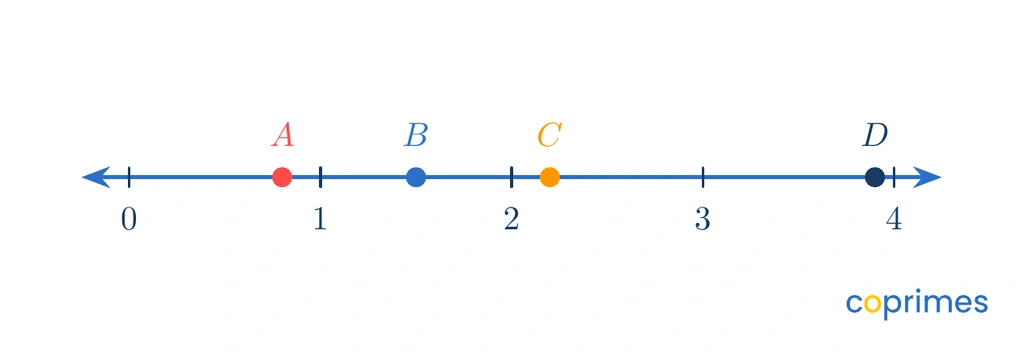
Based on the number line provided, which sequence correctly lists the points in descending order?
, , ,
, , ,
, , ,
, , ,
, , ,
Which of the following sets of decimals is ordered from least to greatest?
, , ,
, , ,
, , ,
, , ,
, , ,
Which decimal value could accurately be placed between and in an ascending sequence?
A student incorrectly states that is greater than . Which statement best explains this mistake?
The student added trailing zeros to both numbers before comparing.
The student compared the tenths digits correctly but ignored the whole numbers.
The student ignored place value and incorrectly judged the size based on the number of decimal digits.
The student arranged the numbers in ascending order instead of descending order.
The student ignored place value and incorrectly judged the size based on the number of decimal digits.
Four athletes ran a race. Their finish times were seconds, seconds, seconds, and seconds. If the winner is the athlete with the shortest time, what is the sequence of finish times from first place to fourth place?
, , ,
, , ,
, , ,
, , ,
, , ,