
Scientific Notation: Guide and Examples
Scientific notation writes a nonzero number as a value at least and less than multiplied by an integer power of . It is a standardized way to express very large or very small numbers concisely, making it easier to read, compare, and calculate without writing long strings of zeros.
What Is Scientific Notation?
Scientific notation follows a strict mathematical structure that splits a number into two distinct parts: a coefficient and a power of . Understanding this format builds upon a foundation of exponents and powers.
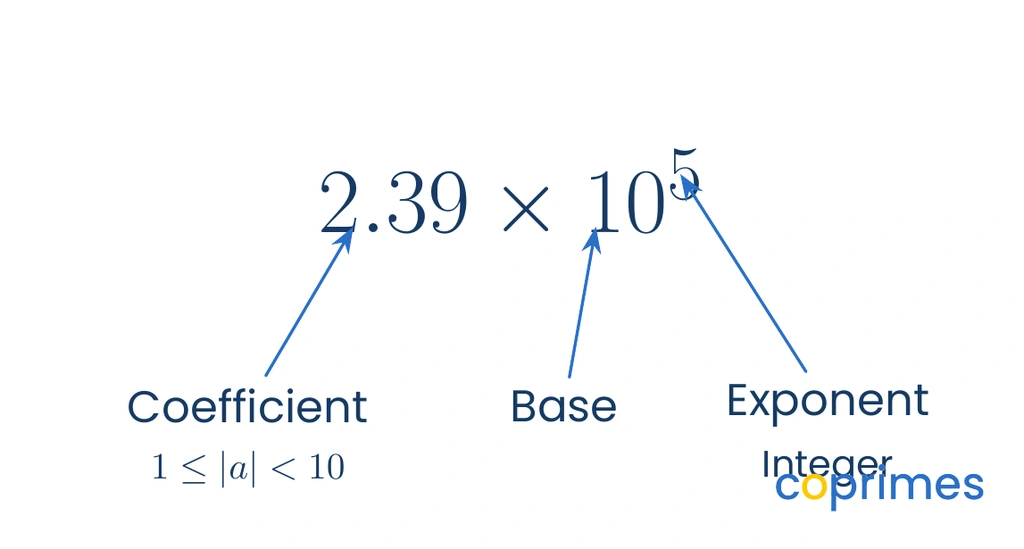
The standard form is written as , where:
- The coefficient, , must have an absolute value that is at least but strictly less than ().
- The base is always exactly .
- The exponent, , must be an integer that indicates the scale or magnitude of the number.
In some international regions and curricula, scientific notation is also known as standard form or standard index form. These terms all describe the exact same mathematical representation.
When to Use It
Scientific notation is primarily used when dealing with numbers that are too large or too small to be managed easily in standard decimal form. It allows scientists, engineers, and mathematicians to quickly grasp the order of magnitude of a value without having to count leading or trailing zeros.
For example, astronomical distances between stars are incredibly vast, while the width of a single cell in biology is microscopically small. Writing these values in scientific notation clarifies their true scale immediately. It is also a convenient way to represent precise values when approximating radicals and surds that contain many decimal places.
Step-by-Step Method
Converting a number from its ordinary decimal form to scientific notation involves isolating the core digits and determining the correct exponent.
- Locate the decimal point in the original number. If no decimal point is written, it is understood to be at the far right of the number.
- Move the decimal point so that it sits immediately after the first non-zero digit. This creates a coefficient between and .
- Count the total number of places the decimal point moved. This count becomes the absolute value of the exponent.
- Determine the sign of the exponent. If the original number was greater than or equal to , the exponent is positive. If the original nonzero number was strictly between and , this involves negative exponents.
Unlike fractional exponents, scientific notation only ever uses integer powers. To convert from scientific notation back to an ordinary number, reverse the process by moving the decimal point left or right based on the exponent.
A learning plan shaped by your child, not the class
State-aligned Math plus our own Logic and English curriculum. An adaptive baseline test finds the gaps and fills them.
Visual Worked Examples
By analyzing both large and small numbers, we can see how the exponent's sign changes based on the value's original magnitude.
Example 1: Converting a large number
Question: Write in scientific notation.
Method:
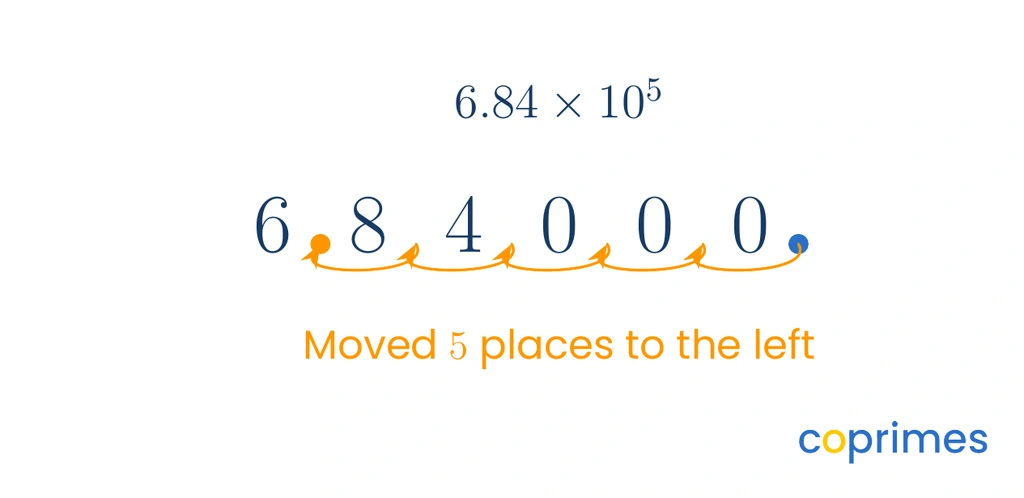
- Locate the implied decimal point at the far right of .
- Move the decimal point to the left so it sits immediately after the first non-zero digit (), giving the coefficient .
- Count the places moved. The decimal point moved places to the left.
- Because the original number is much greater than , the exponent is positive .
Answer: .
Check: Multiply by to confirm it equals .
Example 2: Converting a small number
Question: Write in scientific notation.
Method:
- Start with the visible decimal point in .
- Move the decimal point to the right until it sits after the first non-zero digit (), creating the coefficient .
- Count the places moved. The decimal point moved places to the right.
- Because the original value is between and , the exponent is negative .
Answer: .
Check: Multiply by to confirm it equals .
Example 3: Converting back to standard form
Question: Express as an ordinary decimal number.
Method:
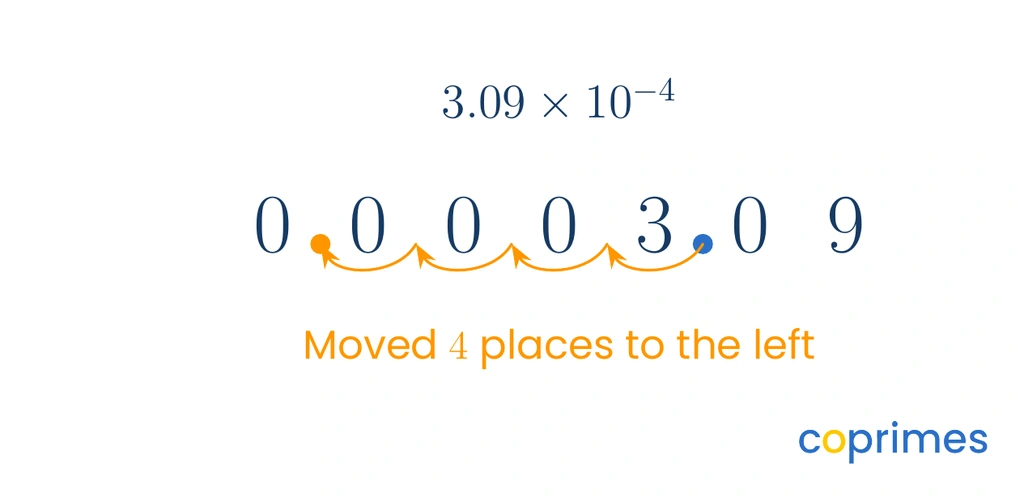
- Identify the exponent, which is .
- The negative exponent indicates the original number is small.
- Move the decimal point in the coefficient exactly places to the left.
- Fill any empty place values with zeros.
Answer: .
Check: Move the decimal point places to the right in to verify it yields .
How to Check the Answer
To verify any scientific notation conversion, expand the expression back to standard form. The simplest way is to multiply the coefficient by the expanded power of .
For instance, to check if correctly represents , calculate as . Multiplying shifts the decimal three places to the right, yielding . If the expanded value matches the original number, the scientific notation is correct.
Common Mistakes
The most frequent error is choosing an invalid coefficient. The coefficient must be at least but strictly less than .
For example, writing as is mathematically equal in value but is a non-example of correct scientific notation because is greater than . The correct form is .
Another common mistake involves mixing up the sign of the exponent. Remember that moving the decimal to the right to handle a small decimal number requires a negative exponent, while moving it to the left for a large number requires a positive exponent.
A positive exponent indicates a magnitude greater than or equal to 10. A negative exponent indicates a magnitude between 0 and 1.

Practice questions
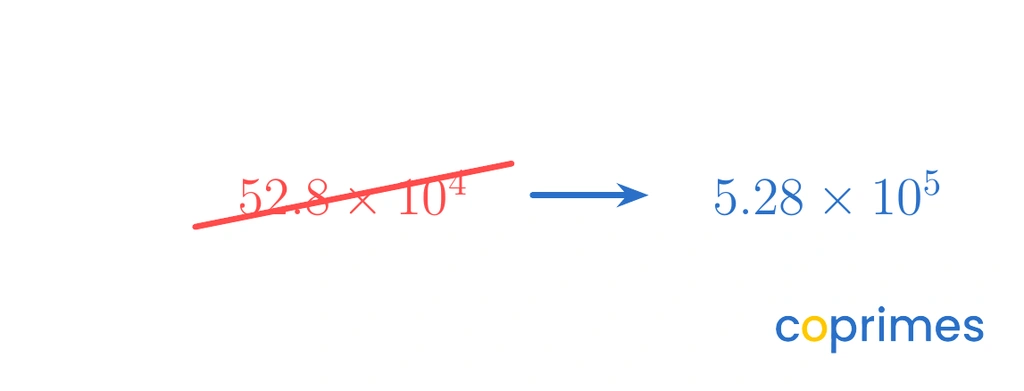
Why is not written in proper scientific notation?
The coefficient is not between and .
The exponent is a positive integer.
The base is instead of another number.
The number has decimals in the coefficient.
The coefficient is not between and .
Which of the following numbers is correctly written in scientific notation?
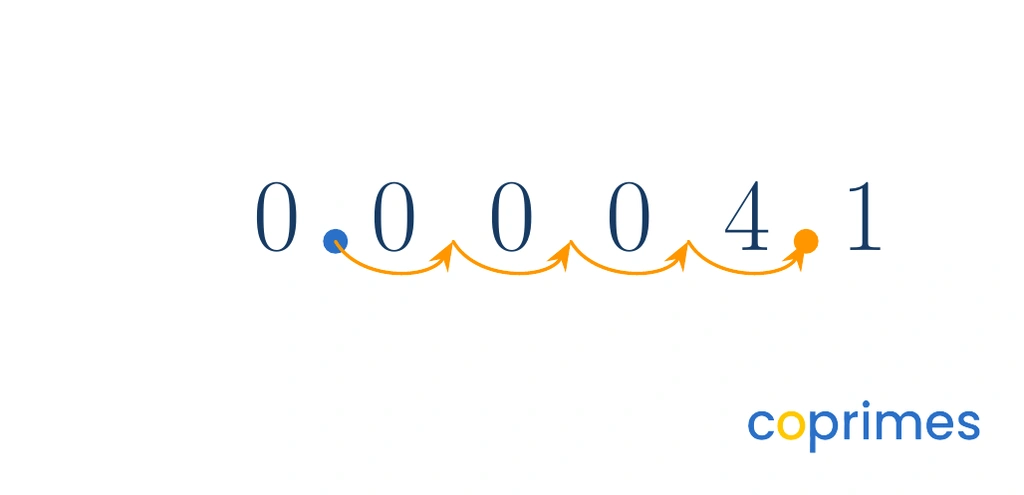
Based on the diagram above, how should be written in scientific notation?
Convert the scientific notation into a standard decimal number.
A spacecraft is traveling at a speed of kilometers per hour. If it travels for hours, what is its total distance traveled in scientific notation?