
Adding Decimals: Steps, Models and Examples
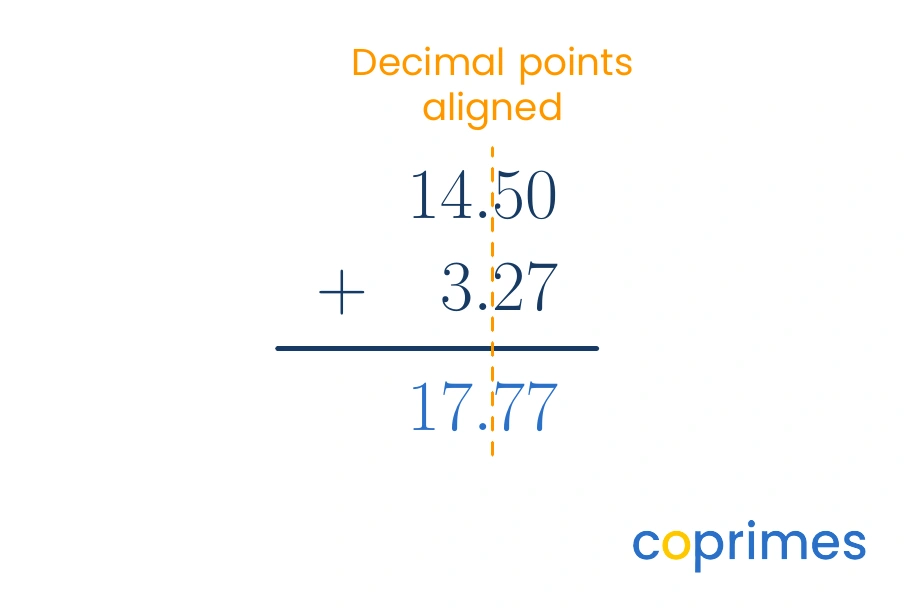
To add decimals, align the decimal points so equal place values are in the same columns, add zero placeholders when useful, add as with whole numbers and place the decimal point directly below the aligned points.
How do you add decimals?
Adding decimals follows the same standard algorithm as adding whole numbers, with the critical extra step of aligning the decimal point. Understanding decimal place value ensures you are adding tenths to tenths and hundredths to hundredths.
Method for decimal addition:
- Align the decimal points: Write the numbers vertically so the decimal points line up exactly.
- Add zero placeholders: If the numbers have a different amount of decimal digits, write zeros at the end of the shorter decimal so they match.
- Add column by column: Starting from the rightmost column, add the digits just as you would with whole numbers.
- Place the decimal point: Bring the decimal point straight down into your answer.
Why decimal points must align
Aligning the decimal points guarantees that digits with the same place value are added together.
If you add the digit from the ones column to the digit from the tenths column, your answer will be incorrect. The position of the decimal point defines the value of every digit around it.
Always add tenths to tenths, hundredths to hundredths, and ones to ones.
Add zero placeholders
When you are finding the sum of decimals with unequal lengths, write a zero at the end of the shorter decimal.
Writing a zero to the right of the final decimal digit does not change the number's value, because and both represent the same proportion of a whole. Adding the zero placeholder fills the empty spaces in your columns, making it much easier to add each place value accurately without misaligning the digits.

Add with regrouping
Just like adding whole numbers, if the sum of a column reaches or more, you must regroup.
Write the rightmost digit of the sum in the current column and carry the value of the leftmost digit to the top of the next column to the left. Remember to add this carried digit when you sum the next column. This works exactly the same across the decimal point: if your tenths column adds to , write the in the tenths column and carry the into the ones column.
Use visual models and estimation
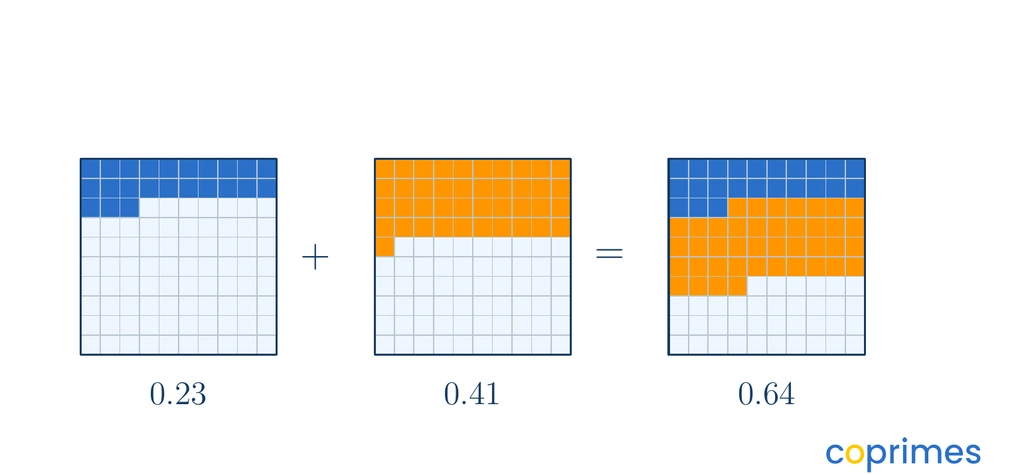
Visual models such as hundredths grids show clearly how parts combine. One full grid represents one whole. Each long column is one tenth, and each small square is one hundredth. Shading the first decimal on the grid, and then shading the second, allows you to count the total.
Estimation provides an excellent way to check if your final answer is reasonable. By rounding decimals to the nearest whole number before you add, you can find a quick approximate sum. If your exact calculation is far from your estimate, you may have aligned the decimal points incorrectly.
Worked examples
Applying this to decimal word problems often requires adding multiple values with different decimal lengths. Follow the vertical algorithm step by step to build your confidence.
Example 1: Using a zero placeholder
Question: Add and .
Method:
- Align the decimal points vertically.
- The number has one decimal place, and has two. Write a zero at the end of so it becomes .
- Add the columns from right to left.
- .
- . Write the and carry the to the ones column.
- .
- Bring the decimal point down.
Answer:
Check: Estimate the sum by rounding: . The result is close, so it is reasonable.
Example 2: Adding more than two decimal numbers
Question: Calculate .
Method:
- Stack all three numbers and align their decimal points.
- The longest decimal has three places. Add zero placeholders to the other numbers so they all have three decimal places.
- The numbers become , , and .
- Add the thousandths: .
- Add the hundredths: . Write the and carry the .
- Add the tenths: . Write the and carry the .
- Add the ones: .
- Add the tens: .
Answer:
Check: Estimate: . The result is close to the estimate.
A learning plan shaped by your child, not the class
State-aligned Math plus our own Logic and English curriculum. An adaptive baseline test finds the gaps and fills them.
Common mistakes
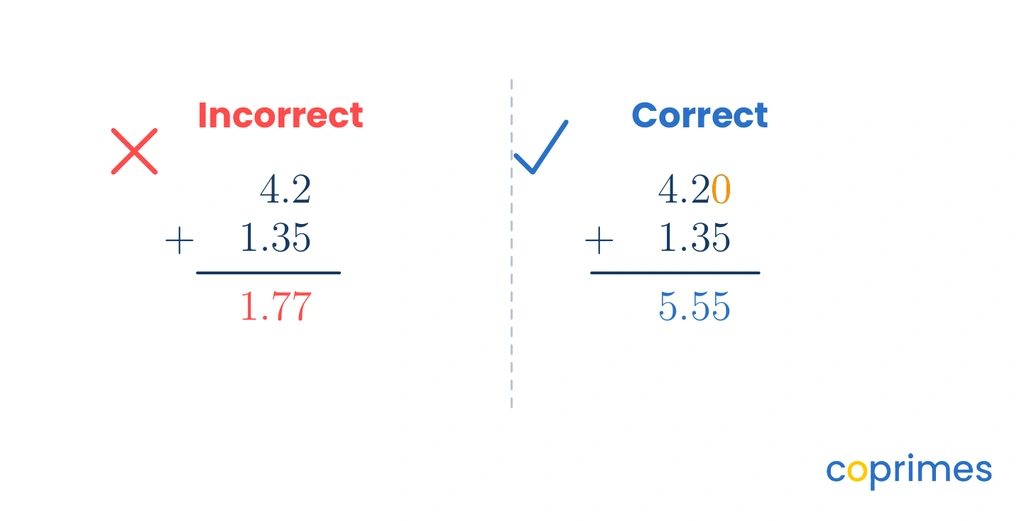
The most common error is ignoring the decimal point and lining up the rightmost digits instead. This incorrect method treats decimals exactly like whole numbers and ruins the place value structure.
Another mistake is forgetting to add the numbers that you regrouped. When carrying a into the next column, write it clearly above the next digits so it is visually included in the final addition for that column.
Frequently asked questions
Is adding decimals related to adding fractions?
Yes, decimals are simply fractions with denominators of ten, one hundred, one thousand, and so on. Adding and is the same operation as adding and .
Is the method the same for subtracting decimals?
Yes, you follow the exact same structural rules when you subtract decimals. You still align the decimal points vertically, use zero placeholders to balance the lengths, and regroup when necessary. The only difference is the subtraction operation itself.
Can I add whole numbers and decimals together?
Yes. Every whole number has a hidden decimal point at its end. For example, to add and , write as to align the decimal points correctly.
Practice questions
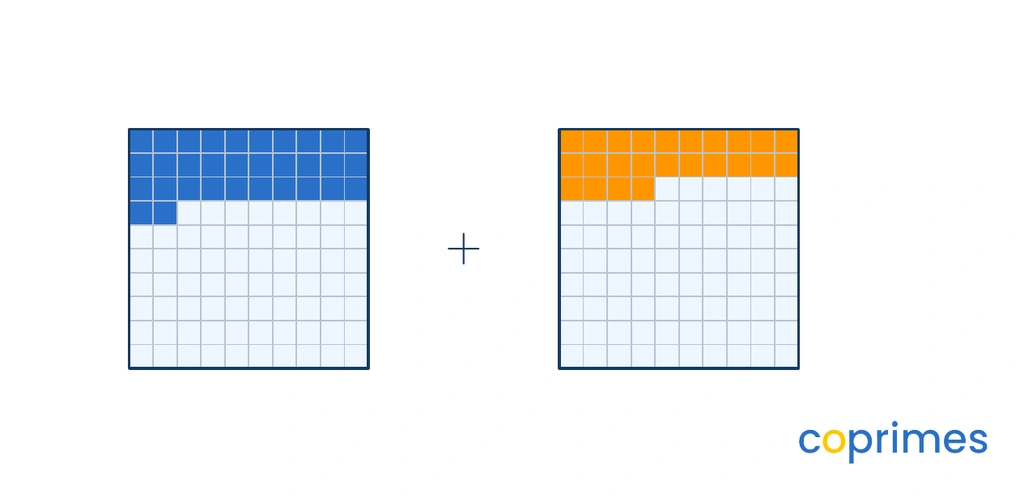
What is the sum represented by this model?
How should you prepare the numbers and before adding them vertically?
Line up the digit with the digit so the numbers end in the same column.
Align the decimal points and add two zero placeholders to .
Remove the and from so both numbers have one decimal place.
Align the decimal points and add one zero placeholder to .
Align the decimal points and add two zero placeholders to .
What is ?
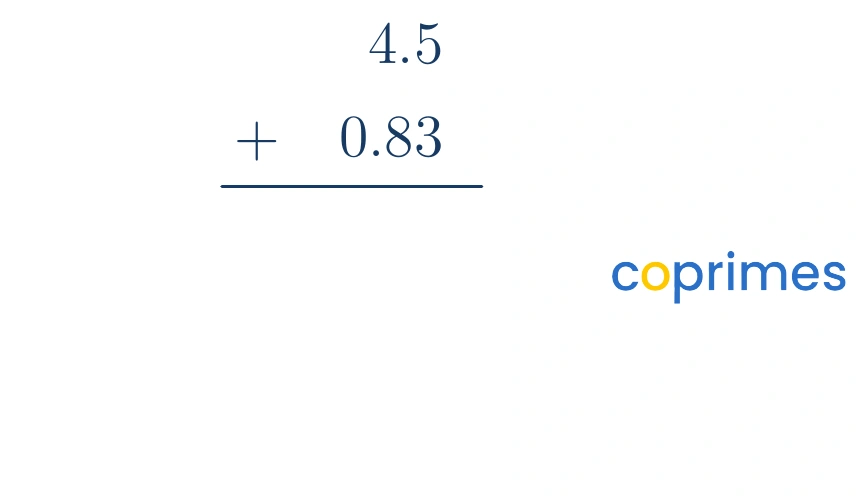
A student set up this addition problem incorrectly. What is the actual sum of and ?
Calculate the total of , , and .