
Mass from Density and Volume: Definition, Method and Examples
To find mass from density and volume, multiply the density by the volume using the formula . Because density represents the amount of mass per unit volume, multiplying it by the total volume gives the total mass.
What does mass from density and volume mean?
Mass is the amount of matter in an object, typically measured in grams () or kilograms
(). Volume is the amount of space the object occupies, commonly measured in cubic centimeters () or cubic meters ().
Density is a compound measure that acts as a unit rate, describing the mass per single unit of volume. When you know both the density of a material and its total volume, you can determine its total mass by scaling up that unit rate.
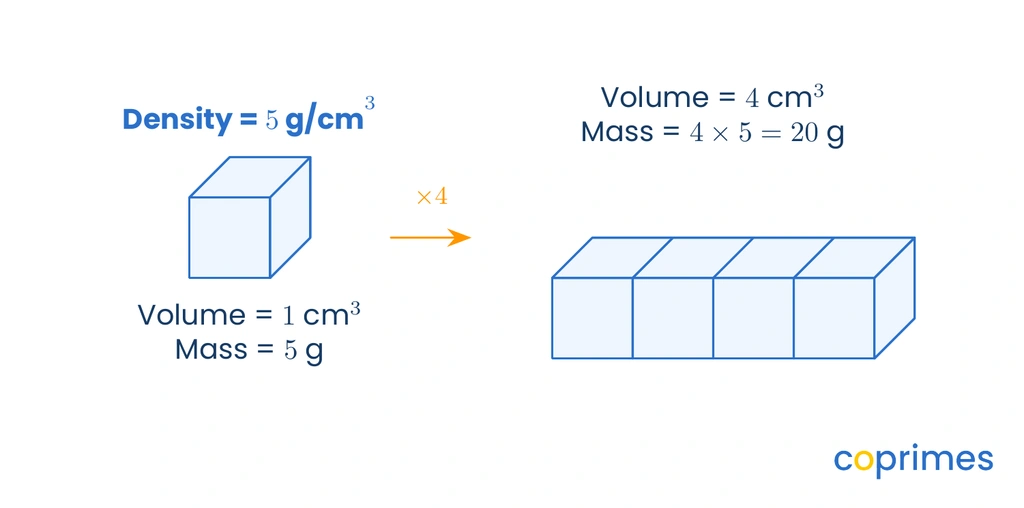
Rearrange the density relationship
The basic density formula is written as . To find the mass when you know the density and the volume, you rearrange this equation by multiplying both sides by volume ().
This gives the direct relationship .
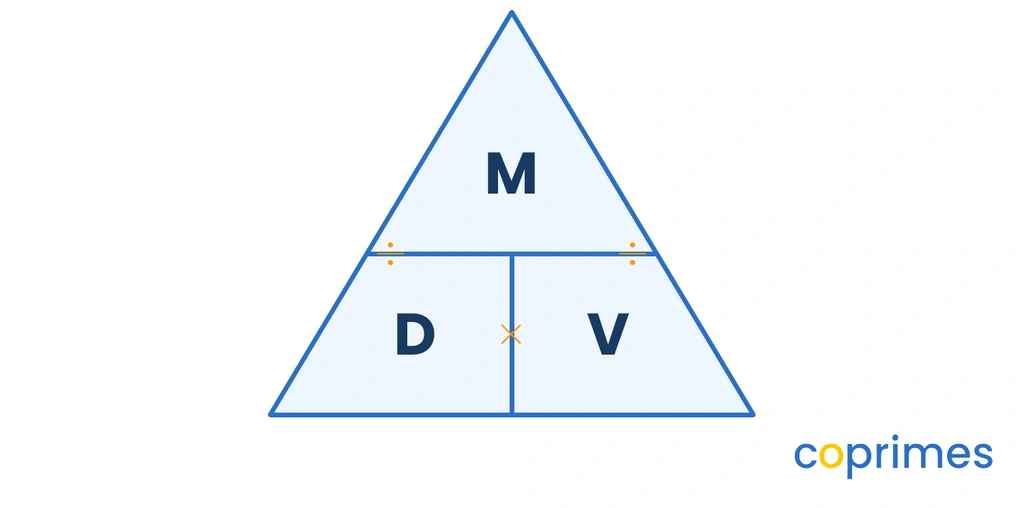
The triangle provides a helpful visual shortcut: cover the at the top to see that you must multiply by at the bottom.
Multiply density by volume
To calculate the mass, substitute the known density and volume into the rearranged formula.
Method:
- Identify the given density and volume.
- Ensure their units are compatible.
- Multiply the density by the volume.
- State the mass with its correct unit.
Mass equals density times volume.

Check units
Always verify that the units of volume match the volume component of the density unit before calculating.
If density is given in kilograms per cubic meter () and volume is given in cubic meters
(), multiplying them cancels the , leaving the mass correctly in kilograms ().
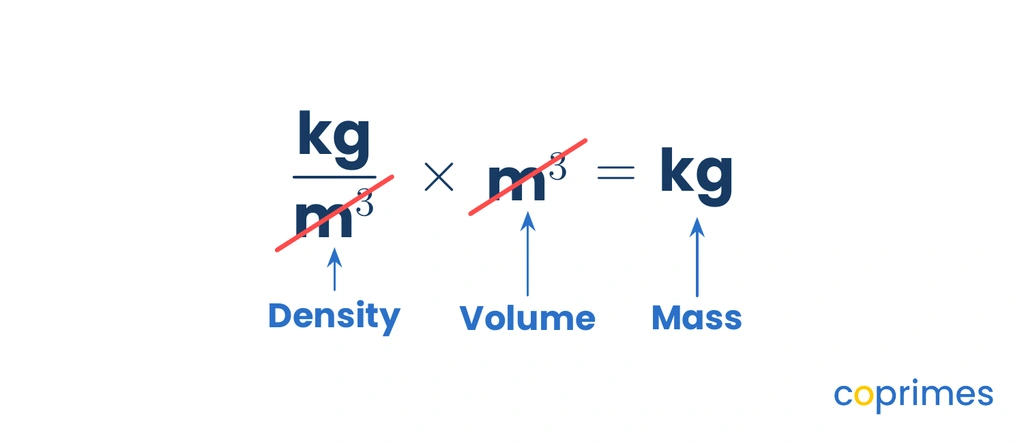
If the units do not match—for instance, if volume is in but density is in —you must convert one of the measurements so they align perfectly before multiplying.
Solve contextual problems
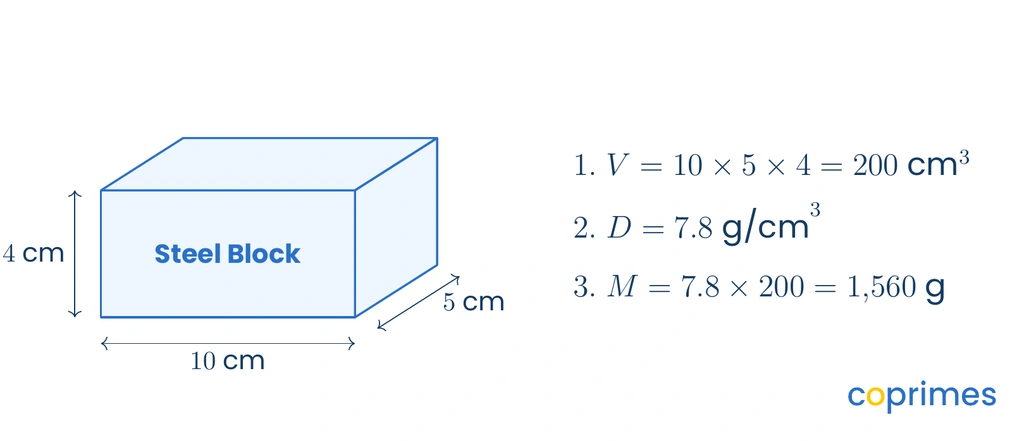
When applying this formula to real-world objects, you may need to calculate the volume of a three-dimensional shape before finding its mass. Real-world engineering often uses compound measures like the pressure formula or flow rate, which require accurate mass and volume calculations.
Once the volume is determined from the object's dimensions, multiply that volume by the material's density to find the total mass.
Worked examples
Review these examples to see how to calculate mass with matching units, apply unit conversions, and verify your answers using the formula relationships.
Example 1: Finding mass with matching units
Question: An aluminum block has a volume of and a density of . What is its mass?
Method:
- Identify the given values: and .
- Check units: Both values use , so no conversion is needed.
- Multiply density by volume: .
- Calculate the result: .
Answer: The mass is .
Check: Since , check that .
Example 2: Finding mass with unit conversion
Question: A gold bar has a volume of . The density of gold is . What is the mass of the gold bar in kilograms?
Method:
- Identify the given values: and .
- Convert the volume to match the density unit: Since , divide by to get .
- Multiply density by volume: .
- Calculate the result: .
Answer: The mass is .
Check: Convert the mass to grams to verify: . Using the density of gold in () multiplied by also gives .
Example 3: Verifying the mass calculation
Question: A block of ice has a volume of . The density of ice is . Calculate the mass and use the density formula to check your answer.
Method:
- Identify the given values: and .
- Check units: Both values use , so no conversion is needed.
- Multiply density by volume: .
- Calculate the result: .
Answer: The mass is .
Check: Rearrange the density formula to . Divide by . The result is , verifying the calculation is correct.
A learning plan shaped by your child, not the class
State-aligned Math plus our own Logic and English curriculum. An adaptive baseline test finds the gaps and fills them.
Common mistakes
A frequent error is dividing the values instead of multiplying them. Always remember the correct rearrangement . Dividing density by volume will not give you the mass.
Another common mistake is ignoring unit mismatches. Multiplying a density measured in by a volume in results in an incorrect answer. You must convert one of the units so they match. When converting volume, remember that cubic units scale by the cube of the length conversion factor. For example, is equal to , not .
Frequently asked questions
Here are answers to common questions about calculating mass, density, and volume.
What is the formula to find mass from density and volume?
The correct formula is , where stands for mass, for density, and for volume.
How do you find volume if you know mass and density?
You can rearrange the original density formula to isolate volume. This gives the relationship .
What units are used for mass?
Common metric units for mass include grams () and kilograms (). The appropriate unit often depends on the density measurement provided in the problem.
Practice questions
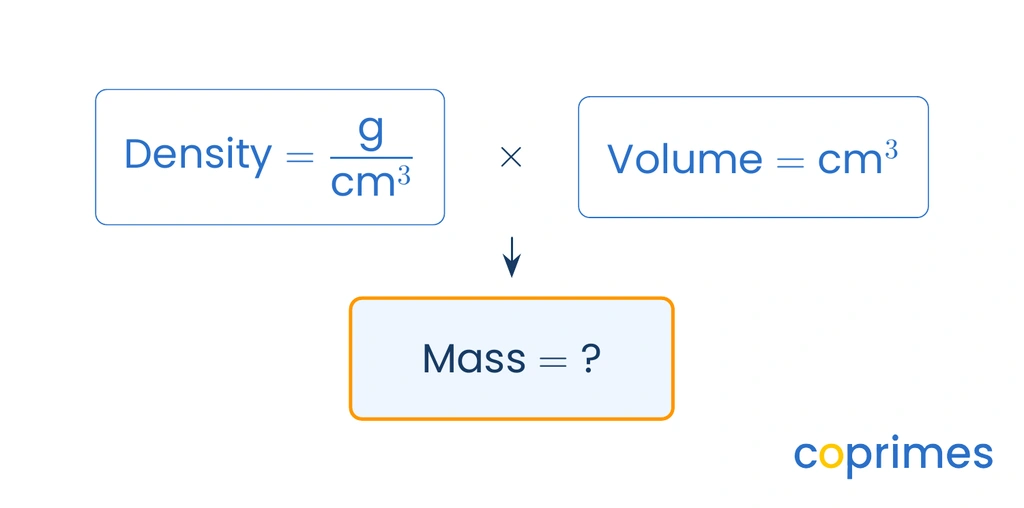
Which equation correctly shows how the units cancel out when finding mass from density () and volume ()?
A piece of metal has a volume of and a density of . What is its mass?
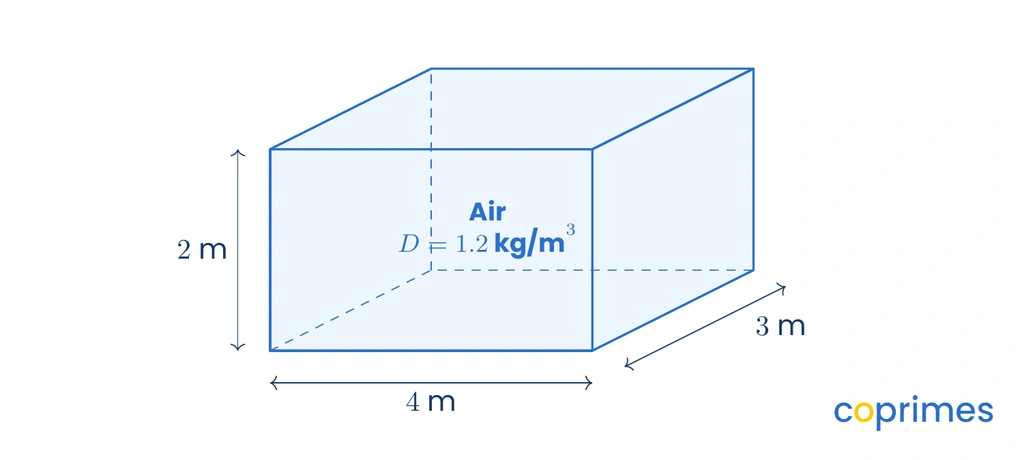
The rectangular room shown in the diagram is filled with air. What is the total mass of the air inside the room?
A piece of metal has a volume of and a density of . A student calculates the mass by evaluating to get . What mistake did the student make?
They divided density by volume instead of multiplying them.
They forgot to convert cubic meters to cubic centimeters.
They multiplied volume by density instead of dividing them.
They used the wrong units for the final mass result.
They divided density by volume instead of multiplying them.
A wooden block has a volume of and a density of . What is its mass in grams?