
Pressure Formula: Calculating Force per Unit Area
The pressure formula calculates the amount of force applied to a surface per unit of area. To find the pressure, you divide the total force by the total area.
What is pressure?
Pressure describes how concentrated a physical force is when it pushes against a surface. It is a specific type of rate that connects an applied force to the physical space it covers.
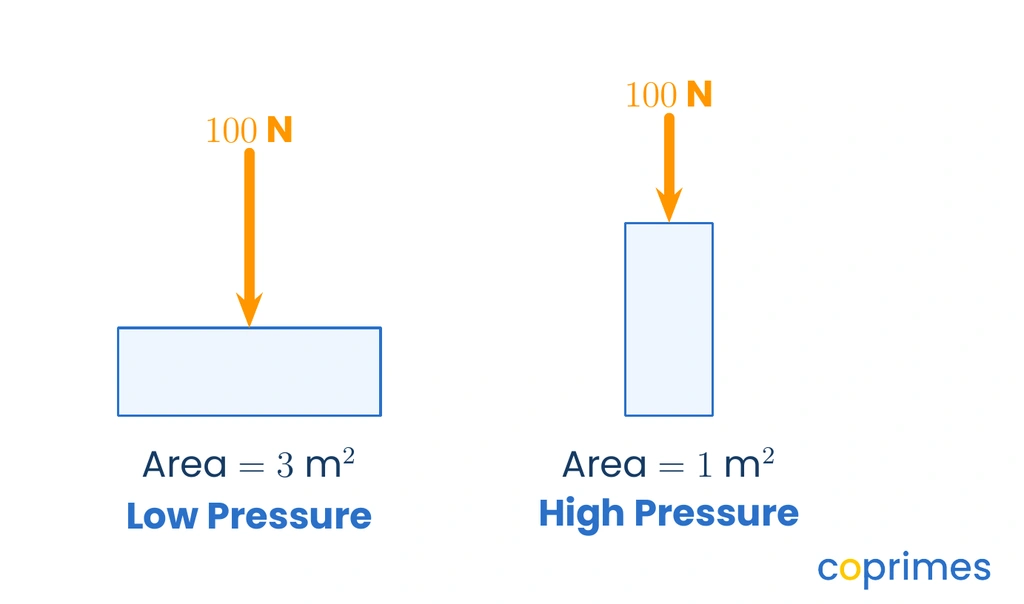
A large force spread over a vast area creates low pressure. The same force concentrated onto a tiny point creates a much higher pressure.
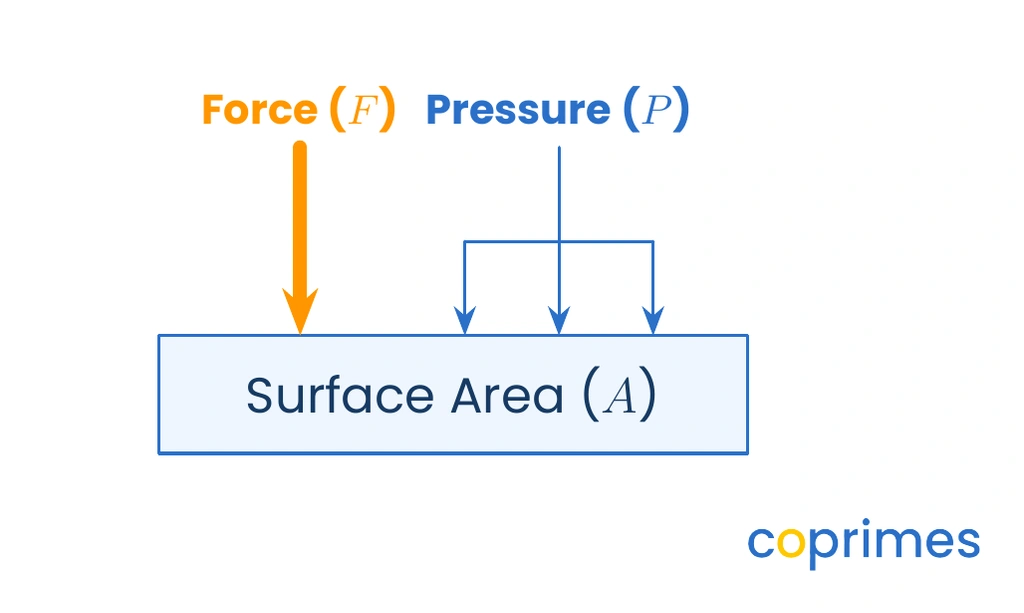
Use P equals F over A
The primary mathematical representation is the pressure equation, which relates the three components.
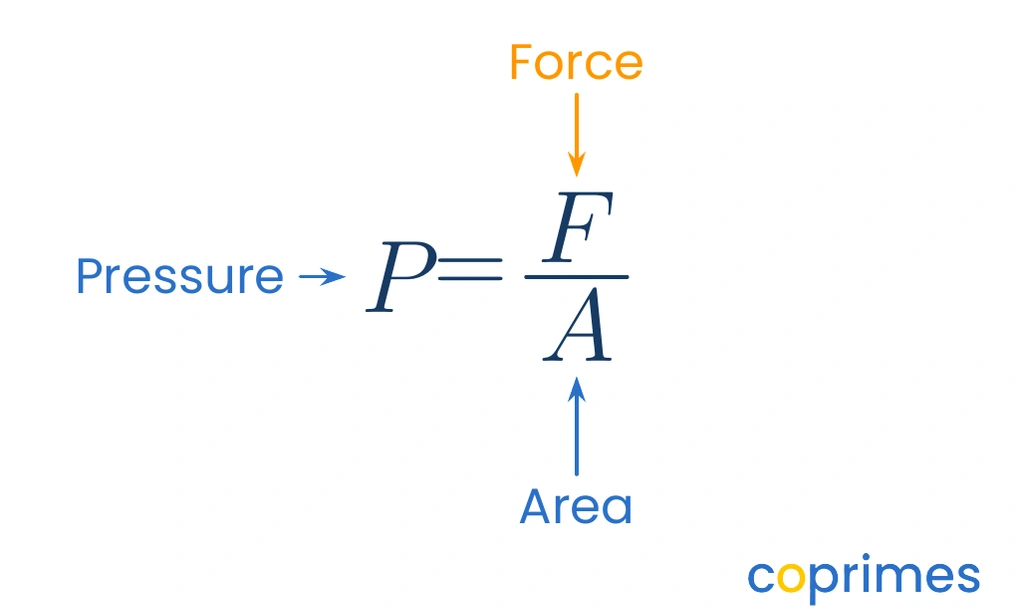
The pressure formula is pressure equals force divided by area.
In algebraic form, the formula is written as:
The variables represent:
- is the pressure.
- is the applied force.
- is the area of the surface.
Find pressure, force or area
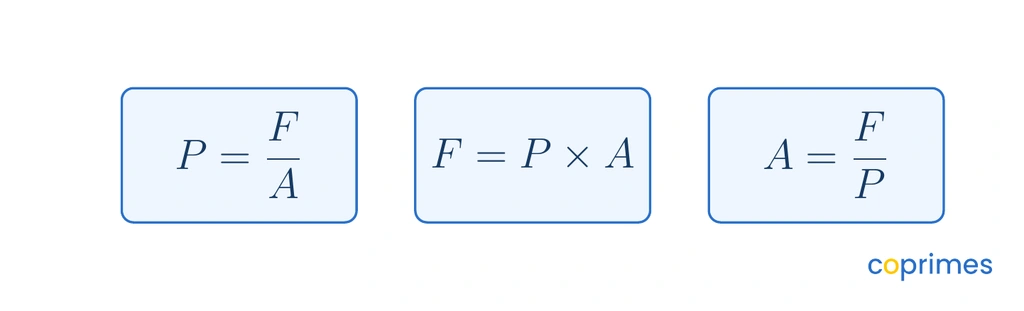
Because the formula is an algebraic equation, you can rearrange it to solve for any missing value. This allows you to find the pressure force and area depending on what information is given in a problem.
To find the total force when you know the pressure and the area, multiply them together:
To find the surface area when you know the force and the pressure, divide the force by the pressure:

Use pressure units
Because pressure is a compound measure, its units are derived from the units used for force and area. This is mathematically similar to calculating the density formula, which combines mass and volume.
The standard scientific unit of force is the Newton (). Area is typically measured in square meters () or square centimeters ().
When force is in Newtons and area is in square meters, the unit of pressure is Newtons per square meter (). This specific unit is also called a Pascal ().
When the area is measured in square centimeters, the resulting unit is Newtons per square centimeter (). It is important to ensure your force and area units match the requested pressure unit before calculating.
Interpret area and force changes
When the force remains constant, pressure and area are inversely proportional. This means that as the surface area increases, the pressure decreases.
For example, snowshoes spread a person's weight over a large area, reducing the pressure on the snow and preventing them from sinking. Conversely, an ice skate concentrates the same weight onto a thin blade, creating enough pressure to cut into the ice.
Worked examples
Review these examples to see how the formula is applied in different scenarios.
Example 1: Calculating pressure from force and area
Question: A block rests on a table. The block exerts a downward force of and covers a surface area of . What is the pressure exerted on the table?
Method:
- Identify the given force and area.
- Substitute the values into the pressure formula .
Answer: .
Check: Multiply the pressure by the area to recover the force: . This matches the original force exactly.
Example 2: Calculating force from pressure and area
Question: A hydraulic press applies a pressure of over a surface area of . What is the total force applied?
Method:
- Select the rearranged formula that solves for force: .
- Substitute the given pressure and area values.
Answer: .
Check: Divide the calculated force by the area: . This correctly reproduces the given pressure.
Example 3: Finding area before calculating pressure
Question: A wooden crate weighs . Its rectangular base measures by . What pressure does the crate exert on the ground?
Method:
- Calculate the area of the rectangular base by multiplying its length and width.
- Substitute the force and the calculated area into the pressure formula.
Answer: The area is . The pressure is .
Check: Use the force formula . Multiply the pressure by the area: . The dimensions are consistent.
A learning plan shaped by your child, not the class
State-aligned Math plus our own Logic and English curriculum. An adaptive baseline test finds the gaps and fills them.
Common mistakes
Watch out for these frequent errors when applying the formula:
- Dividing in the wrong order: A common error is calculating area divided by force instead of force divided by area. Always place the force in the numerator.
- Forgetting to calculate the area first: Problems often provide the dimensions of a surface rather than the total area. You must calculate the surface area using a geometry formula before you can find the pressure.
- Mixing up units: If an area is given in square centimeters but the required answer is in Pascals, you must ensure your units match appropriately before making the final calculation.
Frequently asked questions
Is pressure a vector or a scalar?
Pressure is a scalar quantity. While force has a specific direction, pressure merely describes the magnitude of force distributed over a surface area and does not have a single direction itself.
What does one Pascal mean?
One Pascal () is exactly equal to one Newton of force spread evenly over one square meter of area. It is mathematically identical to .
Practice questions
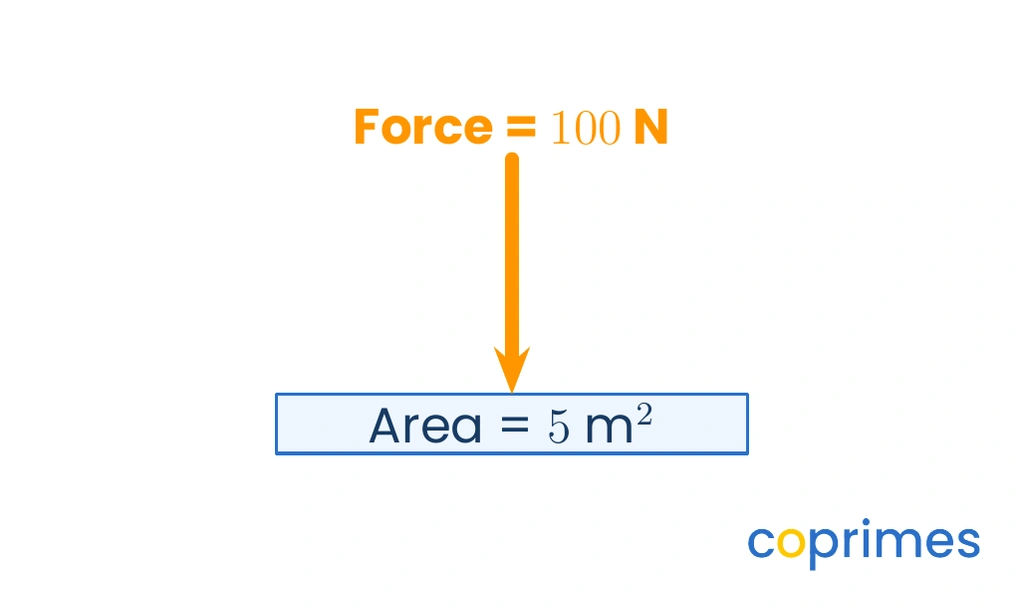
What is the pressure exerted by the block on the surface?
Which equation correctly rearranges the pressure formula to find the surface area?
A constant force is applied to a surface. If the surface area is doubled, what happens to the pressure?
The pressure is doubled.
The pressure stays the same.
The pressure is halved.
The pressure is quadrupled.
The pressure is halved.
An object exerts a pressure of over an area of . What is the total force exerted by the object?
A heavy machine weighs and sits on a square base with a side length of . What is the pressure exerted on the floor?