
Subtraction Word Problems
A subtraction word problem describes a real-world scenario that asks about an amount removed, a comparison, a difference, or a missing part. Solving these problems requires translating a written story into a mathematical subtraction equation.
Identifying the correct values and relationships in a word problem allows you to calculate the correct answer confidently.
What is a subtraction word problem?
A subtraction word problem, sometimes called a subtraction story problem, uses text to describe a situation where one quantity is subtracted from another.
Instead of giving you a direct mathematical equation like , a word problem requires you to read the context, identify the starting amount, recognize the part that is changing or being compared, and determine the unknown difference.
These scenarios represent the inverse of addition word problems, where separate quantities are combined into a single total.
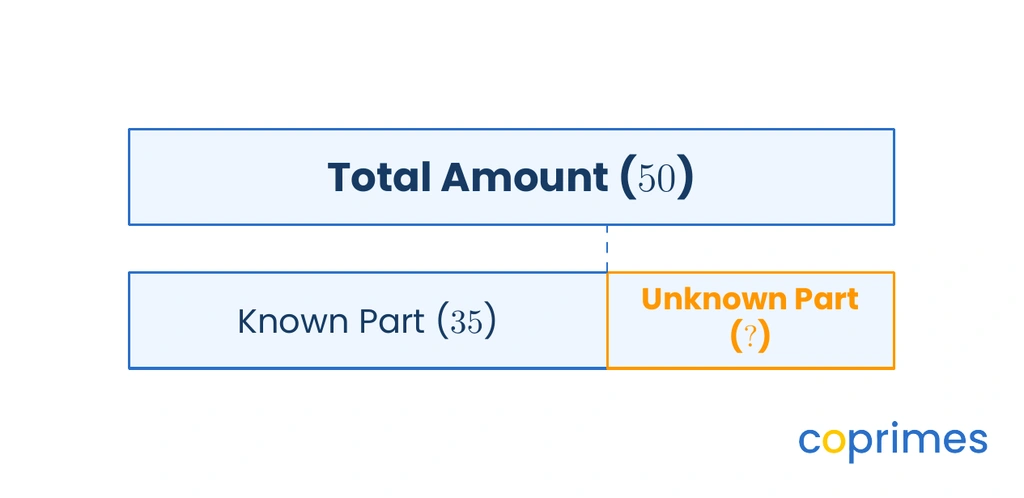
Understanding the different ways subtraction can be described is the first step toward solving these problems effectively.
Subtraction problem structures
There are three main structures for subtraction word problems: take-away, comparison, and missing part.
Take-away structure
This is the most common form of subtraction. You start with a total amount, a specific quantity is removed, and you must calculate how much is left. For example, starting with apples and eating apples describes a take-away structure.
Comparison structure
In a comparison problem, nothing is physically removed. Instead, you compare two different amounts to find the difference between them. Finding out how many more points one team scored than another team is a comparison structure.
Missing-part structure
A missing-part problem gives you the total amount and one of the parts that make up that total. You must subtract the known part from the total to find the unknown part. For instance, knowing a class has students and are girls means you must find the missing part (the number of boys).
How to choose subtraction
Identifying the correct operation depends on understanding the mathematical action happening in the story.
Look for context clues that suggest finding a difference or reducing a total. Words and phrases such as "difference", "left", "remain", "less than", "fewer", "minus", and "take away" often indicate that subtraction is required.
Always read the entire problem before deciding to subtract.
Relying only on a single keyword can be misleading. For example, the sentence "Tom has 3 fewer apples than Sarah, and Tom has 5 apples" contains the word "fewer", but you must add to find Sarah's total. Focus on the relationship between the numbers rather than memorizing a list of words.

Bar models and equations
Bar models are visual tools that organize the numbers in a word problem into a diagram, making it easier to write the correct equation.
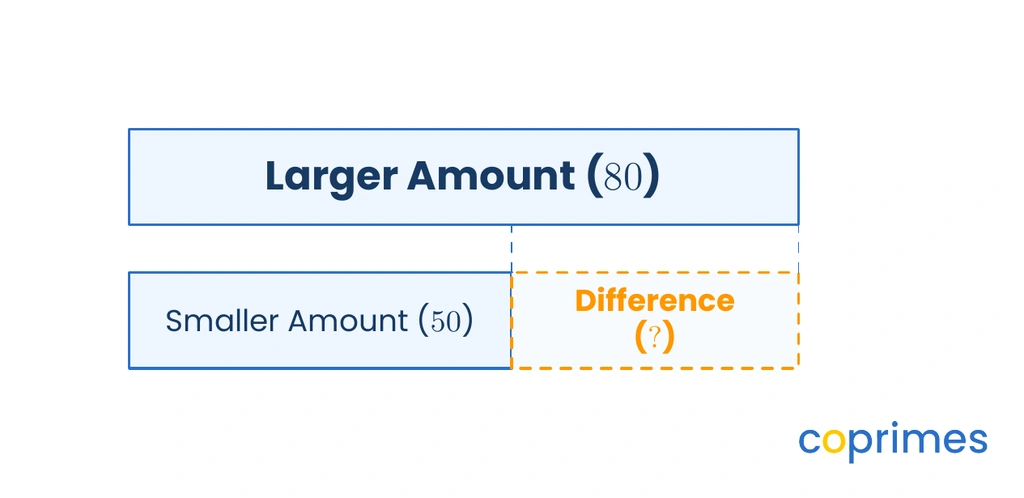
By drawing a bar model, you can instantly see whether you have the total and a part, or two parts that need comparing. If the total is known and a part is missing, you write a subtraction equation. For the comparison model above, the equation is .
Step-by-step solving method
Following a consistent method ensures accuracy when solving any subtraction story problem.
- Read the problem carefully to understand the real-world situation.
- Identify the known values and determine what the question is asking you to find.
- Draw a bar model to visualize the relationship between the numbers.
- Write the mathematical equation based on your model.
- Solve the equation using an appropriate calculation method.
- Check your answer by using the inverse operation (addition) to see if it reconstructs the original total.
Worked examples
Applying the step-by-step method to different problem structures helps build confidence.
Example 1: Take-away structure
Question: A library has books. During the week, books are checked out. How many books are left in the library?
Method:
- The story describes an amount being removed from a total.
- The starting total is . The amount removed is .
- Write the equation:
- Use column subtraction to solve.
Answer: There are books left.
Check: . The answer is correct.
Example 2: Comparison structure
Question: A mountain peak is meters high. A nearby hill is meters high. What is the difference in height between the two?
Method:
- The story compares two different heights to find the difference.
- The larger value is and the smaller value is .
- Write the equation:
- Subtract the smaller value from the larger value.
Answer: The difference in height is meters.
Check: . The answer is correct.
Example 3: Missing-part structure
Question: A bakery needs to bake loaves of bread for an order. They have already baked loaves. How many more loaves do they need to bake?
Method:
- The story provides the total needed and the part already completed.
- The total is and the known part is .
- Write the equation:
- Perform the subtraction.
Answer: They need to bake more loaves.
Check: . The answer is correct.
A learning plan shaped by your child, not the class
State-aligned Math plus our own Logic and English curriculum. An adaptive baseline test finds the gaps and fills them.
Common mistakes
A frequent mistake when solving subtraction word problems is misaligning the digits when setting up the calculation, especially when the numbers have a different number of digits.
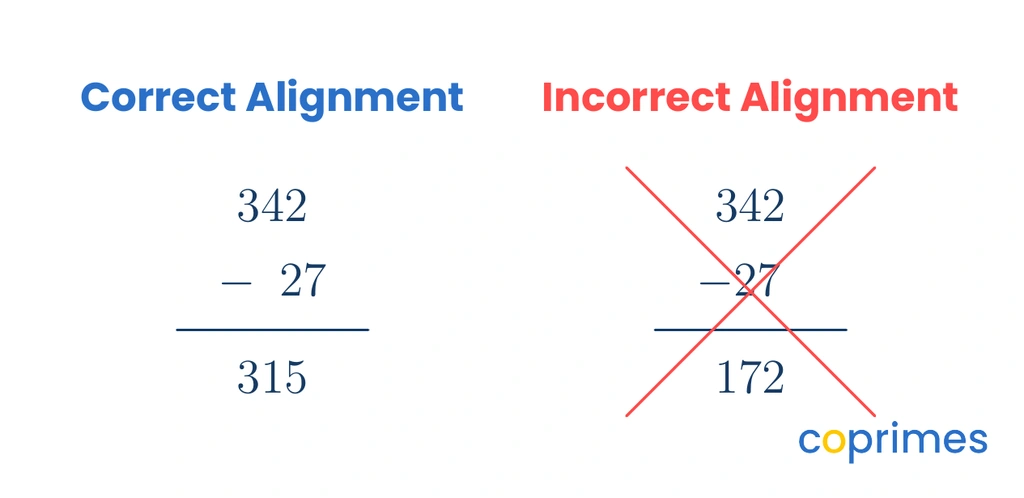
Always ensure that ones are aligned with ones, tens with tens, and hundreds with hundreds before you begin subtracting.
Another common mistake is subtracting the smaller number from the larger number blindly, even when the problem requires a different operation. Always draw a model or read the context to verify that subtraction is the correct mathematical action.
Frequently asked questions
How do you know when to subtract in a word problem?
You should subtract when the problem asks you to find a difference between two amounts, determine how much of an item is left after some is removed, or calculate a missing part when the total is already known.
What is the difference between an addition and a subtraction word problem?
Addition word problems involve combining parts to find an unknown total. Subtraction word problems provide the total and ask you to find a missing part, or they ask you to compare two known quantities to find their difference.
How can drawing a model help?
Drawing a bar model helps you visualize the relationships between the numbers. It clarifies whether you need to combine amounts or find a difference, preventing you from guessing the operation based solely on confusing keywords.
Once you master single-operation scenarios, you will be prepared for two-step word problems that combine multiple mathematical actions within the same story.
Practice questions
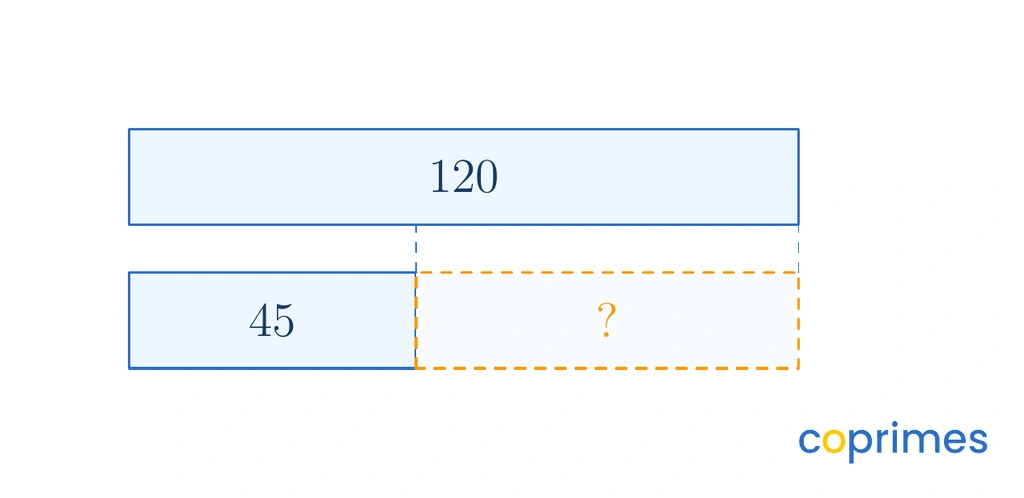
Which mathematical equation correctly represents the visual model above?
A store has kilograms of rice. A customer buys kilograms of rice. How many kilograms of rice are left in the store?
A train travels miles on its journey. A bus travels miles on its journey. What is the difference in distance between the two vehicles?
miles
miles
miles
miles
miles
Sarah has fewer stickers than Mark. Mark has stickers. How many stickers does Sarah have?
Sarah has stickers.
Sarah has stickers.
Sarah has stickers.
Sarah has stickers.
Sarah has stickers.
A school needs to raise dollars for a new playground. They have already raised dollars. How much more money do they need to raise?
They need to raise dollars.
They need to raise dollars.
They need to raise dollars.
They need to raise dollars.
They need to raise dollars.