
Understanding Absolute Value: A Complete Guide
The absolute value of a number is its distance from zero on the number line. Because distance is a physical measurement that cannot be less than zero, an absolute value is always nonnegative. Whether you move forward or backward from zero, the distance covered is measured as a positive amount or exactly zero.
What Is Absolute Value?
Absolute value describes how far a number is from zero, regardless of the direction it lies on the number line. To indicate absolute value, we write the number inside two straight vertical bars. This is called the absolute value symbol.
For example, the absolute value of is written as . Because is exactly units away from zero, .
This concept is sometimes called the modulus or the magnitude of a number. It is a fundamental property that applies to integers, basic natural numbers, and all other real numbers.
The absolute value of any number is never negative.
If a number is positive, its absolute value is the number itself. If a number is negative, its absolute value becomes positive. If the number is zero, its absolute value is simply .
Key Ideas and Vocabulary
To work with absolute value accurately, it is helpful to master a few key mathematical terms.
- Absolute Value Symbol: Two vertical bars placed around a number or expression, written as .
- Distance: The number of units between two points. Distance is always nonnegative.
- Nonnegative: A value that is either positive or zero.
- Additive inverse: Two numbers that are the same distance from zero but in opposite directions, such as and . Additive inverses always have the exact same absolute value.
Visual Explanation
A number line is the most reliable way to understand absolute value. By counting the units starting from zero, you can see that both positive and negative directions yield a positive distance.
Consider the numbers and . The number lies units to the left of zero, while lies units to the right of zero.
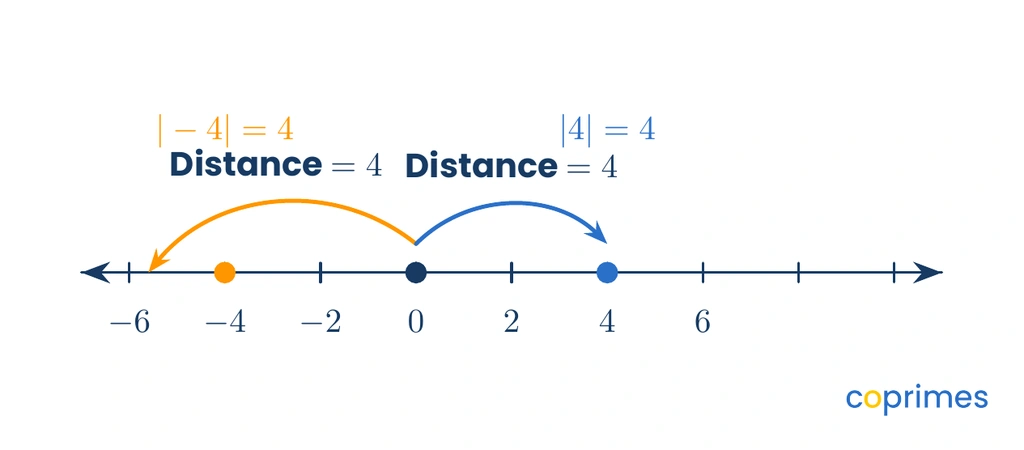
Because both numbers are the same distance from zero, they share the same absolute value: and .
A learning plan shaped by your child, not the class
State-aligned Math plus our own Logic and English curriculum. An adaptive baseline test finds the gaps and fills them.
Worked Examples
Absolute value symbols act similarly to parentheses when evaluating mathematical expressions. You must determine the absolute value of the number before applying other operations located outside the bars.
Example 1: Evaluating simple absolute value expressions
Question: Evaluate the expressions and .
Method:
- Identify the distance each number is from zero.
- Write that distance as a nonnegative number.
Answer: The absolute value of is because it is units away from zero. The absolute value of is because it is exactly at zero. Therefore, and .
Check: Confirm that neither result is negative. Since and , the distances are valid.
Example 2: Comparing numerical values
Question: Compare and using , , or .
Method:
- Simplify any absolute value expressions first.
- Rewrite the comparison using standard nonnegative numbers.
- Compare the resulting values.
Answer: First, find the absolute value of , which is . Next, compare and . Because , we know that .
Check: Even though is less than on a number line, its distance from zero () is greater than 's distance from zero ().
Example 3: Operations inside and outside absolute value symbols
Question: Evaluate the expression .
Method:
- Treat absolute value bars like grouping symbols. Simplify the arithmetic inside the bars first.
- Find the absolute value of the resulting numbers.
- Perform the final addition outside the absolute value bars.
Answer:
Step 1: Simplify inside the second set of bars: . The expression becomes .
Step 2: Evaluate the absolute values: and .
Step 3: Add the results: .
Check: Test a common error. If we mistakenly changed all signs inside first, we would get , making the total . This proves why we must evaluate expressions inside the bars as a single sum before applying the absolute value. The correct answer remains .
Common Mistakes and Non-Examples
Absolute value has strict rules. Misunderstanding these rules can lead to incorrect calculations, especially when negative signs appear in different positions.
Mistake: Thinking absolute value means "change the sign"
Many learners assume that absolute value flips the sign of any number. While becomes , the expression does not become . Absolute value means "make nonnegative," not "switch the sign." Both and equal .
Mistake: Applying absolute value before finishing inside operations
When you see an expression like , you cannot turn the into first. You must subtract first: . Then take the absolute value: .
Non-Example: A negative sign outside the absolute value
What happens when a negative sign sits entirely outside the absolute value bars, such as ?
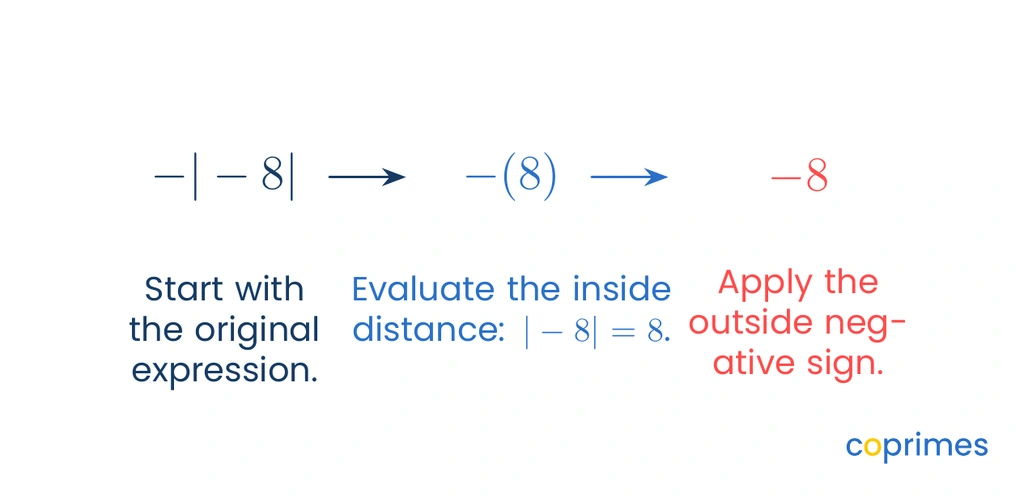
The absolute value cannot change a negative sign that is located outside the bars. The absolute value of is . The negative sign waiting outside attaches to the , making the final answer .
Real-World Connections
Absolute value is useful whenever we want to know the size of a change without worrying about the direction.
- Temperature: If the temperature drops from to , it has moved on the thermometer. However, the absolute change in temperature is degrees.
- Elevation: A submarine operating at meters and a helicopter flying at meters are at different positions, but they share the same absolute value. Their distance from sea level (zero) is exactly meters.
- Financial Debt: If a bank account is overdrawn by , the balance is . The absolute value, , tells the bank exactly how much money is owed.
These ideas govern all real numbers, from basic integers and rational numbers to complex irrational numbers. In all cases, absolute value measures pure magnitude.

Practice questions
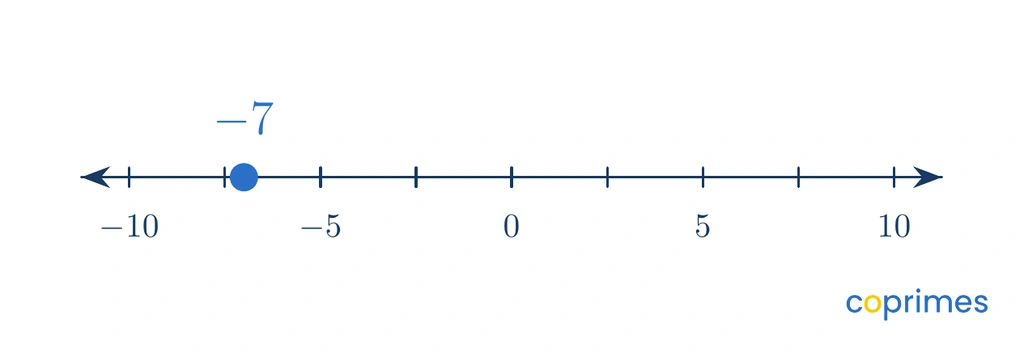
Based on the number line shown, what is the absolute value of the marked point?
Evaluate the expression:
Which of the following evaluations is mathematically correct?
Evaluate the following mathematical expression:
Evaluate the following mathematical expression: