
Rational Numbers: Guide and Examples
A rational number can be written as divided by , where and are integers and is not zero. This definition covers fractions, integers, and many decimals, providing a system for measuring and calculating precise values.
What Is Rational Numbers?
Any number that can be expressed as a fraction of two integers belongs to the rational number set. In the fraction , the numerator and the denominator must both be integers.
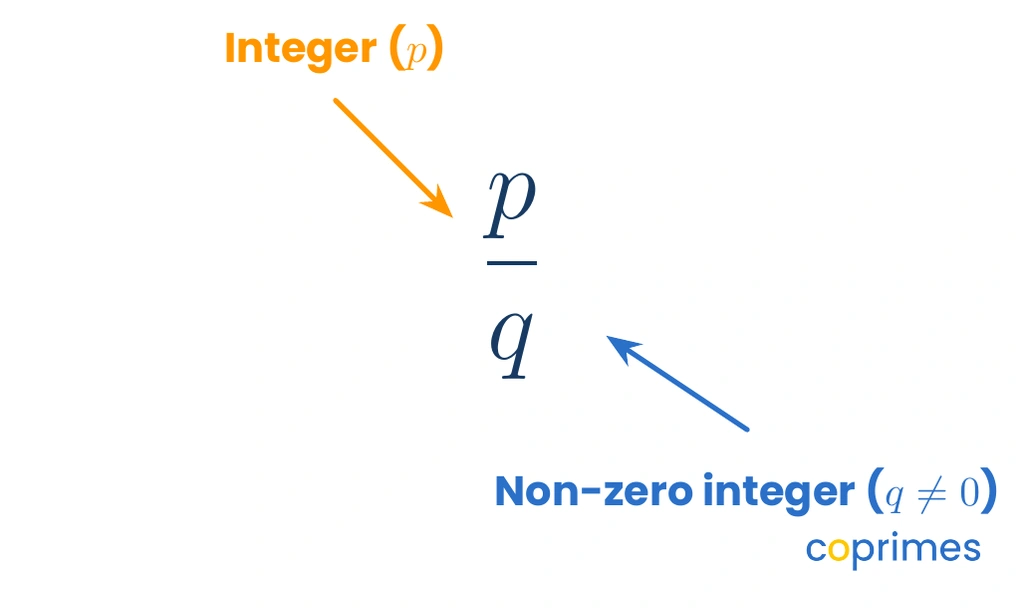
Because division by zero is mathematically undefined, the denominator can never be zero. As long as this single rule is met, the number is rational. This means that positive fractions, negative fractions, and even whole numbers can all be written in this format.
Key Ideas and Vocabulary
Understanding rational numbers means recognizing how different number formats connect to fractions.
- Subsets: The natural numbers (counting numbers like ) and all integers can be written with a denominator of . Therefore, they are all rational numbers.
- Decimals: Both terminating and repeating decimals are rational because they can be converted into exact fractions.
- Distance: The absolute value of a rational number measures its distance from zero, representing its magnitude regardless of its sign.
- Opposites: Every rational number has an additive inverse. When you add a number and its inverse, the result is always zero.
- Number Sets: Together, rational numbers and irrational numbers make up the complete set of real numbers.
Visual Explanation
We can visualize how the rational number set contains other familiar number systems using a nested diagram.
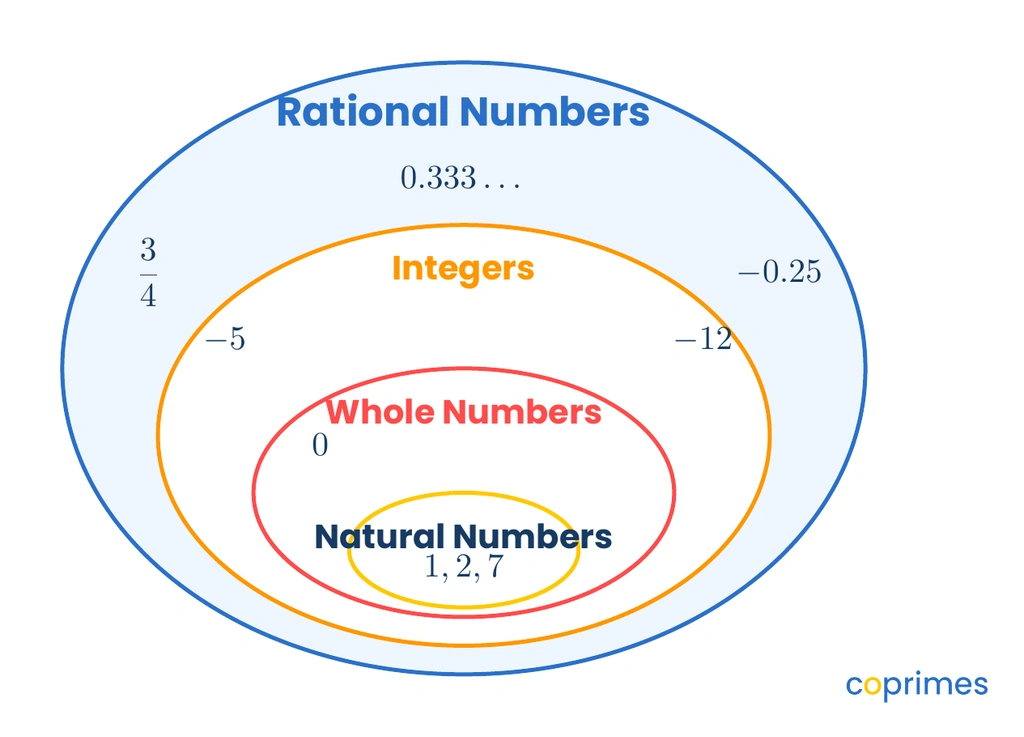
Every natural number is a whole number. Every whole number is an integer. Finally, every integer is a rational number because it can easily be written as a fraction by placing it over .
A learning plan shaped by your child, not the class
State-aligned Math plus our own Logic and English curriculum. An adaptive baseline test finds the gaps and fills them.
Worked Examples
Example 1: Classifying integers and decimals
Question: Show that and belong to the rational number set.
Method:
- Recall that a rational number must be writable as , where and are integers.
- For the integer , write it as a fraction with a denominator of .
- For the terminating decimal , read it as "two and seventy-five hundredths" and convert it to a fraction.
Answer: The integer can be written as . The decimal can be written as , which simplifies to . Both are rational numbers.
Check: Divide by to get . Divide by to get .
Example 2: Identifying repeating decimals
Question: Is the repeating decimal a rational number?
Method:
- Identify whether the decimal terminates, repeats, or does neither.
- Recognize that is a repeating decimal.
- Convert the recognized repeating decimal into its equivalent fraction.
Answer: Yes. The repeating decimal is equal to the exact fraction . Since both and are integers, it is a rational number.
Check: Perform long division by dividing by . The result is , confirming the fraction is correct.
Example 3: Identifying non-examples
Question: Which of the numbers and is a rational number?
Method:
- Evaluate each square root to see if it simplifies to a whole number.
- Express any resulting whole number as a fraction.
- Classify numbers with infinite, non-repeating decimal expansions as non-examples.
Answer: The number evaluates exactly to , which can be written as , making it a rational number. The number is approximately and never repeats or terminates. It is an irrational non-example.
Check: Multiply to confirm it equals . There is no rational fraction that multiplies by itself to exactly equal .
Common Mistakes and Non-Examples
Not every number can be written as a fraction. It is a common mistake to assume that all numbers with decimal points are rational numbers.
A rational vs irrational comparison comes down to recognizable patterns. If a decimal goes on forever without any repeating pattern, it cannot be turned into a fraction of integers. The mathematical constant (approximately ) is a classic non-example.
Another common mistake is attempting to create a fraction with zero in the denominator, such as . Because division by zero has no mathematical meaning, this does not represent a rational number or any number at all.
Any fraction with a denominator of zero is undefined and is not a rational number.
Real-World Connections
Rational numbers are everywhere in daily life because we constantly need to measure parts of a whole accurately.
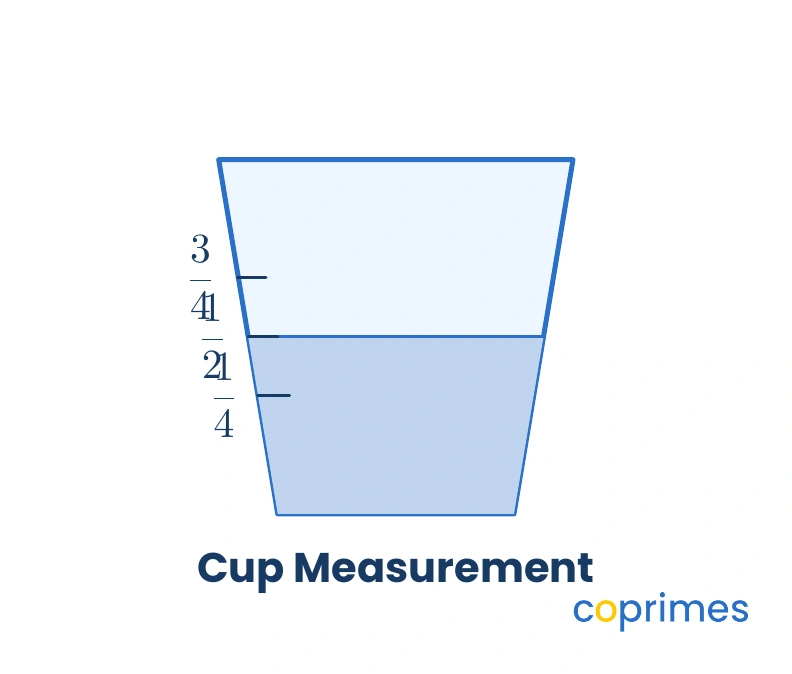
When cooking, measuring cups use fractions like or to quantify ingredients exactly.
When shopping, prices are written as terminating decimals, such as , which translates exactly to of the currency unit.
Even percentages are rational numbers. A common discount of simply means out of , which simplifies to the useful fraction .

Practice questions
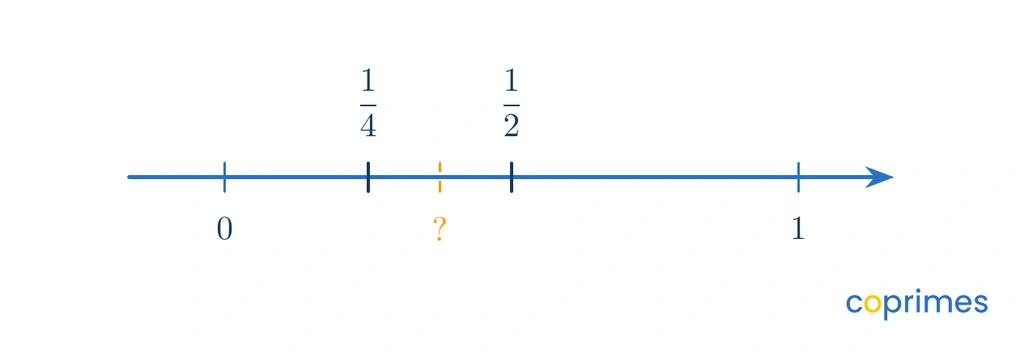
Which rational number is located exactly halfway between and on the number line?

Which of the numbers shown on the cards is NOT a rational number?
A test score is . Which fraction proves that this percentage is a rational number?
What always happens when you add two rational numbers, such as and ?
The result is always a rational number.
The result is always an integer.
The result is always an irrational number.
The result cannot be determined without calculating.
The result is always a rational number.
Which fraction proves that the repeating decimal is a rational number?