
Irrational Numbers: Definition and Examples
An irrational number is a real number that cannot be expressed as a simple fraction, or ratio of integers, and has a nonterminating, nonrepeating decimal expansion.
When exploring different mathematical values, irrational numbers are essential because they represent exact quantities that fractions and regular decimals cannot capture.
What Is Irrational Numbers?
When asking what is irrational numbers, the answer lies in how a number can be written. An irrational number cannot be written in the form , where and are integers and is not equal to zero.
Because they cannot be written as fractions, their decimal expansions go on forever without ever forming a repeating pattern.
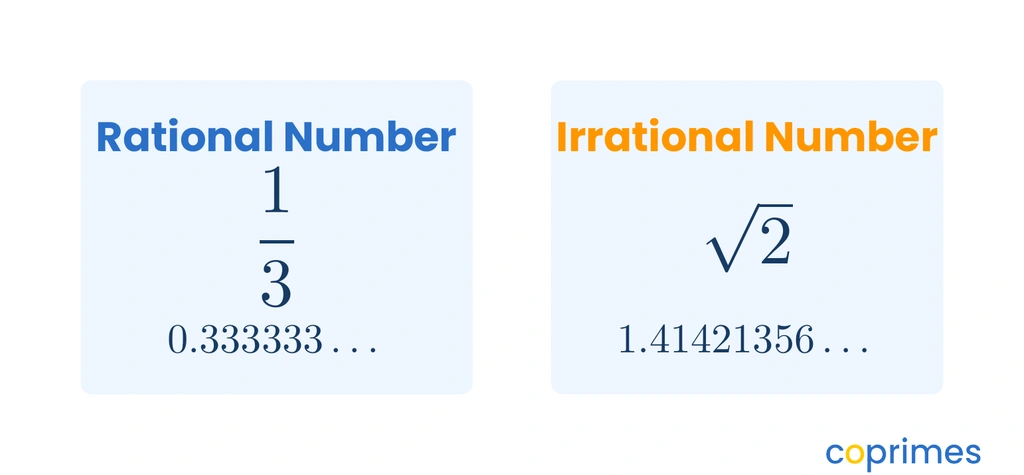
In contrast, rational numbers either terminate completely, like , or feature a repeating sequence of digits, like or
If a decimal number never ends and never repeats, it is an irrational number.
Key Ideas and Vocabulary
Understanding how irrational values relate to other mathematical sets is fundamental. When studying the different types of numbers, you will find that every real number belongs to exactly one of two categories: it is either rational or it is irrational.
Together, these two sets combine to form the complete continuous set of real numbers.
One of the most common sources of irrational numbers is the square roots of non-perfect squares. A perfect square, such as , has a rational root (). However, taking the square root of a non-perfect square, such as , results in an irrational number ().
This property separates irrational numbers from basic counting groups like the natural numbers, which never contain fractional or decimal parts.
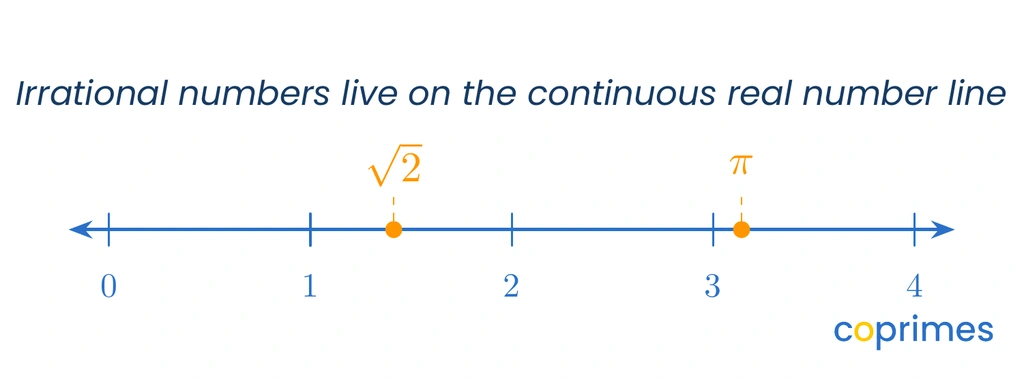
Irrational numbers represent exact positions on the continuous number line, situated between rational numbers.
Visual Explanation
An Euler diagram clarifies how irrational numbers exist separately from other groups within the real number system.
Unlike integers and fractions, which neatly nest inside one another as subsets of rational numbers, irrational numbers occupy their own distinct space.
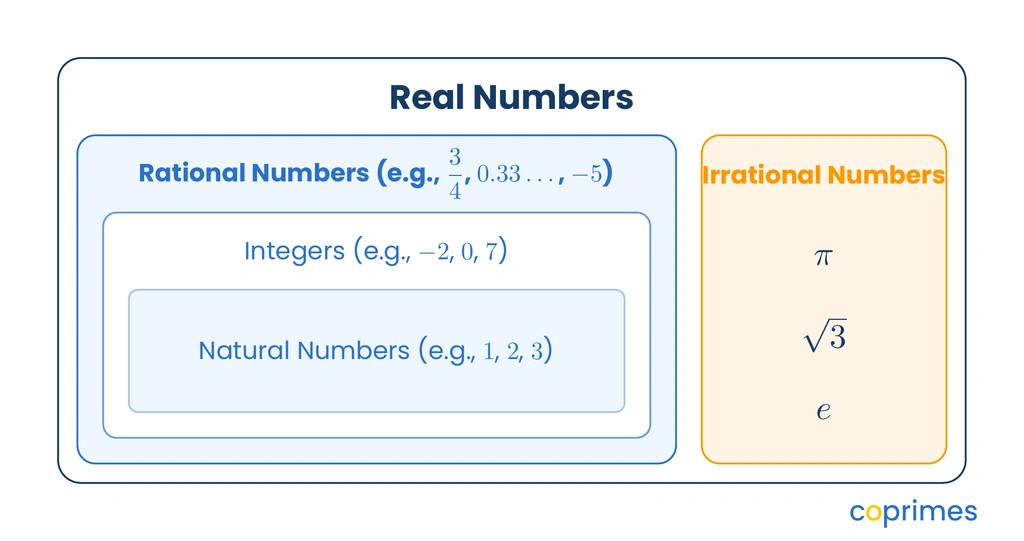
There is no overlap between the left side and the right side of this chart. A number cannot be both rational and irrational at the same time.
A learning plan shaped by your child, not the class
State-aligned Math plus our own Logic and English curriculum. An adaptive baseline test finds the gaps and fills them.
Worked Examples
Applying the definition step-by-step will help you classify whether a number is irrational.
Example 1: Classifying square roots
Question: Is a rational or an irrational number?
Method:
- Evaluate the number inside the square root symbol.
- Check if is a perfect square. The closest perfect squares are () and ().
- Since is not a perfect square, its square root cannot be written as a simple fraction or terminating decimal.
Answer: is an irrational number.
Check: Use a calculator to expand . The result is , which shows no repeating pattern.
Example 2: Analyzing decimal expansions
Question: Is the decimal rational or irrational?
Method:
- Examine the decimal part for any ending point or repetition.
- Notice that the decimal does not terminate.
- Look for a repeating block. The block "12" repeats infinitely.
- Because the decimal repeats, it can be expressed as a fraction.
Answer: is a rational number (specifically, ).
Check: Divide by mathematically to confirm the repeating decimal matches the original number perfectly.
Example 3: Adding rational and irrational numbers
Question: Is the sum of rational or irrational?
Method:
- Identify the components: is rational, and is irrational.
- The decimal form of is exactly .
- The decimal form of is , which is infinite and nonrepeating.
- Adding a terminating rational number to an infinite, nonrepeating decimal results in another infinite, nonrepeating decimal ().
Answer: is an irrational number.
Check: If were rational, subtracting (a rational number) would leave a rational number. However, subtracting leaves , which is known to be irrational. Therefore, the sum must be irrational.
Common Mistakes and Non-Examples
The most frequent mistake when identifying irrational numbers examples is assuming that commonly used approximations are the exact numbers.
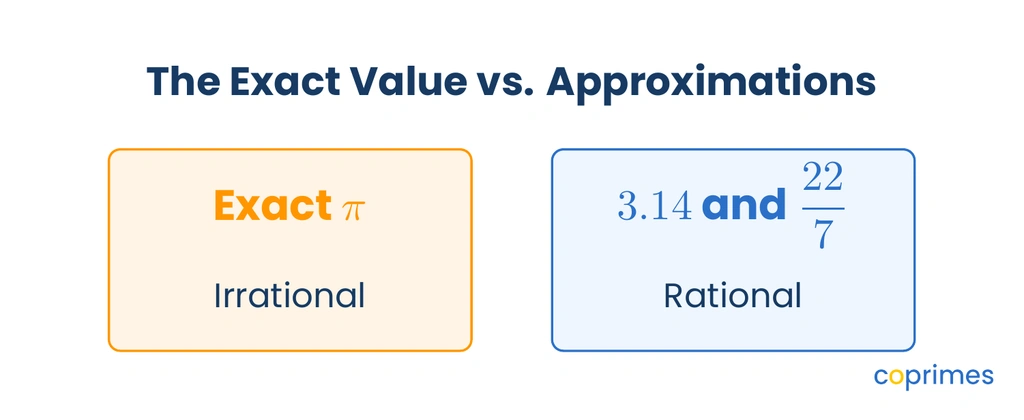
For instance, the value of is an irrational number. Many students mistakenly believe that is exactly equal to or the fraction . Those are only rational approximations. The true value of never ends and never repeats.
Another common mistake is assuming that any number with a square root symbol is irrational. A square root is only a symbol indicating an operation. If the number underneath the radical is a perfect square, the result is rational. For example, is a rational number because it simplifies exactly to .
Not all square roots are irrational. Only the square roots of non-perfect squares are irrational.
Real-World Connections
Irrational numbers appear frequently in geometry and physics.
When you draw a square with sides exactly meter long, the diagonal distance across that square is exactly meters. You can use the absolute value to express the distance between points, but the numerical magnitude remains an infinite, nonrepeating decimal.
Similarly, the irrational number determines the circumference and area of every perfect circle in the universe. If you measure the circumference of a circle and its diameter, the ratio will always be exactly .
Because of this, true physical precision requires the use of exact irrational symbols rather than relying completely on rounded decimal answers.

Practice questions
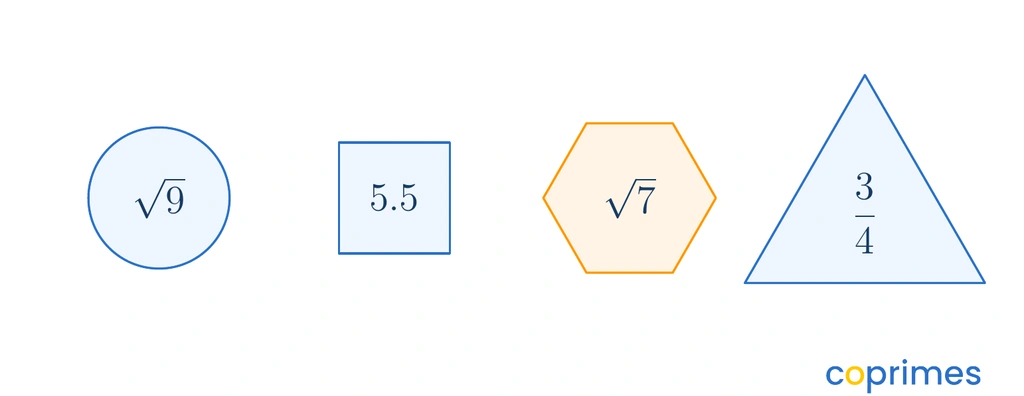
Which of the shapes shown above contains an irrational number?
The circle containing .
The square containing .
The hexagon containing .
The triangle containing .
The hexagon containing .
Which property must be true for the decimal expansion of an irrational number?
It terminates after a certain number of decimal places.
It continues infinitely with a repeating block of digits.
It continues infinitely without ever forming a repeating pattern.
It consists entirely of zero digits after the decimal point.
It continues infinitely without ever forming a repeating pattern.
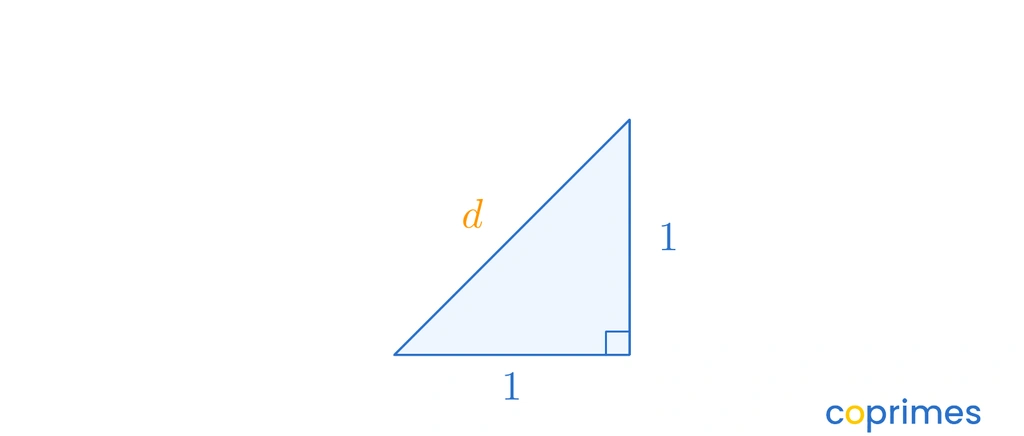
Using the Pythagorean theorem (), the length of the hypotenuse is exactly . How is classified?
It is a rational number because it is derived from integers.
It is an irrational number because is not a perfect square.
It is a rational number because terminates at .
It is neither rational nor irrational because it represents distance.
It is an irrational number because is not a perfect square.
Which of the following statements is a common mathematical misconception?
The square root of is a rational number.
An irrational number cannot be expressed as a fraction of integers.
The number is exactly equal to .
Adding an irrational number and a rational number produces an irrational number.
The number is exactly equal to .
If you multiply by , what kind of number is the result?
An irrational number, because multiplying irrationals always gives an irrational result.
A rational number, because .
An irrational number, because is not a perfect square.
An imaginary number, because you are combining two roots.
A rational number, because .