
Understanding Common Factors: Guide and Examples for Grades 4-7
Common factors are whole numbers that divide exactly into two or more given numbers without leaving a remainder. Finding these shared divisors is an essential step for simplifying fractions, grouping items equally, and understanding the core structure of whole numbers.
What Are Common Factors?
When comparing the factors of two or more numbers, you will often find that they share some of the same divisors. These shared divisors are called common factors.
If a number divides exactly into every number in your given set, it belongs to the list of common factors for that set.
A common factor divides a pair of two or more numbers exactly, leaving a remainder of zero.
For example, the numbers , and are all factors of . The numbers , and are all factors of . The numbers that appear in both groups are , and . Therefore, , and are the common factors of and .
Key Ideas and Vocabulary
Every whole number greater than has at least two factors: and itself. Because divides into every whole number without a remainder, is a common factor for any set of numbers you choose.
If is the only shared factor between two numbers, those numbers are called co-prime. For example, the factors of are , and . The factors of are , and . They share no divisors other than , making and co-prime numbers.
The largest shared number in a set of common factors is called the greatest common factor. Identifying the largest shared divisor helps solve problems involving maximum equal groupings.
Visual Explanation
A Venn diagram is an excellent way to visualize how factors relate. By placing the factors of one number in the left circle and the factors of another number in the right circle, the shared intersection in the middle clearly displays the common factors.
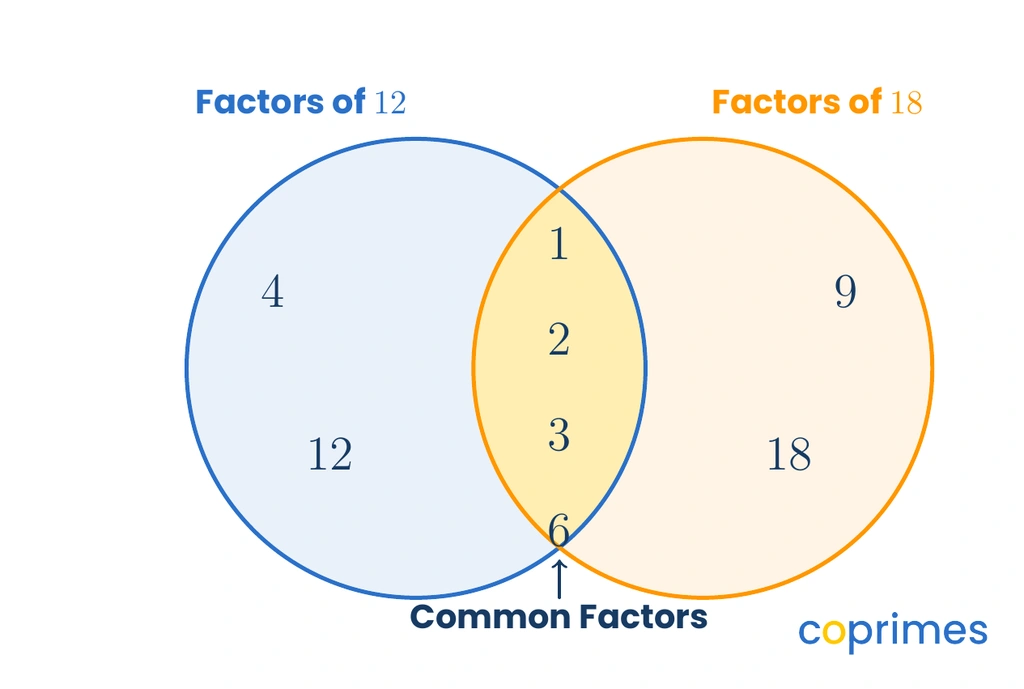
The overlap in the center collects the divisors that work for both and . By isolating the intersection, you can easily identify that the shared factors are , and .

Worked Examples
Finding shared factors is straightforward when you use systematic lists or factorization. Review the examples below to see different methods applied.
Example 1: Finding shared factors using lists
Question: What are the common factors of and ?
Method:
- List all factors of by finding dividing pairs: .
- List all factors of : .
- Identify the numbers that appear in both factor lists.
Answer: The common factors are , and .
Check: Verify that both and can be divided by without leaving a remainder. and .
Example 2: Finding shared factors for three numbers
Question: What are the common factors of , and ?
Method:
- Write out the full list of factors for : .
- Write out the full list of factors for : .
- Write out the full list of factors for : .
- Locate the specific numbers that are present in all three lists.
Answer: The common factors are , and .
Check: The largest shared divisor is . Since , , and , the factors are correct.
Example 3: Using prime factorization
Question: Find the greatest common factor of and using prime factors.
Method:
- Use a factor tree to find the prime factorization of . This breaks down into .
- Find the prime factorization of . This breaks down into .
- Identify the prime numbers shared by both lists. They both contain two s and one .
- Multiply the shared prime numbers together: .
Answer: The greatest common factor is .
Check: Divide both original numbers by . We get and . Because and share no other factors, is accurately confirmed as the greatest shared divisor.
Common Mistakes and Non-Examples
A frequent error is confusing shared factors with common multiples. Factors are divisors that are equal to or smaller than the given number. Multiples are the result of multiplying the number, making them equal to or larger than the given number.
Always check every proposed factor to ensure it leaves no remainder for both numbers. For example, a student might guess that is a common factor of and because it divides evenly into . However, is a non-example here. When you divide by , it leaves a remainder of . Therefore, cannot be shared by both.
Real-World Connections
You rely on common factors whenever you need to organize different items into equal groups.
Suppose you have apples and oranges, and you want to pack them into identical gift baskets with no fruit left over. Finding the common factors of and tells you exactly how many baskets you can make. Since their shared factors are , and , you have the option of making , or identical baskets containing both types of fruit.
A learning plan shaped by your child, not the class
State-aligned Math plus our own Logic and English curriculum. An adaptive baseline test finds the gaps and fills them.
Practice questions
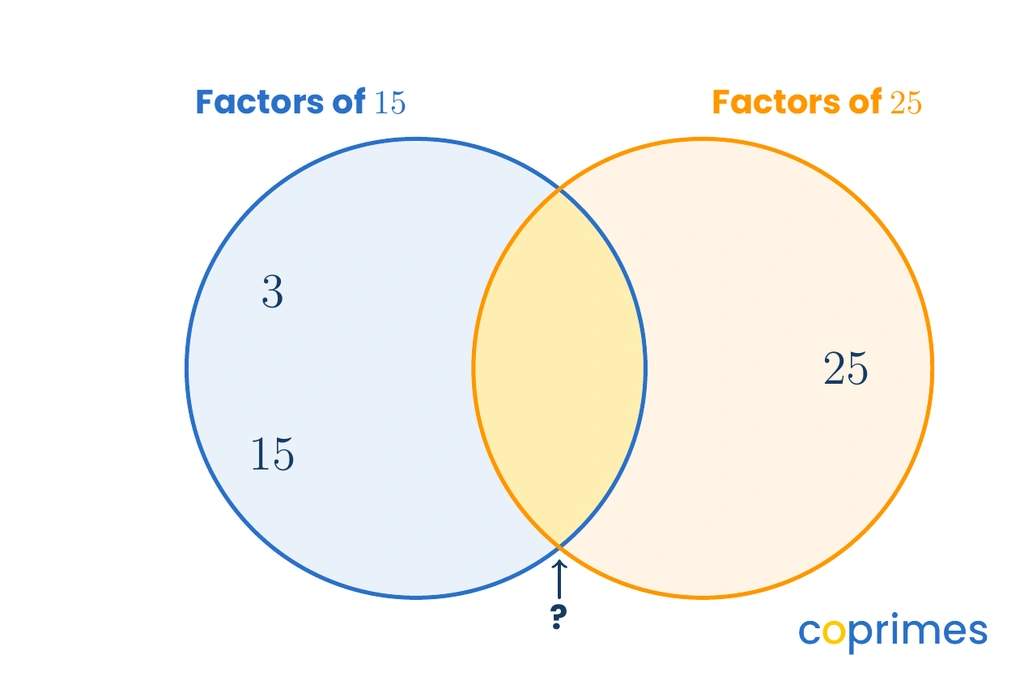
Which numbers belong in the overlapping highlighted section for the common factors of and ?
What are all the common factors of and ?
Which of the following statements about common factors is true?
The lowest common factor of any two whole numbers is always .
Co-prime numbers have no common factors at all.
A common factor can be larger than the numbers being compared.
Every pair of even numbers has exactly one common factor.
The lowest common factor of any two whole numbers is always .
Find the greatest common factor of and .
How many common factors do the numbers and share in total?