
What Is the Greatest Common Factor (GCF)?
The greatest common factor is the largest positive integer that divides two or more numbers evenly without leaving a remainder. Finding this value is an essential skill for simplifying fractions, scaling ratios, and dividing objects into equal groups.
To find the greatest common factor, you first need to understand factors. Factors are whole numbers that multiply together to make a specific product. When two or more numbers share the same factors, those shared values are called common factors. The greatest common factor is simply the largest number in that shared list.
The greatest common factor of two numbers is the largest divisor they share.
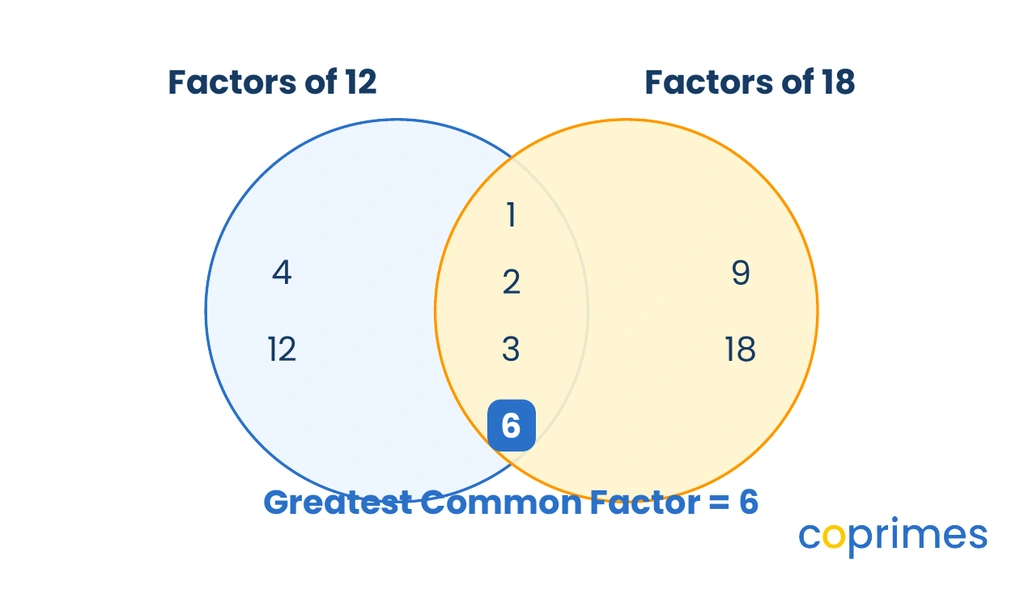
What Is Greatest Common Factor (GCF, HCF or GCD)?
The greatest common factor describes the largest integer that divides perfectly into a set of numbers. Depending on where you study mathematics, this concept may be referred to by a few different names.
You might see it called the Highest Common Factor (HCF) or the Greatest Common Divisor (GCD). These terms all mean exactly the same thing. Whether you are asked to find the GCF, the HCF, or the GCD, your goal is to find the largest shared divisor.
When two numbers have a greatest common factor of , they are called relatively prime or coprime. This means they share no other factors.
When to Use It
Finding the greatest common factor is a practical skill used frequently in mathematics and everyday problem-solving.
You use the greatest common factor when simplifying fractions. Dividing both the numerator and the denominator by their GCF reduces the fraction to its simplest form in one step.
It is also used when scaling ratios down to their smallest proportional values. In algebra, factoring expressions often requires pulling out the greatest common factor of the coefficients and variables before moving to the next step.
Step-by-Step Method
There are three main methods for finding the greatest common factor. The best method depends on the size of the numbers you are working with.
Method 1: Listing Factors
- List every factor for each number from smallest to largest.
- Circle or highlight the factors that appear in every list.
- Identify the largest number among the shared factors. This is the greatest common factor.
This method works well for small numbers under , where listing every factor is quick.
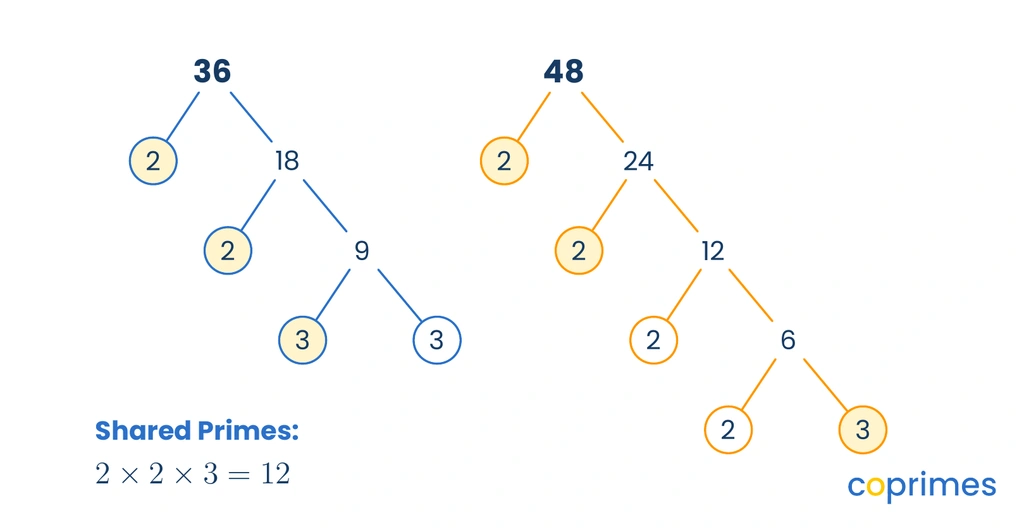
Method 2: Prime Factorization
- Break each number down into its prime factors using a factor tree or division ladder.
- Identify the prime factors that both numbers share.
- Multiply the shared prime factors together to find the greatest common factor.
This method is highly effective for medium and large numbers because it removes the need to list every single divisor.
Method 3: The Division Method
- Divide the larger number by the smaller number to find a quotient and a remainder.
- Divide the previous divisor by the new remainder.
- Continue this process until the remainder is exactly zero. The last divisor you used is the greatest common factor.
This is based on the Euclidean Algorithm and is the fastest method for very large numbers that are difficult to factor.
A learning plan shaped by your child, not the class
State-aligned Math plus our own Logic and English curriculum. An adaptive baseline test finds the gaps and fills them.
Visual Worked Examples
Let us apply the three methods to progressively larger numbers.
Example 1: Using the listing method
Question: What is the greatest common factor of and ?
Method:
- List the factors of : .
- List the factors of : .
- Identify the common factors: .
- Choose the largest common factor.
Answer: The greatest common factor is .
Check: and . The quotients and share no other factors.
Example 2: Using prime factorization
Question: What is the greatest common factor of and ?
Method:
- Find the prime factorization of : .
- Find the prime factorization of : .
- Identify the prime factors they share: they both have one and one .
- Multiply the shared prime factors together: .
Answer: The greatest common factor is .
Check: and . The remaining quotients are coprime.
Example 3: Using the division method
Question: What is the greatest common factor of and ?
Method:
- Divide by . The result is with a remainder of .
- Divide the previous divisor () by the remainder (). The result is with a remainder of .
- Divide the previous divisor () by the new remainder (). The result is with a remainder of .
- Because the remainder is zero, the last divisor used () is the GCF.
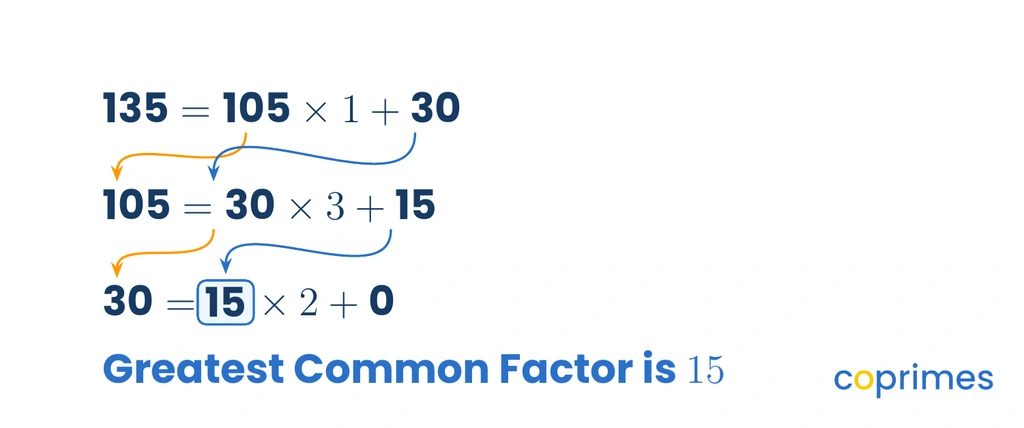
Answer: The greatest common factor is .
Check: and . The numbers and share no factors other than .
How to Check the Answer
Whenever you calculate a greatest common factor, you can quickly verify your answer by performing division. Divide each of the original numbers by your proposed greatest common factor.
First, confirm that every division results in a whole number. If there is a remainder, your number is not a factor at all.
Second, examine the resulting quotients. They must share no common factors other than . If they still share a factor, it means you did not find the greatest common factor; you only found a smaller factor.
Common Mistakes
A frequent mistake is confusing factors with common multiples. Remember that factors divide a number evenly and are never larger than the number itself. Multiples are created by multiplying a number by integers and grow infinitely larger.
Because of this vocabulary overlap, many students accidentally mix up the GCF with the least common multiple. If you are asked for the GCF, your answer will be smaller than or equal to the starting numbers. If you are asked for the LCM, your answer will be larger than or equal to the starting numbers.
To fully master the differences, you can practice solving problems that compare the GCF and LCM side by side.

Practice questions
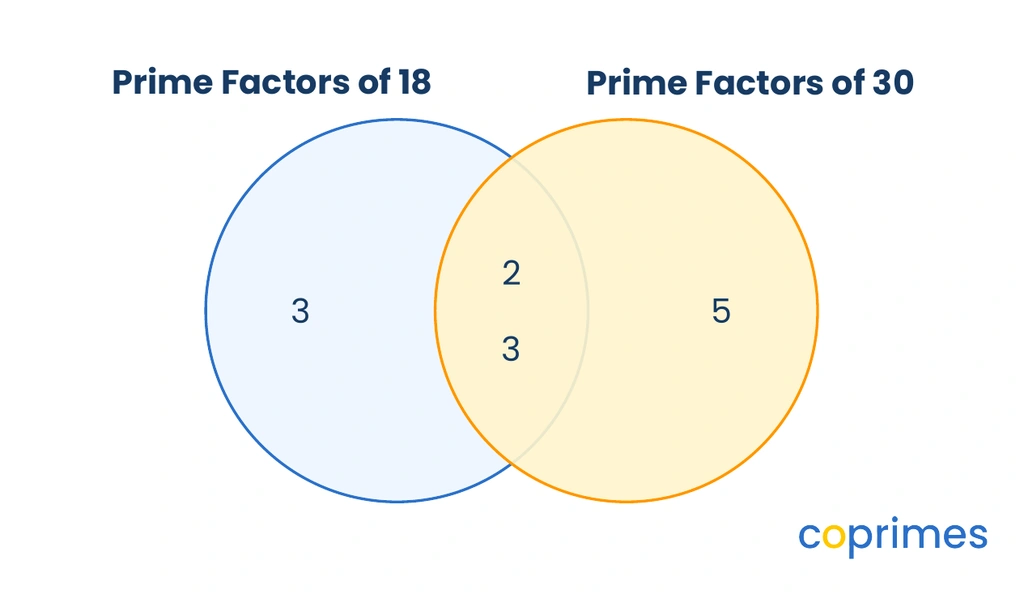
Based on the Venn diagram of prime factors above, what is the greatest common factor of and ?
What is the greatest common factor of and ?
Number has the prime factorization .
Number has the prime factorization .
What is their greatest common factor?
A student claims that the greatest common factor of and is . What is the actual greatest common factor?
A teacher has blue markers and red markers. She wants to divide them into identical packs with no markers left over. What is the greatest number of identical packs she can make?