
Common Multiples: Guide and Examples
Common multiples are numbers that are multiples of each of two or more given numbers.
When you list the multiples of several different numbers, the values that appear in every list are their common multiples.
What Is Common Multiples?
To understand how to find common multiples, you must first know what a multiple is.
A multiple is the product of a given number and an integer.
When two or more numbers share the exact same multiple, that shared number is called a common multiple.
For instance, if you list the multiples of and the multiples of , you will find certain numbers that appear in both lists.
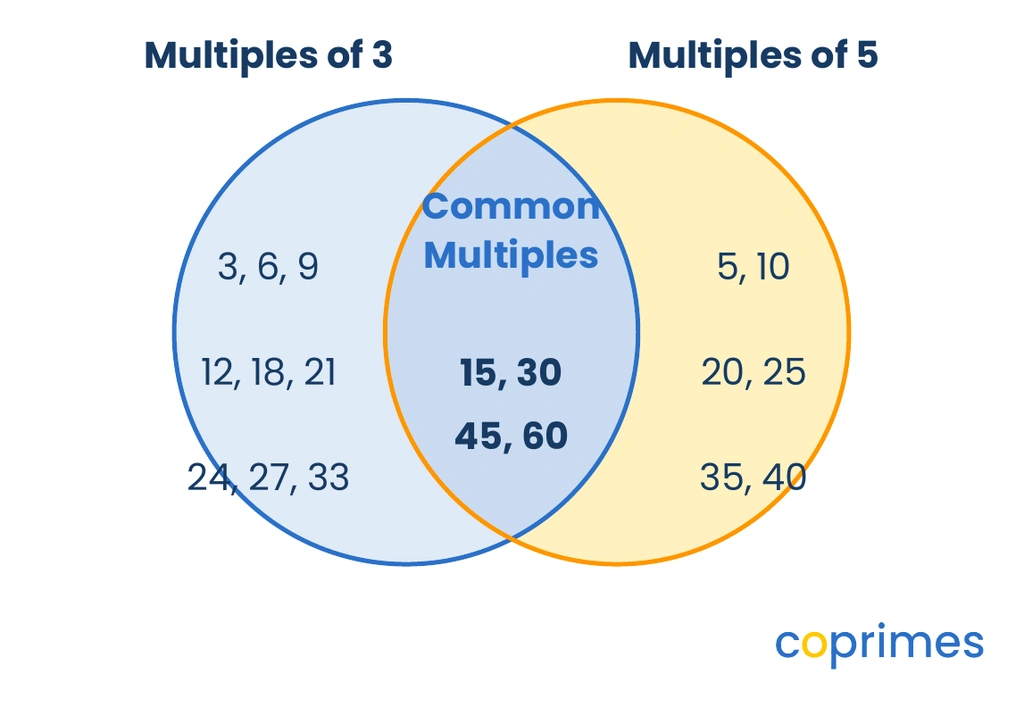
The numbers and are common multiples of and because they can be divided evenly by both initial numbers.
Key Ideas and Vocabulary
There are several important properties to remember when working with common multiples.
- Infinite lists: Because numbers have an infinite number of multiples, any set of numbers has an infinite number of common multiples.
- Least common multiple: The smallest positive common multiple of a set of numbers is known as the least common multiple.
- Shared multiples: This is simply an alternative term for common multiples.
It is also important to distinguish between multiples and factors.
While factors divide evenly into a number, multiples are created by multiplying the number.
You can break a number down into its prime components using a factor tree, but this finds prime factors, not multiples.
Understanding the difference between shared multiples and common factors will help you solve problems correctly before you move on to topics like the greatest common factor.
Visual Explanation
A number line is an excellent tool to visualize how common multiples work.
Imagine two objects moving forward from zero on a number line.
One object jumps forward in intervals of , and the other object jumps forward in intervals of .
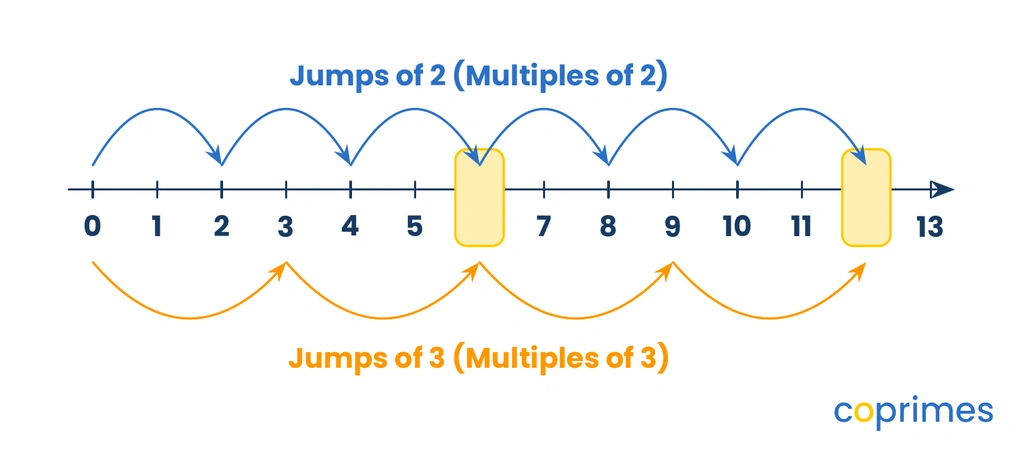
Every point where both objects land together represents a common multiple.
In this case, both objects land on and , proving that these numbers are common multiples of and .

Worked Examples
These progressively harder common multiples examples show how to correctly list and verify shared multiples.
Example 1: Finding common multiples of two numbers
Question: What are the first three positive common multiples of and ?
Method:
- List the first several multiples of .
- List the first several multiples of .
- Identify the numbers that appear in both lists.
Multiples of : , , , , , , , , ,
Multiples of : , , , , , ,
Answer: The first three common multiples are , , and .
Check: Verify that each answer is divisible by both and without a remainder.
Example 2: Finding a common multiple for three numbers
Question: What is the smallest positive common multiple of , , and ?
Method:
- List the multiples for the largest number first, which is .
- Check each multiple of to see if it is also a multiple of both and .
Multiples of : , , ,
Check : Multiple of , but not .
Check : Multiple of , but not .
Check : Multiple of () and multiple of ().
Answer: The smallest positive common multiple is .
Check: Since , , and , the answer is correct.
Example 3: Checking if a large number is a common multiple
Question: Is a common multiple of and ?
Method:
- Divide the target number by the first given number.
- Divide the target number by the second given number.
- If both division problems result in whole numbers with no remainders, the target is a common multiple.
Calculate .
Calculate .
Answer: Yes, is a common multiple of and .
Check: Multiply to verify it equals .
Common Mistakes and Non-Examples
Watch out for these frequent errors when identifying common multiples.
- Confusing multiples with factors: Students often list numbers that divide into the given numbers instead of numbers that the given numbers multiply into. For example, is a common factor of and , not a common multiple.
- Assuming the product is the only common multiple: Multiplying two numbers together always gives a common multiple, but it is not always the smallest one. For and , the product is , but is a smaller common multiple.
- Stopping at one match: Remember that common multiples are infinite. If a question asks for three common multiples, do not stop after finding the first one.
Non-Example: Identifying a false common multiple
The number is a multiple of because .
However, is not a multiple of because with a remainder of .
Therefore, is a non-example of a common multiple of and .
Real-World Connections
Common multiples appear frequently in everyday situations involving alignment and scheduling.
For example, if hot dogs are sold in packs of and hot dog buns are sold in packs of , finding a common multiple helps you buy an equal number of each.
You would need to buy hot dogs ( packs) and buns ( packs) so nothing is left over.
Similarly, if one city bus arrives every minutes and another arrives every minutes, they will arrive at the stop at the exact same time every minutes.
A learning plan shaped by your child, not the class
State-aligned Math plus our own Logic and English curriculum. An adaptive baseline test finds the gaps and fills them.
Practice questions
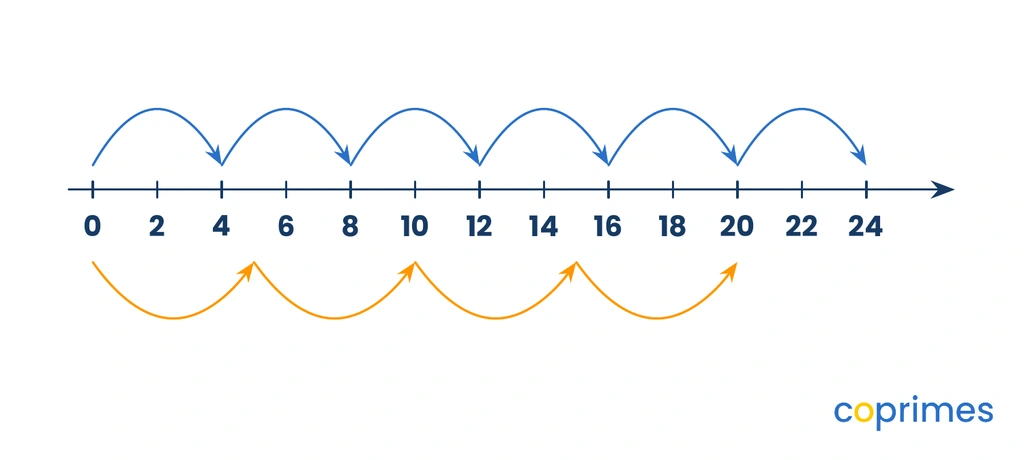
Based on the number line jumps shown in the diagram, which two numbers share a common multiple of ?
and
and
and
and
and
What are the first two positive common multiples of and ?
and
and
and
and
and
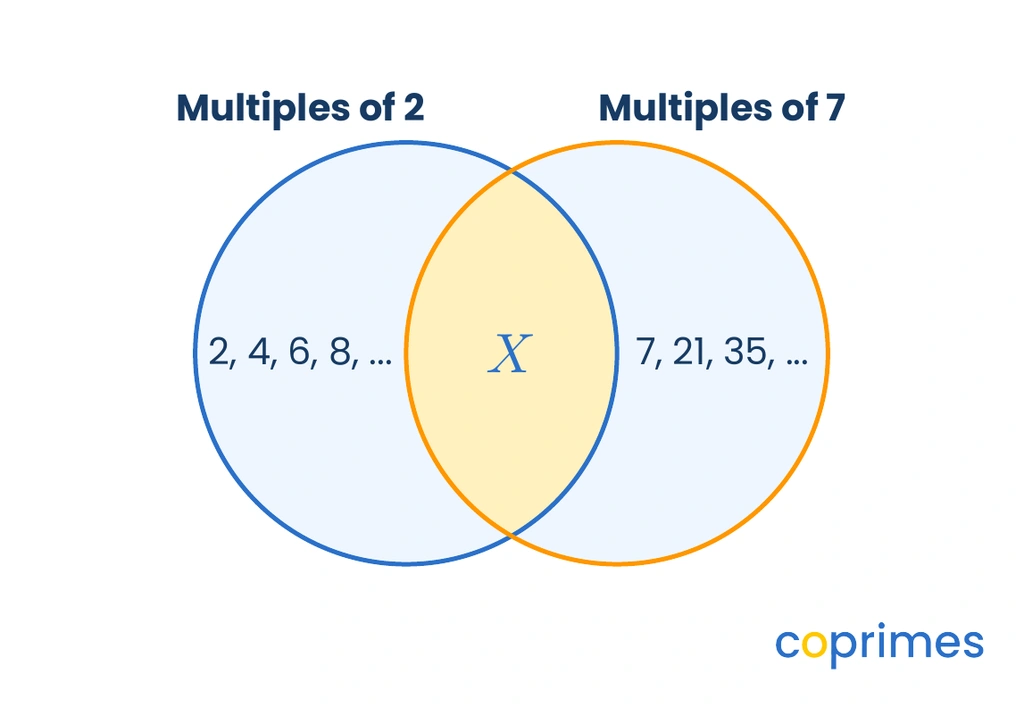
Which number could correctly be placed in the shared region of the Venn diagram?
,
Why is considered a common multiple of and ?
Because can be divided evenly by both and .
Because plus is a factor of .
Because is the only number they both multiply into.
Because both and are larger than .
Because can be divided evenly by both and .
A baker sells muffins in boxes of and cookies in boxes of . If a customer wants to buy the exact same number of muffins and cookies, what is the smallest total number of each treat they must buy?