
Decimal Expansion of Rational Numbers: Rules and Examples
When analyzing rational numbers, every fraction has a decimal expansion that either terminates or repeats; a non-terminating, non-repeating decimal represents an irrational number instead. A rational number decimal expansion transforms a fraction into its equivalent value in base ten, providing a practical way to compare sizes and perform exact calculations.
What is a decimal expansion?
A decimal expansion is the representation of a number using a decimal point. It converts a fraction into a decimal by dividing the numerator by the denominator. This process yields the rational decimal representation, revealing exactly how the number behaves past the decimal point.
Decimal expansions of rational numbers
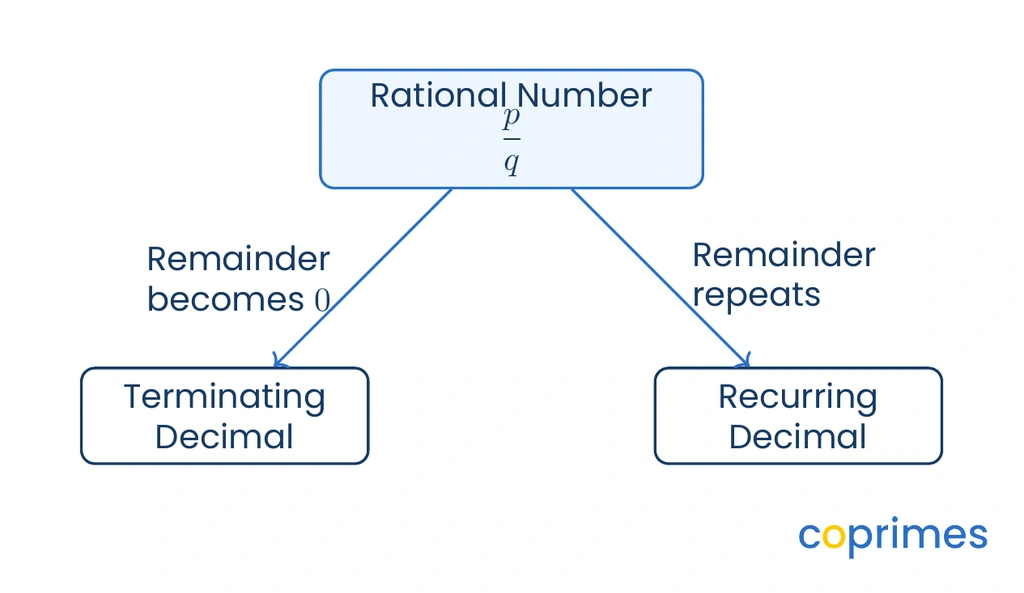
When we divide the numerator of a rational fraction by its denominator, the resulting quotient is its decimal expansion. Analyzing the decimal forms of rational numbers reveals that every rational number decimal expansion takes one of two possible forms: a decimal that ends or a decimal that continues endlessly with a repeating pattern of digits.
Terminating versus recurring expansions
A decimal expansion is either terminating or recurring based on how the division process unfolds. Evaluating terminating, recurring decimals allows us to classify fractions accurately without ambiguity.
Proper terminating decimals end after a finite number of digits. This happens when the division reaches a remainder of zero. For instance, .
In contrast, recurring decimals continue forever, but a specific digit or sequence of digits repeats endlessly. This occurs when the division yields a repeating remainder, meaning it never reaches zero. For instance, .

Use denominator factors
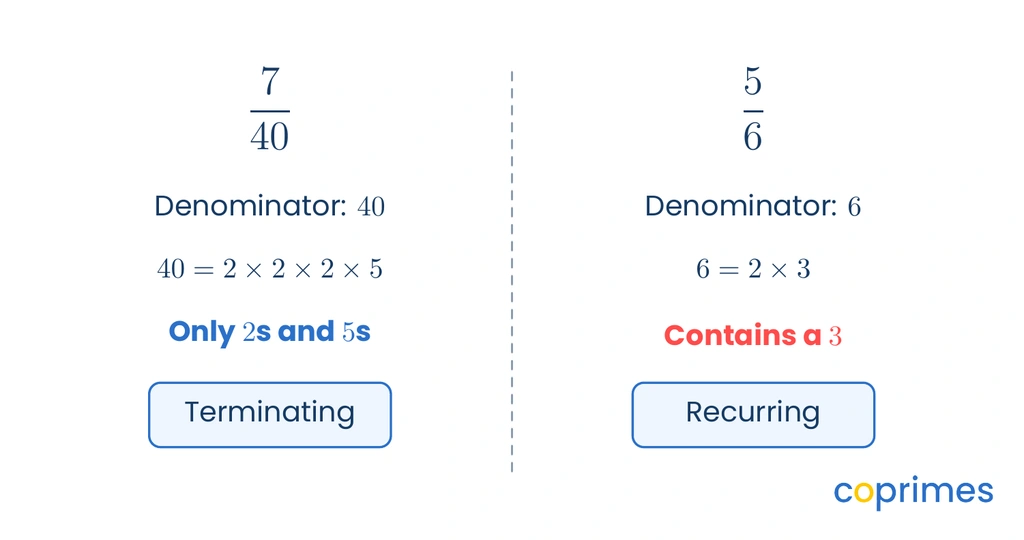
You can determine the type of decimal expansion without performing long division by analyzing the prime factors of the fraction's denominator. The fraction must first be in its simplest form.
If the prime factorization of the denominator contains only the numbers , , or both, the fraction will have a terminating decimal expansion. If the denominator contains any prime factor other than or , the decimal expansion will be recurring.
Contrast rational and irrational decimals
All real numbers can be written as decimals, but their behavior separates the rational from the irrational. While rational numbers always terminate or repeat, irrational numbers have decimal expansions that never terminate and never settle into a repeating pattern.
Number Type | Fractional Form | Classification | |
Integer | Terminating rational | ||
Terminating decimal | Terminating rational | ||
Recurring decimal | Non-terminating, recurring rational | ||
Recurring decimal | Non-terminating, recurring rational | ||
Irrational number | Not applicable | Non-terminating, non-recurring irrational |
Worked examples
Working through examples builds confidence in predicting decimal behavior without relying on long division.
Example 1: Identifying a terminating decimal
Question: Without performing long division, determine if the decimal expansion of is terminating or recurring.
Method:
- Check if the fraction is in simplest form. The numbers and share no common factors.
- Find the prime factorization of the denominator.
- The denominator is , and its prime factorization is .
- Apply the denominator rule. Since the only prime factor is , the expansion terminates.
Answer: The decimal expansion is terminating.
Check: Using division, , which confirms it terminates.
Example 2: Identifying a recurring decimal
Question: Is the decimal expansion of terminating or recurring?
Method:
- Verify the fraction is in simplest form. The numbers and share no common factors.
- Factor the denominator into its prime components.
- The prime factorization of is .
- Check for factors other than and . The presence of the factor means the decimal will not terminate.
Answer: The decimal expansion is recurring.
Check: Using division, , which confirms the digit recurs.
Example 3: Applying the rule after simplification
Question: Determine the type of decimal expansion for .
Method:
- Check if the fraction can be simplified. Both and are divisible by .
- Simplify the fraction: .
- Factor the new denominator into primes: .
- Evaluate the factors. Since they are only and , the expansion will terminate.
Answer: The decimal expansion is terminating.
Check: Using division, , which clearly terminates.
A learning plan shaped by your child, not the class
State-aligned Math plus our own Logic and English curriculum. An adaptive baseline test finds the gaps and fills them.
Common mistakes
A frequent error is checking the denominator's prime factors before simplifying the fraction. If a fraction contains a factor like in the denominator that can be cancelled out by the numerator, you might incorrectly assume the decimal is recurring.
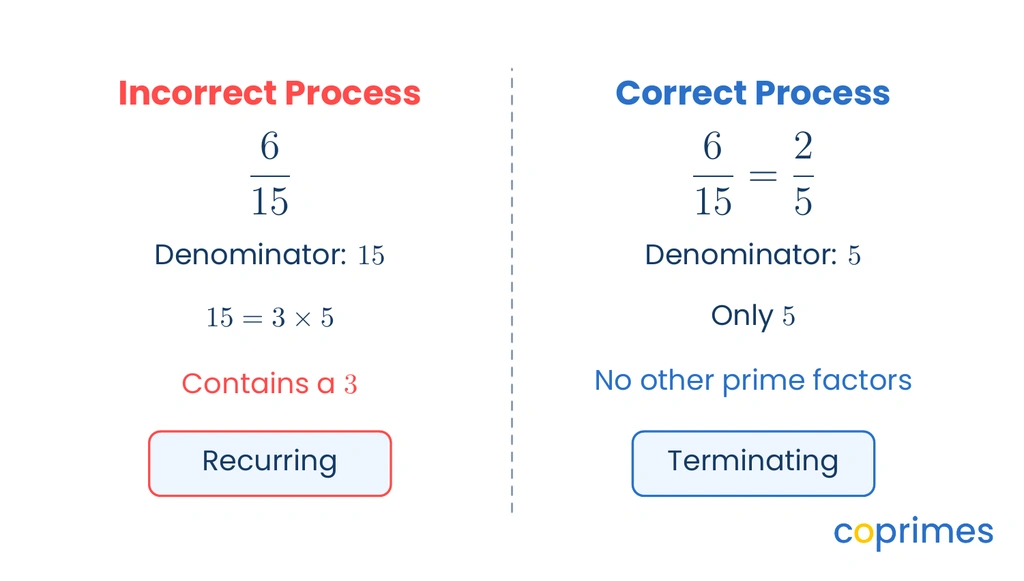
Always reduce the fraction to its simplest form before analyzing the denominator.
Simplify fractions completely before finding prime factors.
Frequently asked questions
Understanding the properties of decimals clarifies how different number sets overlap.
Is every decimal a rational number?
No. Decimals that terminate or have a repeating pattern are rational numbers. Decimals that go on forever without any repeating pattern are irrational numbers instead.
Why do factors of 2 and 5 create terminating decimals?
Our number system is base ten, and the prime factors of are and . Any denominator composed entirely of s and s can be scaled to become a power of , which results naturally in a terminating decimal.
Does 0.999... count as a rational number?
Yes. It is a non-terminating, recurring decimal. In fact, is exactly equal to the integer , which can be written as the fraction .
Practice questions
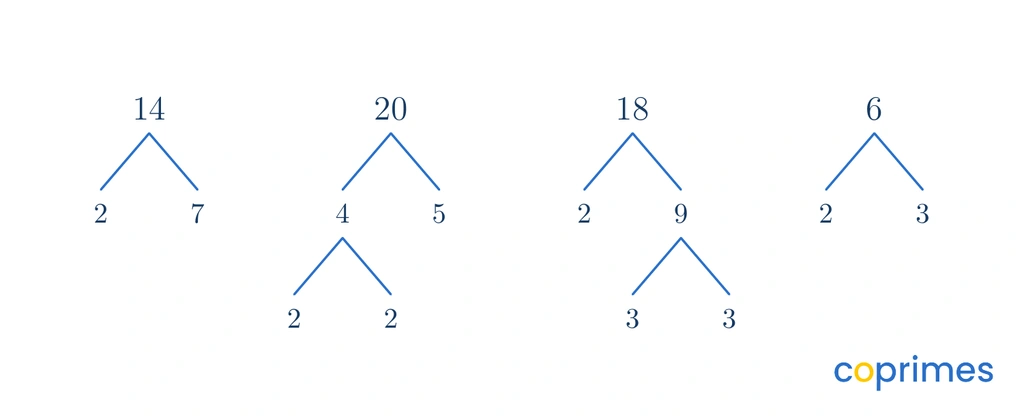
Which denominator represented in the factor trees above belongs to a fraction (in simplest form) with a terminating decimal expansion?
Which of the following rational numbers has a non-terminating, recurring decimal expansion?
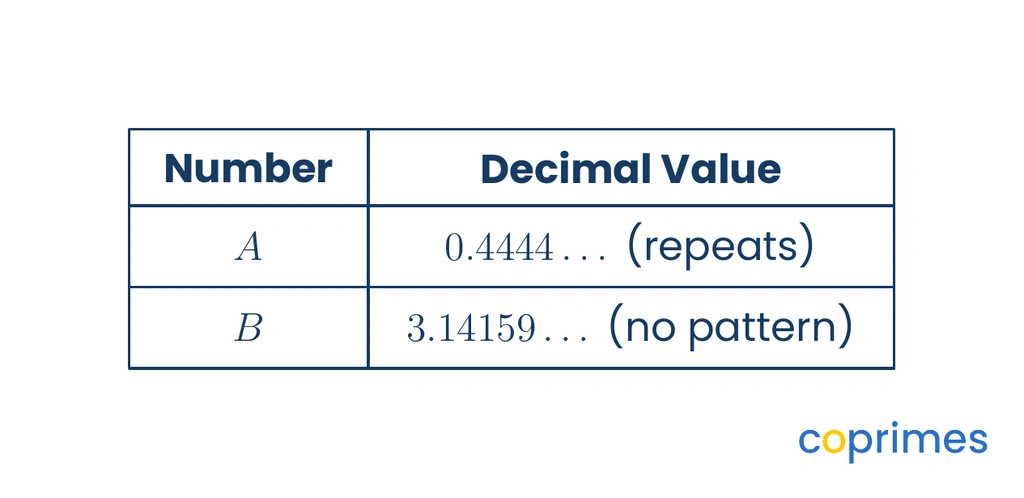
Based on the table, which statement correctly classifies the numbers and ?
Both and are rational numbers because they are decimals.
is a rational number, but is an irrational number.
is an irrational number, but is a rational number.
Neither nor is a rational number because they do not terminate.
is a rational number, but is an irrational number.
A student concludes that the fraction will have a recurring decimal expansion because the denominator has a prime factor of . What is the error in the student's reasoning?
The student factored incorrectly; it does not contain a factor of .
The student forgot that any denominator ending with a zero always terminates.
The student evaluated the denominator before simplifying the fraction.
The student misunderstood the rule; factors of cause decimals to terminate.
The student evaluated the denominator before simplifying the fraction.
Which of the following fractions, when added to , produces a sum with a terminating decimal expansion?