
Direct Variation Equation
A direct variation equation is a linear equation that describes a constant ratio between two variables. When one variable changes, the other changes at the exact same rate. This means the relationship between the two variables is directly proportional.
What is a direct variation equation?
A direct variation equation represents a relationship where the quotient of two variables remains completely constant. As the input variable increases, the output variable increases or decreases by a consistent multiple.
If two quantities vary directly, their graph always forms a perfectly straight line that passes exactly through the origin, which is the coordinate point . The relationship never has a starting value other than zero.
Identify the form y equals kx
The standard formula for a direct variation equation is written as .
In this formula, the variables and represent the changing quantities. The letter represents the constant of proportionality, which is the fixed multiplier connecting the two variables.
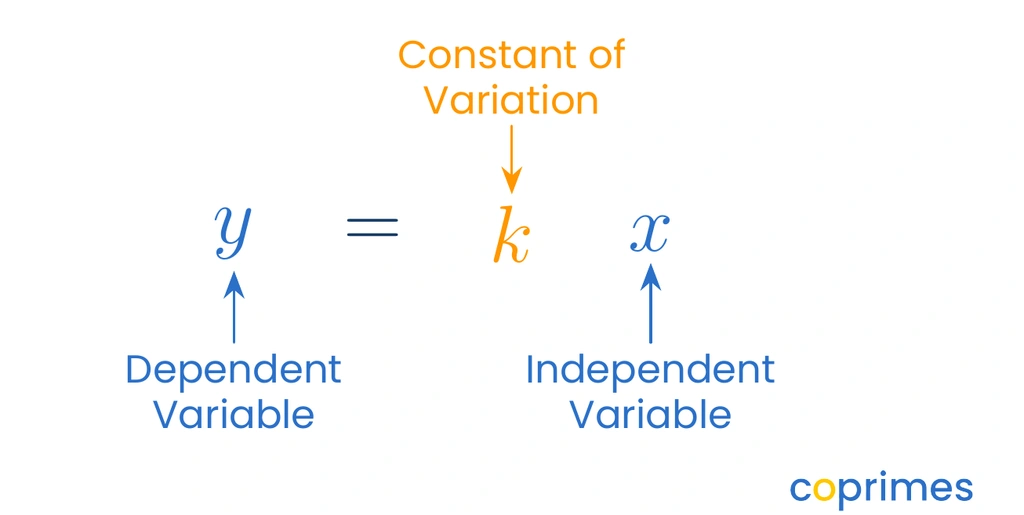
The constant can be any real number except zero. If a linear equation includes an added or subtracted value at the end, such as , it is not a direct variation equation because its graph does not pass through the origin.
Find the constant of variation
To write a direct variation equation, you must first find the numerical value of . Because , you can isolate by dividing both sides of the equation by .
The constant of variation is found by dividing the output by the input.
The formula to find the constant of variation is .
Substitute any valid pair of and values into this formula. For example, if a bicycle travels kilometers in hours, the constant is divided by , which equals . In word problems, this constant often represents a unit rate, such as kilometers per hour.
A learning plan shaped by your child, not the class
State-aligned Math plus our own Logic and English curriculum. An adaptive baseline test finds the gaps and fills them.
Write an equation from values
When given a data table or a set of paired values, you can write the direct variation equation by calculating the constant multiplier connecting each pair.
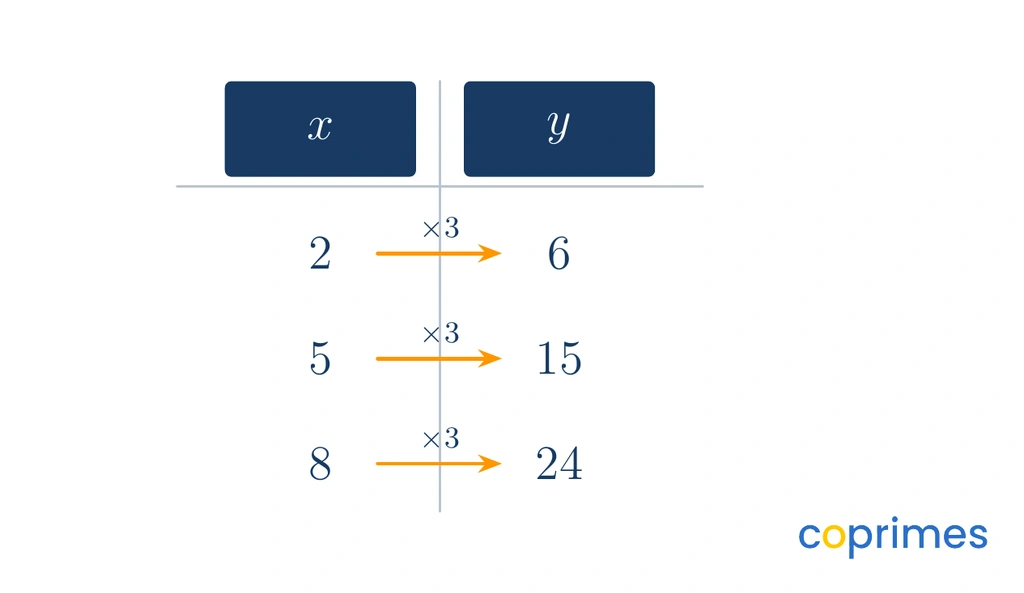
Follow these exact steps to build the equation:
- Select one pair of non-zero values for and .
- Divide the value by the value to calculate .
- Check another pair of values from the table to confirm the ratio remains identical.
- Substitute your verified value of into the standard equation form .
Write an equation from a graph
You can also determine the direct variation equation by analyzing its visual representation on a coordinate grid. Directly proportional graphs are always straight lines extending from the origin, .
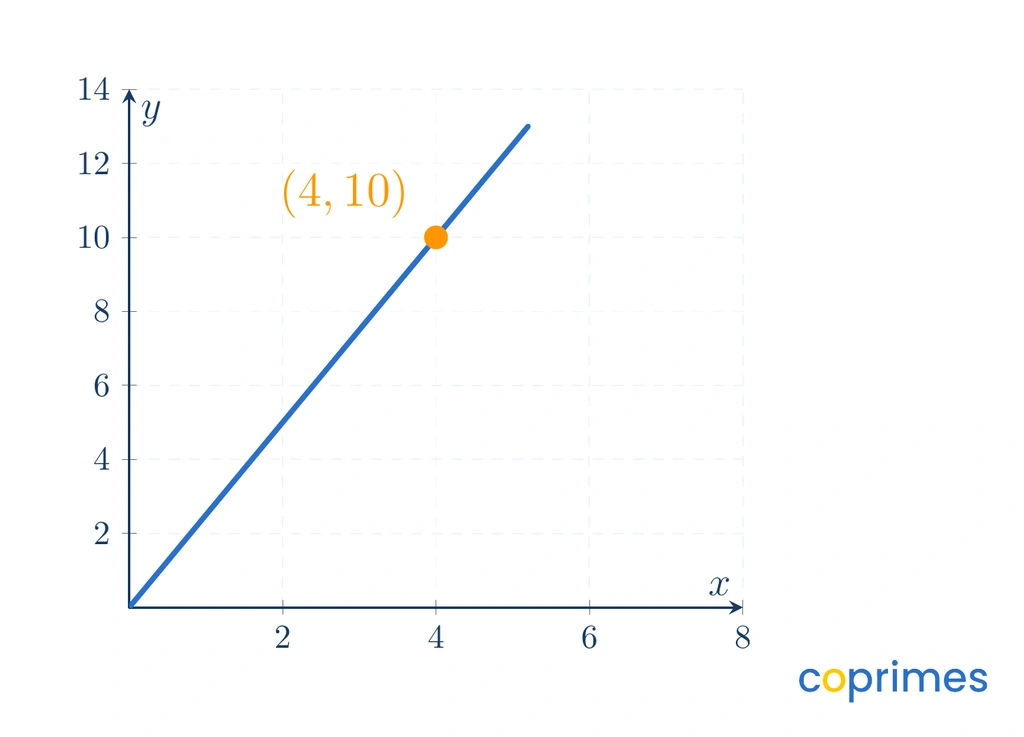
- Verify that the graphed line is straight and intersects the origin.
- Identify the exact coordinates of another clear point on the line, written as .
- Divide the -coordinate by the -coordinate to find the constant .
- Write the final formula by substituting into the equation .
Worked examples
Review these step-by-step examples to see how the direct variation equation is built in different mathematical contexts.
Example 1: Finding an equation from a word problem
Question: A painter earns dollars for hours of work. The total pay varies directly with the number of hours worked . Write the direct variation equation for this relationship.
Method:
- Identify the given values: and .
- Calculate the constant of variation using .
- Substitute the values: .
- Write the standard equation: .
- Substitute the constant: .
Answer: The direct variation equation is .
Check: Multiply by hours to confirm it produces exactly dollars.
Example 2: Writing an equation with a fractional constant
Question: If varies directly with , and when , what is the direct variation equation?
Method:
- Identify the values: and .
- Find the constant of variation: .
- Substitute the numbers: .
- Simplify the fraction by dividing the numerator and denominator by . The result is .
- Insert into .
Answer: The direct variation equation is .
Check: Substitute into the equation. , which matches the original given value.
Example 3: Checking if a mixed equation is a direct variation
Question: Does the equation represent direct variation? If yes, find the constant of variation.
Method:
- A direct variation must be written in the form .
- Isolate in the given equation by dividing both sides by .
- Calculate the right side: .
- The simplified equation is . This strictly matches the form with no added terms.
Answer: Yes, it is a direct variation equation. The constant of variation is .
Check: The equation has no -intercept other than zero, meaning it passes directly through the origin.

Common mistakes
Dividing in the wrong order. Students frequently calculate instead of . Always divide the dependent output variable by the independent input variable.
Adding a constant value. A direct variation equation cannot have a non-zero -intercept. An equation like is a valid linear equation, but it is not a direct variation because the line would cross the -axis at , missing the origin completely.
Frequently asked questions
Can the constant of variation be a fraction or a decimal?
Yes, can be any non-zero real number. Equations like or are completely valid direct variation equations.
Can the constant of variation be negative?
Yes. A negative constant means that as the value increases, the value decreases at a constant rate. The graph of an equation like still forms a straight line passing through the origin, sloping downward.
What is the difference between direct and inverse variation?
In direct variation, the two variables increase or decrease together while maintaining a constant ratio. In direct and inverse variation, an inverse variation means one variable decreases proportionately as the other increases, keeping a constant product where .
Practice questions
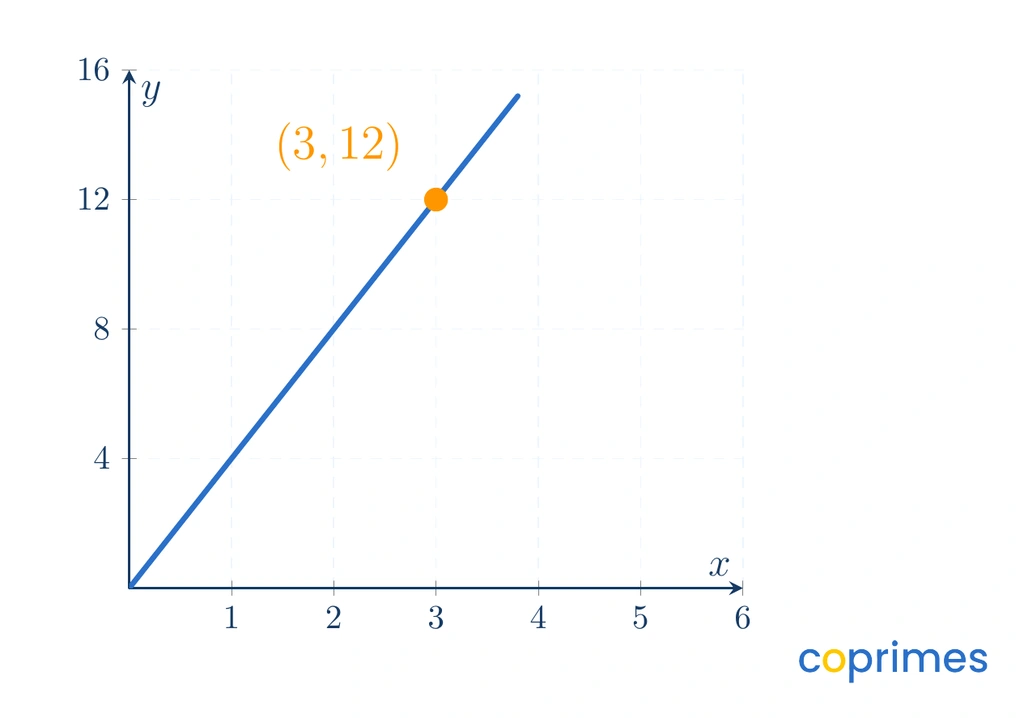
Which direct variation equation represents the line shown in the graph?
If varies directly with , and when , what is the constant of variation?
A machine produces parts in hours. If the total number of parts varies directly with the number of hours , which equation models this relationship?
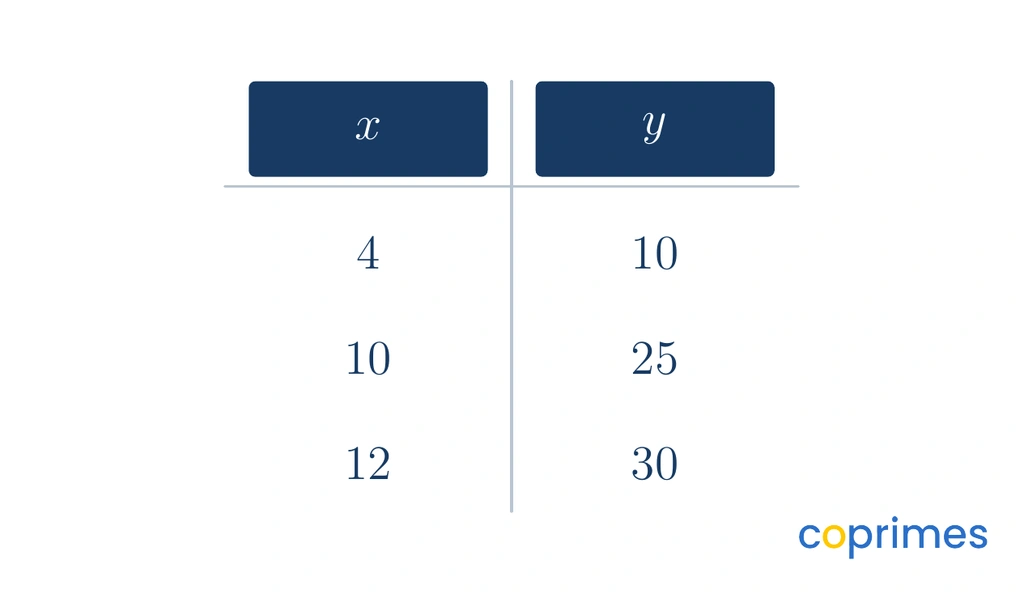
Which direct variation equation matches the values in the table?
Which of the following equations does not represent a direct variation?