
Understanding Inversely Proportional Relationships
Two quantities are inversely proportional when their product is constant: as one quantity is multiplied by a factor, the other is divided by that exact same factor. The mathematical relationship can be written as .
In this guide, you will learn how to identify inverse variation, calculate the constant of proportionality, and solve real-world problems.
What does inversely proportional mean?
When analyzing a proportion, relationships can take different forms. Inversely proportional describes a relationship between two variables where one variable increases as the other decreases, at a specific mathematical rate.
When two quantities are in an inverse proportion, doubling one quantity halves the other. Multiplying one quantity by ten divides the other by ten. Their product always remains exactly the same. This concept is also called inverse variation.
Two classic examples of inversely proportional relationships are fixed work and fixed distance.
Fixed Work
Imagine painting a large fence. If one person takes hours to complete the job alone, two people working at the same pace will take only hours. Three people will take hours. As the number of workers increases, the time required decreases proportionally.
Fixed Distance
If you travel a set distance of kilometers, your speed and travel time are inversely proportional. Traveling at kilometers per hour takes hours, while traveling at kilometers per hour takes hour.
This contrasts with variables that are directly proportional, where both quantities increase or decrease together at a constant ratio.
Recognise a constant product
You can identify an inversely proportional relationship by checking if the product of the two variables is always the same constant value.
If and are inversely proportional, multiplying by for any pair of values will always yield the exact same result.
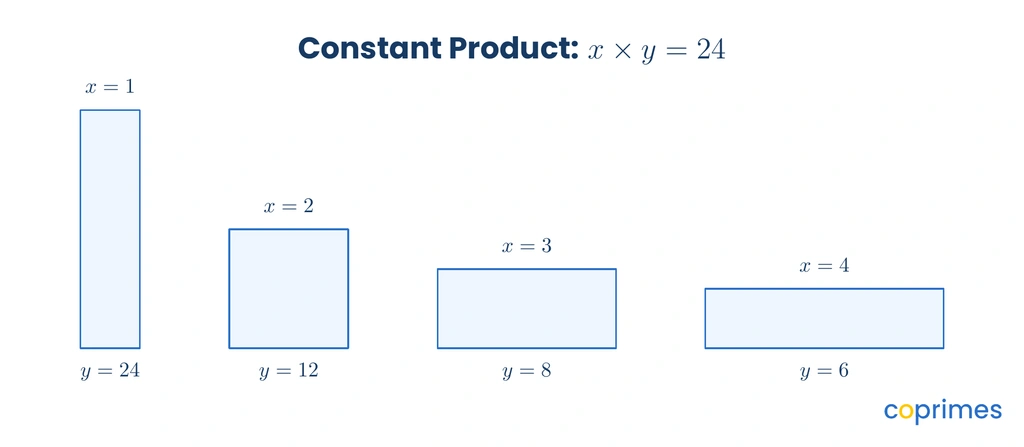
Not all decreasing relationships are inversely proportional. If one value decreases as the other increases, you must check the product to confirm the relationship.
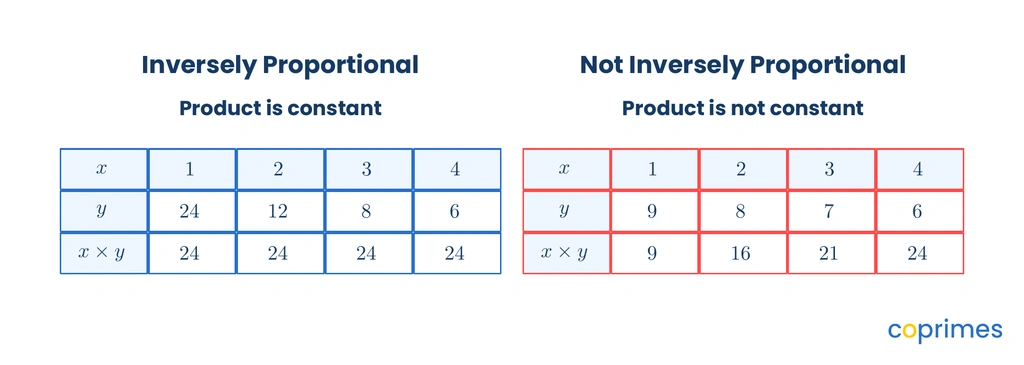
Consider the linear relationship . As increases from to , decreases from to . However, their product changes: , while . Because the product is not constant, the relationship is not inversely proportional.
Use y equals k over x
The relationship between two inversely proportional variables can be written algebraically as an equation.
Using the proportionality symbol, you can write , which reads as is proportional to the reciprocal of .
To turn this relationship into an equation, introduce a constant multiplier :
By rearranging this equation, you can see that the product of and always equals this constant:
This constant multiplier is called the constant of proportionality.
When graphed on a coordinate plane, the equation produces a distinct curve called a hyperbola.
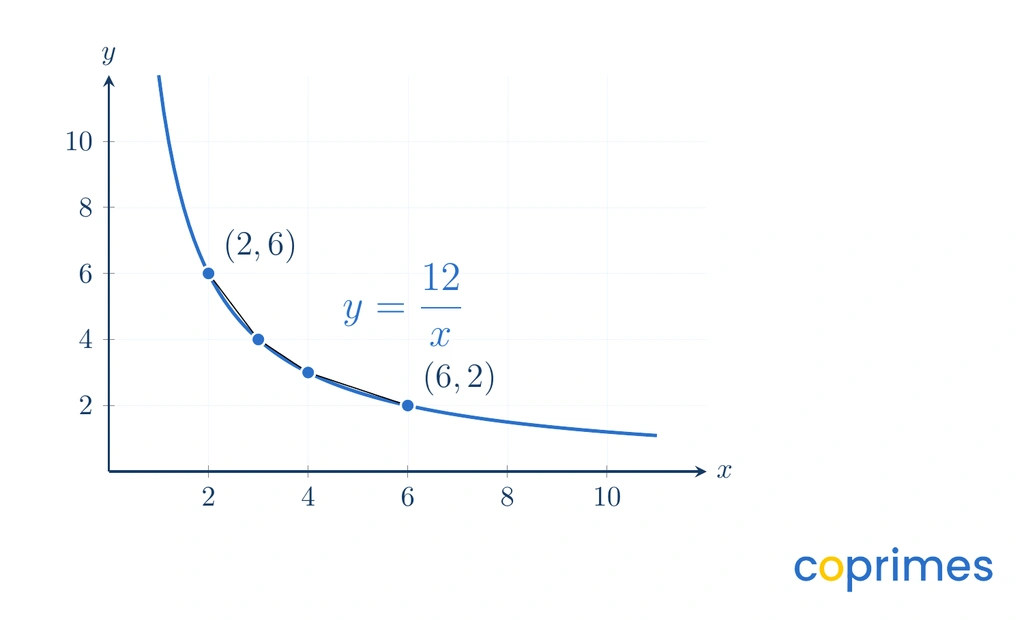
Notice that the curve approaches the -axis and -axis but never crosses them. This is because of zero restrictions. If , the formula requires dividing by zero, which is mathematically undefined. If , the product would be , which contradicts having a non-zero constant . Therefore, and cannot be zero in an inversely proportional relationship.

Find the constant
To solve inverse proportion problems, you must first find the exact value of the constant .
Follow these steps to find the constant and build the final equation:
- Write the general inverse proportion formula: .
- Substitute a known pair of and values into the formula.
- Multiply the values together to find .
- Rewrite the formula with the calculated constant in place of .
Once you have the specific formula, you can substitute any new value of to find its corresponding , or substitute a new to solve for .
Compare direct and inverse relationships
Understanding how inversely proportional relationships differ from direct ones helps prevent common mistakes when setting up your formulas.
- Direction of change: In direct proportion, both variables increase together. In inverse proportion, one variable increases while the other decreases.
- Constant rule: In direct proportion, the ratio is constant. In inverse proportion, the product is constant.
- Graph shape: Direct proportion graphs are straight lines passing through the origin. Inverse proportion graphs are curves that never touch the axes.
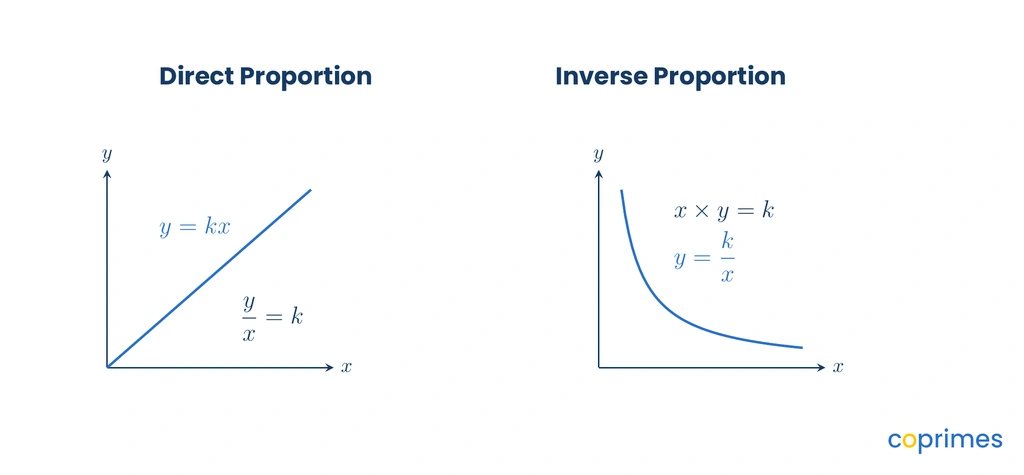
For more details on building and interpreting straight-line models, review directly proportional graphs.
Worked examples
Use the step-by-step method to solve these inversely proportional problems.
Example 1: Finding an unknown value in a table
Question: The variable is inversely proportional to . When , . What is the value of when ?
Method:
- Write the inverse proportion formula.
The general formula is .
- Substitute the known values to find .
Substitute and .
- Multiply to determine .
- Substitute the new value into the completed formula.
The specific formula is .
Substitute .
Answer: .
Check: Verify that the product remains constant: and . The products match perfectly.
Example 2: Solving a fixed-work word problem
Question: It takes machines exactly hours to harvest a field. Assuming all machines work at the same rate, how long will it take machines to harvest the same field?
Method:
- Identify the mathematical relationship.
As the number of machines () increases, the required time () decreases. This is an inversely proportional relationship: .
- Substitute the known values.
Substitute and .
- Find the constant of proportionality.
- Substitute the new value to find the requested time.
The specific formula is .
Substitute .
Answer: It will take hours.
Check: Multiply the machines by the hours for both scenarios. and .
Variables can also be inversely proportional to a power, such as or . The method remains exactly the same, but you must apply the power to the variable during your substitution.
Example 3: Inverse proportion with a squared variable
Question: The quantity is inversely proportional to . When , . What is the value of when ?
Method:
- Write the correct formula including the exponent.
- Substitute the known values.
- Solve for .
- Use the specific formula to find the new .
- Substitute .
Answer: .
Check: Verify is constant. and .
A learning plan shaped by your child, not the class
State-aligned Math plus our own Logic and English curriculum. An adaptive baseline test finds the gaps and fills them.
Common mistakes
Assuming any decreasing relationship is inversely proportional
A graph might show one variable decreasing as the other increases, but that does not necessarily mean it is inversely proportional. The relationship is only inverse if the product of the two variables remains exactly constant. A straight downward-sloping line is a linear relationship, not an inverse one.
Confusing the constant formulas
For direct proportion, the constant is found by dividing (). For inverse proportion, is found by multiplying (). Using the wrong operation will result in an incorrect constant.
Allowing the graph to cross an axis
The graph of an inversely proportional relationship cannot cross the -axis or the -axis. Because the equation involves division by , cannot be . If you are solving proportions graphically, never extend an inverse curve through the origin.
Frequently asked questions
What does inversely proportional mean?
Two quantities are inversely proportional when they multiply to a constant value. As one quantity increases by a certain factor, the other decreases by that exact same factor.
What is the formula for inversely proportional relationships?
The formula is , where and are the variables and is the constant multiplier. This can also be rearranged and written as .
How is an inverse proportion graph different from a direct proportion graph?
A direct proportion graph is a straight line that passes exactly through the origin . An inverse proportion graph is a curved line, called a hyperbola, that approaches but never touches either axis.
Practice questions
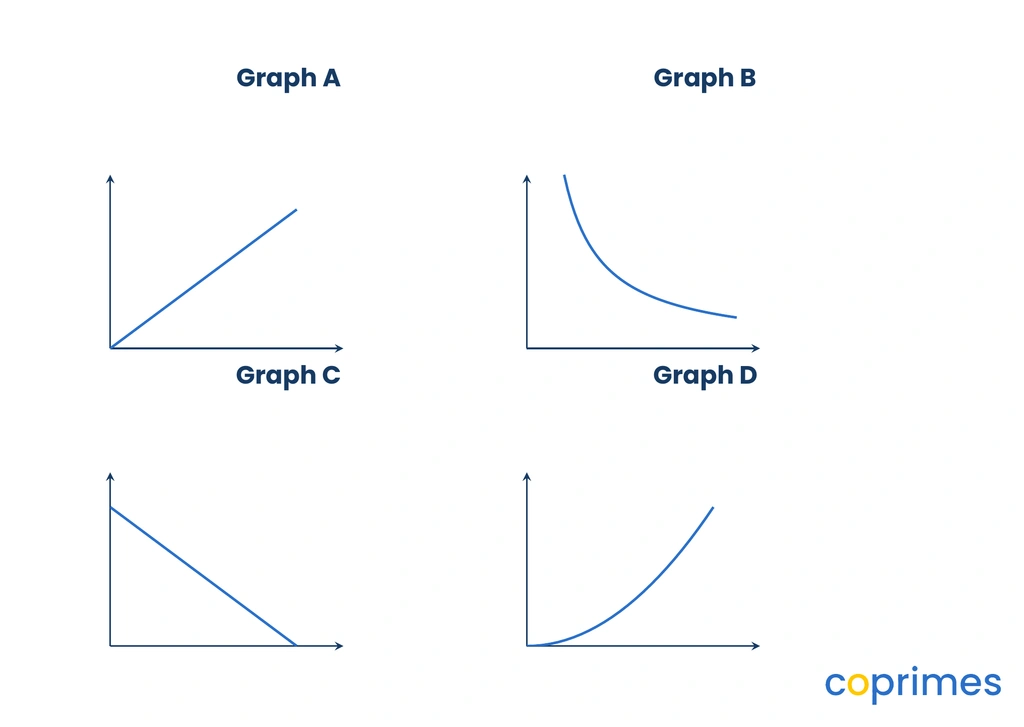
Which graph correctly represents an inversely proportional relationship?
Graph A
Graph B
Graph C
Graph D
Graph B
The variable is inversely proportional to . When , .
What is the value of when ?
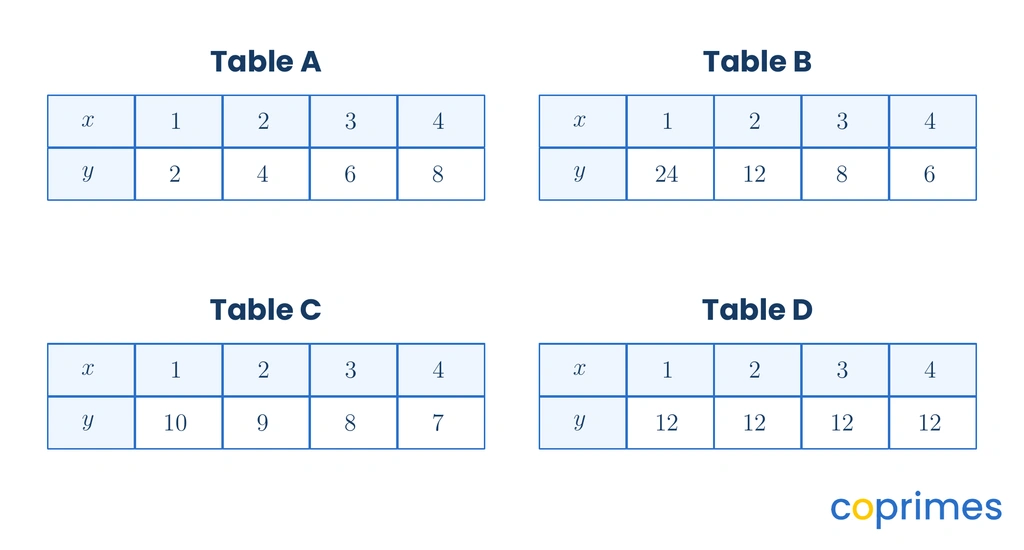
Which table correctly displays an inversely proportional relationship?
The table labeled A
The table labeled B
The table labeled C
The table labeled D
The table labeled B
Given that is inversely proportional to . When , .
What is the exact constant of proportionality ?
A catering team of chefs takes exactly hours to prepare a large banquet.
Assuming all chefs work at the exact same pace, how many hours would it take a team of chefs to prepare the same banquet?