
Dividing Fractions with Whole Numbers
When dividing fractions with whole numbers, write the whole number as a fraction with a denominator of and multiply by the reciprocal of the divisor. Interpreting the situation decides whether the answer describes a smaller share or a count of groups.
Fraction divided by a whole number
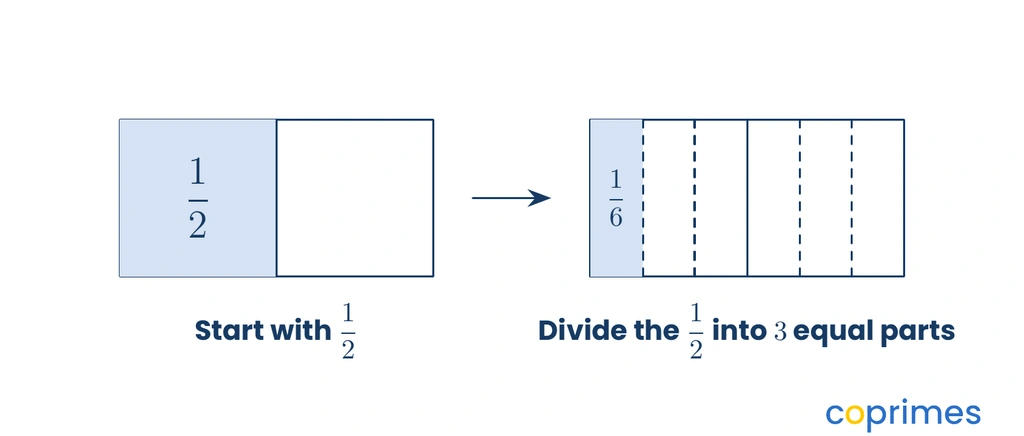
A fraction divided by a whole number means splitting a fractional amount into smaller equal parts. This process always results in a smaller fraction than the original dividend.
For example, dividing by means taking one half and splitting it into three equal pieces. The result is . The same concept applies when dividing unit fractions, where a fraction with a numerator of is divided into smaller pieces.
Whole number divided by a fraction
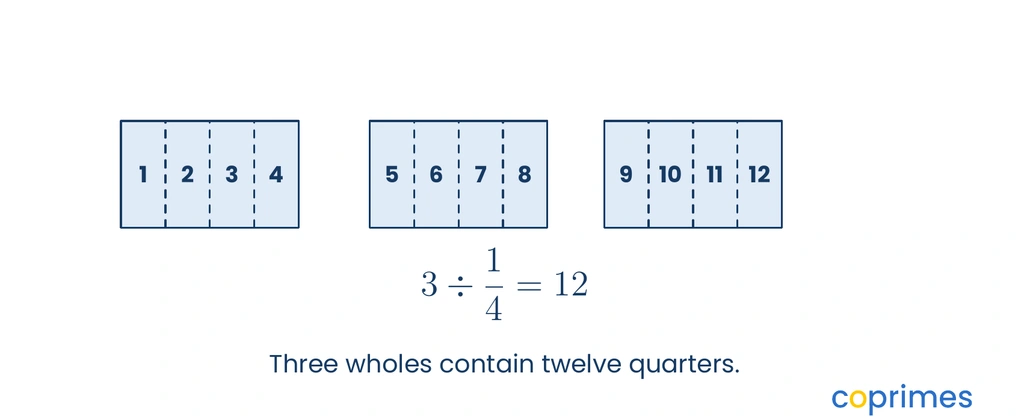
A whole number divided by a fraction asks how many times the fractional part can fit into the given whole number. This typically results in a quotient that is larger than the original whole number.
For example, to evaluate , you must determine how many quarters fit into wholes. Because there are four quarters in one whole, there are twelve quarters in three wholes. Therefore, .
Write whole numbers as fractions
To perform fraction division whole number problems accurately, both terms should be written in fraction form. Every whole number can be converted into a fraction without changing its actual mathematical value.
Write the whole number over a denominator of . For instance, the number is written as , and is written as . This step ensures that numerators and denominators align correctly for multiplication later in the process.
Always rewrite a whole number as a fraction with a denominator of 1 before dividing.
A learning plan shaped by your child, not the class
State-aligned Math plus our own Logic and English curriculum. An adaptive baseline test finds the gaps and fills them.
Use reciprocal multiplication
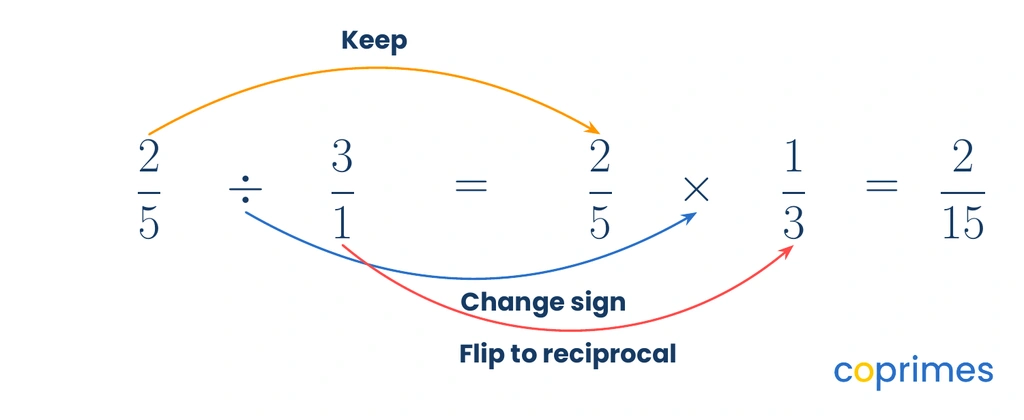
The standard method to divide fractions by whole numbers is to change the division into multiplication. This involves using the reciprocal of a fraction, which means flipping its numerator and its denominator.
Method for division:
- Write any whole number as a fraction with a denominator of .
- Keep the first fraction (the dividend) exactly the same.
- Change the division sign to a multiplication sign.
- Flip the second fraction (the divisor) to its reciprocal.
- Multiply the numerators together and the denominators together.
- Check if simplifying fractions is necessary to reduce the final answer.
Only the divisor (the number after the division sign) is flipped to its reciprocal.
Use visual sharing and measurement models
Understanding division visually helps make sense of the operations rather than relying entirely on algorithms.
The sharing model is used when a fraction is divided by a whole number. It represents sharing a fractional amount among a specific number of groups. For example, means taking three quarters and splitting them equally into two groups.
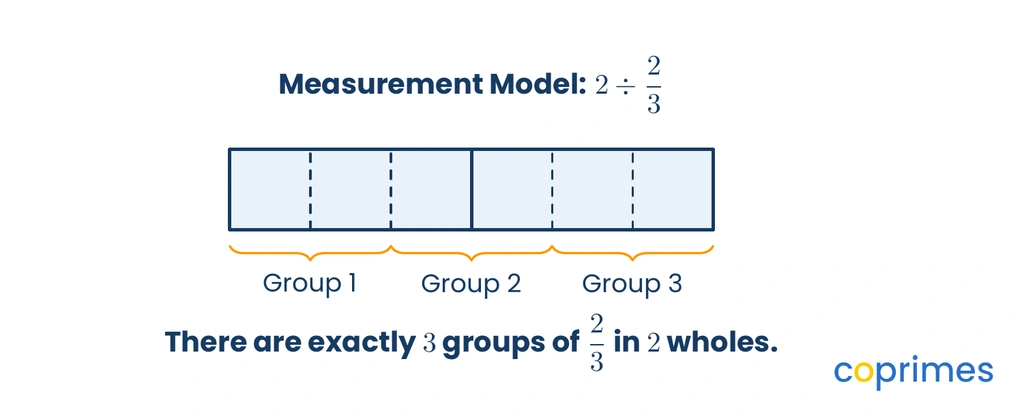
The measurement model is used when dividing a whole number by a fraction. It measures how many times a fractional size fits into the total. For example, asks how many groups of two thirds can be measured out of two wholes.
Worked examples
These examples show how to divide whole numbers by fractions and solve fraction word problems.
Example 1: Fraction divided by a whole number
Question: Evaluate .
Method:
- Rewrite the whole number as a fraction: .
- Change division to multiplication and flip the divisor: .
- Multiply the numerators: .
- Multiply the denominators: .
Answer: .
Check: Multiply the quotient by the divisor: .
Example 2: Whole number divided by a fraction
Question: Evaluate .
Method:
- Rewrite the whole number as a fraction: .
- Change the operation to multiplication and use the reciprocal of the divisor: .
- Multiply the numerators and denominators: .
- Simplify the fraction: .
Answer: .
Check: Multiply the quotient by the divisor: .
Example 3: Division in context
Question: A baker has kilograms of flour. Each batch of cookies requires of a kilogram. How many batches can be made?
Method:
- Set up the division expression: .
- Write the whole number as a fraction: .
- Multiply by the reciprocal of the divisor: .
- Calculate the product: .
Answer: The baker can make batches of cookies.
Check: batches multiplied by kilograms per batch equals kilograms total.

Common mistakes
When dividing fractions with whole numbers, learners often make calculation errors by confusing which rules belong to which operation.
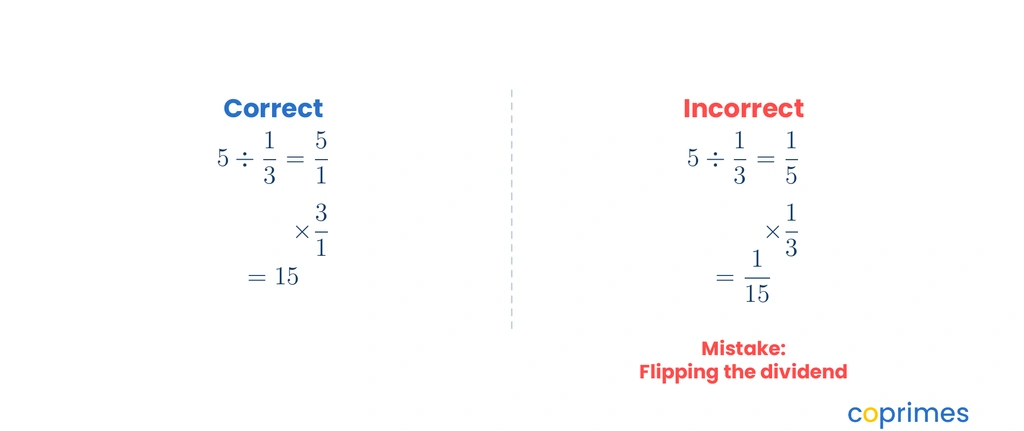
- Flipping the wrong fraction: Always take the reciprocal of the divisor (the second number). Flipping the dividend (the first number) will produce an incorrect answer.
- Forgetting to change the sign: After finding the reciprocal, the division sign must be changed to multiplication.
- Multiplying the whole number by both parts: A whole number only multiplies with the numerator when written as a fraction over . Multiplying it by both the numerator and denominator is a mistake.
Frequently asked questions
Does division always make a number smaller?
No. When a whole number is divided by a proper fraction, the quotient is larger than the original whole number. For example, .
What is unit fraction division?
This occurs when dividing a fraction that has a numerator of , such as or , by a whole number, or vice versa. The steps of writing the whole number over and using reciprocal multiplication remain exactly the same.
Why do we multiply by the reciprocal?
Dividing by a number is mathematically the same as multiplying by its reciprocal. Finding how many halves are in a whole number is the same as multiplying that whole number by .
Practice questions
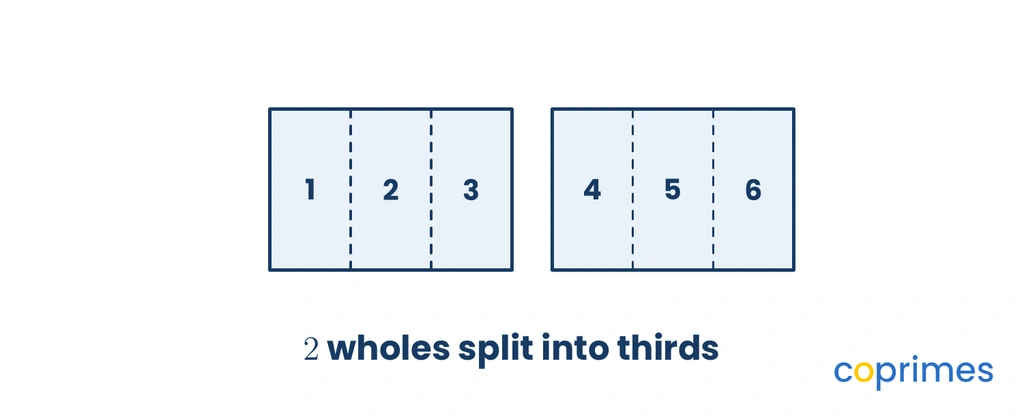
Which division equation does this visual model represent?
Evaluate the following division expression: .
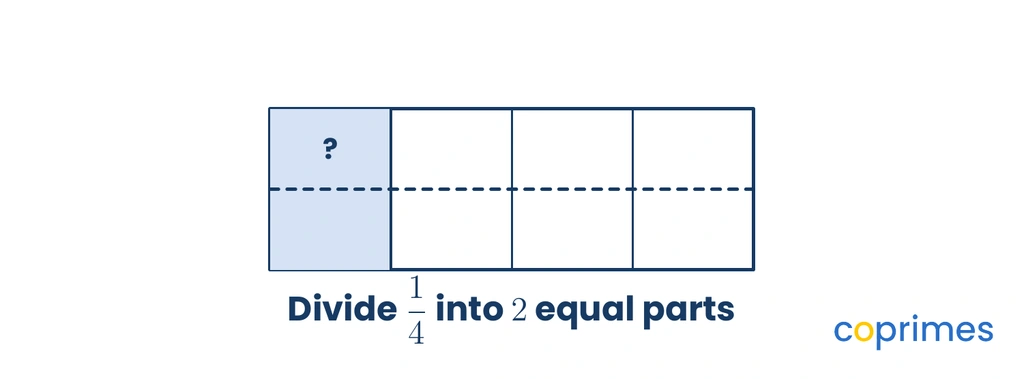
Evaluate the division expression shown by the area model.
A student evaluates and mistakenly arrives at an answer of . What calculation error did they make?
They flipped both the dividend and the divisor to their reciprocals.
They multiplied the numerators together and added the denominators.
They found the reciprocal of the dividend instead of the divisor.
They forgot to change the division sign to a multiplication sign.
They found the reciprocal of the dividend instead of the divisor.
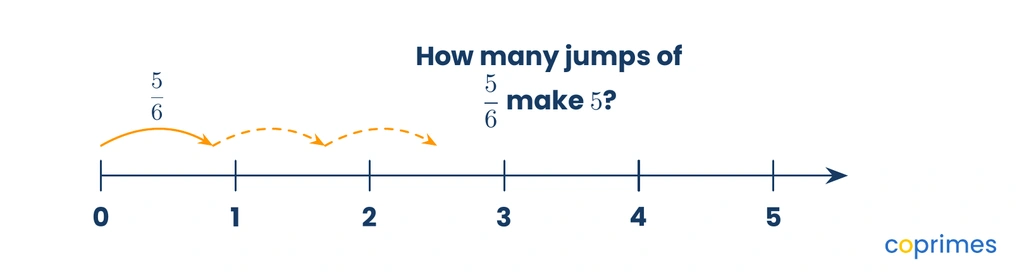
A -meter ribbon is cut into pieces that are each of a meter long. How many pieces of ribbon are there?