
Unit Fractions: Definition, Method and Examples
A unit fraction is a fraction that represents exactly one equal part of a whole. It always has a numerator of and a positive whole number as the denominator, such as or . Learning about unit fractions is the first step in understanding all fractions.
What is a unit fraction?
A unit fraction (sometimes called a one-part fraction or a one over n fraction) is the building block of all other fractions. The word unit means one.
A unit fraction has a numerator of 1 and a positive integer denominator.
The denominator tells us how many equal parts the whole is divided into. The numerator tells us we have exactly one of those equal parts. For example, in the fraction , the whole is divided into equal pieces, and the unit fraction represents just of those pieces.
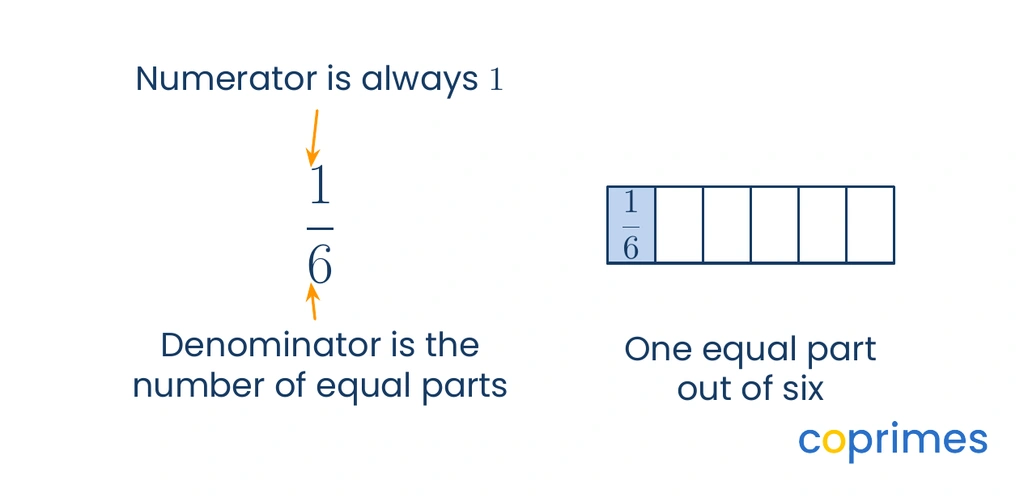
Every standard fraction is built by adding unit fractions together. For instance, is made by adding three separate fractions together.
Identify unit and non-unit fractions
To determine if a fraction is a unit fraction, check its numerator.
- Unit fractions: The numerator is exactly . Examples include , , and . They are always proper fractions because the numerator is smaller than the denominator.
- Non-unit fractions: The numerator is any whole number other than . Examples include , , and .
Fraction | Numerator | Type | Reason |
Unit fraction | The numerator is exactly . | ||
Non-unit fraction | The numerator is greater than . | ||
Non-unit fraction | Represents a whole; numerator is not . |
Unit fractions in visual models
We can use visual fraction models to see how one whole can be divided into different equal parts. A fraction strip is a rectangular bar that represents one whole.
When we divide the strip into more equal pieces, the denominator increases. Because the same whole is shared among more pieces, each individual piece becomes smaller.
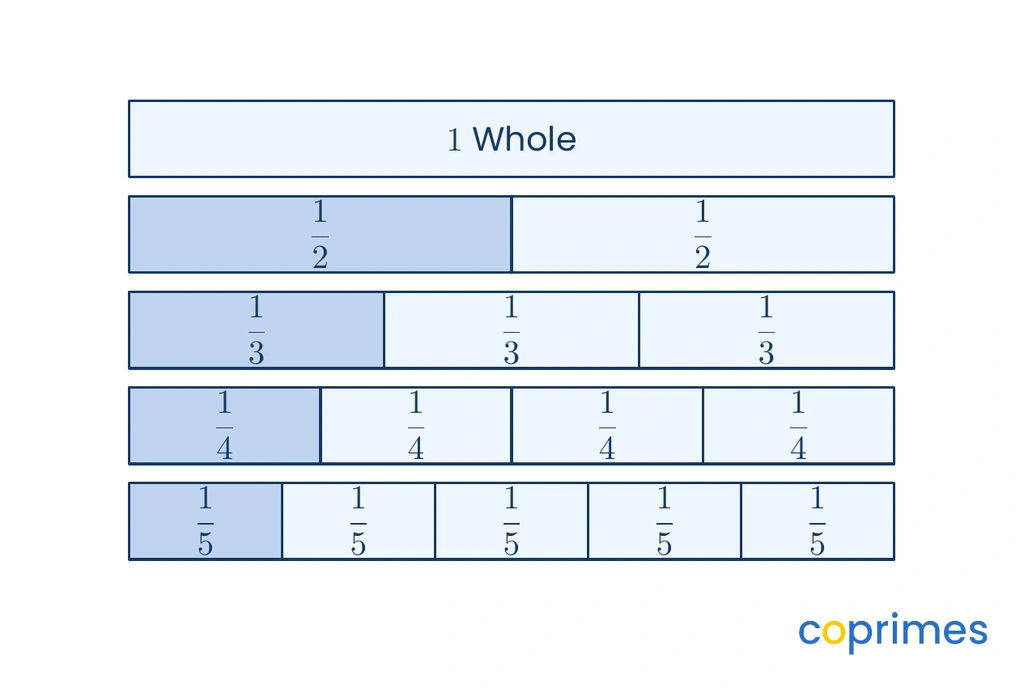
Looking at the models, notice that one part out of two () takes up much more space than one part out of five ().

Unit fractions on a number line
We can also position unit fractions between and on a number line. Placing fractions on a number line helps us visualize their value as numbers rather than just shapes.
Because every unit fraction is greater than zero but less than one whole, they all live on the segment between and . The larger the denominator, the closer the unit fraction is to .
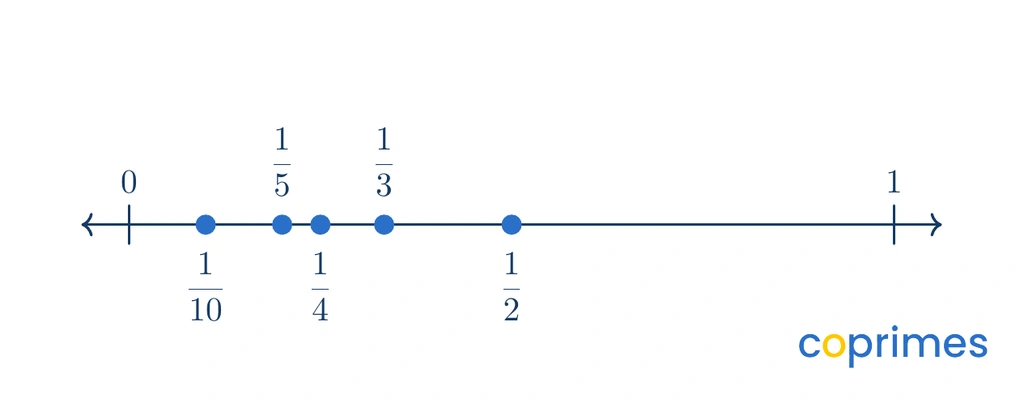
This number line confirms what the fraction strips showed: is much smaller than .
Compare unit fractions
When comparing two unit fractions, the relationship between their sizes can feel reversed compared to whole numbers.
The greater the denominator, the smaller the unit fraction.
Imagine sharing a pizza. If you share it between people, you get a larger slice than if you share it between people. Therefore, one third is greater than one eighth ().
When putting unit fractions in order from smallest to largest, you list them in descending order of their denominators: , , , .
Fractions of quantities
We can also find a unit fraction of a whole number, such as the number of objects in a group or a measurement. This requires dividing the total quantity by the denominator.
To find of items, we split the items into equal groups. The number of items in one single group is our answer.

Since , we know that of equals . Learning how to calculate fractions of a whole and a set will let you solve these problems for any type of fraction.
A learning plan shaped by your child, not the class
State-aligned Math plus our own Logic and English curriculum. An adaptive baseline test finds the gaps and fills them.
Worked examples
Example 1: Identifying a unit fraction
Question: Which of the following fractions is a unit fraction: , , or ?
Method:
- Recall that a unit fraction must have exactly as the numerator.
- Examine the numerators of the given fractions.
- has a numerator of .
- has a numerator of .
- has a numerator of .
Answer: The unit fraction is .
Check: The denominator is , which is a positive whole number, and the numerator is exactly .
Example 2: Comparing sizes of unit fractions
Question: Order the fractions , , , and from smallest to largest.
Method:
- Recognize that all four numbers are unit fractions.
- Remember the rule: the larger the denominator, the smaller the fraction's value.
- Compare the denominators: .
- Order the fractions inversely to their denominators. The largest denominator () belongs to the smallest fraction ().
Answer: The fractions in order from smallest to largest are , , , .
Check: Visualize the sizes on a number line. is closest to , and is exactly in the middle.
Example 3: Working backward from a unit fraction
Question: If of a ribbon is centimeters long, what is the total length of the ribbon?
Method:
- Identify the unit fraction and its corresponding value: of the length is centimeters.
- Understand that the denominator means the whole ribbon is made up of equal parts.
- If one part is centimeters, multiply the value of one part by the total number of parts to find the whole.
- Calculate .
Answer: The total length of the ribbon is centimeters.
Check: Verify by finding of the answer. , which matches the original problem.
Frequently asked questions
Is 1 over 1 a unit fraction?
Yes, is technically a unit fraction because its numerator is and its denominator is a positive whole number. It represents one whole. However, it is most commonly written simply as the whole number .
Can a unit fraction have a negative denominator?
No. By definition, a standard unit fraction represents dividing a whole into a positive number of equal parts. The denominator must be a positive integer.
How do you add unit fractions?
If the denominators are the same, you add the numerators while keeping the denominator exactly the same. For example, . If the denominators are different, you must find a common denominator before adding.
Are all unit fractions proper fractions?
Every unit fraction with a denominator greater than is a proper fraction because the numerator () is less than the denominator. The only exception is , which is an improper fraction because the numerator is equal to the denominator.
Practice questions
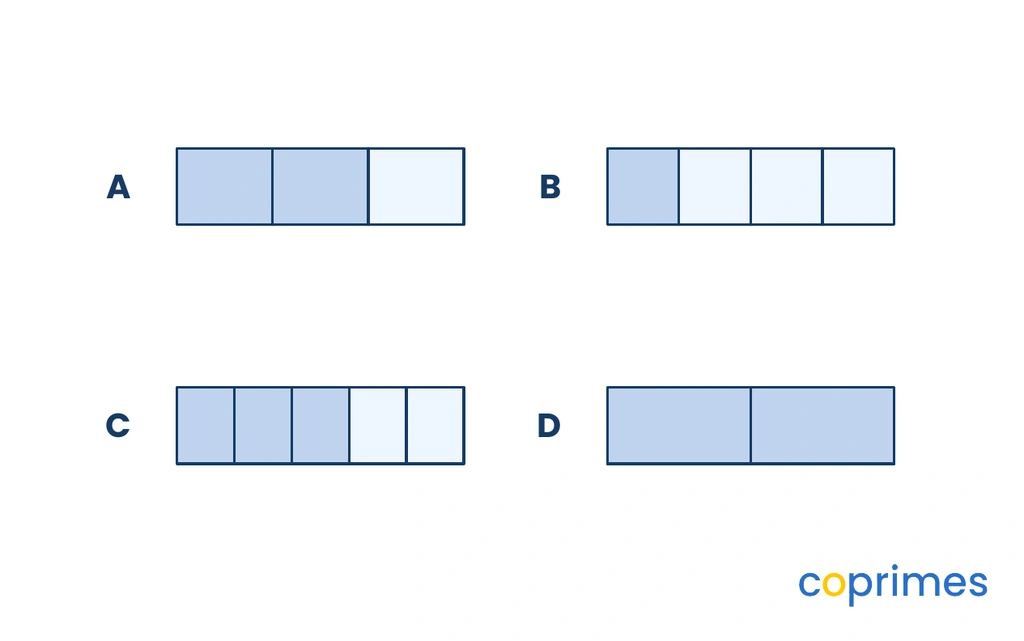
Which visual model represents a unit fraction?
Model A
Model B
Model C
Model D
Model B
Which of the following is not a unit fraction?
Which list shows the unit fractions ordered from largest to smallest?
, , ,
, , ,
, , ,
, , ,
, , ,
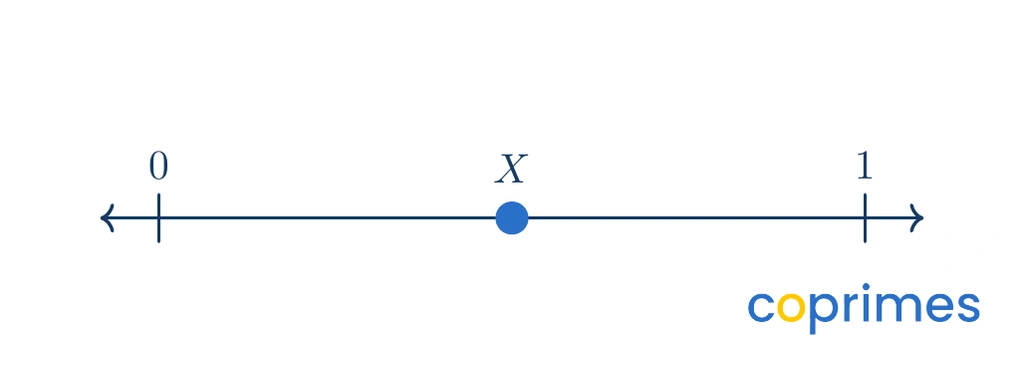
What unit fraction does point represent on the number line?
If of a garden requires bags of soil, how many bags of soil are needed for the whole garden?
bags
bags
bags
bags
bags