
Proper Fractions: Definition, Method and Examples
A proper fraction is a fraction where the numerator is smaller than the denominator. Because the top number is less than the bottom number, a proper fraction always represents a value strictly between and when the numbers are positive. It shows a part of a whole rather than a complete whole.
What is a proper fraction?
To understand proper fractions, you must look at the two numbers that make up fractions. The numerator is the top number, and it tells you how many parts you have. The denominator is the bottom number, and it tells you how many equal parts make up one complete whole.
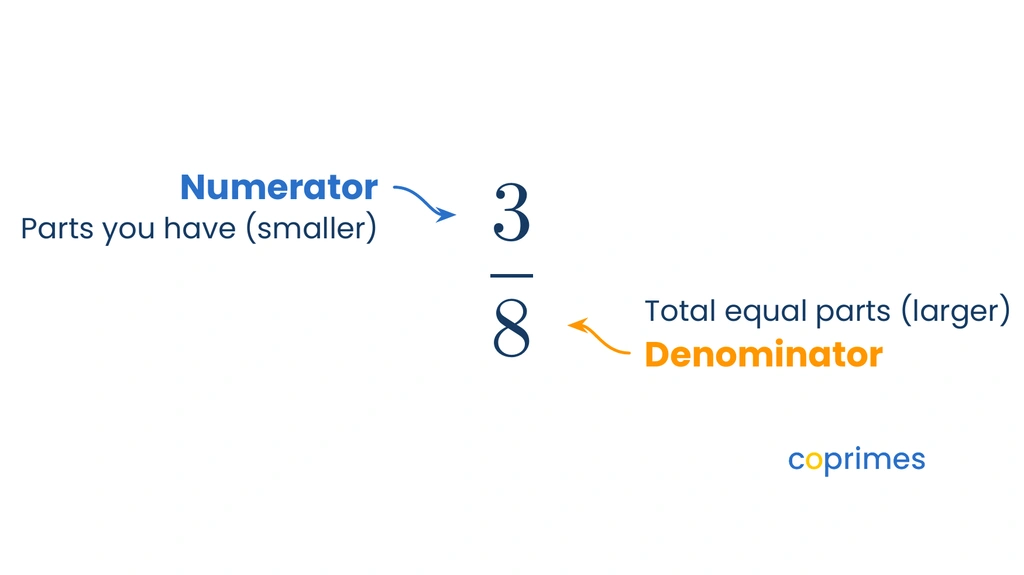
A proper fraction has a numerator that is strictly less than its denominator.
For example, , , and are all proper fractions because their top numbers are smaller than their bottom numbers.
How to identify a proper fraction
You can determine if a fraction is proper by looking closely at the two numbers. You do not need to convert the fraction to a decimal or draw a picture if you know the rule.
Use these steps to check any fraction:
- Find the numerator (the number on top).
- Find the denominator (the number on the bottom).
- Compare their values. If the numerator is smaller than the denominator, it is a proper fraction.
If the top number is equal to or larger than the bottom number, it is not a proper fraction.
Proper fractions in models
Visual models are a great way to show that a proper fraction represents a value less than one complete whole. When you draw a shape and divide it into equal parts, you shade the parts you have.
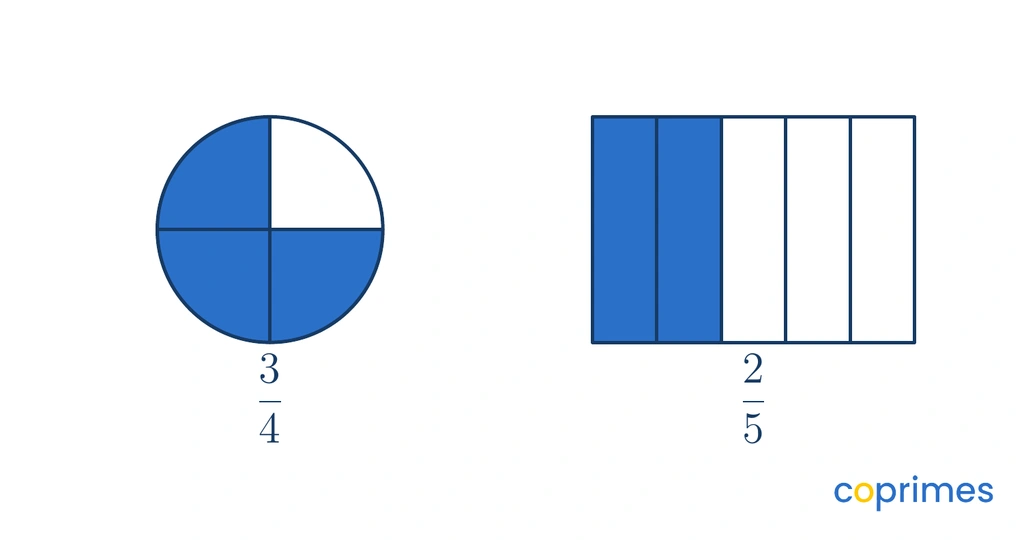
In a proper fraction model, there will always be at least one unshaded section remaining. If the entire shape is shaded, the fraction equals and is no longer proper.

Proper fractions on a number line
You can also plot fractions on a number line to see how large they are. Because a positive proper fraction is always less than , it will always be located between and on a number line.
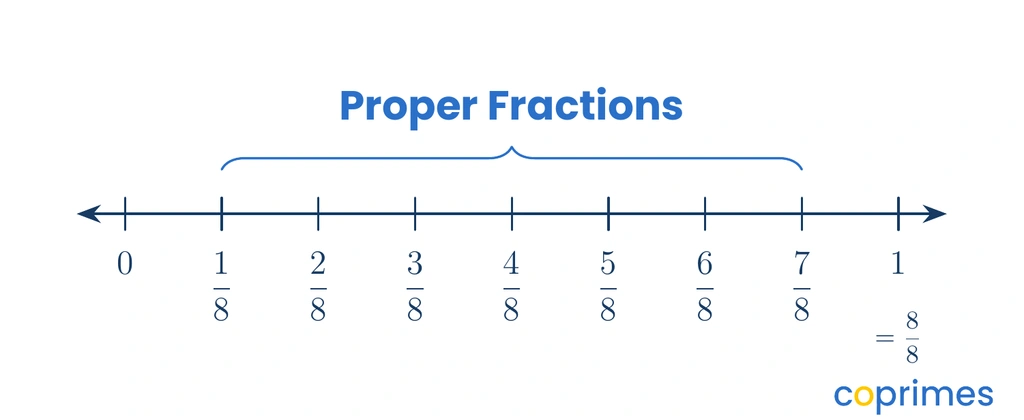
The fractions , , , , , , and are all proper. However, is equal to , so it is no longer proper.
Proper versus improper fractions
Some fractions equal or are greater than . These are called improper fractions. An improper fraction has a numerator that is equal to or greater than its denominator. Improper fractions can also be rewritten as mixed numbers, which include a whole number and a proper fraction together.
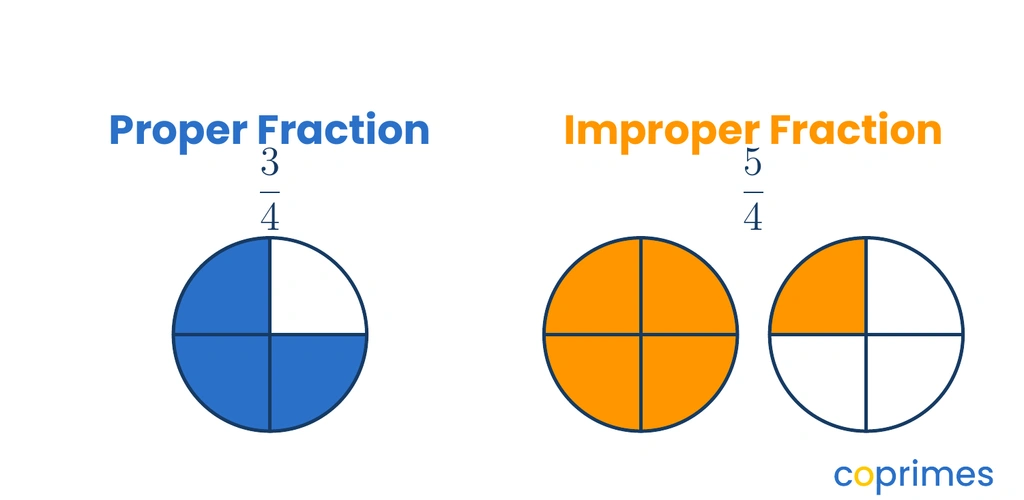
Here is a quick summary of the differences:
Type of Fraction | Numerator and Denominator | Value | Example |
Proper | Numerator is smaller | Less than | |
Improper | Numerator is larger or equal | or more | |
Mixed Number | Whole number plus proper fraction | More than |
Worked examples
Use these examples to practice finding and checking proper fractions.
Example 1: Identifying proper fractions
Question: Which of the following numbers is a proper fraction: , , or ?
Method:
- Check each number against the rule: the numerator must be smaller than the denominator.
- Look at . The numerator is larger than the denominator . It is an improper fraction.
- Look at . This is a mixed number because it has a whole number part.
- Look at . The numerator is smaller than the denominator .
Answer: is the proper fraction.
Check: A proper fraction must have a value less than . If you divide a shape into parts and take , you have less than a whole shape.
Example 2: Determining fractions from a model
Question: A rectangle is divided into equal parts. Exactly of those parts are shaded. Write the fraction for the shaded amount and determine if it is proper.
Method:
- Identify the total number of equal parts. This is the denominator. The denominator is .
- Identify the number of shaded parts. This is the numerator. The numerator is .
- Write the fraction: .
- Compare the numerator and denominator. Since is less than , the fraction is proper.
Answer: The fraction is , and it is a proper fraction.
Check: Since not all parts are shaded, the shaded amount is less than a whole. Therefore, it is proper.
Example 3: Finding the largest proper fraction
Question: A pie is cut into equal slices. What is the largest proper fraction of the pie you can take?
Method:
- The denominator is because there are slices in the whole pie.
- To make a proper fraction, the numerator must be smaller than .
- The whole numbers smaller than are , and .
- The largest possible numerator is .
Answer: The largest proper fraction you can take is .
Check: If you take , you take the whole pie, which is equal to (an improper fraction). So, is the maximum proper fraction.
A learning plan shaped by your child, not the class
State-aligned Math plus our own Logic and English curriculum. An adaptive baseline test finds the gaps and fills them.
Common mistakes
A very common mistake is assuming that a fraction like is proper because there is no whole number written in front of it. However, if the numerator is equal to the denominator, the fraction represents exactly . Therefore, it is an improper fraction.
Another mistake is confusing the terms. Some learners incorrectly believe that a proper fraction just means any fraction that is written nicely. Remember, "proper" in mathematics has a strict definition: the numerator must be strictly smaller than the denominator.
Frequently asked questions
Is zero a proper fraction?
Yes. For example, is a proper fraction because the numerator is smaller than the denominator . It evaluates to , which is less than .
Can a proper fraction be negative?
Yes. A fraction like is a proper fraction. The absolute value of its numerator () is less than the absolute value of its denominator ().
Do proper fractions always have to be simplified?
No. A fraction like is still a proper fraction even though it can be simplified to . Both forms are proper because the top number is smaller than the bottom number in both cases.
Practice questions
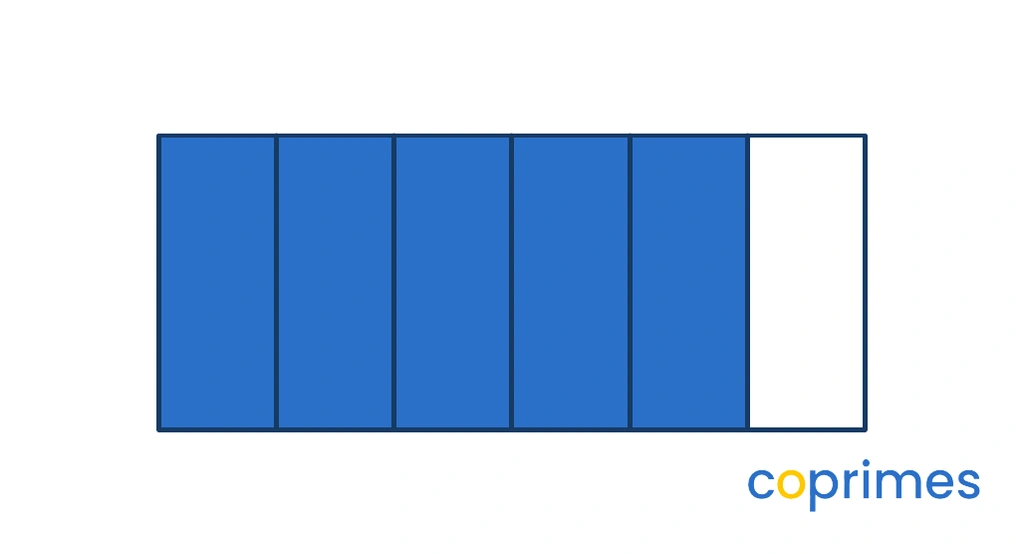
Which proper fraction does this model show?
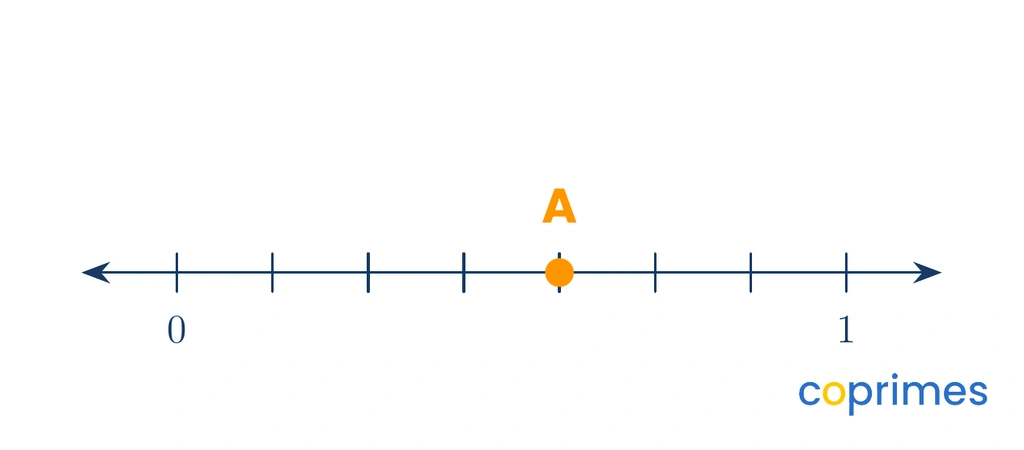
What proper fraction is marked by point A on the number line?
Which of these fractions is a proper fraction?
Why is not considered a proper fraction?
The numerator is strictly greater than the denominator.
The numerator is equal to the denominator.
It represents a value less than one.
The denominator is an even number.
The numerator is equal to the denominator.
A piece of ribbon is divided into equal sections. What is the largest proper fraction of the ribbon you can select?