
Significant Figures: Definition and Rounding Rules
Significant figures are the digits that communicate a number's precision, counted from the first nonzero digit. Also known as significant digits or sig figs (s.f.), they help us understand how exact a measurement or calculation is by ignoring placeholder zeros that only show magnitude.
What Is Significant Figures?
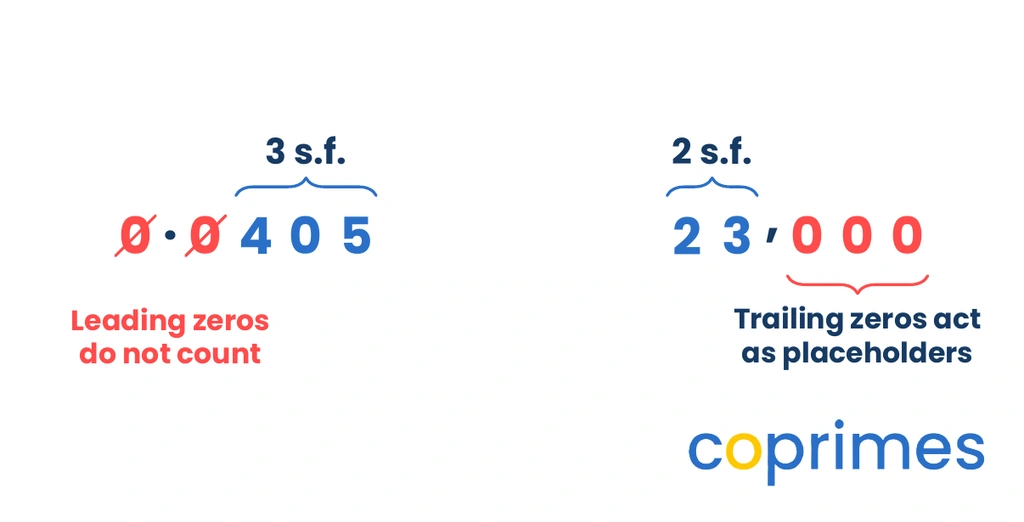
Every digit in a number has a place value, but not every digit is significant for measuring precision. A significant figure represents a meaningful contribution to the number's accuracy.
To identify which figures are significant, we follow these rules:
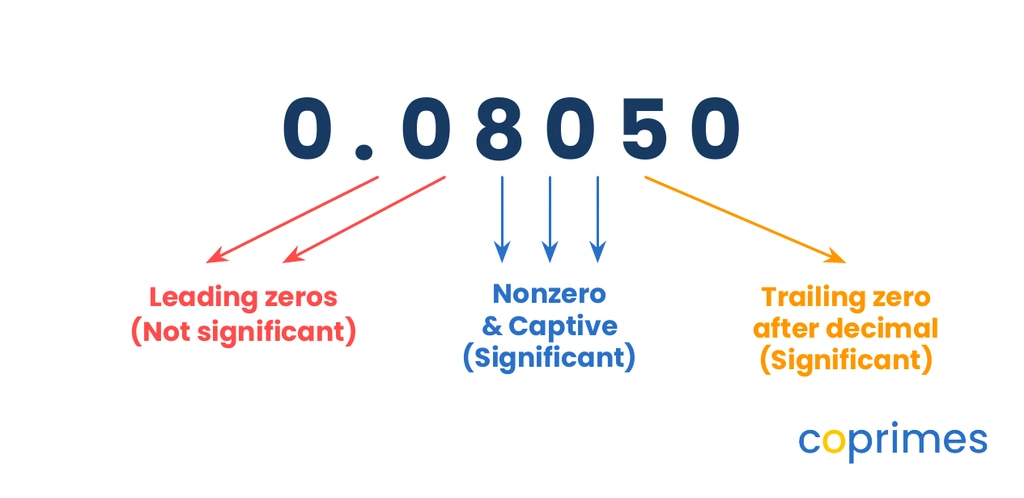
- Nonzero digits: All digits from to are always significant.
- Captive zeros: Any zero between nonzero digits is always significant (for example, the zero in ).
- Leading zeros: Zeros at the very beginning of a decimal are never significant. They only locate the decimal point (for example, the zeros in ).
- Trailing zeros: Zeros at the end of a number are significant if there is a written decimal point (like in ). In a whole number without a decimal point (like ), they are usually just placeholders.
The first significant figure is always the first nonzero digit you read from left to right.
When to Use It
We use significant figures when exact values are unnecessary or impossible to measure. If a football stadium holds fans, reporting the crowd as (rounded to two significant figures) is much easier to read while still keeping the scale accurate.
This is a vital tool for estimation in math and science. We often round numbers to one or two significant figures before calculating to get a rough idea of the answer.
Furthermore, writing extremely large or small measurements in scientific notation relies entirely on counting significant figures accurately.
Step-by-Step Method
Whether you are rounding whole numbers or rounding decimals, the process for rounding to a specific number of significant figures is the same.
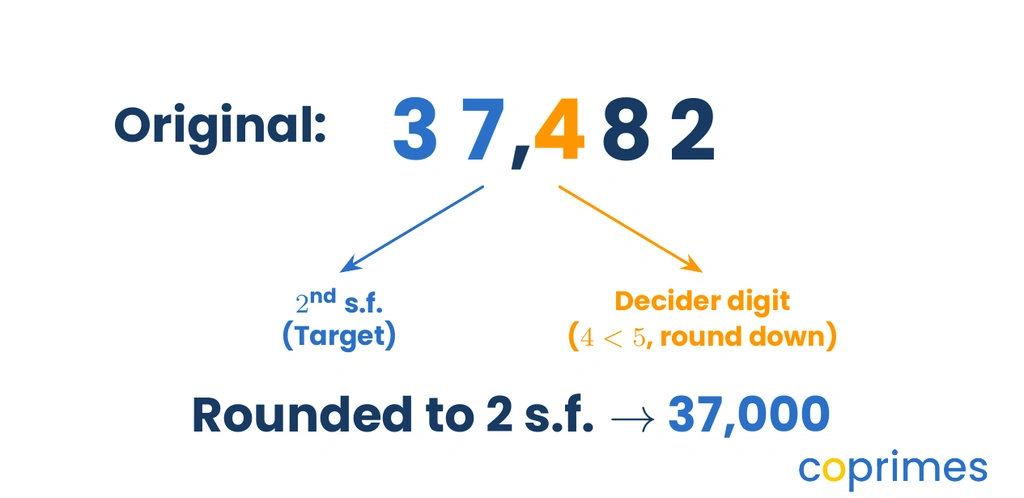
- Find the first significant figure (the first nonzero digit from the left).
- Count to the right until you reach the requested number of significant figures. This is your target digit.
- Look at the very next digit to the right, called the decider digit.
- If the decider digit is or more, round the target digit up by . If it is or less, leave the target digit the same.
- Replace all remaining digits before the decimal point with zeros to hold the place value. Remove any remaining digits after the decimal point.

Visual Worked Examples
Let us apply this method to different types of numbers, paying close attention to where the significant figures begin.
Example 1: Rounding a whole number with trailing zeros
Question: Round to significant figures.
Method:
- Identify the significant figure: .
- Count to the significant figure: . This is the target digit.
- Look at the decider digit immediately to its right: .
- Because is or more, round the target digit up to .
- Replace all the remaining digits before the decimal point with zeros to keep the magnitude.
Answer: .
Check: The number is roughly half a million. correctly maintains this size while showing exactly two nonzero significant figures.
Example 2: Rounding a decimal with leading and captive zeros
Question: Round to significant figures.
Method:
- Ignore the leading zeros. The significant figure is .
- Count to the significant figure: . (Captive zeros count.)
- Look at the decider digit: .
- Because is less than , keep the target digit exactly as it is ().
- Remove the remaining digits after the decider. Keep the leading zeros so the value remains the same size.
Answer: .
Check: The zero at the end is a trailing zero after a decimal, meaning it is counted as a significant figure. Therefore, has exactly two significant figures.
Example 3: Contrasting with decimal places
Question: Round to significant figures.
Method:
- The significant figure is . The significant figure is the second .
- The decider digit is .
- Because is or more, round the up to . This forces the next to round up to , which carries over and changes the to a .
- Keep the trailing zero because we need exactly significant figures.
Answer: .
Check: The number has exactly three significant figures. If the question had asked for decimal places, the answer would have been (which has four significant figures).
How to Check the Answer
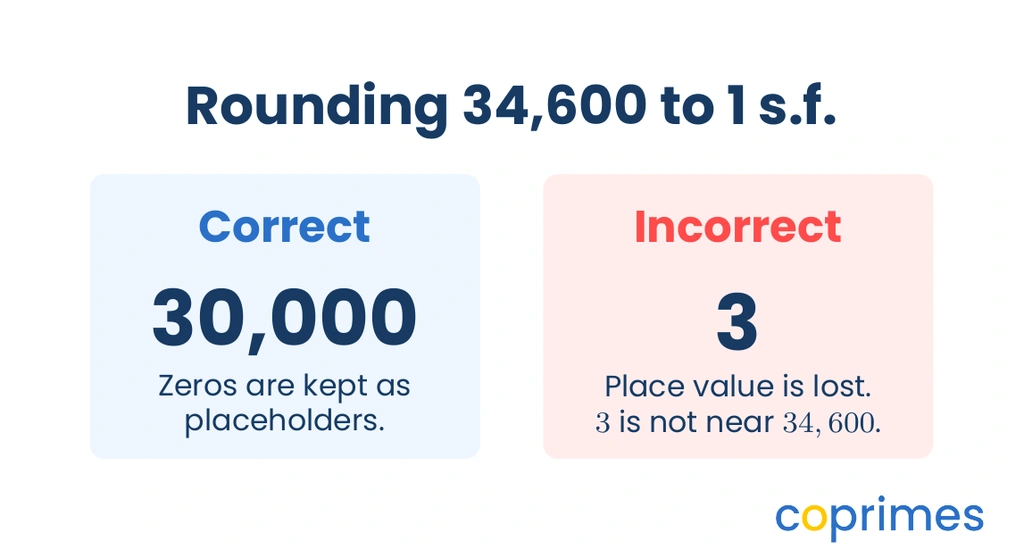
You can verify your rounding by checking if the rounded answer is roughly greater than, less than, or equal to the original size. If you round to significant figures and get , you have lost the place value. The correct answer must be so the size stays the same.
Additionally, recount the significant figures in your final answer. Leading zeros do not count, but trailing zeros after a decimal point do. If you need significant figures for , those zeros must be visible.
Common Mistakes
A frequent mistake is confusing significant figures with decimal places. Decimal places are counted starting immediately after the decimal point, no matter what the digit is.
Significant figures are counted starting from the very first nonzero digit, anywhere in the number.
Another common error is deleting necessary placeholder zeros in large numbers.
A learning plan shaped by your child, not the class
State-aligned Math plus our own Logic and English curriculum. An adaptive baseline test finds the gaps and fills them.
Practice questions
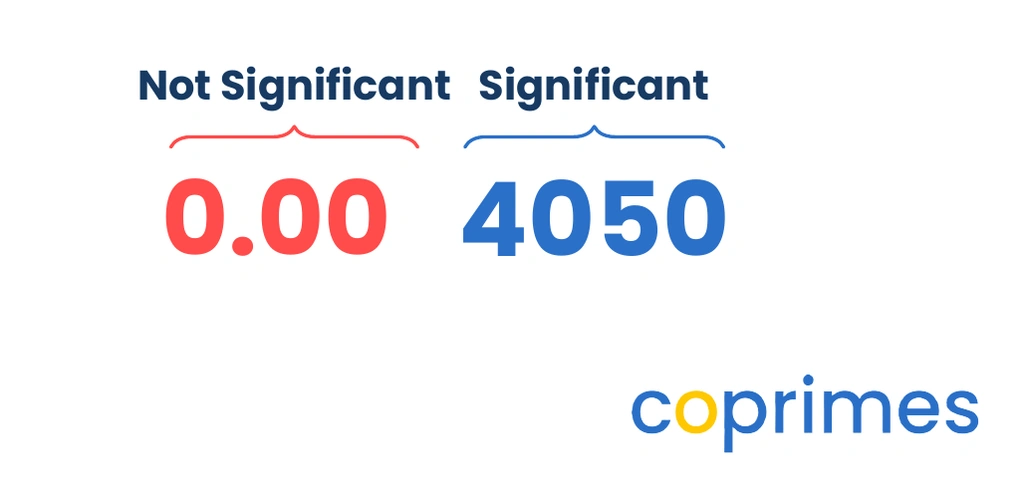
Look at the number . How many significant figures does this number have?
Round to significant figures.
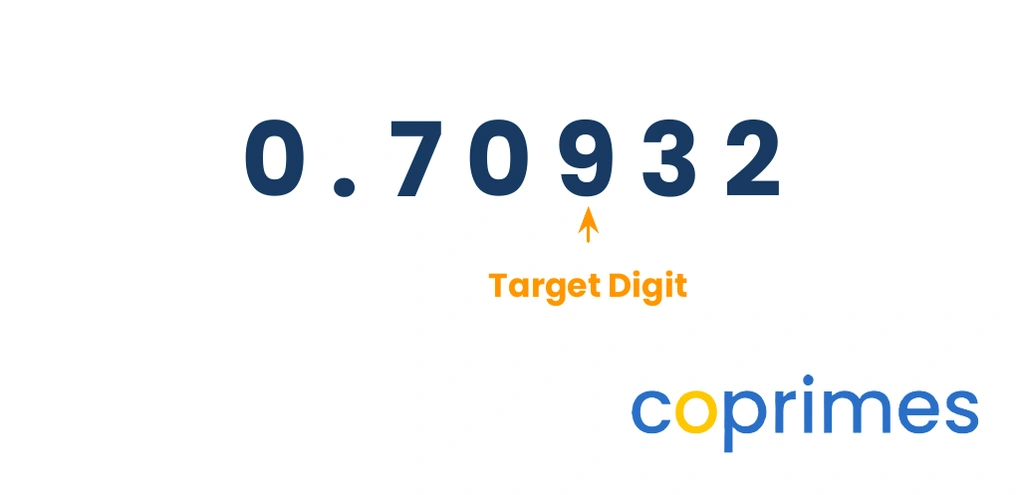
Look at the visual. The target digit is . If a student is rounding to this target digit, how many significant figures are they rounding to?
significant figure
significant figures
significant figures
significant figures
significant figures
What is the difference between rounding to significant figures and rounding it to decimal places?
Both give the exact same answer: .
Rounding to significant figures gives , while rounding to decimal places gives .
Rounding to significant figures gives , while rounding to decimal places gives .
Rounding to significant figures gives , while rounding to decimal places gives .
Rounding to significant figures gives , while rounding to decimal places gives .
An engineer needs to cut a wire that is exactly long, but her machine can only measure to significant figures. What length will the machine measure?