
Finding the Percent of a Number
To find a percent of a number, convert the percent to a fraction or decimal multiplier and multiply by the whole amount; benchmark methods such as 10 percent and 1 percent can also make mental calculation efficient.
Finding a percent of a number is a fundamental mathematical skill used to calculate discounts, taxes, and proportional parts. By understanding the core relationship between parts and wholes, you can confidently determine the value of any percentage.
What is a percent of a number?
A percent of a number is a specific proportional part of a total amount. The word percent translates directly to "per one hundred."
Therefore, calculating a percent means dividing the whole into one hundred equal pieces and finding the value of a specific number of those pieces.
Understanding basic percentages is essential before calculating the value of specific parts, as every percentage is simply a ratio where the denominator is always .
When a percentage is less than , it represents a proper fraction of the whole. Multiplying a whole amount by a proper fraction always produces a result smaller than the original number. When a percentage is exactly , the result equals the whole. When a percentage is greater than , the result will be larger than the original whole.
Identify the whole and the percent
Every percentage calculation involves two critical components: the whole and the percent. The whole is the total base amount you are starting with, which represents . The percent is the rate or part out of that you need to find.
Consider the problem: Find of .
- The whole: The number is the total starting amount. This is .
- The percent: The rate tells you how much of the whole to find.
By clearly identifying these two parts, you can correctly set up a visual model or a multiplication equation.
Use a hundred grid or ratio table
Visual models like hundred grids, double number lines, and ratio tables help organize the relationship between the percentage and the whole amount.
A ratio table allows you to break down the whole into smaller, manageable percentages using division and multiplication. For example, to find of :
Percent | Value | Operation |
Start with the whole | ||
Divide by | ||
Multiply by |
A percent bar (or double number line) provides a geometric representation of the same relationship, aligning the percentage scale directly with the value scale.
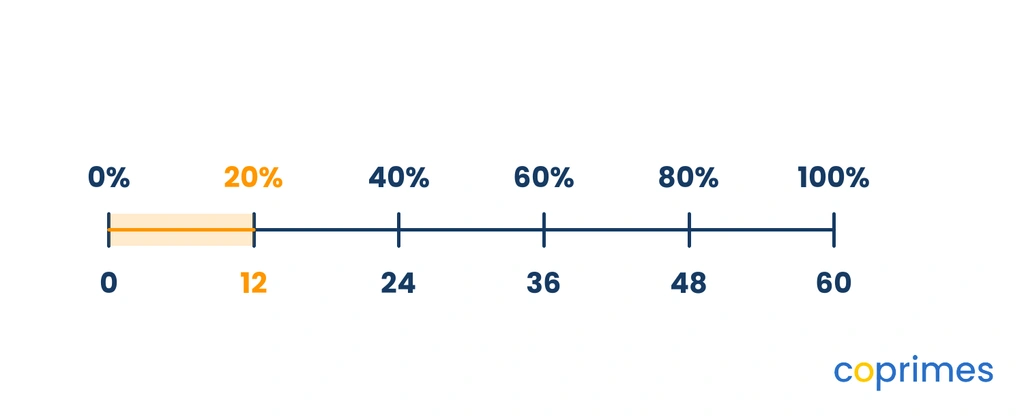
These methods are exceptionally useful for visualizing relationships, especially when the whole is easily divisible.
A learning plan shaped by your child, not the class
State-aligned Math plus our own Logic and English curriculum. An adaptive baseline test finds the gaps and fills them.
Use fraction and decimal multipliers
The most universal method to find a percent of a number is to use a multiplier. Because the word "of" in mathematics usually indicates multiplication, you can convert the percentage into either a fraction or a decimal and multiply it by the whole.
Always rewrite the percentage in its fraction or decimal form before multiplying.
To convert the percent to a fraction, write the percentage value over and simplify if possible.
To use a decimal multiplier, convert the percent to decimal form by dividing the percentage by , which moves the decimal point two places to the left.
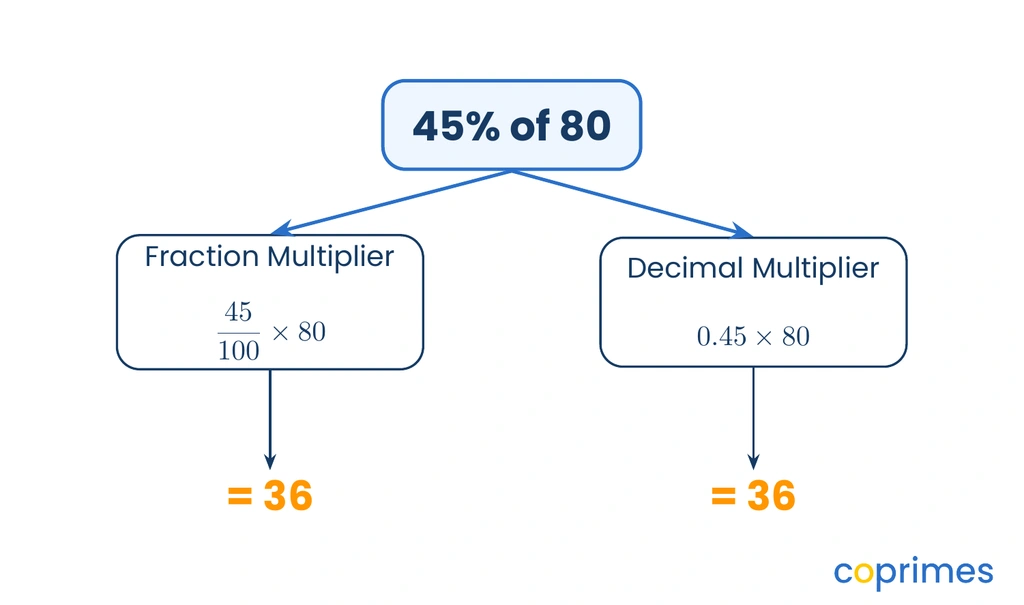
Using either the fraction multiplier or the decimal multiplier will result in the exact same mathematical value.
Use benchmark percentages
Benchmark percentages are common, easily calculable percentage values that serve as building blocks for mental math. By quickly converting a fraction to percent, you can identify benchmarks such as and .
Here are the most useful benchmark rules for fractions decimals and percent conversion:
- : Divide the whole by .
- : Divide the whole by .
- : Divide the whole by .
- : Find , then halve it.
- : Divide the whole by .
You can combine these benchmarks to find more complex percentages quickly. For example, to find of a number, calculate , calculate , and add the two results together.
Worked examples
Applying different methods ensures you have the right tool for any percentage problem, including math word problems.
Example 1: Using a ratio table
Question: Find of using a ratio table.
Method:
- Write the whole as .
- Divide both the percent and the whole by .
Percent | Value |
Answer: of is .
Check: Using a decimal multiplier, .
Example 2: Using a percent bar
Question: Find of using a percent bar.
Method:
- Set the whole at the mark on the bar.
- Find by dividing by , which equals .
- Find by multiplying by , which equals .
- Find by halving the value, which equals .
- Add the and values together: .
Answer: of is .
Check: Using a fraction multiplier, .
Example 3: Producing a non-whole number result
Question: Find of using a decimal multiplier.
Method:
- Convert the percentage to a decimal: .
- Multiply the decimal by the whole: .
- Perform the calculation: .
Answer: of is .
Check: The whole is . Because is less than , the result must be smaller than . A quarter of is , confirming the logic.

Common mistakes
One of the most frequent errors is forgetting to convert the percentage into a decimal or fraction before multiplying. For instance, when finding of , a learner might multiply . The correct step is to convert to first, producing .
Another common mistake is misplacing the decimal point during conversion, particularly with single-digit percentages. Remember that is as a decimal, not , which would represent .
Frequently asked questions
Can a percent of a number be greater than the number itself?
Yes. If the percentage is greater than , the calculated result will be larger than the original whole. For example, of is .
Is finding the same as finding ?
Yes, percentages are reversible because multiplication is commutative. Finding of yields exactly the same result as finding of . Both equal . This property often makes mental calculations much easier.
Practice questions
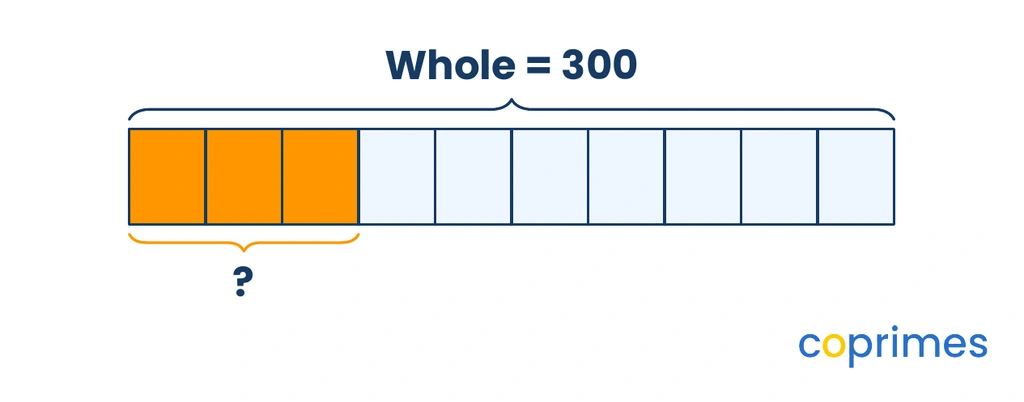
Based on the visual model, what is the value of the shaded part?
What is of ?
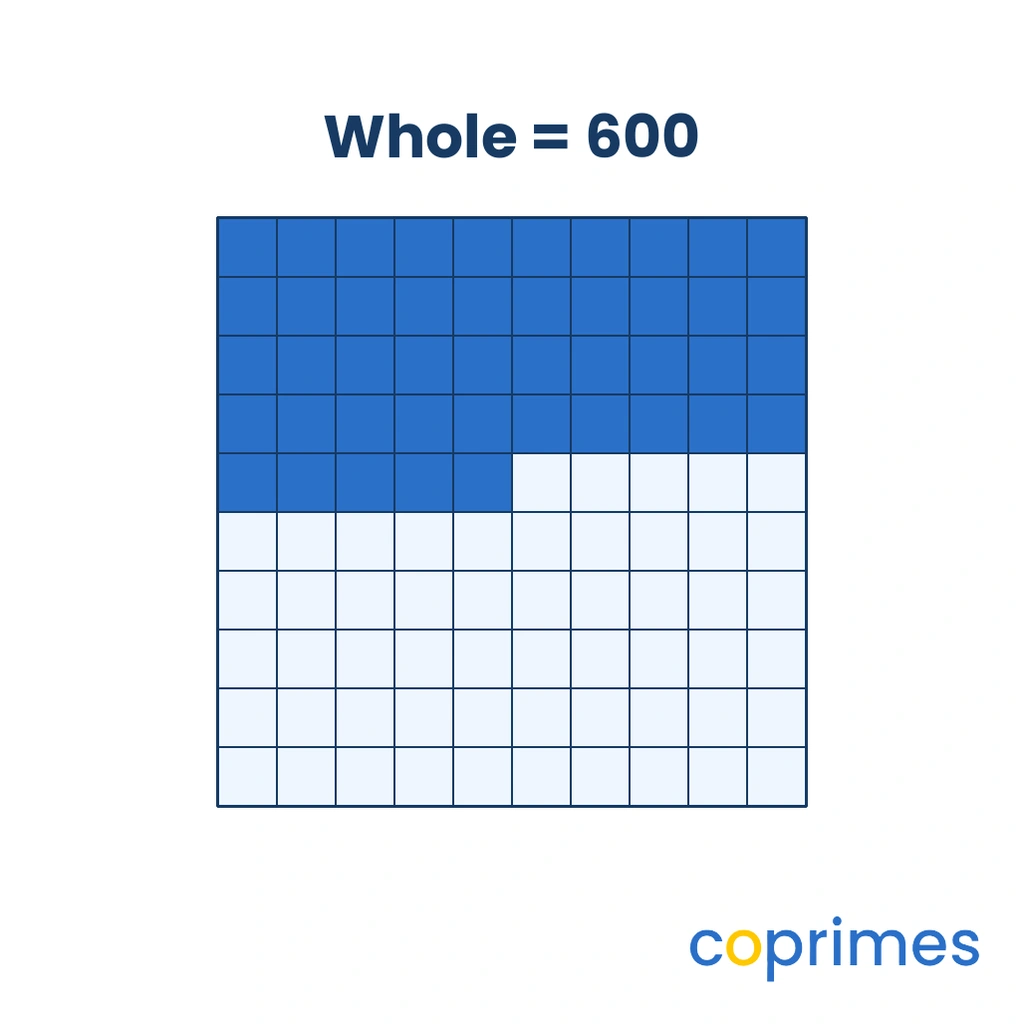
The entire hundred grid represents a value of . What is the value of the shaded area?
What is of ?
A pair of shoes originally costs dollars. They are on sale for off. What is the discount amount?
dollars
dollars
dollars
dollars
dollars