
Converting a Percent to a Decimal
To convert a percent to a decimal, divide the percentage value by 100 and remove the percent symbol. For example, 45 percent equals 0.45 because it represents 45 out of 100. This method relies on the foundational relationship between fractions, decimals, and percentages.
How do you convert a percent to a decimal?
You convert a percent to a decimal by scaling the number down by a factor of one hundred. The word "percent" literally translates to "per hundred" or "out of one hundred."
Because our number system is built on decimal place value, moving between percentages and decimals is a direct process of dividing by 100. This division shifts the value of every digit two places to the right, creating an equivalent decimal representation.
Write percent as a fraction over 100
A clear way to understand percentage conversion is to first write the percent as a fraction with a denominator of 100.
Because a percentage is simply a ratio out of 100, substituting the percent symbol with a fraction bar and a denominator of 100 preserves the exact value.
The percent symbol means the same thing as dividing a value by one hundred.
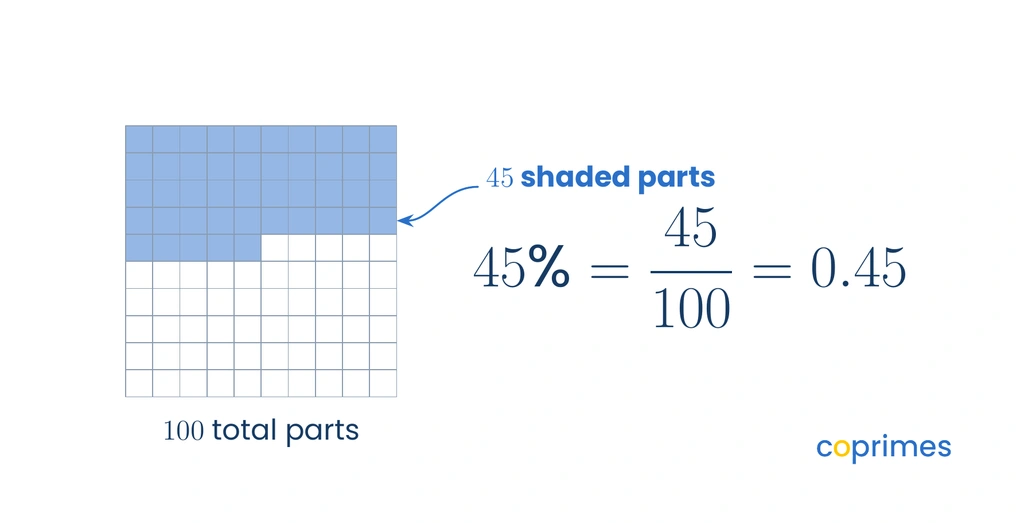
For example, becomes . This fraction is read as "forty-five hundredths," which corresponds directly to the decimal format .
Divide by one hundred
To transition from the fraction to the final decimal, you divide the numerator by the denominator. Dividing any number by 100 shifts its digits two places to the right on a place value chart.
When is divided by , the in the tens place moves to the tenths place, and the in the ones place moves to the hundredths place.
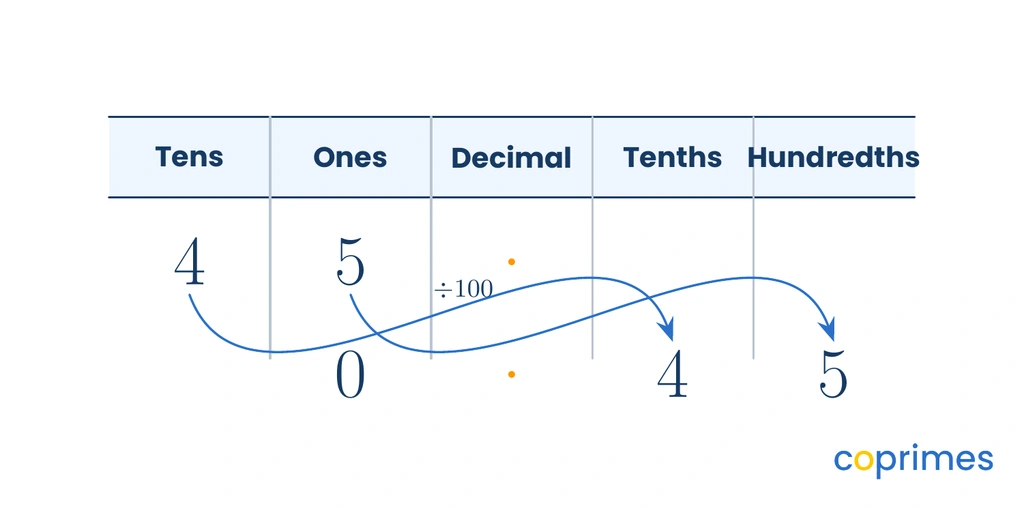
Because there are no longer any whole numbers, a zero is placed in the ones column to make the decimal clear, resulting in .

Use place value to explain the shortcut
The visual shortcut for dividing by 100 is moving the decimal point two places to the left.
Because shifting all digits to the right creates the same relative change as shifting the decimal point to the left, this shortcut is a fast and reliable method. For whole-number percentages, an invisible decimal point sits at the far right of the number.
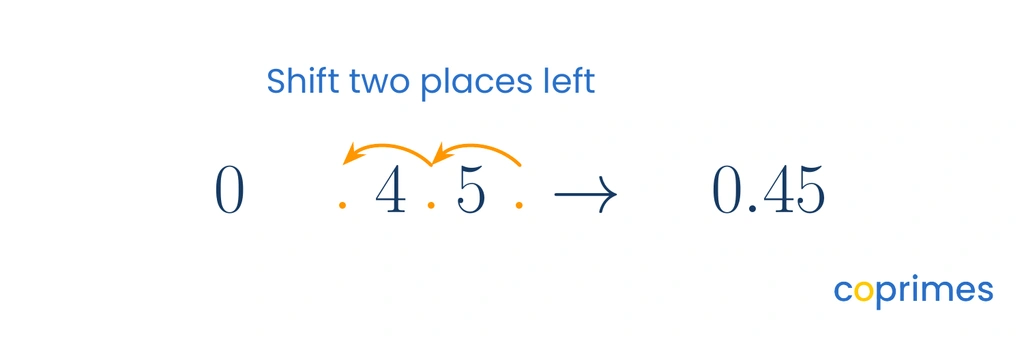
To perform the shortcut on :
- Write the percentage value with its decimal point: .
- Move the decimal point one place left: .
- Move the decimal point a second place left: , which simplifies to .
Convert decimal percentages
The same division process applies when a percentage already contains a decimal. You must still divide the value by 100, which moves the existing decimal point two places to the left.
If the number does not have enough digits on the left to accommodate the shift, you insert placeholder zeros. For example, to convert , move the decimal point past the , add a placeholder zero, and move it one more place.
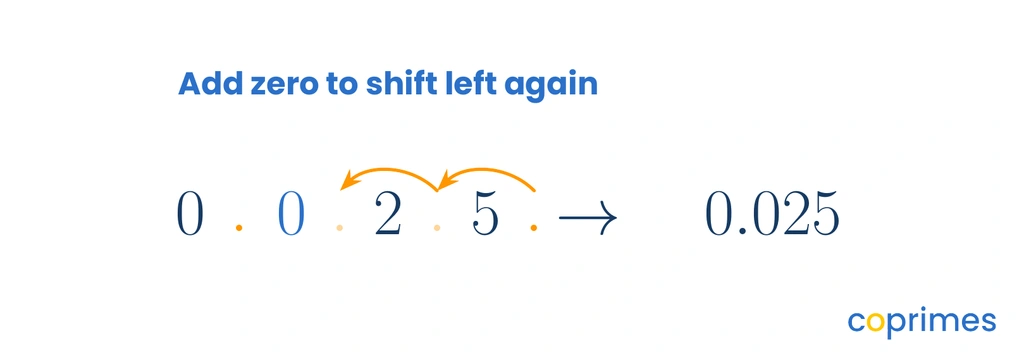
The value becomes . The digits remain in the same sequence, but their place values are reduced by a factor of 100.
Worked examples
These examples demonstrate how to convert various types of percentages, including single digits, values over 100%, and decimal percentages. Finding the percent of a number usually begins with this exact conversion skill.
Example 1: Single-digit conversion
Question: Write as a decimal.
Method:
- Write the percentage as a fraction over 100: .
- Divide by 100 by moving the decimal point two places left. Since is a single digit, add a placeholder zero before the .
- The decimal point moves past the and the placeholder zero.
Answer:
Check: Verify by multiplying by 100: .
Example 2: Value greater than 100%
Question: Convert to a decimal.
Method:
- Write the percentage over 100: .
- Divide 125 by 100 by shifting the decimal point two places to the left.
- The decimal point starts after the and moves between the and the .
Answer:
Check: Verify by multiplying by 100: .
Example 3: Decimal percentage conversion
Question: Convert to a decimal.
Method:
- Write the division operation: .
- Locate the existing decimal point between the and the .
- Move the decimal point two places to the left, past the and then past the .
Answer:
Check: Verify by multiplying by 100: .
A learning plan shaped by your child, not the class
State-aligned Math plus our own Logic and English curriculum. An adaptive baseline test finds the gaps and fills them.
Common mistakes
When converting from a percent to a decimal, moving the decimal point incorrectly is the most frequent error.
Always divide by 100, never multiply.
- Forgetting the placeholder zero: When converting single-digit percentages, learners often write . However, represents . The correct conversion for requires a placeholder zero, resulting in .
- Moving the decimal point to the right: A common mistake is multiplying by 100 instead of dividing, turning into . Remember that percentages are parts of a whole; the resulting decimal will be mathematically smaller than the numerical percentage face value.
- Confusing the directions: If you are unsure which way to move the decimal point, check your work by reversing the process. Converting a decimal to percent is the opposite operation, meaning you multiply by 100 to get back to the start.
Frequently asked questions
Here are clear answers to common questions about relating decimals and percentages.
Do I need to convert a percentage to a fraction first?
No, writing it as a fraction is not required. However, converting a percent to fraction is a useful mental step that explains why you divide the number by 100.
How do you convert a decimal back into a percentage?
To go backwards from a decimal to a percentage, multiply the decimal value by 100 and add the percent symbol. For example, .
Can a percentage become a whole number?
Yes, if the percentage is a multiple of 100. For instance, divided by equals the whole number .
Practice questions
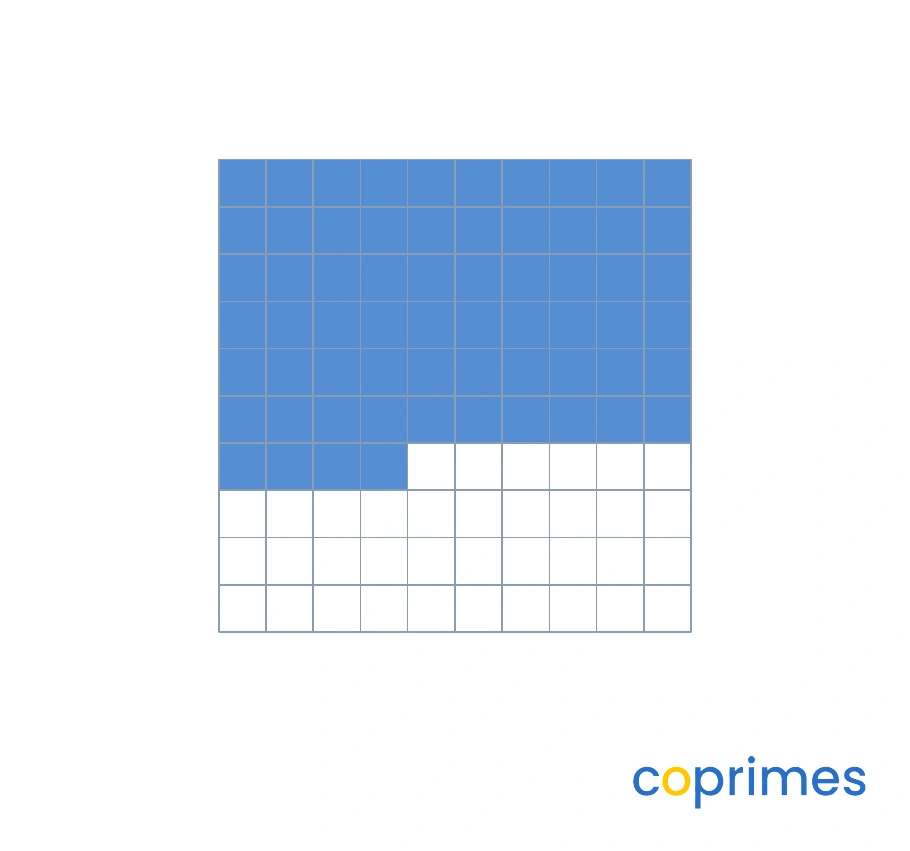
The model shows a percentage out of 100. What is this percentage written as a decimal?
Which decimal is equivalent to ?
Convert to a decimal.
Which of the following is equivalent to ?
A bank offers an interest rate of . What is this rate expressed as a decimal?