
What is a Ratio in Math? Definition and Examples
A ratio is a multiplicative comparison between quantities. For example, a ratio of to means that for every of the first quantity, there are of the second quantity; the order of the quantities matters.
Ratios are fundamental mathematical tools used to describe how much of one thing exists compared to another. They are essential for understanding scaling, sharing amounts, and solving proportion problems.
What is a ratio?
A ratio describes the relative sizes of two or more values. It tells us how the quantities relate to each other by comparing their amounts.
When you compare one part of a group to another part of the same group, you create a part-to-part ratio. The visual below shows a collection of shapes where we compare the number of blue circles to the number of yellow squares.
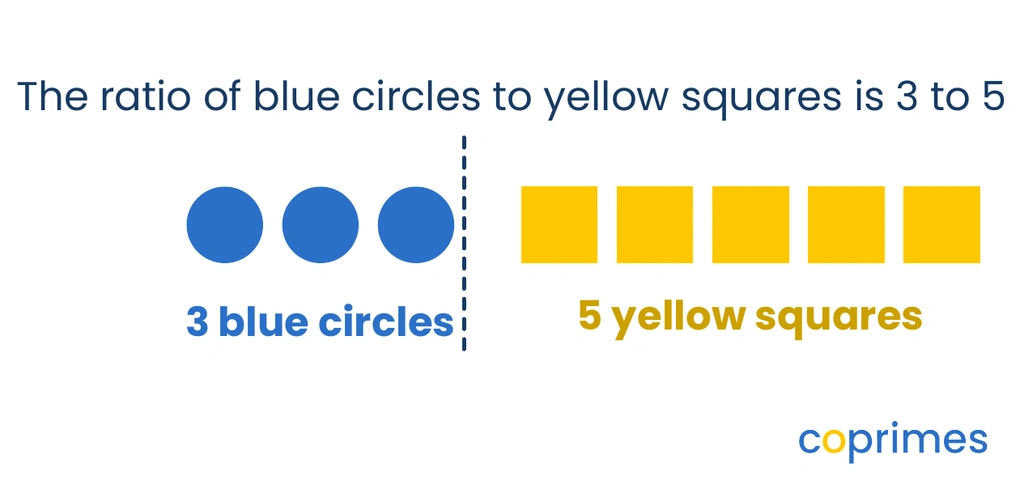
The visual contains exactly blue circles and exactly yellow squares. These two distinct groups form the ratio to .
Use ratio language
Ratios are commonly expressed using descriptive sentences that establish the proportional relationship. The most helpful phrase is "for every."
If a recipe calls for cups of flour and cup of sugar, you can say, "For every cups of flour, there is cup of sugar." This language makes it clear that the pattern repeats. If you double the recipe, you will need cups of flour because for every cups of flour, you must add cup of sugar, requiring cups of sugar in total.
The order of the words must match the order of the numbers.
If you switch the numbers without switching the words, the mathematical meaning changes entirely. Stating "for every cup of flour, there are cups of sugar" describes a completely different and much sweeter recipe.
Write ratios in different forms
Mathematical notation gives us several ways of writing ratios accurately. The most common notation uses a colon.
For a group containing cats and dogs, the ratio of cats to dogs can be written in three main ways:
- With a colon:
- With words: to
- As a fraction:
Using fractions to represent ratios requires caution. A part-to-part ratio like means there are cats for every dogs. However, the fraction in this exact context represents the ratio of cats to dogs, not cats to total animals. If you want a fraction that represents the cats out of the whole group, you must calculate the total number of parts, which is , making the fraction of animals that are cats .

Model a ratio visually
Bar models, sometimes called tape diagrams, provide an excellent way to organize and solve ratio problems. They represent each part of the ratio as an identical rectangular block.
The visual below models a ratio of . It clearly shows the two distinct parts being compared and also demonstrates how those parts combine to make the whole.
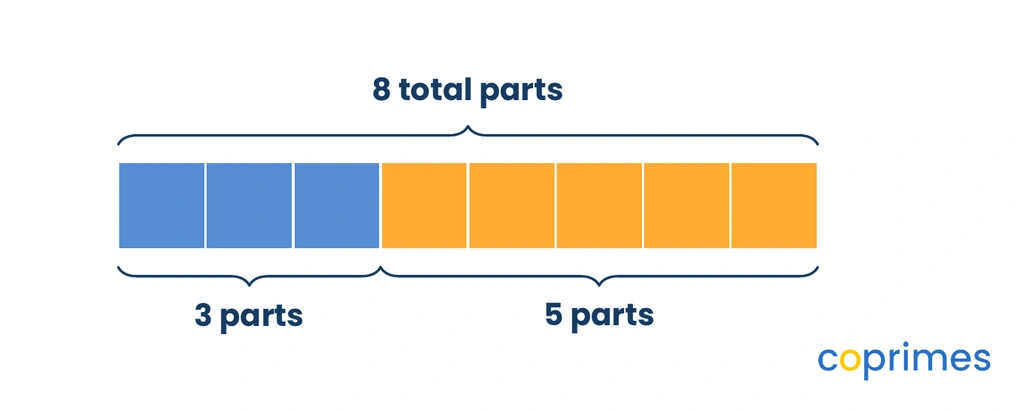
Because every block in a bar model represents the exact same value, bar models are extremely powerful when calculating unknown quantities. If you are told that the blue blocks represent items, you know that each individual block must represent items.
Find ratios from a set
To find a ratio from a given set of data or objects, count the quantities of the specific categories requested. You can compare more than two categories at once, creating a three-part ratio.
For example, a fruit bowl contains apples, bananas, and oranges. The ratio of apples to bananas to oranges is written as .
When extracting ratios from a set, always check if the final ratio can be simplified. Finding the greatest common factor of all the numbers in the ratio allows you to divide them down into their simplest form. A ratio of simplifies to because both and are divisible by .
Worked examples
Review these examples to see how ratio rules are applied step-by-step.
Example 1: Finding a three-part ratio from a table
Question: The table below shows the number of vehicles in a car park. What is the ratio of vans to cars to motorcycles in simplest form?
Vehicle Type | Number |
Cars | |
Vans | |
Motorcycles |
Method:
- Identify the requested order of the ratio: vans first, then cars, then motorcycles.
- Extract the numbers from the table matching that exact order: vans, cars, motorcycles.
- Write the initial ratio: .
- Simplify the ratio by dividing all three numbers by their greatest common factor, which is .
Answer: .
Check: Multiply the simplified ratio by . You get , which matches the exact values and the required order from the original table.
Example 2: Simplifying a part-to-whole ratio
Question: A box contains pens. There are blue pens and the rest are red. What is the ratio of red pens to the total number of pens, in simplest form?
Method:
- Calculate the number of red pens. Subtract the blue pens from the total: red pens.
- Identify the required parts for the ratio: red pens to total pens.
- Write the initial ratio: .
- Find the greatest common factor of and , which is .
- Divide both sides by .
Answer: .
Check: If out of every pens is red, then multiplying by gives red pens out of total pens, which is correct.
Example 3: Demonstrating why order matters
Question: Team A has won games and lost games. Team B has won games and lost games. Explain why the win-to-loss ratios show that Team B performed better.
Method:
- Write the win-to-loss ratio for Team A: .
- Write the win-to-loss ratio for Team B: .
- Compare the meaning of the ratios using ratio language.
Answer: Team A wins games for every they lose, which means they lose more often than they win. Team B wins games for every they lose, meaning they win more often than they lose.
Check: Changing the order of the numbers reverses the meaning of success, confirming that is a completely different record than .
A learning plan shaped by your child, not the class
State-aligned Math plus our own Logic and English curriculum. An adaptive baseline test finds the gaps and fills them.
Common mistakes
A frequent error is reversing the order of the ratio. Always write the numbers in the exact order the categories are presented in the text. If a question asks for the ratio of boys to girls, the number of boys must be written first. The ratio is never equal to the ratio .
Another common mistake is confusing part-to-part and part-to-whole ratios. If a basket has apples and pears, the ratio of apples to pears is . However, if you write this as the fraction and treat the denominator as the total, you have made a mistake. The total number of fruits is , making the fraction of apples out of the whole group .
Frequently asked questions
What is the definition of a ratio?
A ratio is a mathematical comparison of two or more quantities that indicates how their sizes relate to each other.
Are ratios always simplified?
In final answers, ratios should usually be simplified to their smallest integer values. However, unsimplified ratios are still valid and are referred to as equivalent ratios. The ratio represents the same relative relationship as the simplified ratio .
Can a ratio have decimals?
While ratios can initially include decimals (such as ), standard mathematical convention requires converting them into whole numbers by multiplying all parts until the decimals are removed. The ratio is scaled up by multiplying both sides by , yielding the proper whole-number ratio .
Practice questions

Based on the image above, what is the ratio of blue diamonds to yellow stars?
A school choir has sopranos, altos, and tenors. What is the ratio of altos to sopranos in simplest form?
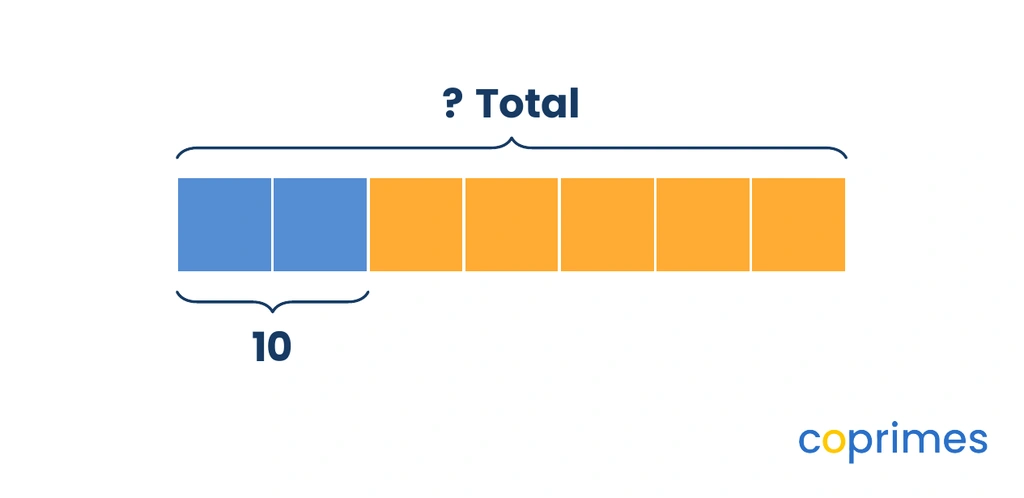
The bar model represents a ratio of . If the blue parts represent a value of , what is the total value of all the parts combined?
A recipe uses cups of oats for every cup of raisins. A student writes the ratio of oats to the total mixture as . What mistake did the student make?
The student added the parts incorrectly to find the total.
The student treated the ratio as a part-to-part ratio instead of a part-to-whole ratio.
The student reversed the order and wrote the ratio of raisins to the total mixture.
The student simplified the ratio when they should not have.
The student reversed the order and wrote the ratio of raisins to the total mixture.
A gardener plants roses, tulips, and daisies in the ratio . What is this ratio in simplest form?