
Fractions: Definition, Models, and Examples
A fraction is a number that represents one or more equal parts of a whole, a collection, a measurement, or a division. Written with a numerator above a denominator, fractions in math show exact portions rather than complete whole numbers.
What are fractions?
A fraction is a numerical representation of a part of a whole. It describes how many equal sections of a quantity are present compared to the total number of sections available.
Fractions are used when a whole number is not precise enough. For example, if a rectangle is divided into equal sections and are highlighted, the mathematical value representing the highlighted area is .
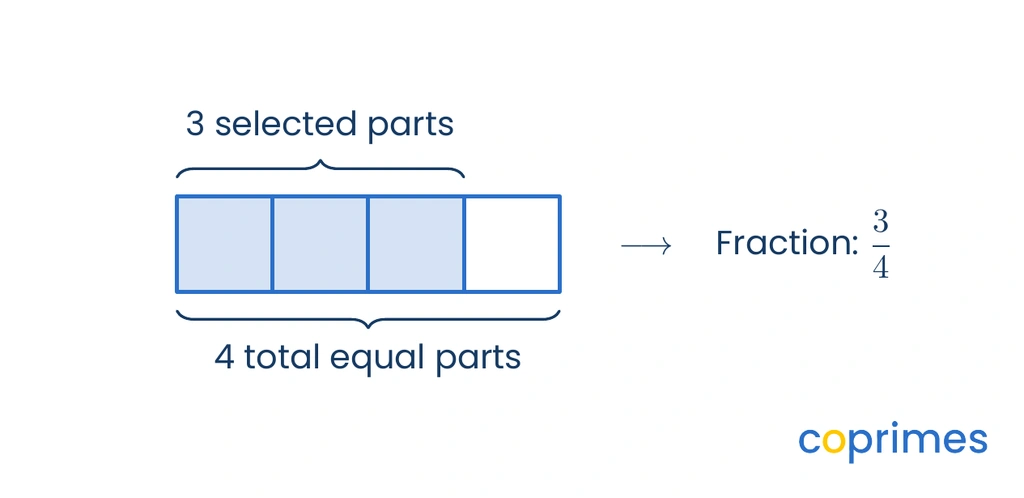
Fractions can describe portions of a single shape, a continuous measurement like distance, or a discrete collection of objects.
Fractions must use equal parts
A fraction only correctly describes a whole when all parts are identical in size. If a shape is cut into pieces of different sizes, counting those pieces will not give an accurate fractional value.
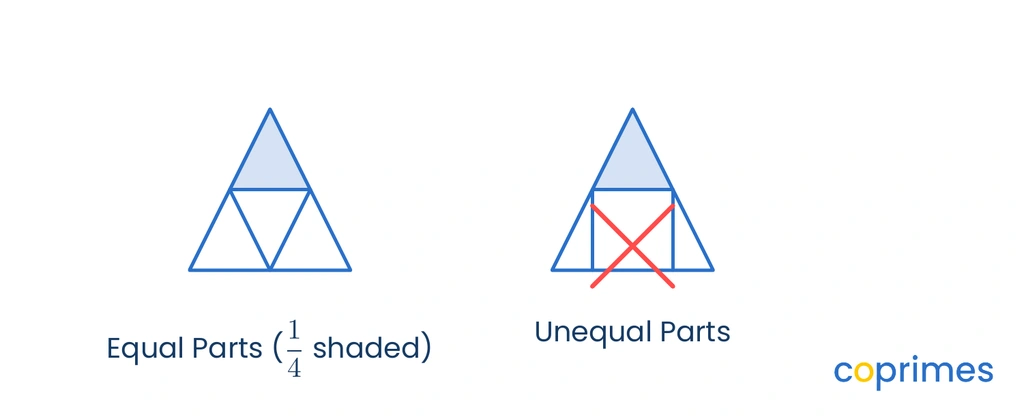
When partitioning a continuous object, such as a shape or a length, every section must cover the exact same area or distance. If the pieces are unequal, the denominator cannot accurately define the whole.
Parts of a fraction
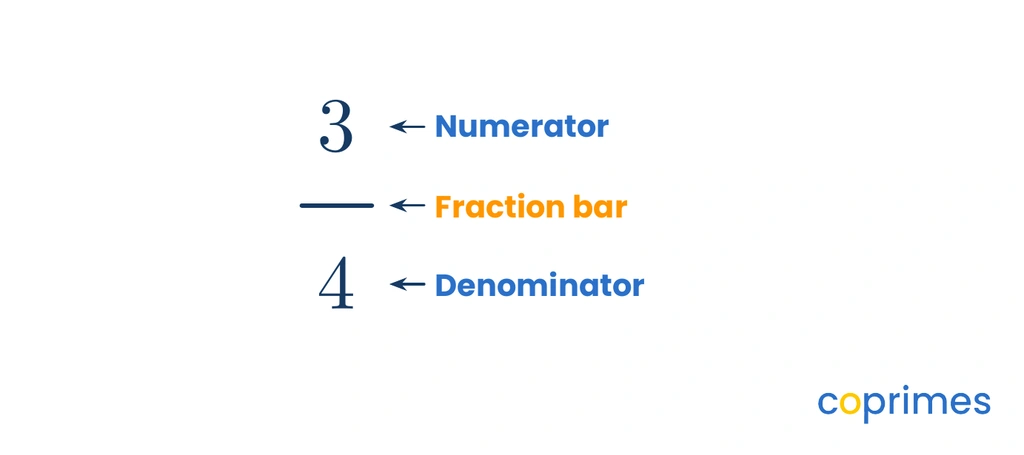
Every fraction is constructed using three essential components.
The top value is the numerator, the dividing line is the fraction bar, and the bottom value is the denominator.
- Numerator: The top number indicates how many equal parts are currently selected, shaded, or being counted.
- Fraction bar: The horizontal line separates the numerator from the denominator and also represents mathematical division.
- Denominator: The bottom number indicates the total number of equal parts needed to complete exactly one whole.

Fractions of wholes and sets
Fractions often describe a single continuous object, such as a sliced pie or a measured length. However, they are equally useful for describing fractions of a whole and a set.
In a set model, the whole is a collection of separate items rather than a single shape. The denominator counts the total number of individual items in the entire group, and the numerator counts the items that share a specific characteristic.

Because each item in a set counts as one complete unit, the individual objects themselves do not need to be physically cut into equal pieces.
Fractions as numbers
Fractions are exact mathematical values. They exist on the number line between integers and represent precise magnitudes.
Plotting fractions on a number line requires dividing the space between two whole numbers into equal intervals. The denominator dictates the number of intervals, while the numerator dictates the number of steps forward from zero.
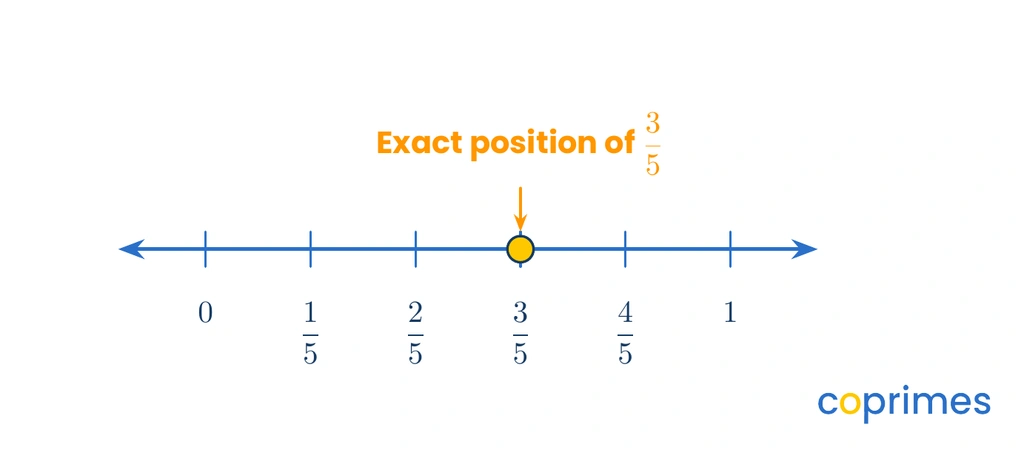
Understanding fractions as numbers is crucial for comparing their sizes and performing arithmetic operations such as addition and subtraction.
Visual examples
The relationship between a whole and its parts can be modeled mathematically. The examples below demonstrate how to construct a fraction accurately in different scenarios.
Example 1: Identifying a fraction from a set
Question: A basket contains apples. Of these, are green and the rest are red. What fraction of the apples are green?
Method:
- Identify the total number of items in the set. This will be the denominator.
- Identify the number of specific items being counted. This will be the numerator.
- Write the fraction with the numerator above the denominator.
Answer:
Check: The green apples () and red apples () add up to the total (), confirming the whole is correctly partitioned.
Example 2: Writing a fraction from an area model
Question: A rectangle is divided into equal vertical strips. If strips are shaded, what fraction of the rectangle is shaded?
Method:
- Count the total equal parts to find the denominator.
- Count the shaded parts to find the numerator.
- Place the numerator above the denominator, separated by the fraction bar.
Answer:
Check: The unshaded parts () plus the shaded parts () equal the total parts (). The fraction accurately represents the shaded area.
Example 3: Placing a fraction on a number line
Question: Which fraction is located exactly halfway between and on a number line?
Method:
- The distance between and represents one whole.
- To find the halfway point, divide the whole into equal sections.
- The total number of sections is the denominator ().
- The first section marks the midway point, so the numerator is .
Answer:
Check: Counting forward in halves, then , reaches . This confirms the halfway position.
A learning plan shaped by your child, not the class
State-aligned Math plus our own Logic and English curriculum. An adaptive baseline test finds the gaps and fills them.
Common mistakes
A frequent error is believing that the numerator can never be larger than the denominator. While proper fractions represent values less than one, improper fractions naturally have larger numerators because they represent quantities greater than one whole.
Another mistake is adding the numerators and denominators together when combining two fractions. Because the denominator only defines the size of the piece, it remains unchanged during simple addition. Only the numerators are added together.
Frequently asked questions
What are the different types of fractions?
Fractions are generally classified as proper fractions (representing less than one whole), improper fractions (representing greater than or equal to one whole), and mixed numbers (a whole number combined with a proper fraction).
How are fractions and decimals related?
Fractions and decimals are two different ways of writing the same mathematical value. A fraction can be converted into a decimal by dividing the numerator by the denominator.
Can fractions have a denominator of zero?
No. The denominator represents the total number of equal parts in a whole. A whole cannot be divided into zero parts, so dividing by zero is mathematically undefined.
Practice questions

What fraction of the pentagon is shaded?
Why must a continuous shape be divided into equal parts to represent a fraction correctly?
Because fractions are only used to solve division problems.
Because the numerator must always be smaller than the denominator.
Because a fraction describes units that are exactly the same size.
Because geometric shapes cannot be drawn with unequal sides.
Because a fraction describes units that are exactly the same size.
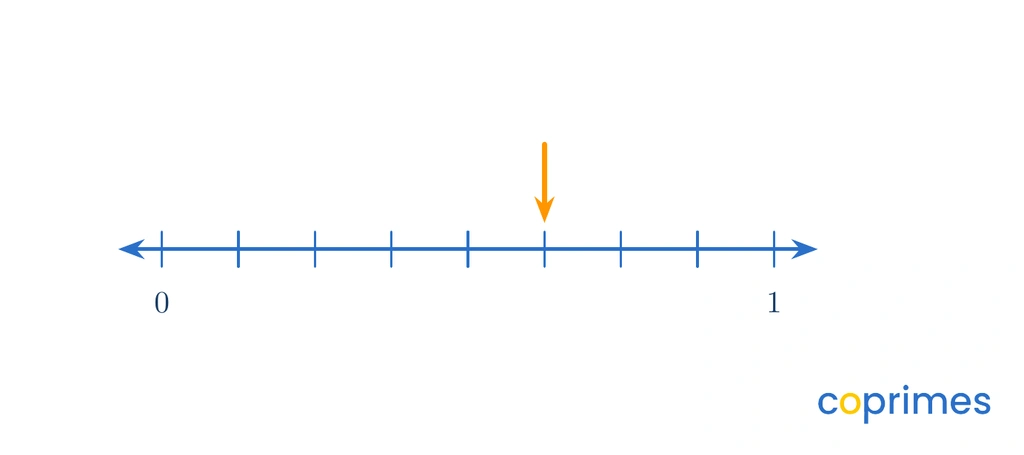
Which fraction does the arrow indicate on the number line?
A jar contains red marbles and blue marbles. What fraction of the marbles in the jar are blue?
If of a ribbon is centimeters long, what is the total length of the complete ribbon?
centimeters
centimeters
centimeters
centimeters
centimeters