
Speed, Distance and Time
Speed is a rate calculated by dividing the distance traveled by the time taken. By using the core relationship between speed, distance, and time, you can find any one of these values as long as the other two are known.
What do speed, distance and time mean?
Speed, distance, and time are three connected measurements that describe how an object moves.
- Distance () is the total length of the path traveled by an object. It is measured in units such as meters (), kilometers (), or miles.
- Time () is how long it takes to complete the journey. It is measured in units such as seconds (), minutes (), or hours ().
- Speed () is the distance covered per unit of time. It is a rate that combines distance and time, such as meters per second () or miles per hour ().
Because speed compares a distance to exactly one unit of time, it is a specific type of unit rate.
Use the speed-distance-time relationship
The fundamental formula connects these three measures.
Speed equals distance divided by time.
This relationship is written as:
A common memory aid for this relationship is the formula triangle. Place distance at the top, and speed and time at the bottom. Covering the value you want to find reveals the operation to perform with the remaining two values.
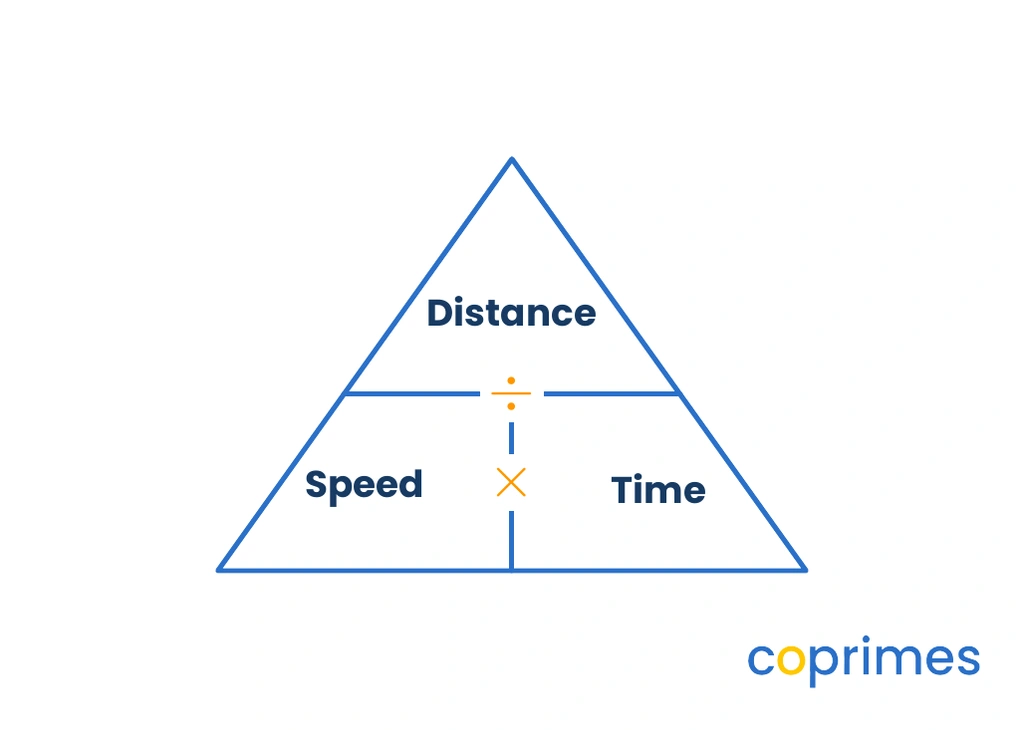
Use the triangle only as a memory check after understanding how to rearrange the algebraic equation.
Find speed, distance or time
To calculate any missing measure, rearrange the core formula or use the relationships from the formula triangle. Finding a unit rate follows the same algebraic logic.
- To find Speed (): Divide distance by time.
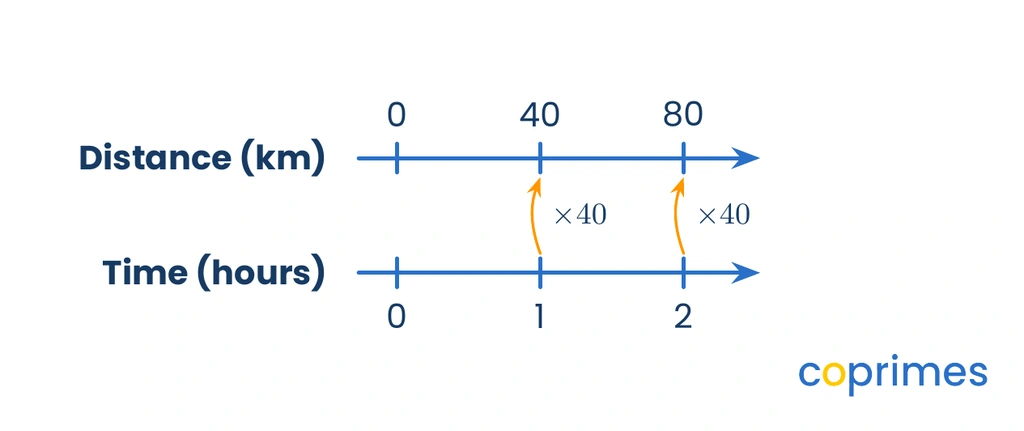
- To find Distance (): Multiply speed by time.
- To find Time (): Divide distance by speed.
Whenever you solve a problem, identify the two known values, choose the correct rearranged formula, substitute the values, and solve.

Convert units before calculating
Before multiplying or dividing, check that the units for speed, distance, and time are compatible. You cannot mix different time units or distance units in the same calculation without converting them first.
If a speed is given in kilometers per hour (), the distance must be in kilometers and the time must be in hours. If a vehicle travels for minutes, you must convert the time into hours before using the formula.
- To convert minutes to hours, divide by . For example, .
- To convert hours to minutes, multiply by .
Interpret a rate in context
When traveling, an object rarely moves at the exact same speed for an entire journey. It may speed up, slow down, or stop. When you calculate the speed over a whole trip, you are calculating the average speed.
Average speed represents the constant speed required to cover the same total distance in the same total time. It does not mean the object traveled at that exact rate at every moment.
Worked examples
Apply the formulas and conversions to solve these math word problems.
Example 1: Finding average speed
Question: A train covers a distance of in . What is its average speed?
Method:
- Identify the knowns: , .
- Choose the formula: .
- Substitute the values: .
- Divide to find the speed.
Answer: .
Check: Multiply the speed by the time to see if it equals the original distance: . The calculation is correct.
Example 2: Finding time
Question: A bird flies at a constant speed of . How long will it take the bird to fly ?
Method:
- Identify the knowns: , .
- Choose the formula: .
- Substitute the values: .
- Divide to find the time.
Answer: .
Example 3: Finding distance with unit conversion
Question: A cyclist travels at a speed of for . What distance does the cyclist cover?
Method:
- Identify the knowns: , .
- Check unit compatibility. The speed uses hours, but the time is in minutes.
- Convert time to hours: .
- Choose the formula: .
- Substitute the compatible values: .
- Multiply to find the distance.
Answer: .
Check: The time minutes is two-thirds of an hour. Two-thirds of the hourly rate of is .
A learning plan shaped by your child, not the class
State-aligned Math plus our own Logic and English curriculum. An adaptive baseline test finds the gaps and fills them.
Common mistakes
Mixing distance and time units without converting them
The most frequent error is substituting incompatible values directly into the formula. If a car travels at for , calculating is incorrect. Always convert time units to match the speed unit before calculating. The correct calculation uses , giving a distance of .
Rearranging the formula incorrectly
Memorizing the formula without understanding the relationship can lead to errors like writing . Always verify the rearranged formula. If speed is distance divided by time, then distance must be the product of speed and time.
Frequently asked questions
What is the distance formula in coordinate geometry?
The distance formula for coordinates is . Although it calculates distance, it is derived from the Pythagorean theorem to find the length of a line segment on a graph, which is different from using speed and time.
Is average velocity the same as average speed?
No. Average speed is a scalar measurement that only tracks how fast an object moves. Average velocity includes the specific direction of travel and is based on displacement, not just total distance.
How do I convert meters per second to kilometers per hour?
To convert to , multiply the speed by . For example, equals . This works because there are seconds in an hour and meters in a kilometer, making the conversion factor .
Practice questions
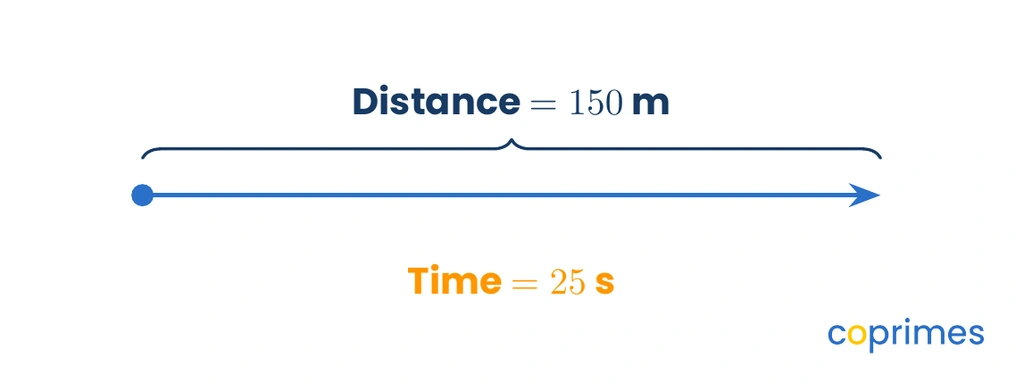
A runner completes the sprint shown in the diagram. What is the runner's average speed?
A car travels at a constant speed of . How far will it travel in ?
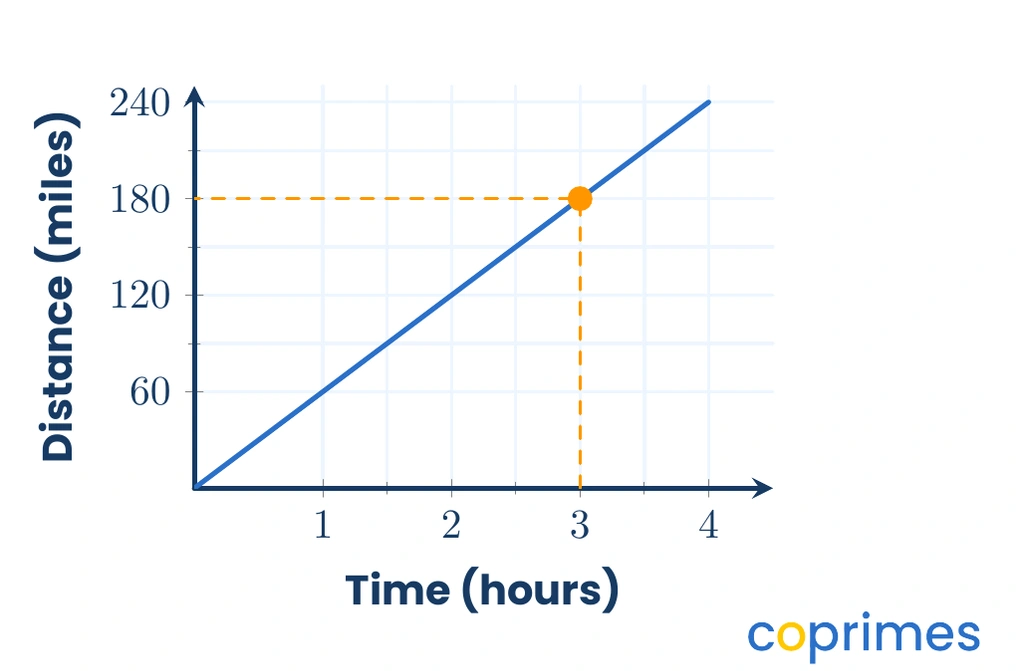
The graph represents a vehicle's journey. What is the average speed of the vehicle?
A boat travels at a constant speed of . How long does the journey take?
An airplane flies at an average speed of for . What is the total distance covered?