
Rate in Mathematics: Definition and Examples
A rate in math is a ratio that compares two quantities measured in different units, such as pages per minute or kilometers per hour. The word "per" tells you which quantity is associated with one unit of the other.
Understanding how to compare different units is essential for calculating speed, finding the best prices, and working with rate of change basics in later mathematics.
What is a rate in math?
A rate is a mathematical comparison of two related quantities that have different units of measurement. While a standard ratio might compare the number of apples to oranges, a rate compares completely different types of measurements, such as distance and time.
A rate always describes how one quantity changes in relation to another quantity.
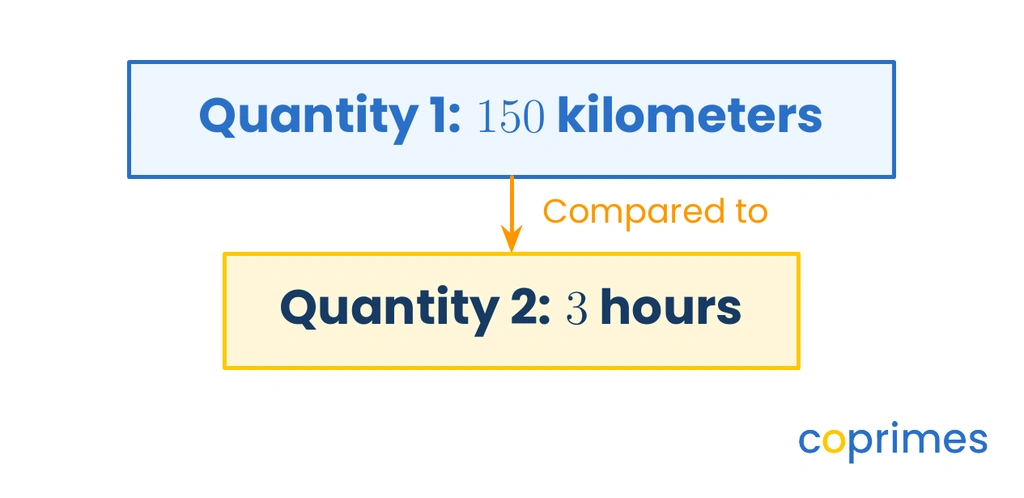
Whenever you measure how fast something moves, how quickly a task is completed, or how much an item costs per unit, you are using rates.
Recognise different units
To identify a rate, look for two entirely different units of measurement working together. If both quantities share the same unit, it is not considered a rate in standard mathematics.
Common rate examples include:
- Speed, which compares distance and time (kilometers and hours).
- Typing speed, which compares text volume and time (pages and minutes).
- Flow rates, which compare liquid volume and time (liters and days).
- Earning rates, which compare money and time (dollars and hours).
Because the units are different, they must always be written alongside the numbers. Writing " to " is incomplete for a rate; it must be written as " kilometers per hours".
Read rate language
The most important word used in rate language is "per". When you see or hear the word "per", it translates to "for every" or "in each".
For instance, saying " pages per minute" means that for every single minute that passes, exactly pages are completed. The word "per" is represented mathematically by the division symbol or a fraction bar.
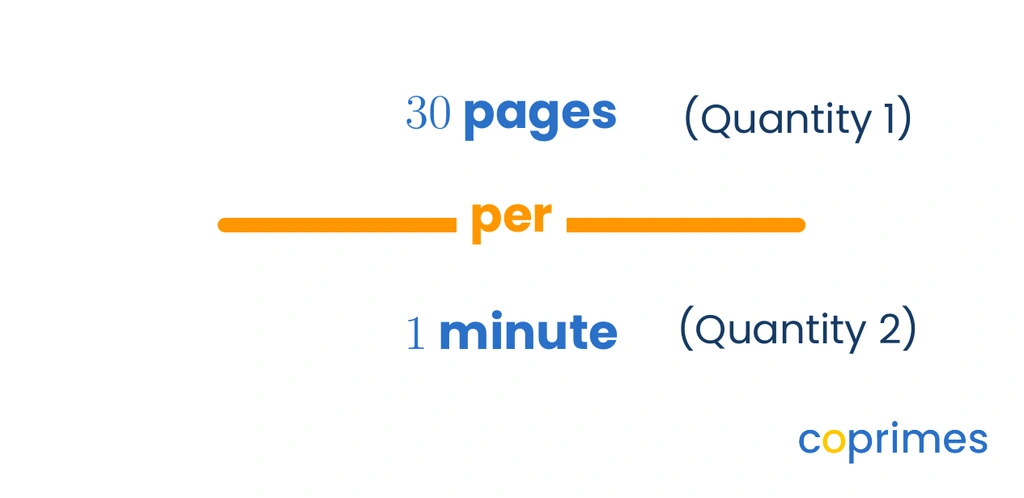
When reading a rate aloud, you will typically state the first quantity and its unit, say the word "per", and then state the second unit.

Rate versus ratio
While all rates are ratios, not all ratios are rates. The key difference in ratio versus rate lies in the units being compared.
A standard ratio compares quantities with the exact same units, meaning the units can be simplified and removed from the final ratio. A rate compares different units that cannot be simplified away.
Type | Comparison | Example |
Ratio | Same units | meters to meters (or ) |
Rate | Different units | dollars for hours |
Non-example | Single quantity | kilograms |
Because the units in a rate are different, they must remain in the final mathematical expression.
Represent a rate
The clearest way to represent a rate is by writing it as a fraction. The first quantity becomes the numerator, and the second quantity becomes the denominator.
You must include the measurement units in both the numerator and the denominator. For example, if a machine pumps liters of water every hours, the rate is represented as .
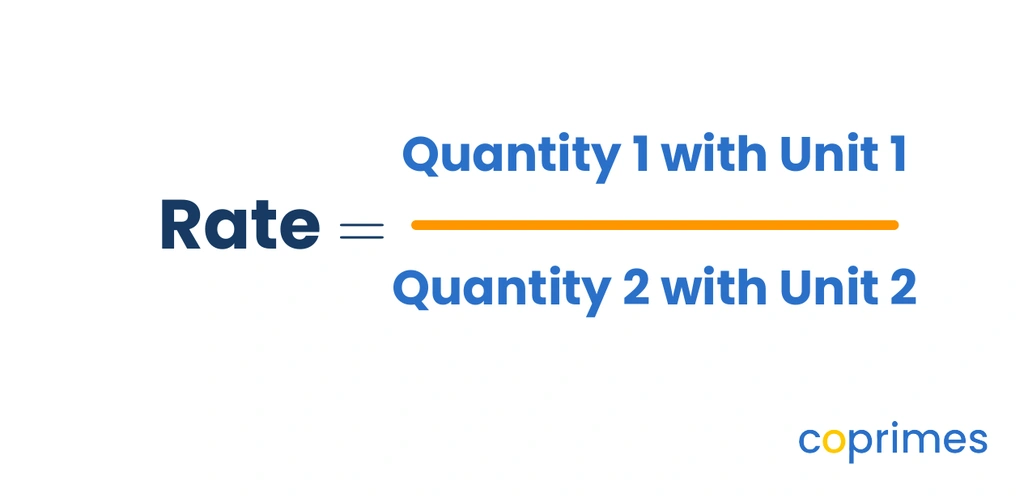
By writing the rate as a fraction, you can easily divide the numerator by the denominator to simplify the measurement.
Worked examples
The following examples demonstrate how to identify and calculate rates using different real-world contexts.
Example 1: Calculating pages per minute
Question: A printing press produces pages in minutes. What is the printing rate?
Method:
- Identify the two different quantities and their units. The quantities are pages and minutes.
- Write the quantities as a fraction, keeping the units attached.
Rate =
- Divide the numerator by the denominator to simplify the rate for one minute.
Answer: The rate is pages per minute.
Check: Multiply the simplified rate by the time: pages. The rate is correct.
Example 2: Calculating liters per day
Question: A large reservoir loses liters of water over days due to a leak. What is the rate of water loss per day?
Method:
- Identify the volume and the time. Volume is liters, time is days.
- Set up the rate fraction.
Rate =
- Perform the division: .
Answer: The rate of water loss is liters per day.
Check: Over days, liters. The total matches the given volume.
Example 3: Calculating kilometers per hour
Question: A train covers a distance of kilometers in exactly hours. What is the rate of speed distance time for the train?
Method:
- Identify distance and time. Distance is kilometers, time is hours.
- Write the fraction.
Speed =
- Divide by .
Answer: The speed is kilometers per hour.
Check: . The answer is verified.
A learning plan shaped by your child, not the class
State-aligned Math plus our own Logic and English curriculum. An adaptive baseline test finds the gaps and fills them.
Common mistakes
A frequent mistake is dropping the units when writing a rate. If you write the rate of a car simply as "", it has no mathematical meaning because it could represent miles per hour, kilometers per hour, or even meters per second.
Another mistake is confusing a rate with a standard ratio. Remember that comparing " blue marbles to red marbles" is just a ratio because both items are marbles (the same unit type). A true rate must compare fundamentally different properties, like mass and volume or distance and time.
Frequently asked questions
What is a unit rate?
A unit rate is a specific type of rate where the second quantity (the denominator) is exactly one unit. For example, " kilometers per hour" is a unit rate, while " kilometers per hours" is a general rate.
How do you convert a rate into a unit rate?
The method for finding a unit rate involves dividing the numerator by the denominator. By calculating the division, you automatically scale the denominator down to exactly one unit.
Are all ratios considered rates?
No, all ratios are not rates. Ratios that compare quantities measured in the identical unit (like centimeters to centimeters) are not rates. Rates specifically compare quantities with different units of measurement.
Practice questions
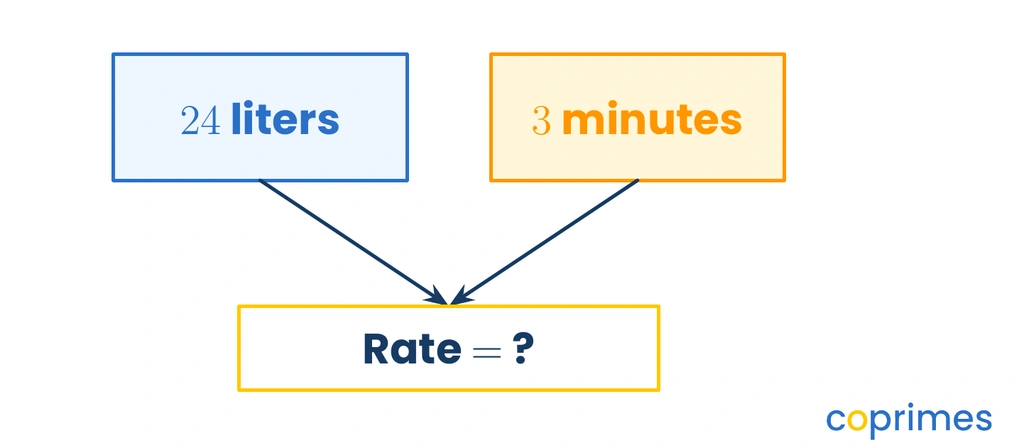
Based on the diagram, which of the following correctly describes the rate of water flow per minute?
liters per minute
liters per minute
liters per minute
liters per minute
liters per minute
Which of the following comparisons represents a rate?
red apples to green apples
meters to meters
dollars for hours
boys to girls
dollars for hours
A machine produces toys in hours. What is the production rate of the machine?
toys per hour
toys per hour
toys per hour
toys per hour
toys per hour
When reading a rate aloud, what mathematical operation does the word "per" represent?
Addition
Subtraction
Multiplication
Division
Division
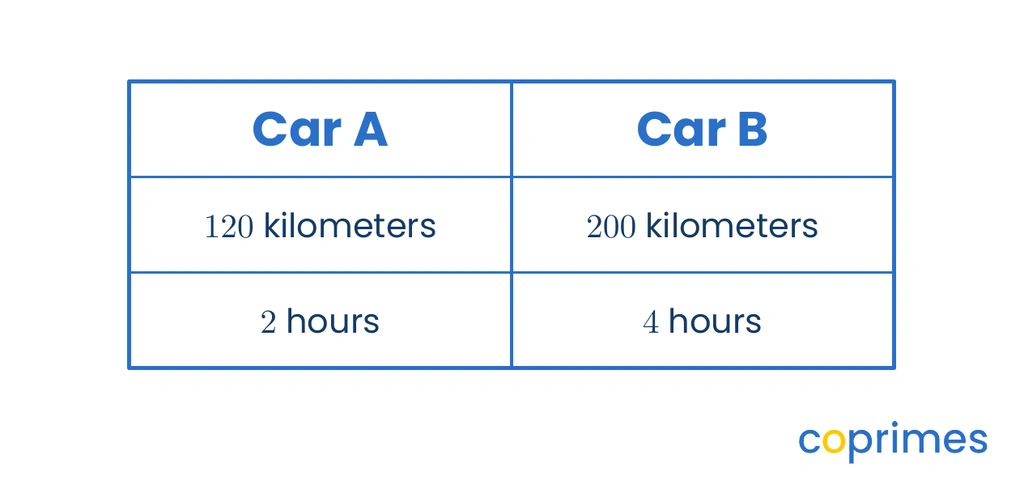
Based on the table, which car travels at a faster rate, and what is its speed?
Car A, travelling at kilometers per hour
Car A, travelling at kilometers per hour
Car B, travelling at kilometers per hour
Car B, travelling at kilometers per hour
Car A, travelling at kilometers per hour