
Finding a Unit Rate: Methods, Examples, and Practice
To find a unit rate, divide both quantities by the same factor until the quantity being used as the unit is exactly , or divide the first quantity by the second when that produces the requested value. A rate compares two distinct quantities, and calculating the unit rate determines how much of one quantity exists per single unit of the other.
How do you find a unit rate?
Finding a unit rate requires reducing the comparison so that the chosen reference quantity is exactly .
When you are given a total amount for multiple items or multiple hours, you divide the total by the number of units to find the rate for just one unit. The calculation is a proportional scaling process where both quantities are divided by the same number.
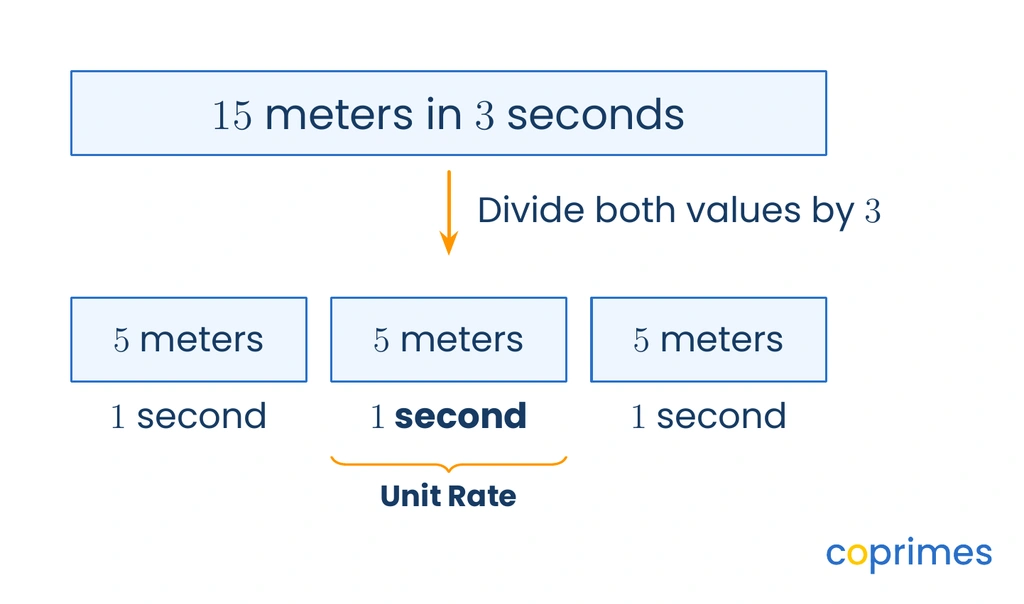
To find a unit rate, divide both quantities by the same factor until the chosen unit becomes exactly one.
Identify the requested unit
Determine which quantity needs to become before performing any calculations.
The word "per" typically identifies the target unit. For example, calculating "dollars per item" means the number of items must become . Calculating "miles per hour" means the number of hours must become .
If you divide without checking the required direction, you might calculate the inverse rate. For instance, dividing dollars by pens finds the cost per pen ( dollars per pen). Dividing pens by dollars finds the number of pens per dollar ( of a pen per dollar). Both are mathematically valid, but only one answers the specific question being asked.
Use division or equivalent ratios
You can work out unit rate using an equation, a double number line, or ratio tables.
The unit rate method involves setting up the equivalent relationship and determining the division step required. When using a ratio table, place the known quantities in one column and the target unit of in the next. Divide both rows by the value needed to transform the original quantity into .
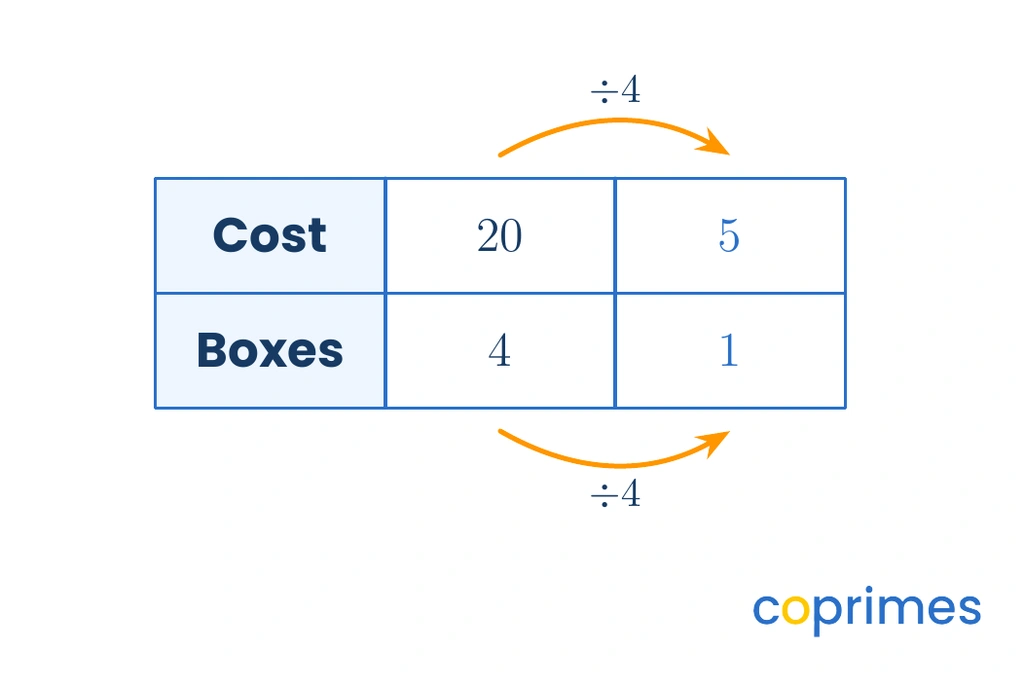

Find a unit rate with decimals and fractions
When calculating a unit rate involving decimals or fractions, the same division methods apply. The mathematical goal remains reducing the chosen unit to exactly .
For example, if a hiker walks of a mile in of an hour, you must divide the miles by the hours to find the unit rate in miles per hour. The expression is .
Dividing by a fraction is equivalent to multiplying by its reciprocal, so the calculation becomes , which equals miles per hour.
Check units and reasonableness
After calculating the unit rate, verify that the units match the context and that the resulting value makes sense for the situation.
A numerical unit rate is incomplete without its attached units. A result of could mean miles per hour, dollars per item, or grams per piece. Always state both units clearly in your final answer. Finally, check your rate by multiplying the unit rate by the original number of units; this calculation should return you to the total quantity provided in the problem.
Worked examples
Review these step-by-step examples demonstrating different methods to find a unit rate.
Example 1: Finding unit price using an equation
Question: A pack of notebooks has a price of dollars. What is the unit price of one notebook?
Method:
- Identify the given rate and the requested unit. The unit price requires finding the cost per single notebook.
- Set up an equation dividing the total cost by the number of notebooks.
- Calculate the quotient: .
- Check the direction of division. Total dollars divided by notebooks yields dollars per notebook.
Answer: The unit price is dollars per notebook.
Check: Multiply the unit rate by the number of notebooks: dollars. The result correctly matches the original total.
Example 2: Using a double number line for speed
Question: A train travels miles in hours at a constant speed. Using the relationship between speed distance time, what is the unit rate in miles per hour?
Method:
- Draw a double number line representing miles and hours.
- Plot the known rate of miles aligned with hours.
- To find the unit rate for one hour, divide the hours by .
- Divide the miles by to maintain the equivalent ratio: .
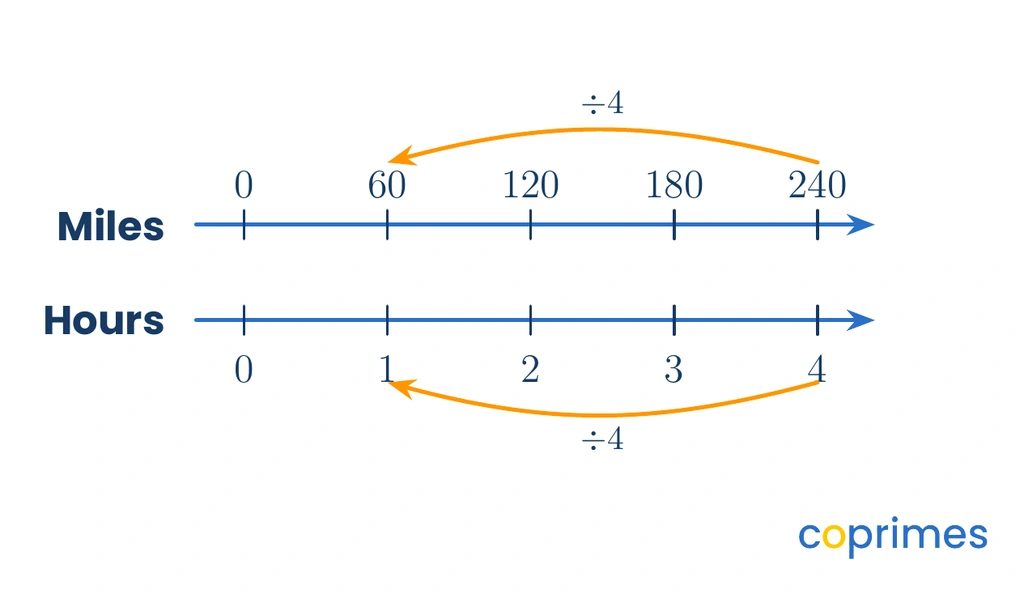
Answer: The train travels at a unit rate of miles per hour.
Check: The total distance increases steadily: miles in hour, in hours, in hours, and in hours. The rate is consistent.
Example 3: Calculating a unit rate for a decimal quantity
Question: A 3D printer uses grams of plastic to print identical pieces. How many grams of plastic are needed for exactly piece?
Method:
- Organize the quantities into a ratio table.
- The target unit is piece. The current given number of pieces is .
- Divide the number of pieces by to scale down to exactly .
- Divide the mass of the plastic by the same factor: .
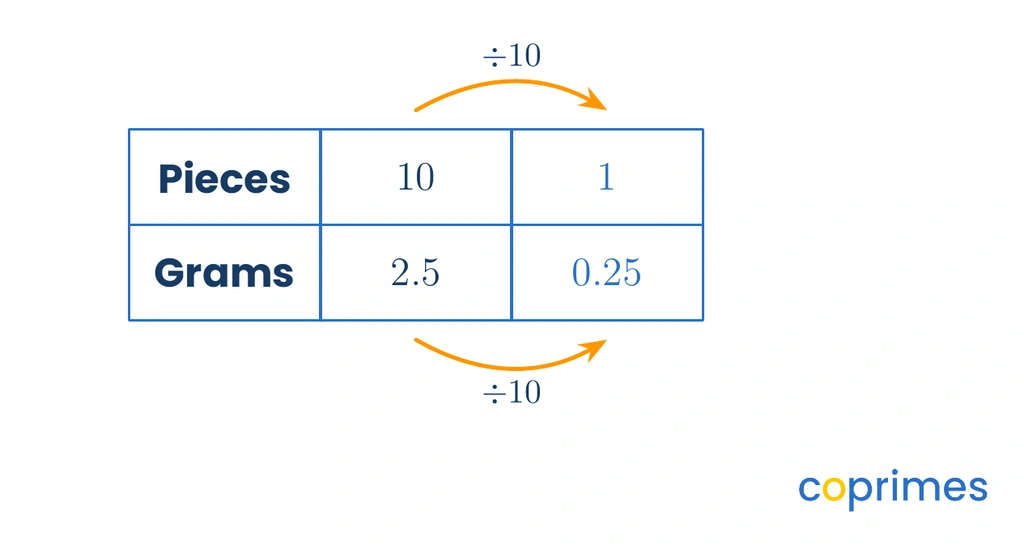
Answer: It takes grams of plastic per piece.
Check: If piece needs grams, then pieces need grams. This confirms the original relationship.
A learning plan shaped by your child, not the class
State-aligned Math plus our own Logic and English curriculum. An adaptive baseline test finds the gaps and fills them.
Common mistakes
Avoid these common errors when finding a unit rate.
Dividing in the wrong direction
A frequent error is dividing the numbers without confirming which one should represent exactly one unit. Dividing the quantity of items by the total cost calculates the number of items you get per dollar, not the cost per item.
Forgetting units of measurement
A unit rate is ambiguous without its descriptive units. A result of could mean miles per hour, dollars per item, or apples per basket. Always state both units.
Leaving the unit as a fraction or decimal unnecessarily
While complex fractions can express rates, a true unit rate must have a reference quantity of exactly . You must simplify expressions like into dollars per item to complete the unit rate properly.
Frequently asked questions
Common questions and answers about calculating unit rates.
How do graphs help find a unit rate?
Graphs visually demonstrate the relationship between two quantities. When a proportional relationship is graphed with a straight line starting at the origin, the unit rate is the vertical -value when the horizontal -value is exactly . The unit rate also matches the constant slope of that line.
How can you write a unit rate as a fraction?
Place the measured quantity in the numerator (the top number) and exactly unit of the reference quantity in the denominator (the bottom number). For example, a rate of words per minute is mathematically written as .
Practice questions
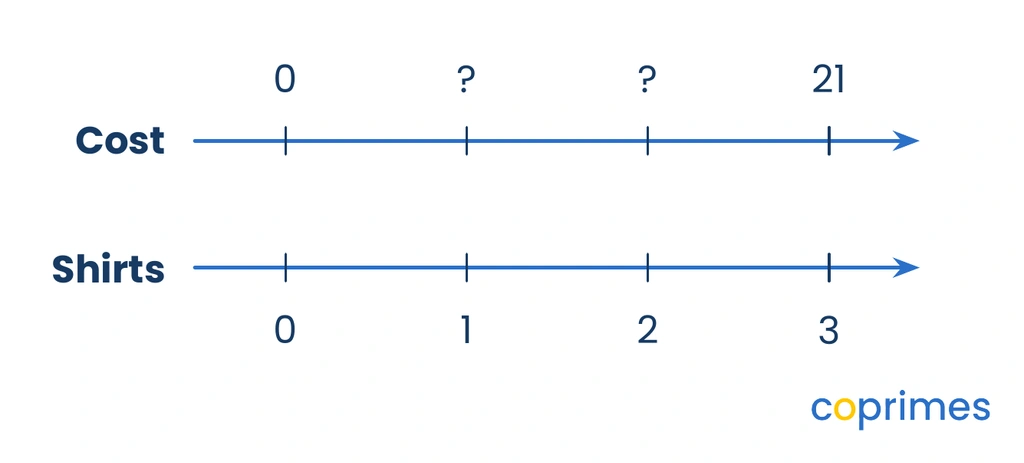
The double number line visually models the relationship between the cost and the number of shirts. What is the unit rate?
dollars per shirt
dollars per shirt
dollars per shirt
dollars per shirt
dollars per shirt
A local bakery sells muffins for a total of dollars. What is the unit price of one muffin?
dollars per muffin
dollars per muffin
dollars per muffin
dollars per muffin
dollars per muffin
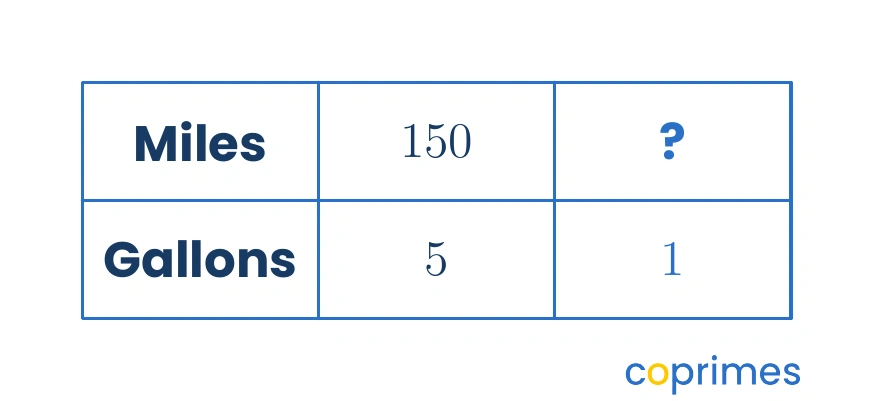
What is the unit rate shown in the ratio table?
miles per gallon
miles per gallon
miles per gallon
miles per gallon
miles per gallon
An office printer outputs pages in minutes. A student calculates the unit rate as . What does this represent?
The number of pages printed in one minute.
The number of minutes it takes to print one page.
The total number of pages printed.
The number of pages printed in one second.
The number of pages printed in one minute.
A cyclist travels of a kilometer in of an hour. What is their unit rate in kilometers per hour?