
Understanding the Denominator in Fractions
The denominator is the bottom number in a fraction. It shows the total number of equal parts that make up one whole. For example, in the fraction , the denominator is , which means the whole is divided into four equal parts.
What is a denominator?
The denominator is the lower number of a fraction, written below the separating line.
It represents the total number of equal parts in a whole object or group. To write fractions, two numbers are placed one above the other, separated by a line. This line is called the fraction bar. The number positioned directly below this bar is always the denominator.
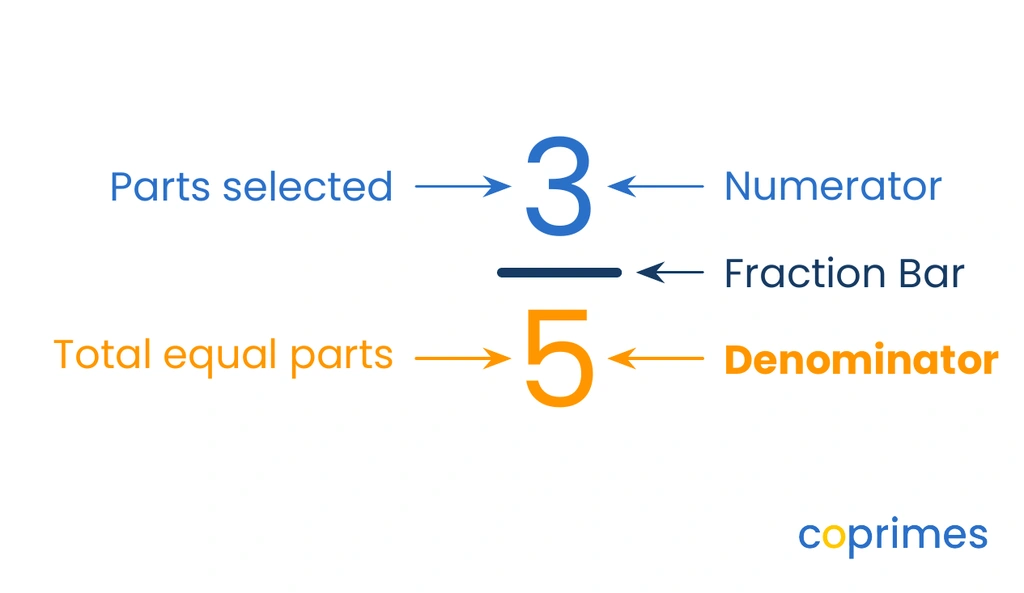
Find the denominator in a fraction
Finding the denominator is as simple as looking for the bottom number or expression.
Whether a fraction uses numbers or variables, the denominator is always positioned below the fraction bar. In the fraction , the denominator is . In the algebraic fraction , the denominator is the variable . The expression on the bottom can also be a combination of terms.
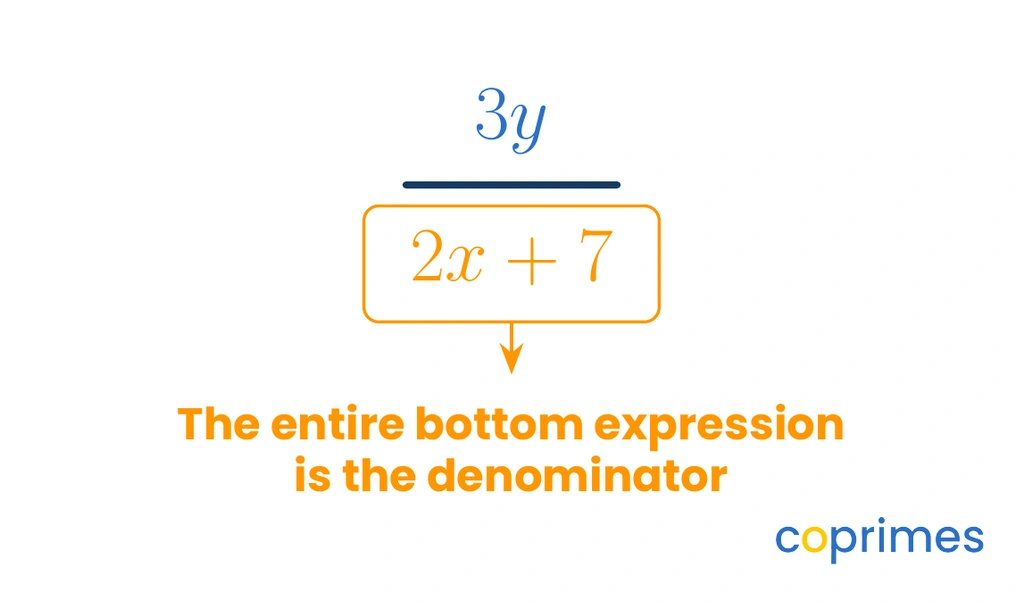
What the denominator means
The denominator defines the size of each equal piece by establishing how many pieces make up the whole.
A whole can be a single continuous object, like a circle, or a group of discrete objects, like a collection of stars. The denominator tells us the total number of objects in the group or the total number of slices in the shape. The top number, called the numerator, simply counts how many of those parts are selected.
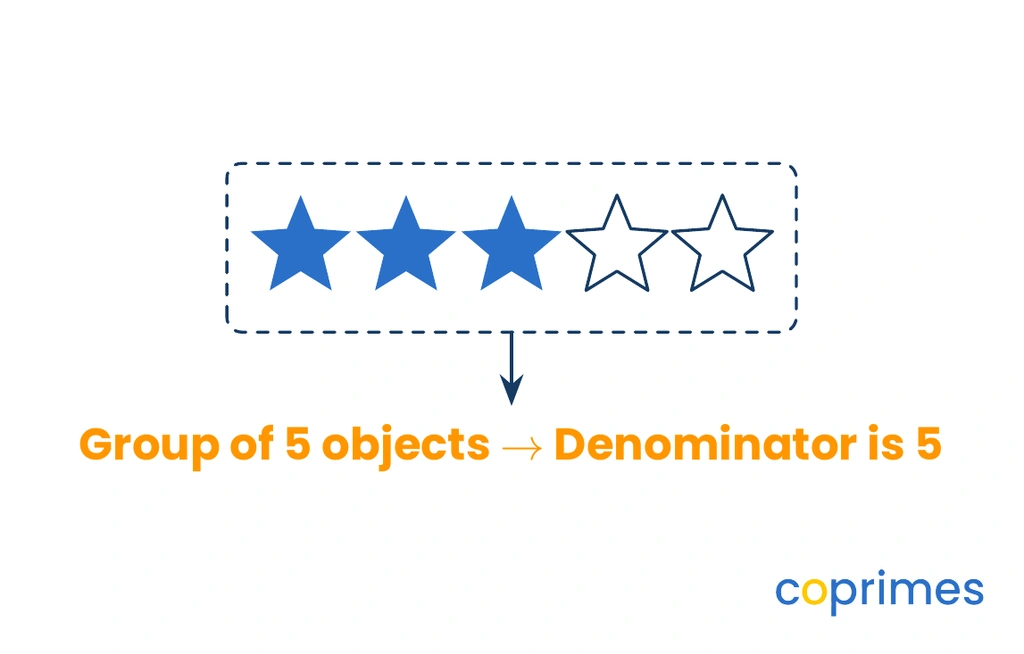
When the denominator increases, the whole is divided into more pieces. Because there are more pieces squeezed into the same whole, each individual piece must be smaller. For example, a denominator of means the whole is cut into eight parts, while a denominator of means the whole is cut into only four parts. The parts from the eighths are smaller than the parts from the fourths.
A larger denominator means smaller equal parts, because the same whole is divided more times.

Why a denominator cannot be zero
A denominator of zero is mathematically impossible because a whole cannot be divided into zero equal parts.
The denominator tells us how many equal parts make up a whole. If the denominator were , it would mean the whole consists of zero parts, which contradicts the existence of the whole itself. Therefore, a fraction like has no meaning in mathematics.
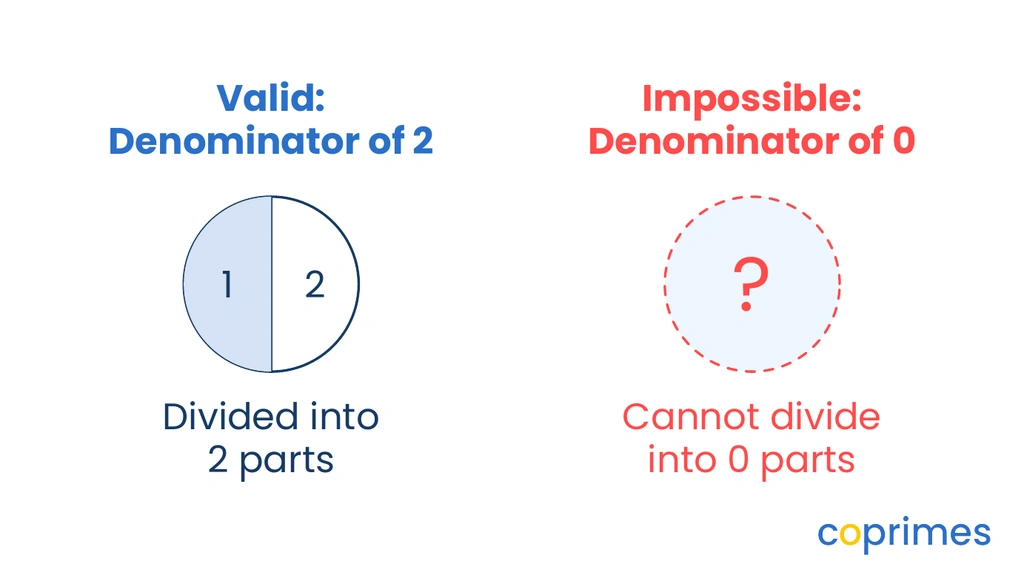
A fraction with a denominator of zero is undefined and mathematically impossible.
Denominators in models and number lines
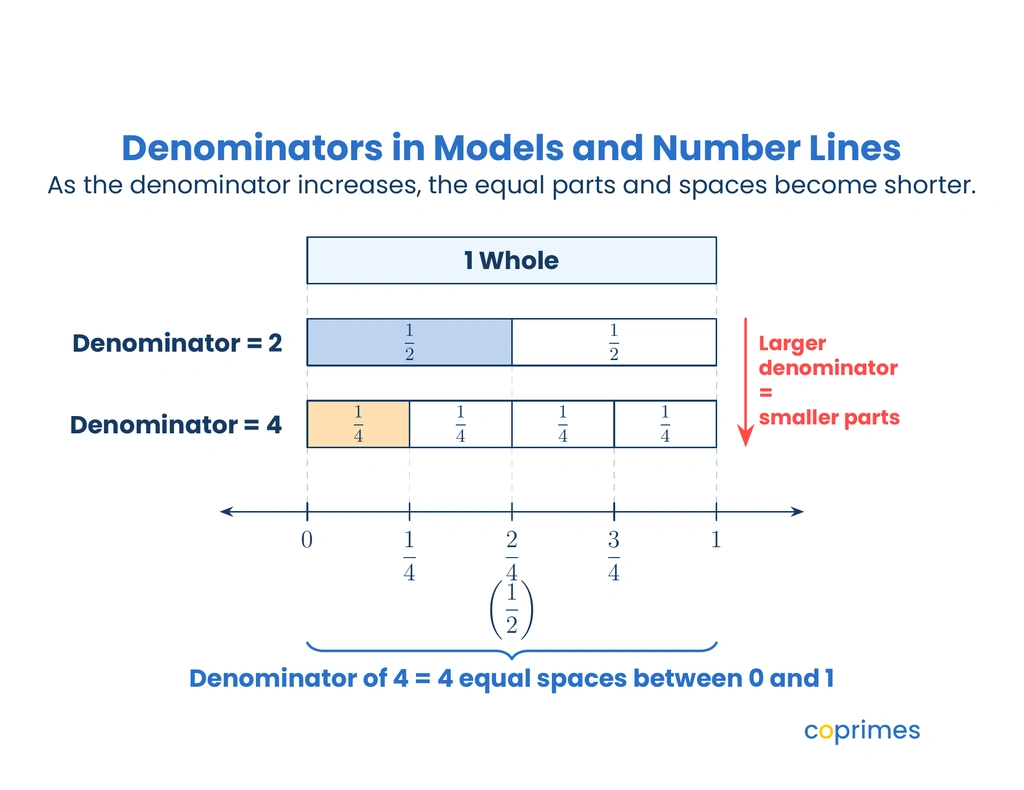
Visual models and number lines show exactly how the denominator determines the size and position of fractions.
By drawing rectangular models, we can compare parts of the same whole. When visualizing fractions on a number line, the denominator tells us how many equal spaces to create between and . As the denominator increases, the spaces on the number line become shorter.
Worked examples
Example 1: Identifying the denominator in a real-world context
Question: A baker cuts a large pie into equal slices. If slices are sold, what is the denominator of the fraction that represents the sold pie?
Method:
- Determine the total number of equal parts that make up the whole pie.
- Identify that this total represents the denominator.
Answer: The pie is divided into equal slices, so the denominator is .
Check: The fraction sold is . The bottom number is , which confirms the denominator.
Example 2: Finding the denominator in an algebraic fraction
Question: What is the denominator in the fraction ?
Method:
- Locate the fraction bar.
- Identify the entire expression written below the fraction bar.
Answer: The expression below the bar is , so the denominator is .
Check: The numerator on top is and the denominator on the bottom is . The identification is correct.
Example 3: Comparing parts based on denominators
Question: Which fraction has smaller equal parts: or ?
Method:
- Identify the denominators of both fractions.
- Compare the denominators. A larger denominator means the whole is divided into more pieces.
- Conclude that more pieces result in smaller individual parts.
Answer: The fraction has smaller equal parts because its denominator, , is larger than .
Check: Dividing a whole into parts creates smaller pieces than dividing it into only parts.
A learning plan shaped by your child, not the class
State-aligned Math plus our own Logic and English curriculum. An adaptive baseline test finds the gaps and fills them.
Common mistakes
Avoid these frequent errors when working with denominators.
- Confusing the numerator and denominator: Remember that the denominator is always positioned at the bottom. The numerator is on top.
- Thinking a larger denominator means a larger fraction: It is easy to assume that because is greater than , is greater than . However, a larger denominator means the whole is divided into more parts, making each part smaller.
- Adding denominators together: When adding or subtracting fractions, such as , never add the denominators. The denominator stays the same to show the size of the parts. The correct answer is , not .
Frequently asked questions
Here are answers to common questions about denominators.
What is a common denominator?
A common denominator occurs when two or more fractions share the same bottom number. For example, and have a common denominator of . Fractions must have a common denominator before they can be easily added or subtracted.
Can a denominator be a negative number?
Yes, a denominator can be negative, such as in the fraction . However, in final mathematical answers, the negative sign is usually moved to the numerator or placed in front of the fraction bar, making it .
What does it mean if the denominator is 1?
If a denominator is , it means the whole is not divided into any smaller pieces. The fraction simply represents a whole number. For example, is exactly the same as the number .
What are unit fractions?
When the numerator is and the denominator is a positive integer, the fraction is known as a unit fraction. For instance, and are unit fractions.
Practice questions
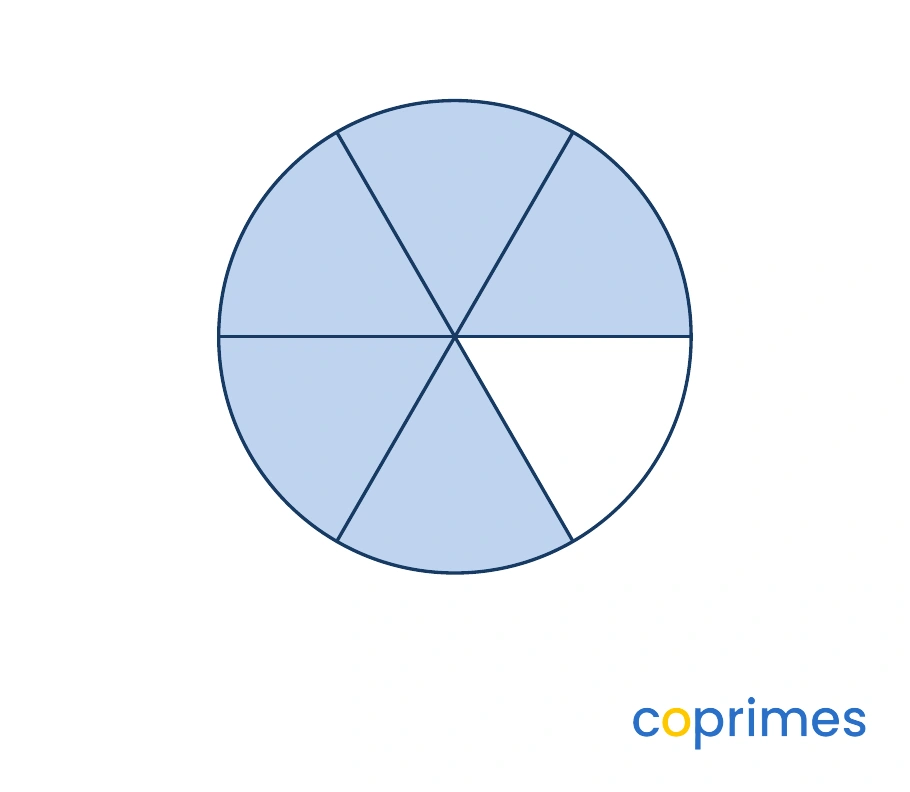
What is the denominator of the fraction shown by the shaded region?
5
6
1
11
6
What is the denominator in the fraction ?
15
7
22
37
22
What does the denominator of a fraction represent?
The total number of equal parts in a whole
The number of parts selected
The total number of wholes
The line separating the numbers
The total number of equal parts in a whole
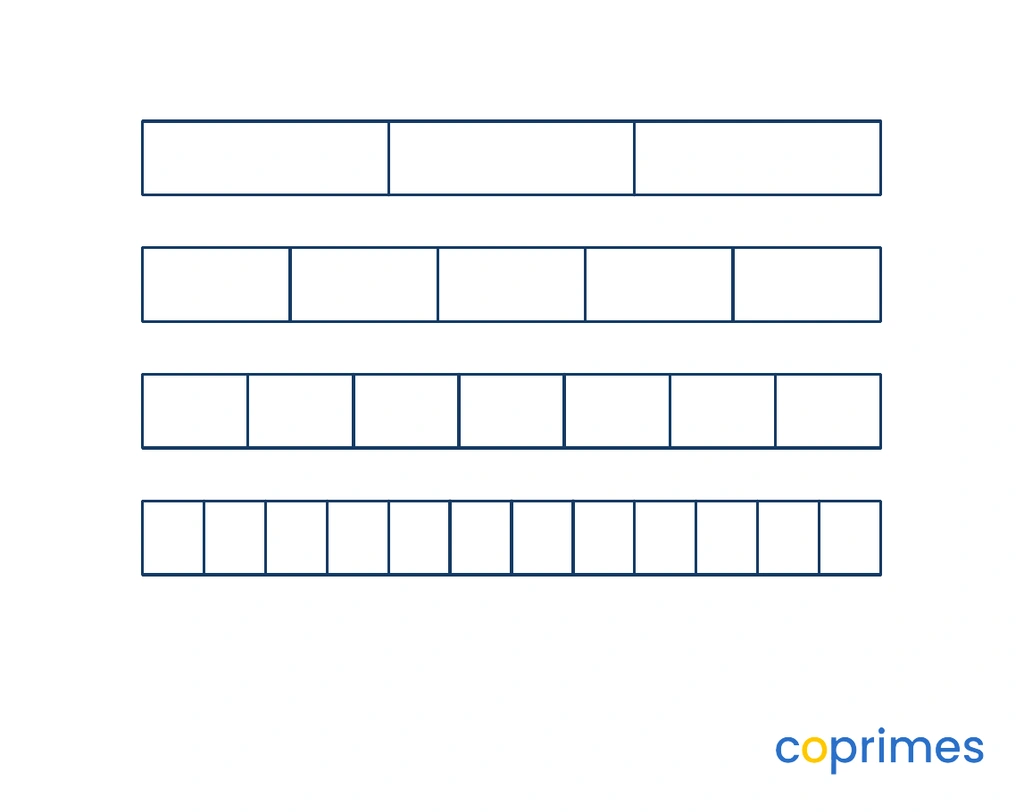
The four whole rectangles above are identical in total length, but each is divided into a different number of equal parts. Which fraction represents one part of the rectangle that has the smallest equal parts?
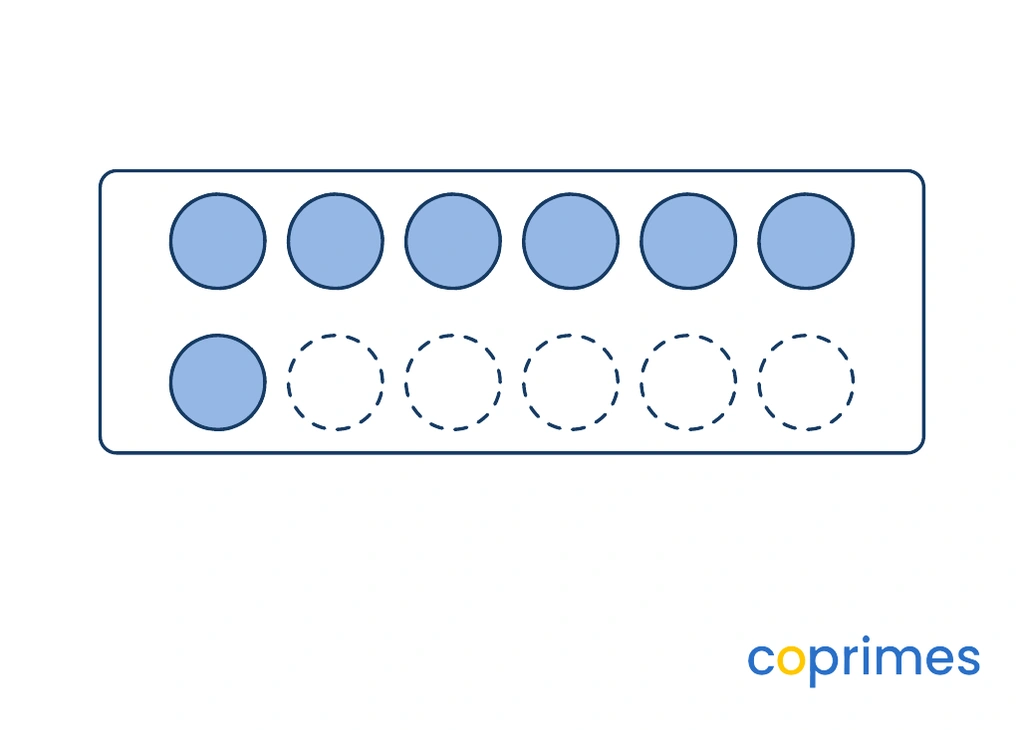
A carton holds eggs. A chef uses of them. What is the denominator of the fraction that represents the eggs used?
7
5
12
19
12