
Dividing Ratios
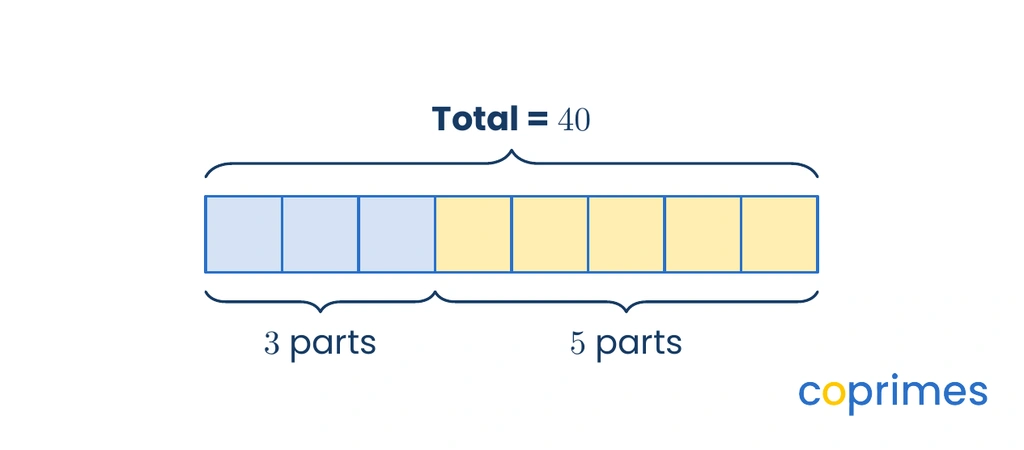
To divide a total in a ratio, add the ratio parts to find the number of equal shares, divide the total by that sum to find one share, then multiply one share by each ratio part.
Understanding how to divide a quantity in a ratio allows you to share resources fairly, split costs accurately, and solve comparative ratio problems in everyday contexts.
What does dividing a ratio mean?
Dividing a ratio means sharing a total amount into proportional parts rather than completely equal pieces.
When you share a quantity according to a ratio, each number in the ratio represents a specific number of shares. The larger the number in the ratio, the larger the portion of the total that part receives.
A ratio specifies how many equal shares each group receives from the total amount.
For example, dividing objects in the ratio means splitting the total into equal shares. The first group receives of those shares, and the second group receives . This connects directly to converting a ratio to fraction, where the denominator represents the total number of parts.
A learning plan shaped by your child, not the class
State-aligned Math plus our own Logic and English curriculum. An adaptive baseline test finds the gaps and fills them.
Allocate each ratio part
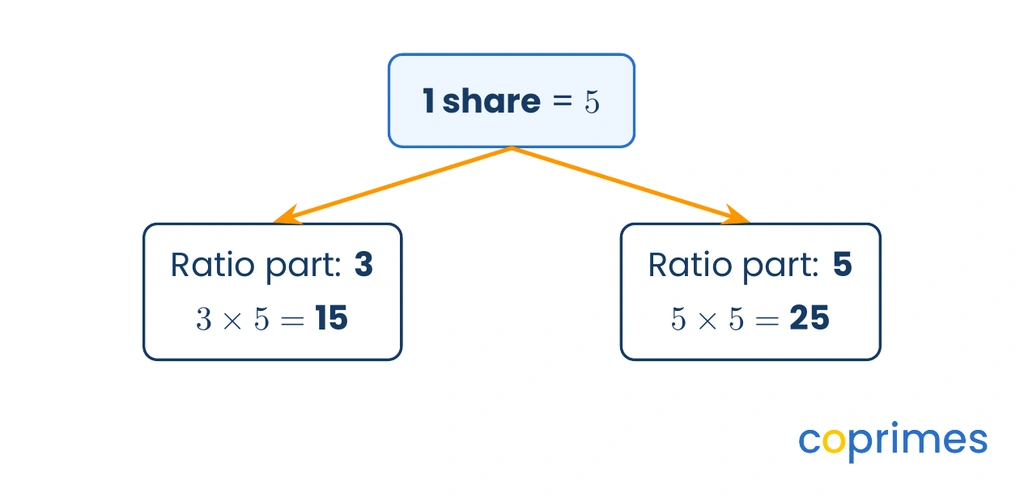
Next, multiply the value of one single share by each original number in the ratio.
This step scales the single unit up to match the exact proportions requested by the ratio. Finding these final amounts is an application of equivalent ratios, maintaining the original relationship while reaching the required total.
Check the total
Finally, always verify your calculation by adding the newly allocated amounts together.
The sum of your final parts must exactly equal the original total quantity. If the numbers do not match perfectly, an error occurred during the addition, division, or multiplication steps.
Worked examples
Follow these numbered steps to accurately divide quantities across different ratio formats.
Example 1: Dividing a generic quantity in a two-part ratio
Question: Divide in the ratio .
Method:
- Find the total number of shares: shares.
- Find one share by dividing the total quantity by the total number of shares: .
- Allocate each part by multiplying one share by the original ratio numbers: and .
Answer: The divided amounts are and .
Check: , which matches the original total.
Example 2: Dividing an amount in a three-part ratio
Question: Share dollars in the ratio .
Method:
- Find the total number of shares: shares.
- Find one share by dividing the total amount by the number of shares: dollars.
- Allocate each part: dollars, dollars, and dollars.
Answer: The shared amounts are dollars, dollars, and dollars.
Check: dollars, which correctly matches the starting amount.
Example 3: Solving when only one part is known
Question: In a recipe, the ratio of flour to sugar is . If grams of flour are used, what is the total weight of the mixture?
Method:
- Identify the given part in this math word problems context. The shares of flour equal grams.
- Find one share by dividing the given amount by its specific ratio part: grams.
- Find the total number of shares by adding the ratio parts: shares total.
- Multiply one share by the total number of shares: grams.
Answer: The total weight of the mixture is grams.
Check: One share is grams. The sugar amount is grams. The combined total equals grams.

Common mistakes
Dividing the total by only one ratio part
A frequent error is dividing the total quantity by the largest or smallest number in the ratio, rather than by the total sum of the ratio parts. Always add the parts together first to find the complete number of shares.
Allocating in the wrong order
The order of a ratio is strictly paired with the order of the categories. If a ratio of cats to dogs is , the first number () applies exclusively to the first category (cats). Mixing up the multiplied amounts assigns the wrong quantities to the subjects.
Frequently asked questions
Can a ratio have more than two parts?
Yes, a ratio can compare three, four, or more quantities. The method remains identical: add all the parts to find the total shares, find the value of one share, and multiply that single value by each part of the expanded ratio.
What happens if the total does not divide evenly?
In many ratio problem solving scenarios, dividing the total by the number of shares produces a decimal or fraction. This is mathematically correct, provided the context allows for fractional parts (such as weight, distance, or money). If the context involves indivisible objects like people or vehicles, a decimal result indicates a mistake in calculation or setup.
Practice questions
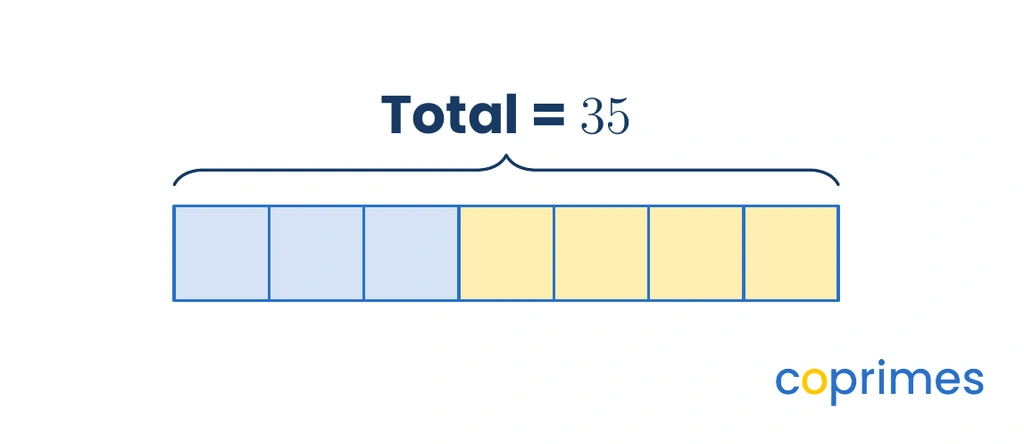
The tape diagram shows a total of divided into a ratio of . What is the allocated value of the larger part?
Divide in the ratio .
and
and
and
and
and
Share dollars in the ratio . What are the allocated amounts?
dollars, dollars, and dollars
dollars, dollars, and dollars
dollars, dollars, and dollars
dollars, dollars, and dollars
dollars, dollars, and dollars
A student is asked to divide into the ratio . They divide by to find the value of one share. What mistake did they make?
They should have divided by because it is the smaller number.
They should have multiplied by instead of dividing.
They divided by only one ratio part instead of the sum of the ratio parts.
They allocated the amounts in the wrong order.
They divided by only one ratio part instead of the sum of the ratio parts.
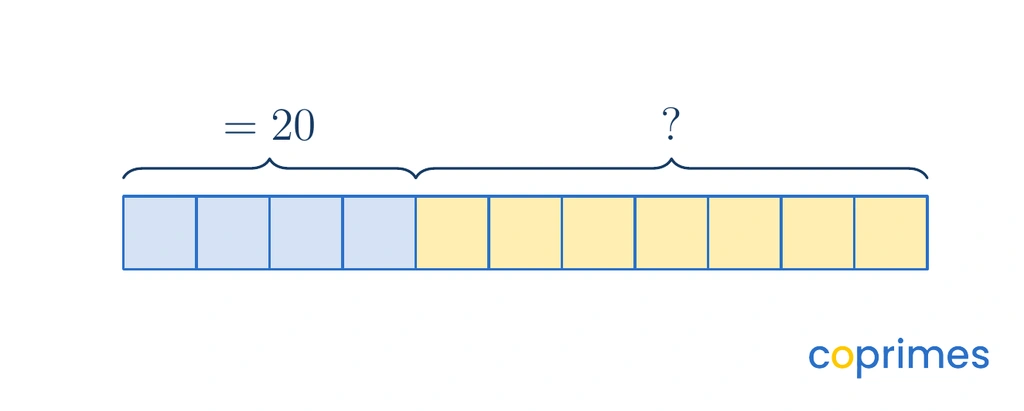
Two quantities are in the ratio . If the smaller quantity is , what is the value of the larger quantity?