
Ratio Problem Solving
To solve a ratio problem, identify what each ratio part represents, preserve the stated order, decide whether to scale, share, compare or convert, use a diagram, table or equation, then check that the answer fits the context.
What are ratio problems?
Ratio problems are applied mathematical scenarios where you compare quantities using their proportional relationships.
In ratio problem solving, the goal is to interpret real-world contexts and calculate missing amounts based on a given ratio. These applied ratio scenarios act as math word problems where you must extract the ratio, identify what the given numbers represent, and find the unknown values.
A ratio can compare parts to other parts, or parts to a whole. Mastering these ratio word problems requires understanding how quantities scale together.
Identify the relationship
The first step in solving is to match each part of the ratio to the correct quantity in the word problem.
Ratios are always written in a specific order. If a mixture contains juice and water in the ratio , the first number represents the juice, and the second represents the water. Mixing up this order is a frequent mistake.
Once the relationship is clear, determine what the given value in the problem represents. It might be the value of one specific part, the total of all parts, or the difference between two parts.
Choose a representation
Visual models and tables organize the information clearly before you begin to calculate.
A tape diagram, or bar model, is highly effective for visualizing ratio groups. Drawing a box for each part of the ratio makes it easy to see how the quantities relate to the total or to each other.
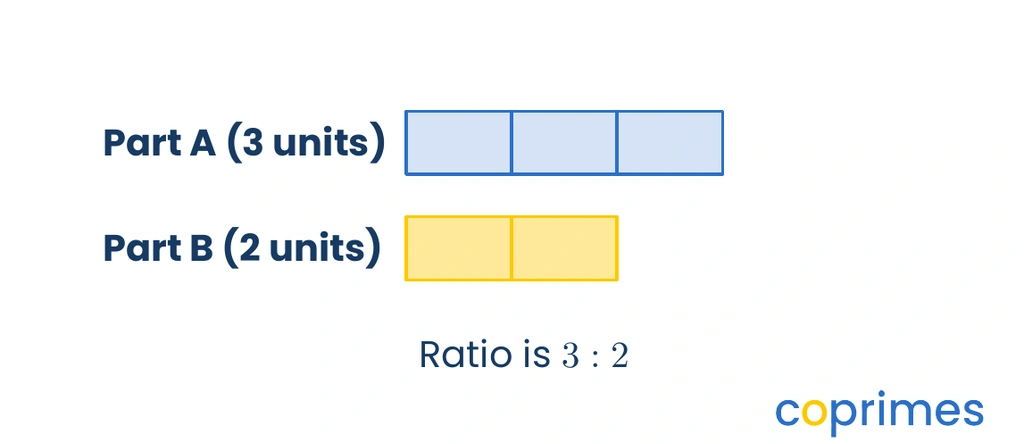
Alternatively, ratio tables allow you to track values clearly as you scale them up or down. Choosing a familiar model ensures you structure the calculation correctly.
A learning plan shaped by your child, not the class
State-aligned Math plus our own Logic and English curriculum. An adaptive baseline test finds the gaps and fills them.
Scale or share a ratio
Once you set up the problem, you will typically find equivalent amounts or divide a total into shares.
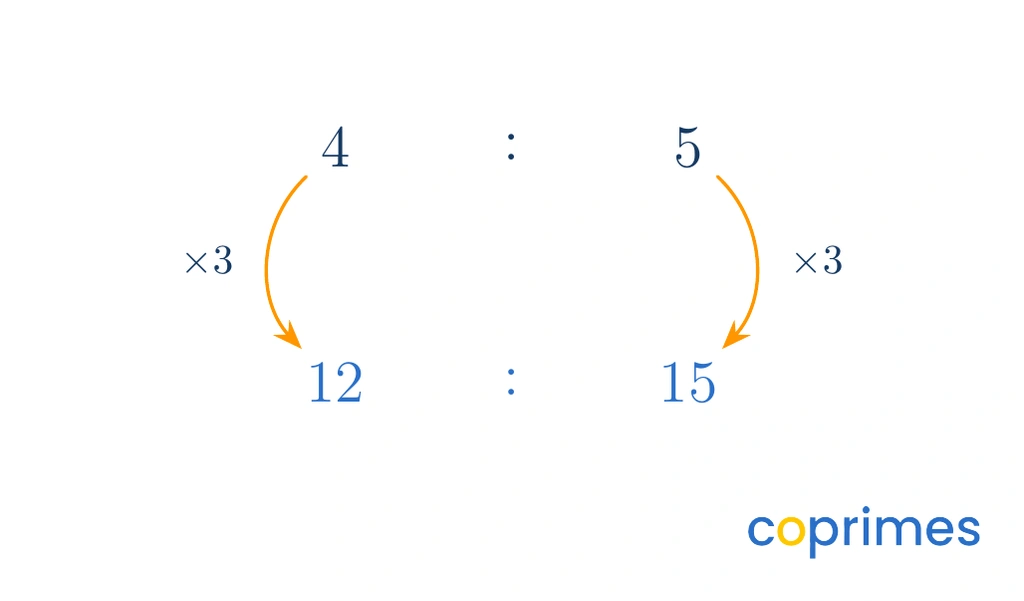
If the problem provides a starting ratio and asks for a larger or smaller version, use multiplication or division to find equivalent ratios. Whatever operation you apply to one side of the ratio, you must apply to the other side.
When a problem provides a total amount and a ratio, you are dividing ratios. You must add the ratio parts together to find the total number of shares, divide the total amount by this number to find the value of a single share, and then multiply to find each specific portion.
Check units and reasonableness
Verify that the units in your calculation match the units requested in the final answer.
Many ratio word problems introduce mixed units to test attention to detail. If a ratio compares lengths but gives one measurement in meters and another in centimeters, you must convert them to a common unit before calculating.
After finding a solution, check if the numbers make sense in the context. If you are sharing dollars, no individual share can be larger than dollars.
Worked examples
Apply these mathematical strategies to common ratio problem types.
Example 1: Sharing a total with unit conversion
Question: A metal alloy is made of copper and zinc in the ratio . The total mass of the alloy is kilograms. What is the mass of copper in grams?
Method:
- Check the units. The question gives kilograms but asks for grams. Convert kilograms to grams.
- Find the total number of parts. The ratio is , so there are total parts.
- Calculate the value of one part by dividing the total amount by the total number of parts: grams.
- Multiply to find the copper mass. Copper is parts, so grams.
Answer: The mass of copper is grams.
Check: Zinc would be grams. grams, which matches the starting total.
Example 2: Equivalent-ratio scaling problem
Question: A recipe for soup uses carrots and potatoes in the ratio . If a chef uses kilograms of potatoes, how many kilograms of carrots are needed?
Method:
- Identify the given ratio and align it with the known value. Carrots to potatoes is . We have kilograms of potatoes.
- Determine the multiplier. Divide the new potato amount by the original ratio part for potatoes: .
- Apply the multiplier to the carrot part to find the required amount: .
Answer: The chef needs kilograms of carrots.
Check: The new ratio is . If you multiply both sides by , you get . Dividing both by simplifies it back to .
Example 3: Multi-step difference problem
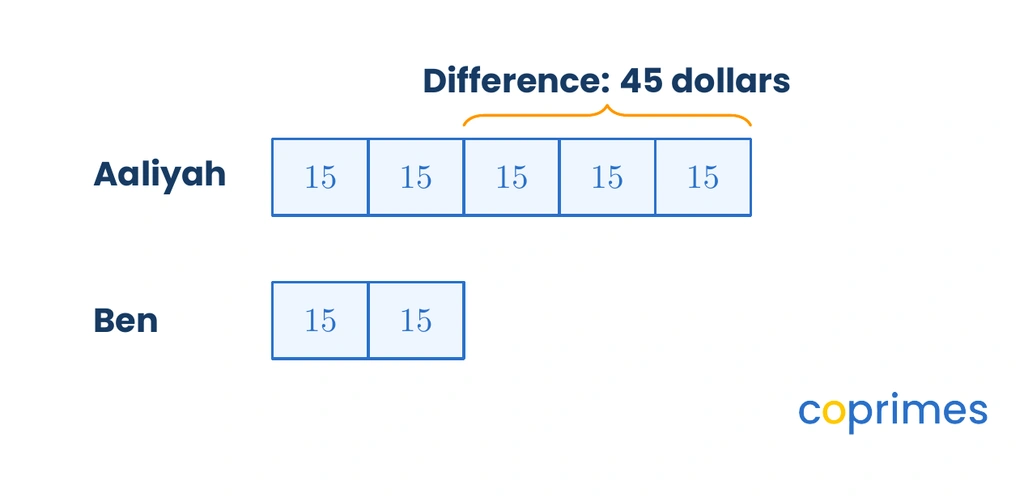
Question: Aaliyah and Ben share prize money in the ratio . If Aaliyah receives dollars more than Ben, what is the total amount of prize money?
Method:
- Identify the difference in ratio parts. Aaliyah has parts and Ben has parts. The difference is parts.
- Set the difference in parts equal to the given quantity difference. Those parts equal dollars.
- Find the value of one part: dollars.
- Find the total number of parts: total parts.
- Multiply the total parts by the value of one part: dollars.
Answer: The total amount of prize money is dollars.
Check: Aaliyah gets dollars. Ben gets dollars. The difference is dollars, and the total is dollars.

Common mistakes
Avoid mixing units, writing ratios in the wrong order, and confusing ratios with fractions.
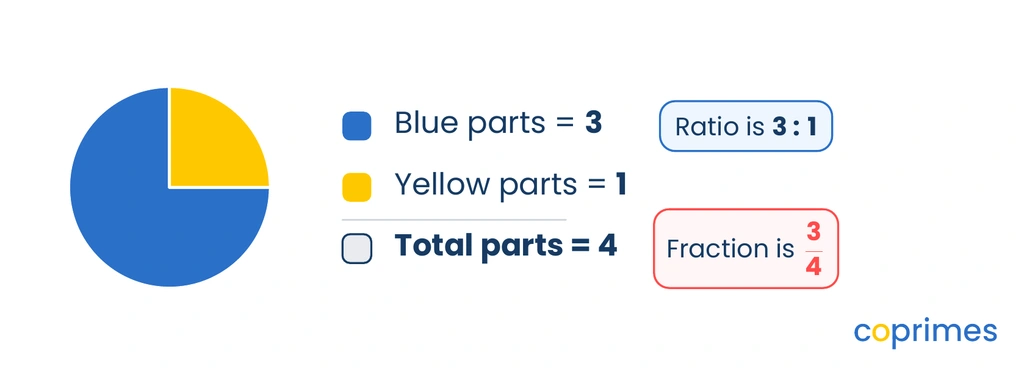
A frequent error occurs when reading a ratio in the format and assuming the fraction for part is . The denominator of a fraction representing a portion of the whole must be the sum of all parts, not just the other part.
Additionally, remember that ratios can involve decimals or fractions. For example, reducing a ratio to the form may result in a decimal value for . This is completely valid and often useful for direct comparisons.
Frequently asked questions
Common questions about ratio problem solving.
What is the difference between a ratio and a rate?
A ratio compares two quantities of the same type, such as cats to dogs. A rate compares two quantities with different units, such as kilometers per hour or cost per kilogram.
Can a ratio have more than two parts?
Yes. A ratio can compare three or more quantities, such as mixing sand, cement, and gravel in a ratio. The same problem-solving methods apply, and the total is found by adding all the parts together.
How do you write a ratio as a fraction?
To find what fraction of the whole a specific part represents, place the value of that part over the total sum of all parts in the ratio. For a ratio, the first part represents of the total.
Practice questions

What is the ratio of blue dots to yellow dots in its simplest form?
A wire measuring centimeters is cut into two pieces in the ratio . What is the length of the longer piece?
cm
cm
cm
cm
cm
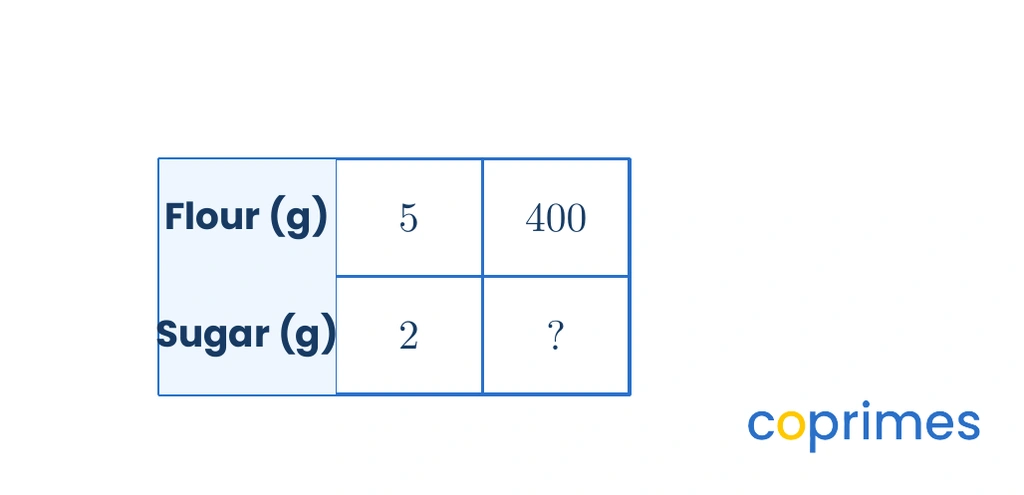
A recipe uses flour and sugar in the ratio . If a baker uses grams of flour, how much sugar is needed?
g
g
g
g
g
In a class, the ratio of students who play sports to those who do not play sports is . Which statement is true?
of the class plays sports.
of the class does not play sports.
of the class does not play sports.
of the class plays sports.
of the class does not play sports.
Maya and Leo share a collection of stamps in the ratio . If Maya has more stamps than Leo, how many stamps do they have in total?