
What is a proportion?
A proportion is a mathematical statement showing that two ratios are strictly equal.
For a statement to be a true proportion, both sides must simplify to the exact same value.
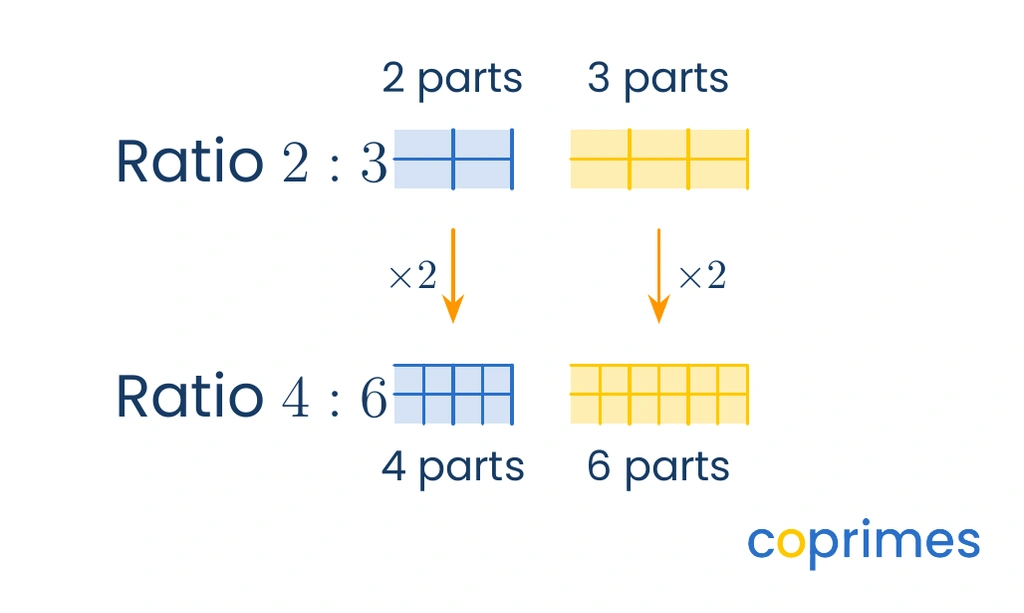
True proportions represent equivalent quantities scaled by a constant multiplier.
A true proportion looks like this:
A non-proportion occurs when the two ratios do not share the same value:
Write a proportion
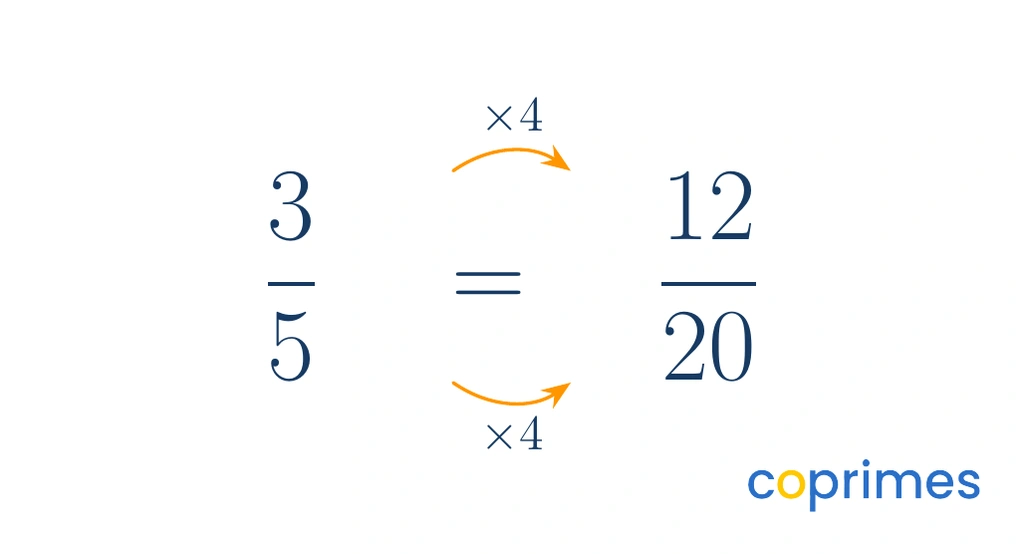
You can write a proportion mathematically by setting two equivalent-fraction expressions equal to one another.
Occasionally, you may see proportions written horizontally using a double colon symbol, such as . This statement reads as " is to as is to ." Although standard fractional equations are more common, both formats communicate the exact same equal-ratio relationship.
Connect equivalent ratios and proportions
Every valid proportion is built entirely from equivalent ratios. You create equivalent ratios by multiplying or dividing both parts of an original ratio by the same non-zero value.
A helpful way to organize multiple equivalent ratios is by using ratio tables. A ratio table groups paired inputs and outputs, proving that a single scaling factor connects the variables across every column.
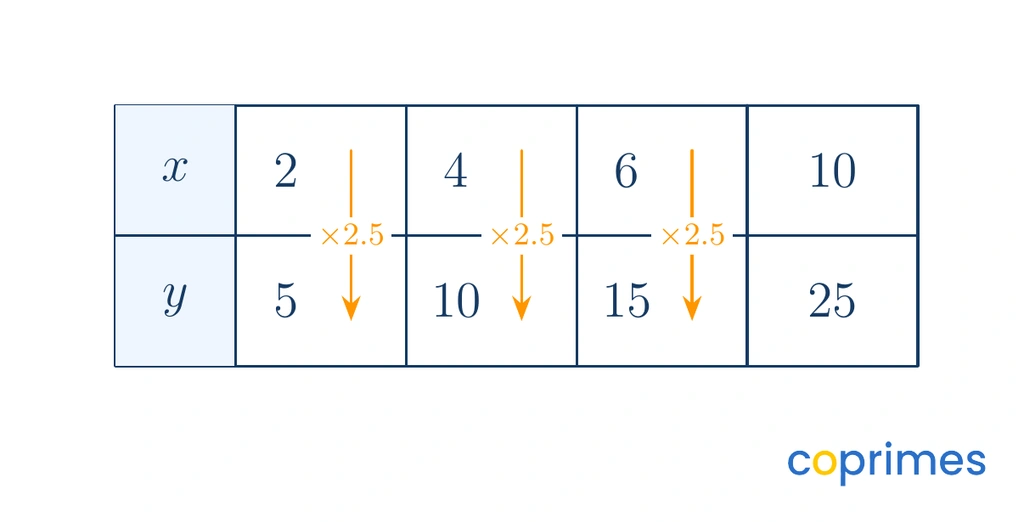
Because multiplying any value in the top row by produces the corresponding value in the bottom row, the table displays a consistent proportion.
A learning plan shaped by your child, not the class
State-aligned Math plus our own Logic and English curriculum. An adaptive baseline test finds the gaps and fills them.
Represent a proportion visually
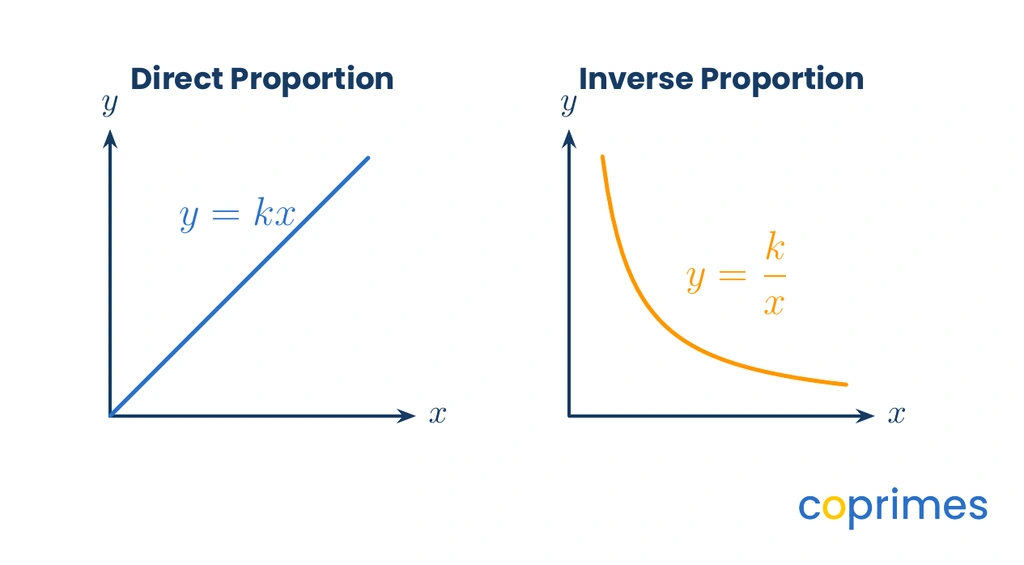
You can represent proportional relationships on a coordinate plane, and their shapes depend on whether the proportion is direct or inverse.
A direct proportion produces a straight line that passes exactly through the origin . An inverse proportion produces a curved line that approaches the axes but never touches them, because as one variable increases, the other variable decreases.
Use proportion vocabulary
Proportions use a specific set of mathematical vocabulary to define their formulas and relationships.
- Constant of proportionality : The fixed numerical value that mathematically connects the two variables.
- Direct proportion: A relationship represented by the equation , where increases steadily as increases.
- Inverse proportion: A relationship represented by the equation , where decreases proportionally as increases.
Worked examples
Example 1: Verifying a true proportion
Question: Is a true proportion?
Method:
- Identify the multiplier connecting the numerators.
- Check if the exact same multiplier connects the denominators. This is a standard procedure for verifying proportions.
Answer: Yes, it is a true proportion because both parts scale strictly by .
Check: Simplify the fraction by dividing both parts by to confirm it returns to .
Example 2: Finding a missing value in a proportion
Question: Solve for in the equation .
Method:
- Find the factor that scales the denominator to the target denominator .
- Apply that same factor to the numerator to find . This is an efficient approach for solving proportions.
Answer: Because , you must multiply to get .
Check: Substitute back into the original proportion and verify that simplifies cleanly to .
Example 3: Determining the inverse proportion formula
Question: The variable is inversely proportional to . When , . What is the formula linking and ?
Method:
- Set up the general inverse proportion equation .
- Substitute the given values to solve for the constant of proportionality, .
Answer: Substituting the values gives . Multiplying both sides by results in . The specific formula is .
Check: Substitute into the new formula. equals , which matches the original given information.

Common mistakes
Misapplying cross-multiplication
Cross-multiplication is an effective algebraic strategy when solving proportions, but only if both ratios are separated by an equal sign. A common error involves cross-multiplying when multiplying two separate fractions, which requires multiplying straight across instead.
Thinking every straight line represents a direct proportion
Many straight lines model linear equations, such as . However, if an equation contains addition or subtraction, its graph will not pass through the origin , meaning the relationship is strictly not a direct proportion.
Frequently asked questions
What is the double colon symbol used for?
The double colon () is traditional notation used to declare that two ratios are equivalent. The expression functions exactly like an equal sign in the fraction equation .
How do direct proportions connect to linear equations?
A direct proportion is a specific, restricted type of linear equation. While all direct proportions graph as straight lines, they must be formatted as and must pass perfectly through the coordinate origin.
Practice questions
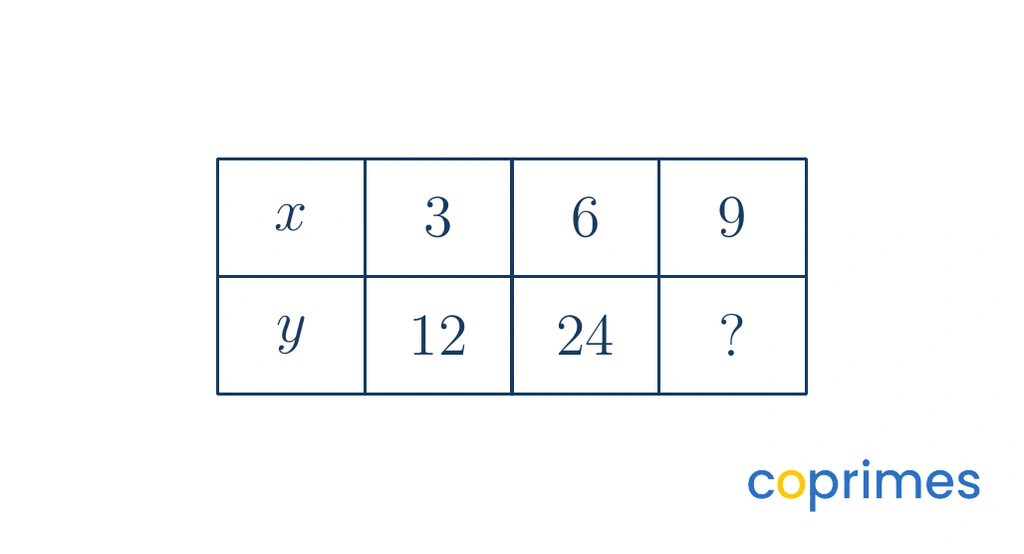
The table models a direct proportion between and . What is the missing value?
Solve for in the proportion .
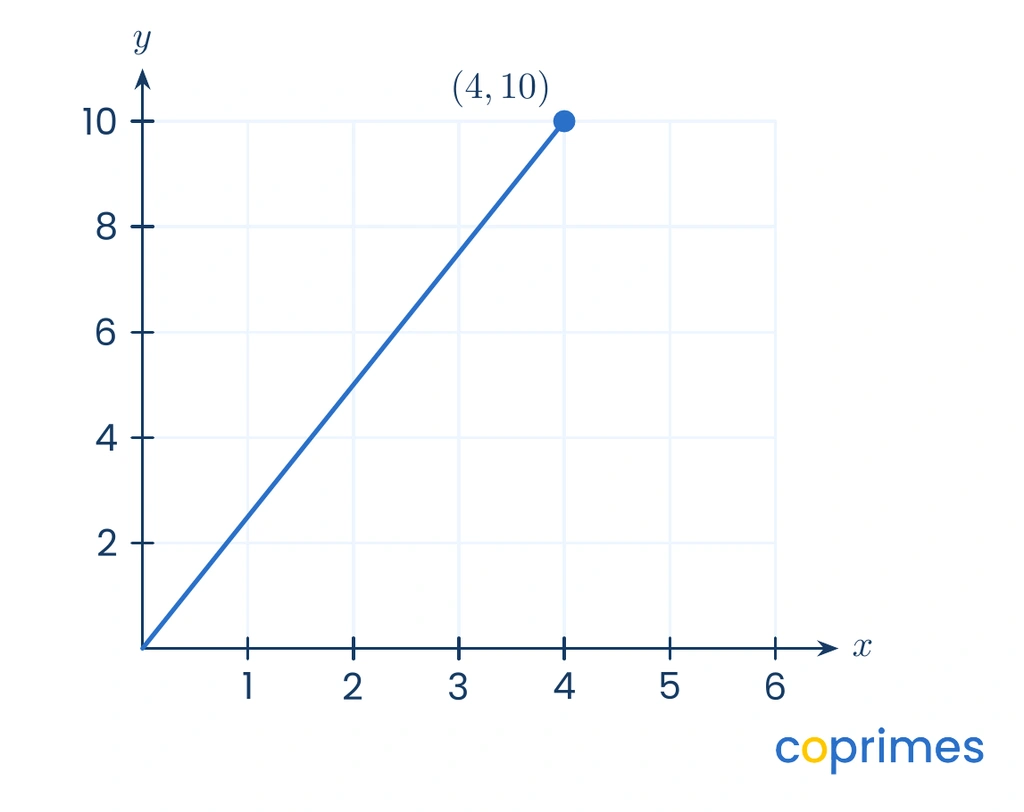
The graph shows a direct proportion between and . What is the constant of proportionality, ?
The variable is inversely proportional to . When , . What is the value of when ?
Which equation mathematically represents a direct proportion?