
Equivalent Fractions: Definition, Method and Examples
Equivalent fractions are different fraction names for the same value, such as one half, two fourths, and four eighths. To create them, multiply or divide both the numerator and the denominator by the same nonzero whole number to keep the value unchanged.
What are equivalent fractions?
Equivalent fractions are fractions that represent the exact same portion of a whole, even though they use different numbers. They look different but have the same value.
Equivalent fractions have different numerators and denominators but equal the same amount.
For example, if you eat of a pizza, you are eating the exact same amount as someone who eats of an identical pizza, or of that same pizza. The slices are simply cut into different sizes, but the total amount of food is equal.
Every fraction has an infinite number of equivalent fractions. Recognizing them is an essential step before comparing fractions or adding them together.
See equivalence in visual models
Visual models are one of the clearest ways to find equivalent fractions. By comparing identical shapes divided into different numbers of pieces, you can see that the shaded areas remain exactly the same size.
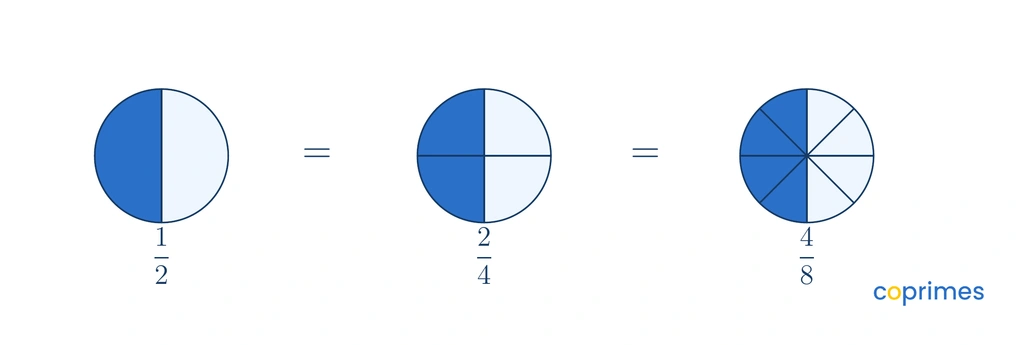
Make equivalent fractions
You can generate an equivalent fraction mathematically by applying a simple rule to the numerator (the top number) and the denominator (the bottom number).
To make an equivalent fraction, multiply or divide both the numerator and the denominator by the exact same nonzero whole number.
When you multiply, you are splitting the existing parts into smaller, more numerous pieces. When you divide, you are grouping smaller pieces together into larger, fewer pieces. Both actions leave the total portion the same.
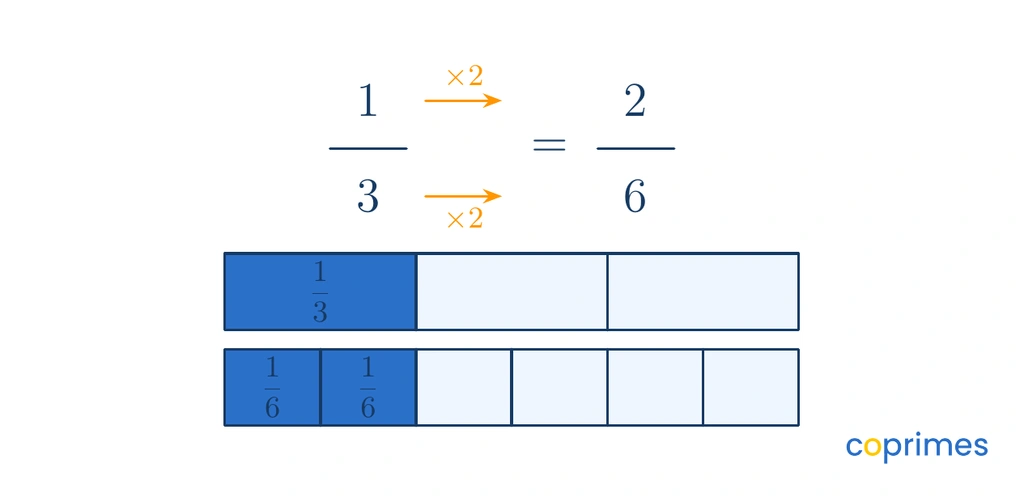
Example 1: Multiplying to find equivalent fractions
Question: Find two equivalent fractions for .
Method:
- Choose any whole number greater than .
- Multiply the numerator and denominator by that number.
- Repeat with a different number to find a second equivalent fraction.
Answer: Using , we get . Using , we get . Both and are equivalent to .
Check: If you divide the numerator and denominator of by , it simplifies back to .
When you divide to find an equivalent fraction, the process is known as simplifying fractions. You must choose a number that divides evenly into both the numerator and denominator so that no decimals are left.
Example 2: Dividing to simplify a fraction
Question: Find an equivalent fraction for by dividing.
Method:
- Identify a common factor that divides evenly into both and .
- Divide the numerator and denominator by that number.
Answer: The number divides evenly into both. . Therefore, is an equivalent fraction.
Check: Multiplying by gives back , confirming the values are equal.

Why multiply or divide both parts
When you multiply the top and bottom by the same number, you are mathematically multiplying the fraction by a form of . Any number multiplied by remains identical in value.
For example, is equal to . If you start with and multiply by , the problem looks like this:
Because you multiplied by , the value of the fraction has not changed. The identical principle applies when dividing: dividing the numerator and denominator by the same number is mathematically the same as dividing the fraction by .
This is also an important rule when you need a common denominator to add or subtract fractions.
Check whether fractions are equivalent
There are multiple ways to verify if two fractions share the same value.
- Simplify completely: If both fractions simplify to the same fraction, they are equivalent. For example, and both simplify to .
- Look for a multiplier: Check if you can multiply the top and bottom of the smaller fraction by the same whole number to get the larger fraction.
- Cross-multiply: Multiply the numerator of the first fraction by the denominator of the second fraction. Then, multiply the denominator of the first by the numerator of the second. If the two products are equal, the fractions are equivalent.
Example 3: Checking for equivalence
Question: Are and equivalent fractions?
Method:
- Attempt to find a whole-number multiplier linking the numerators.
- Verify if the identical multiplier connects the denominators.
Answer: Yes. The numerator multiplies by to reach . The denominator multiplies by the same to reach . The fractions are equivalent.
Check: Using cross-multiplication: , and . The products match, confirming equivalence.
Equivalent fractions on a number line
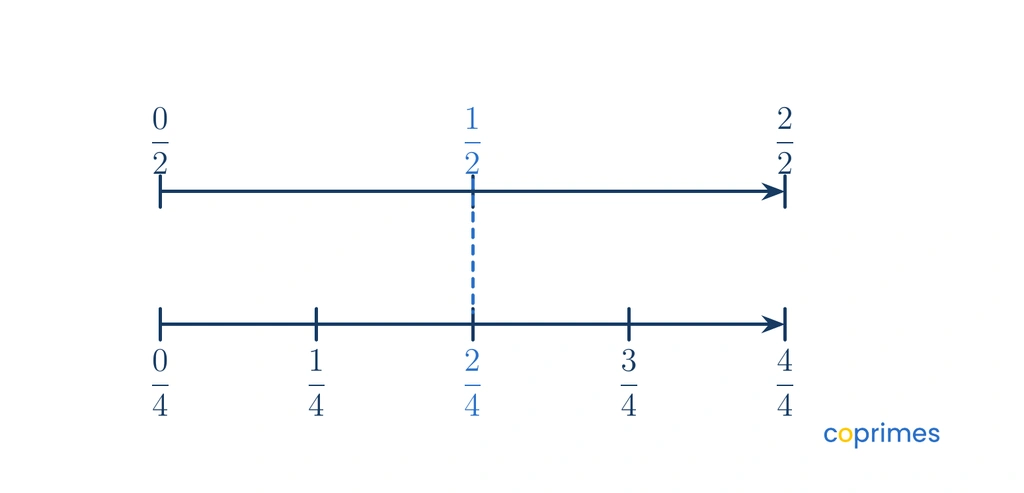
A number line provides another visual way to prove fractions are equivalent. When you plot equivalent fractions on a number line, they land on the exact same point.
For instance, the fraction sits exactly halfway between and . If you divide the number line into four equal sections instead of two, the point is at that same halfway mark.
A learning plan shaped by your child, not the class
State-aligned Math plus our own Logic and English curriculum. An adaptive baseline test finds the gaps and fills them.
Common mistakes
The most common error when working with equivalent fractions is adding or subtracting the same number from the numerator and denominator, instead of multiplying or dividing.
Never add or subtract to find an equivalent fraction.
If you take and add to both the numerator and the denominator, you get . However, is noticeably larger than . The rule of equivalence only works with multiplication and division.
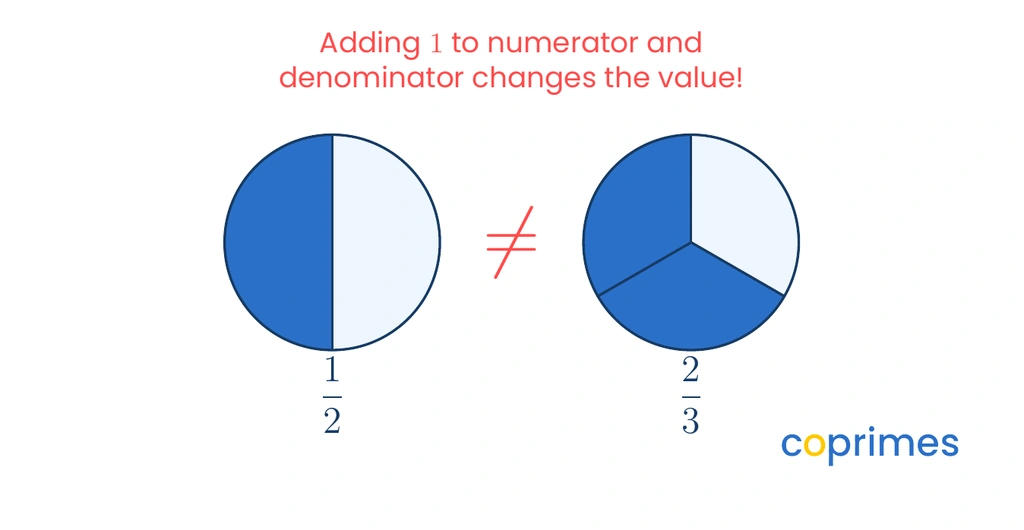
Another common mistake is forgetting to perform the exact same operation to both parts of the fraction. If you multiply the numerator by , you must also multiply the denominator by .
Frequently asked questions
Are simplified fractions always equivalent?
Yes. When you simplify a fraction by dividing both the numerator and the denominator by a common factor, the resulting fraction represents the same value and is entirely equivalent to the original.
How do equivalent fractions help with cooking?
If a recipe requires cup of sugar, but you only have a measuring cup, knowing equivalent fractions allows you to fill the cup exactly two times.
Is it possible to make equivalent fractions with decimals?
While you can mathematically generate equivalent ratios using decimals, standard proper fractions are written with whole numbers. You should choose multipliers or divisors that keep both the top and bottom parts as whole numbers.
Do equivalent fractions apply to mixed numbers?
Yes. For mixed numbers, you can find equivalent fractions by keeping the whole number the same and applying the multiplication or division rule to the fraction part. For example, is equivalent to .
Are benchmark fractions equivalent to other fractions?
Yes. Common benchmark fractions, such as , , and , have countless equivalent forms. Recognizing that is equivalent to the benchmark fraction helps you estimate values quickly.
Practice questions
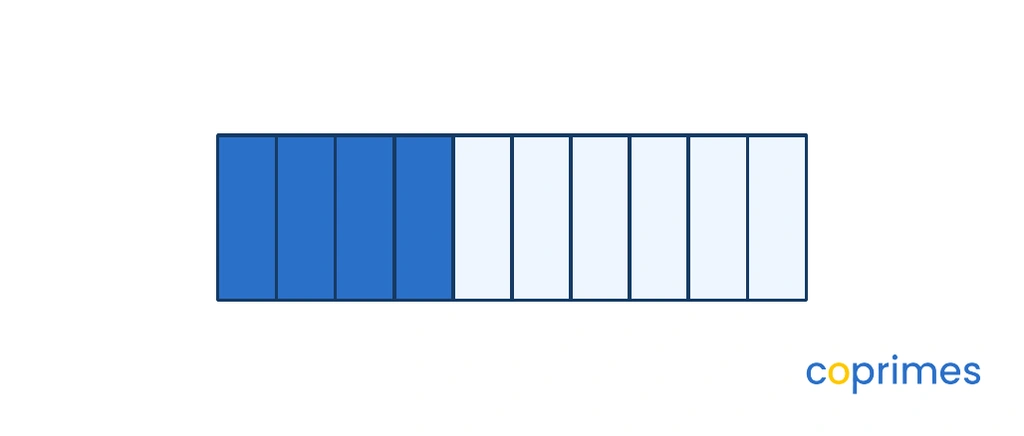
Which fraction is equivalent to the shaded area shown in the model?
Which operation correctly creates an equivalent fraction for ?
Adding to both the numerator and the denominator.
Multiplying both the numerator and the denominator by .
Multiplying the numerator by and leaving the denominator as .
Squaring both the numerator and the denominator.
Multiplying both the numerator and the denominator by .
A number line shows a point exactly on the fraction . Which of the following fractions is located at that exact same point?
A student claims that and are equivalent because they added to both the top and bottom numbers. Why is this reasoning incorrect?
The student should have subtracted instead of adding .
Equivalent fractions are only created by adding , not .
Equivalent fractions can only be created by multiplying or dividing, never by adding.
The fractions are actually equivalent, so the reasoning is completely correct.
Equivalent fractions can only be created by multiplying or dividing, never by adding.
A recipe calls for of a cup of milk, but you only have a measuring cup. How many times will you need to fill the cup to equal of a cup?
times
times
times
times
times