
Fractions of a Whole and a Set: Definition, Method and Examples
A fraction of a whole describes equal pieces of one single continuous object.
A fraction of a set describes an equal share of a collection of separate objects.
In both cases, the whole or full set must be clearly defined before the fraction can be interpreted.
Understanding both fractions representations is essential for solving problems involving sharing and grouping.
Fractions of a whole and a set
A fraction represents a part of something, but that "something" can take two different forms.
When you find a fraction of a whole, you divide one continuous object into equal parts. The entire object represents exactly one whole unit.
When you find a fraction of a set, you divide a collection of discrete, separate items into equal groups. The entire collection of objects represents the whole.
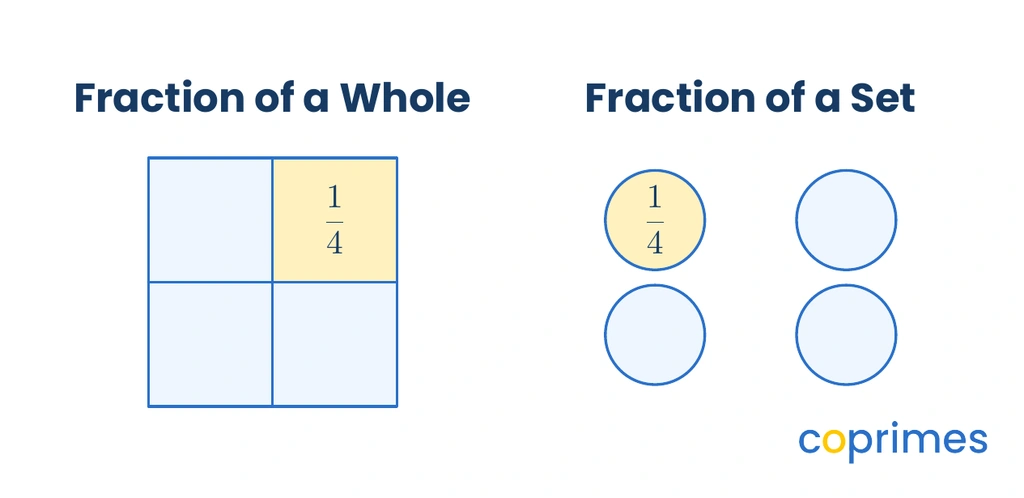
Drawing these different situations using visual fraction models helps you choose the correct method when sharing out items or splitting an area.
Equal parts of one whole
A fraction of a whole requires partitioning a single shape or length into completely equal sections.
The denominator indicates the total number of identical parts the whole is divided into.
The numerator indicates how many of those equal parts are counted.
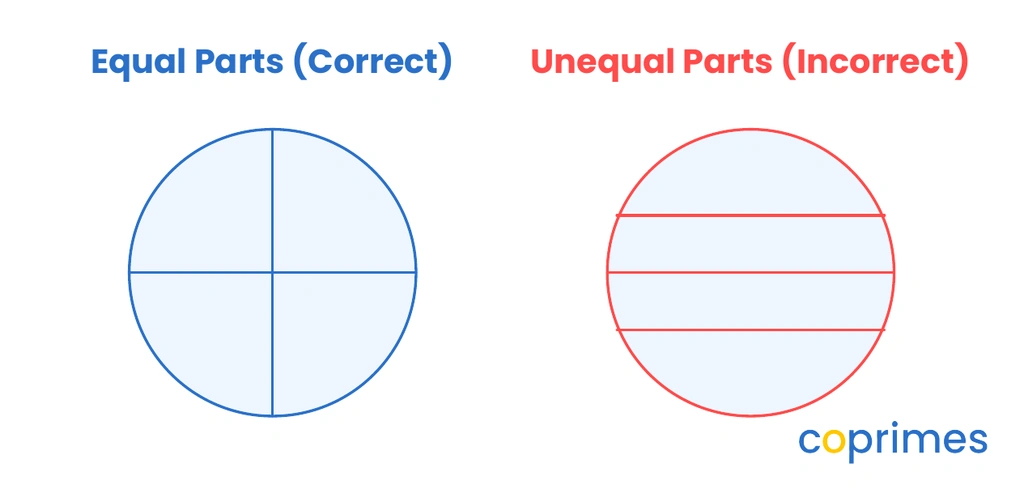
All parts of a whole must be exactly the same size for the fraction to be valid.
If a rectangle is cut into three equal pieces and one is shaded, the fraction is .
If the pieces are different sizes, you cannot use a simple fraction to describe them because the requirement for equal sharing is broken.
Equal groups in a set
A fraction of a set applies the same equal-sharing logic to a collection of individual items.
Instead of cutting one continuous object into pieces, you sort the total number of items into separate but identical groups.
The denominator tells you how many equal groups to create.
The numerator tells you how many of those groups are selected.
For example, if you have a set of stars and you want to find of the set, you divide the stars into equal groups.
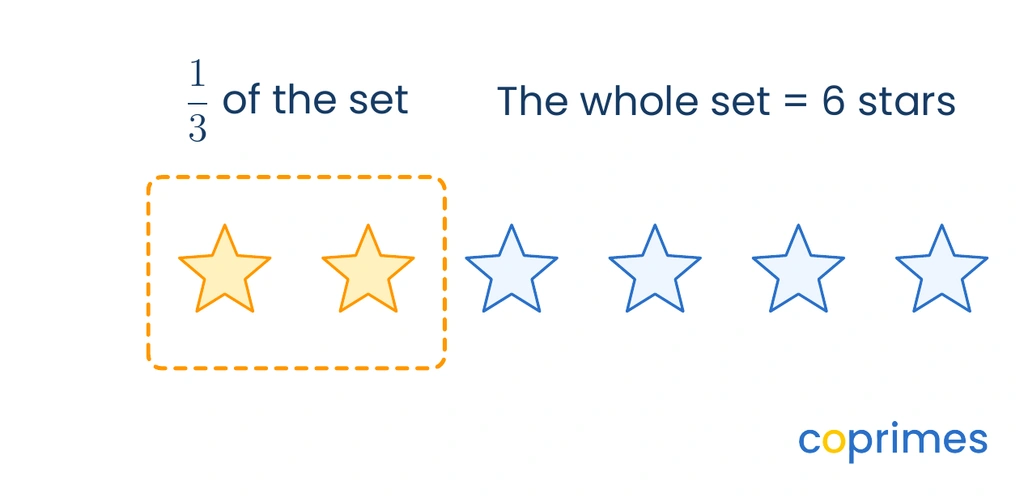
Because the items are shared equally, each group contains stars. Therefore, of is .

Find a unit fraction of a quantity
To find a unit fraction of a number or measurement, divide the total quantity by the fraction's denominator.
This operation shares the total amount into the required number of equal groups.
Because a unit fraction always has a numerator of , you only need the value of one of those groups.
To find a unit fraction of a quantity, divide the quantity by the denominator.
Method:
- Identify the total quantity and the denominator of the fraction.
- Divide the total quantity by the denominator.
- The result is the value of one fractional part.
Practicing this step prepares you for working with non-unit fractions which require additional calculations.
Find a non-unit fraction of a quantity
A non-unit fraction has a numerator greater than , such as or .
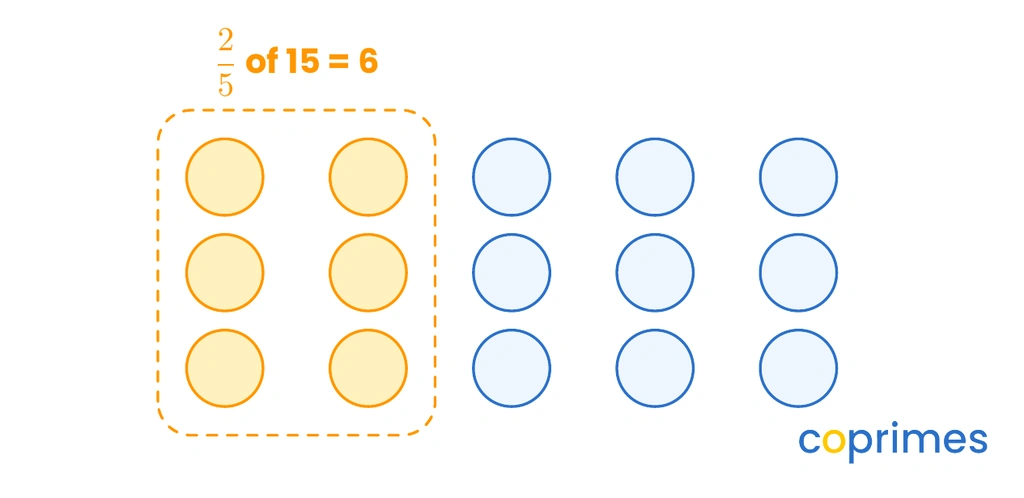
To find a non-unit fraction of a quantity, you calculate the value of one equal part first, and then multiply by the number of parts indicated by the numerator.
Method:
- Divide the total quantity by the denominator to find the value of one unit fraction.
- Multiply this result by the numerator to find the value of the required number of parts.
This two-step process works for any quantity.
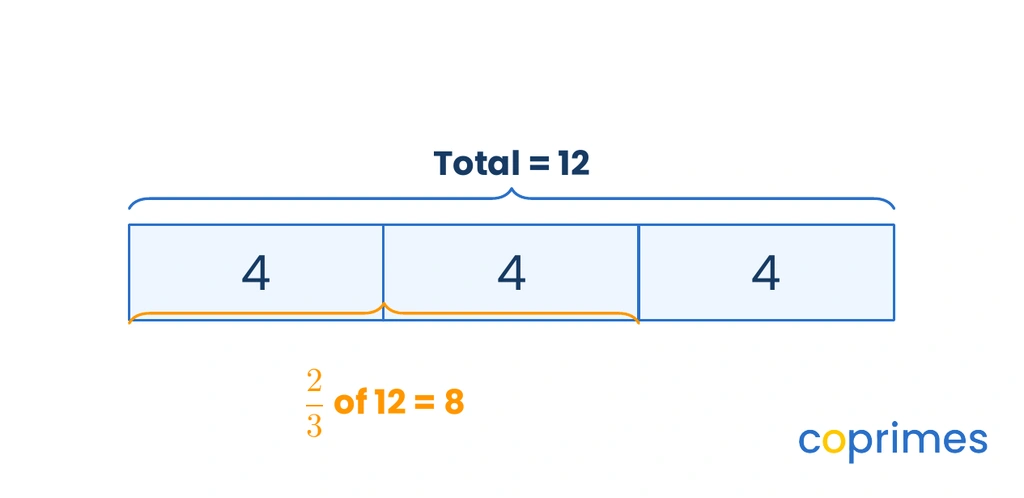
For example, to find of , first calculate .
Then, multiply that result by to get .
Visual worked examples
Applying these steps to visual models makes finding fractions of a quantity straightforward.
Example 1: Finding a fraction of a continuous whole
Question: A ribbon is centimeters long. What is of its length?
Method:
- The total length of the continuous whole is .
- The fraction is a unit fraction with a denominator of .
- Divide the total length by the denominator: .
Answer: of the ribbon is centimeters long.
Check: .
Example 2: Finding a non-unit fraction of a set
Question: There are counters in a bag. What is of the set of counters?
Method:
- Find the value of one part by dividing the total by the denominator: .
- Multiply this unit value by the numerator: .
Answer: of the counters is counters.
Check: Since is , then is .
A learning plan shaped by your child, not the class
State-aligned Math plus our own Logic and English curriculum. An adaptive baseline test finds the gaps and fills them.
Common mistakes
Unequal parts or groups
A fraction only exists when the whole is divided into perfectly equal parts or the set is divided into perfectly equal groups.
If a shape is split into three unequal sections, one section is not of the whole.
Confusing the whole and the part
Always identify what the total represents before calculating.
Finding a fraction of a collection requires knowing the full starting amount.
Dividing by the numerator
When finding a fraction of a quantity, learners sometimes incorrectly divide the whole number by the numerator instead of the denominator.
Always divide by the denominator first to find the value of one single share.
Frequently asked questions
What is the difference between a fraction of a whole and a fraction of a set?
A fraction of a whole partitions one continuous item, like a rectangle or a length of rope.
A fraction of a set partitions a collection of individual objects, like a bag of marbles or a group of students.
Can a fraction of a set be greater than one?
Yes.
If you have more pieces than are contained in one complete defined set, you have an improper fraction or a mixed number.
For example, if a standard set is defined as items, having items means you have of a set.
This requires understanding mixed numbers to interpret correctly.
How do you find a fraction of a number without a calculator?
Use mental math by dividing the number by the fraction's denominator, then multiplying that answer by the numerator.
You can also use fractions on a number line to count in equal jumps up to the total quantity.
Practice questions
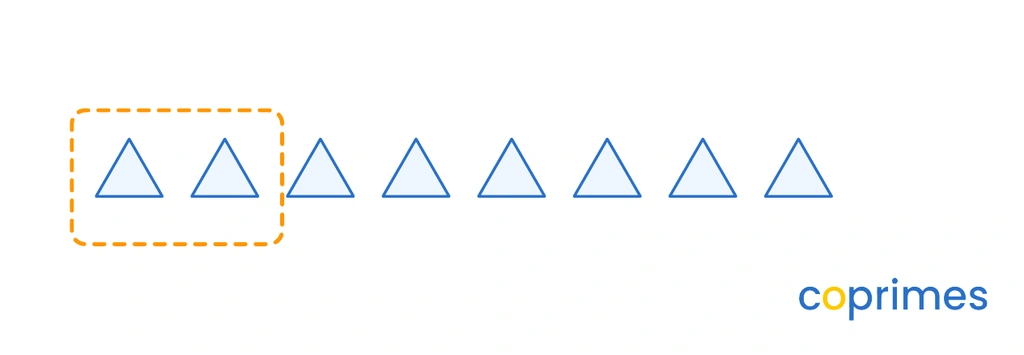
What fraction of the set is enclosed in the dashed box?
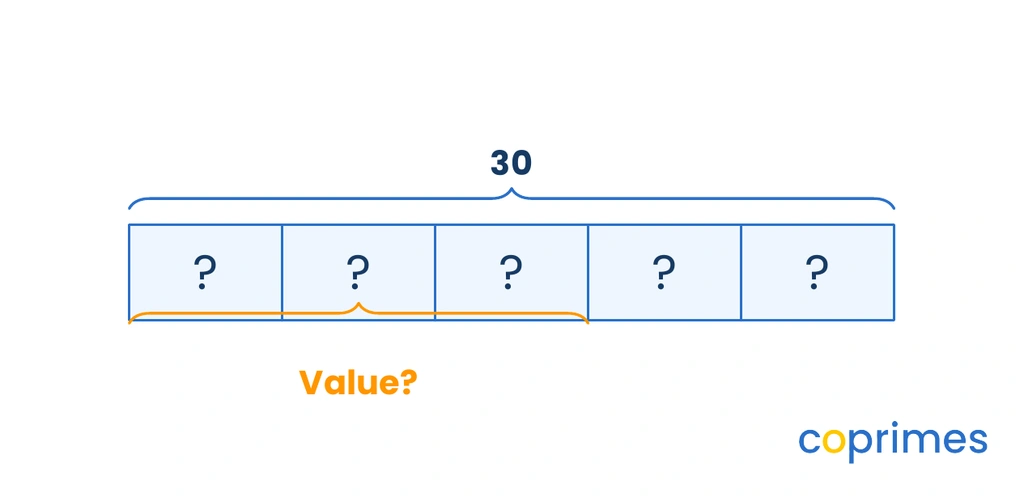
What is the value represented by the orange bracket in the diagram?
A baker has muffins. If she sells of the muffins, how many does she sell?
Calculate of .
A school library receives a donation of dollars to spend on new books. The librarian spends of the money on science books. How much money is spent on science books?
dollars
dollars
dollars
dollars