
Solving Proportions: Methods, Steps, and Examples
To solve a proportion with one unknown, write the equal ratios clearly, multiply diagonally to form an equivalent equation, solve for the unknown and substitute it back to check that the original ratios are equal.
A proportion is a mathematical statement that two ratios or fractions are equivalent. When one part of that relationship is unknown, solving the proportion finds the missing value. The most common and reliable method is cross multiplication, which converts a fractional equation into a simple linear equation.
How do you solve a proportion?
You solve a proportion by finding the value that makes the two ratios perfectly equivalent.
Because a proportion is an equation setting two fractions equal to each other, you can use algebraic operations to isolate the unknown variable. The quickest algebraic shortcut to clear the fractions is to cross multiply.
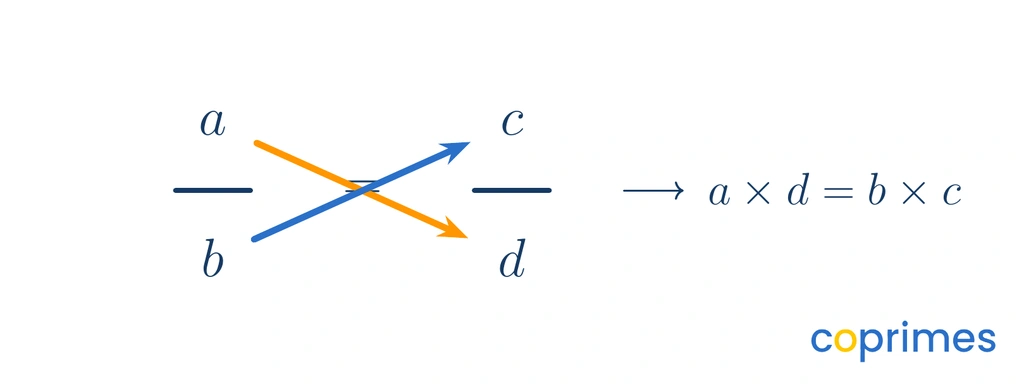
When using this method, multiply the numerator of the first fraction by the denominator of the second fraction. Set that product equal to the numerator of the second fraction multiplied by the denominator of the first fraction.
Set up equal ratios
Before you can solve a proportion, you must write the equation correctly. Ensure that the units or categories in both fractions align perfectly.
If you place the parts in the numerators and the wholes in the denominators for the first ratio, you must maintain that exact arrangement for the second ratio. Creating equivalent ratios relies entirely on consistent alignment.
For example, if you are comparing kilometers travelled to hours taken, structure both ratios as . Mixing the order, such as writing , will produce an incorrect equation.
Cross multiply correctly
Cross multiplication proportions require you to form a diagonal product. The product of the extremes equals the product of the means.
Although cross multiplying is often taught as a visual rule, it is built on standard algebraic principles. When you cross multiply, you are actually multiplying both sides of the equation by the common denominator to eliminate the fractions.
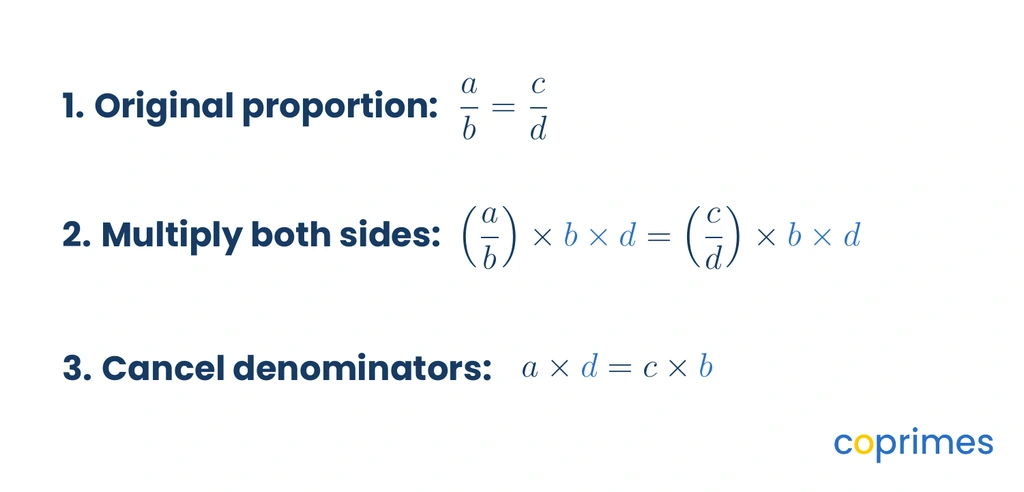
By understanding this algebraic foundation, you can avoid using cross multiplication inappropriately, such as when multiplying or adding two fractions together.

Solve and check the unknown
Once the fraction denominators have been cleared, finding the missing value in a proportion requires standard equation-solving steps.
Follow this reliable method to solve proportion equations:
- Write the proportion cleanly with one variable representing the unknown value.
- Cross multiply to eliminate the fraction bars, setting the two diagonal products equal to each other.
- Solve the resulting equation for the unknown variable using inverse operations, usually by dividing.
- Check your answer by substituting the calculated value back into the original ratio.
If the final ratios are mathematically equivalent, you have succeeded in verifying proportions.
Use a table or scale factor instead
While cross multiplication works for any proportion, using a scale factor is often faster when the relationship between the numbers is obvious.
If you can easily multiply or divide the numerator and denominator of the complete fraction by the same integer to reach the other fraction, you have found a useful multiplier. This multiplier is related to the constant of proportionality.
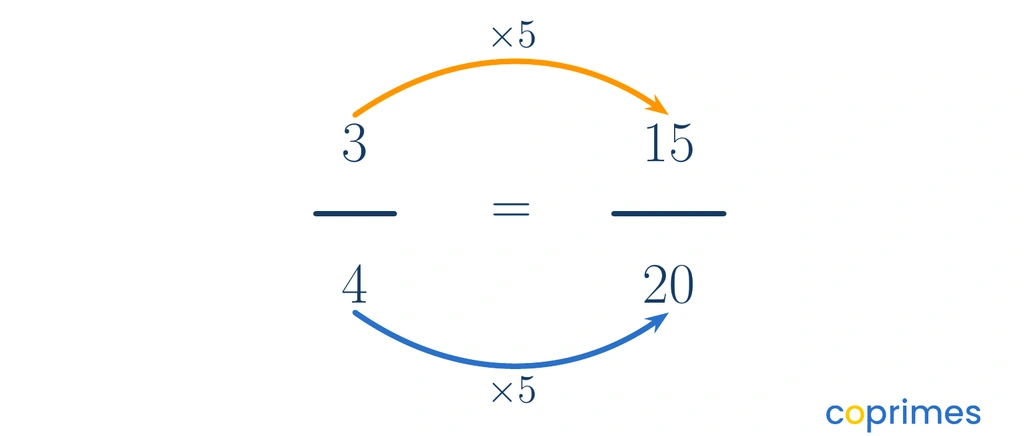
This strategy is especially helpful when dealing with straightforward mental arithmetic, saving you the step of solving a larger equation.
Worked examples
These three examples demonstrate how to handle different types of proportion questions, from simple integers to decimals and applied math word problems.
Example 1: Finding an integer missing value
Question: Solve the proportion .
Method:
- Write the proportion and identify the unknown variable .
- Cross multiply to form an equivalent linear equation.
- Divide both sides by to isolate .
Answer: .
Check: Substitute into the original ratio to get . When simplified, is . The right-hand ratio is , which also simplifies to . The ratios are equivalent.
Example 2: Solving with decimal values
Question: Find in the proportion .
Method:
- Set up the equation.
- Cross multiply.
- Divide both sides by .
Answer: .
Check: Substitute back in: . The second ratio is . The proportion holds true.
Example 3: Modelling context with a ratio table
Question: A printing machine produces posters every minutes. Assuming a constant rate, how many posters will it print in minutes?
Method:
Organize the known and unknown values using a ratio table to ensure units align.
Minutes | Posters |
- Write the proportion from the table columns.
- Cross multiply.
- Divide by .
Answer: The machine will print posters.
Check: The initial rate is posters per minute. The calculated rate is posters per minute. Because the unit rates match, the answer is correct.
A learning plan shaped by your child, not the class
State-aligned Math plus our own Logic and English curriculum. An adaptive baseline test finds the gaps and fills them.
Common mistakes
One frequent error is confusing proportion equations with fraction multiplication. Cross multiplication is only valid when an equal sign separates two fractions. You cannot cross multiply when multiplying, adding, or subtracting two fractions.
Another common mistake occurs when setting up word problems. If you put minutes in the numerator on the left side but place minutes in the denominator on the right side, your cross multiplication will produce a completely incorrect equation. Always verify that your units match horizontally across the equation.
Warning: Never cross multiply across an addition or multiplication sign.
Frequently asked questions
Why does cross multiplication work?
Cross multiplication is an algebraic shortcut. When two fractions are set equal to each other, multiplying both sides of the equation by both denominators clears the fractions entirely, leaving only integer coefficients behind. The visual shortcut of crossing diagonals produces the exact same result.
Can a denominator be zero in a proportion?
No. Division by zero is undefined in mathematics. If a variable is in the denominator, you must assume that the solution cannot equal zero. In a real-world proportion, a zero denominator would mean dividing a quantity into zero parts, which is impossible.
Practice questions
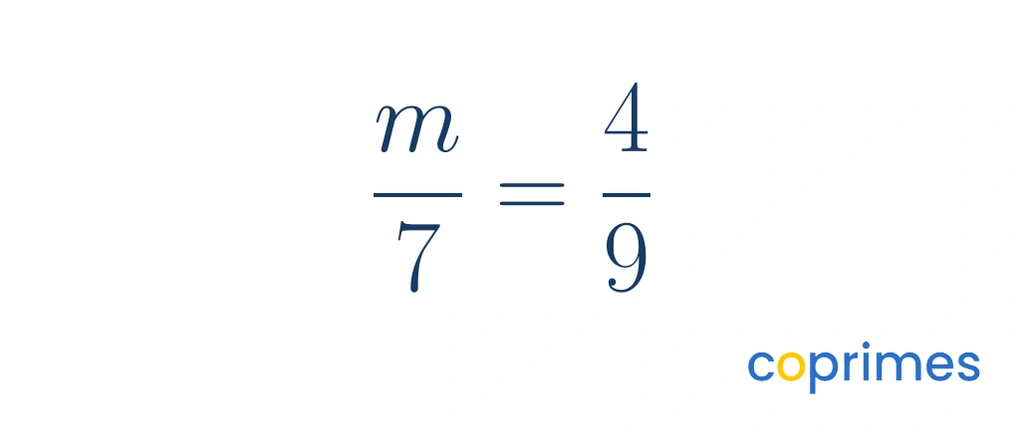
Which equation is the correct result of cross multiplying the proportion above?
Solve the proportion for .
Find the missing value in the proportion .
A student is asked to solve the equation . Which action represents a common mistake when attempting to solve a proportion?
Writing the equation as .
Dividing both sides of by .
Multiplying the two numerators together and the two denominators together.
Checking the answer by substituting back into the original ratio.
Multiplying the two numerators together and the two denominators together.
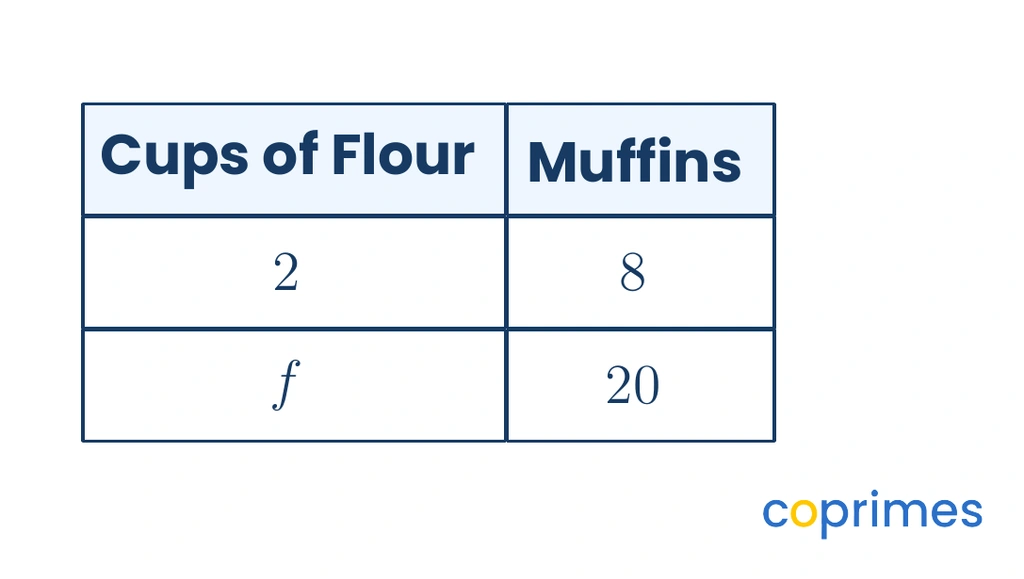
A recipe uses cups of flour to make muffins. How many cups of flour () are needed for muffins?
cups
cups
cups
cups
cups