
Least Common Denominator
The least common denominator, or LCD, is the smallest positive number that can be used as a common denominator for a set of fractions. It is exactly the least common multiple of their denominators.
Any common denominator allows you to add, subtract, or compare fractions. However, finding the least common denominator is often the most efficient choice because it keeps the numbers small and makes calculations easier to manage.
What is the least common denominator?
When fractions have different denominators, they represent different-sized pieces of a whole. To combine or compare them accurately, you must express them using pieces of the same size.
This is why finding a common denominator is necessary. While you can multiply the denominators together to find any shared denominator, the least common denominator is the smallest possible number that works.
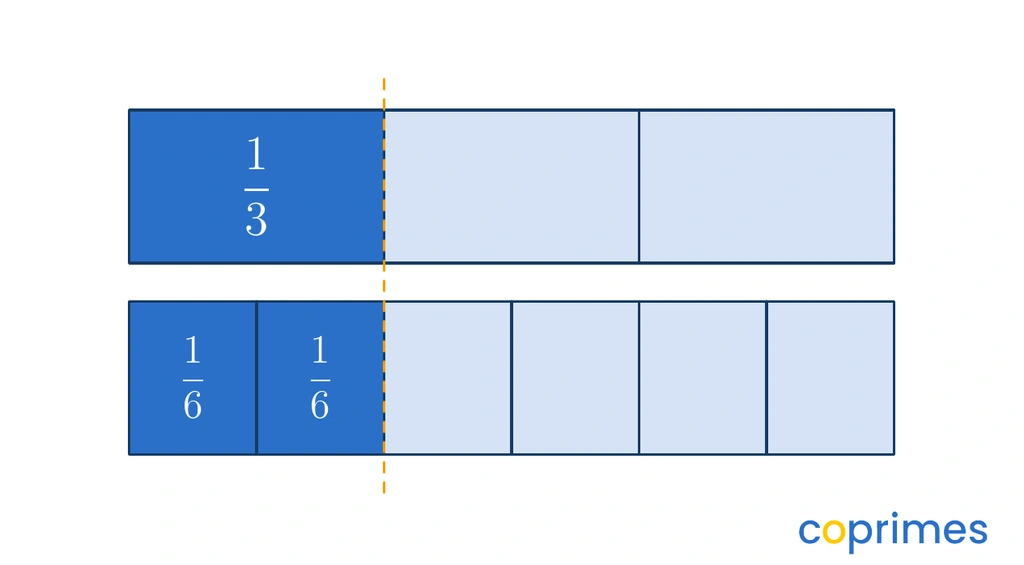
Working with LCD fractions is often called finding the lowest common denominator, and both terms describe the same mathematical idea.
LCD and least common multiple
The least common denominator is simply the least common multiple of the denominators in the set of fractions.
Because the denominators are the numbers you are trying to match, you apply the exact same methods used for finding a least common multiple. The only difference is that you apply the resulting number exclusively to the bottom of the fractions.
Find the LCD by listing multiples
The most direct way to find least common denominator values is to write down the multiples of each denominator until you find a match.
This method works best when the denominators are relatively small numbers.
- Write down the first few multiples of the first denominator.
- Write down the first few multiples of the second denominator.
- Identify the smallest number that appears in both lists.
The smallest shared multiple is the least common denominator.
For example, to find the LCD for and , list their multiples. The multiples of are , and so on. The multiples of are . Because is the smallest number that appears in both lists, the LCD is .
A learning plan shaped by your child, not the class
State-aligned Math plus our own Logic and English curriculum. An adaptive baseline test finds the gaps and fills them.
Find the LCD using prime factors
When the denominators are large, listing multiples can take too long. Instead, you can find the least common denominator using prime factorization.
- Find the prime factors of each denominator.
- Write out the factors, aligning matching prime numbers where possible.
- Multiply each prime factor the greatest number of times it appears in any single factorization.
For example, to find the LCD for fractions with denominators of and , break each number down into prime factors. The prime factorization of is . The prime factorization of is .
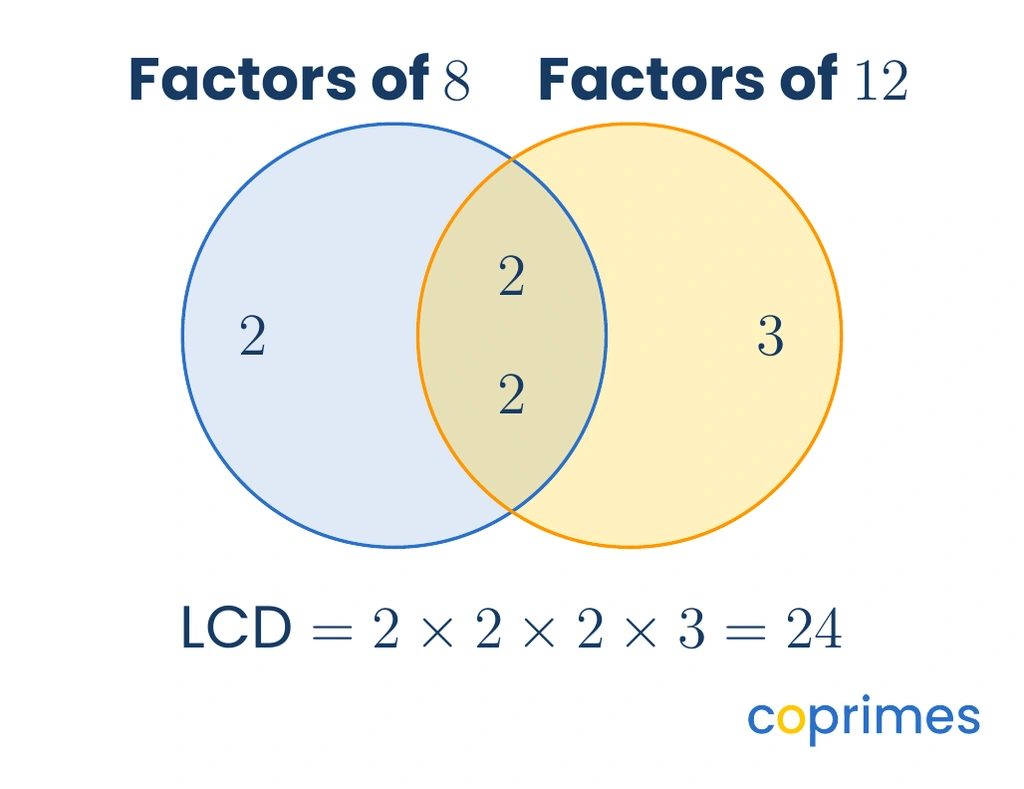
The prime factor appears a maximum of three times in the first factorization. The prime factor appears a maximum of one time in the second factorization. Multiply these together to find the LCD of .
Rewrite fractions using the LCD
Once you find the least common denominator, you must use it to create equivalent fractions. This ensures the overall value of the fraction stays the same even though the denominator changes.
Divide the new least common denominator by the original denominator to find the multiplier. Then, multiply both the numerator and the denominator by that number.
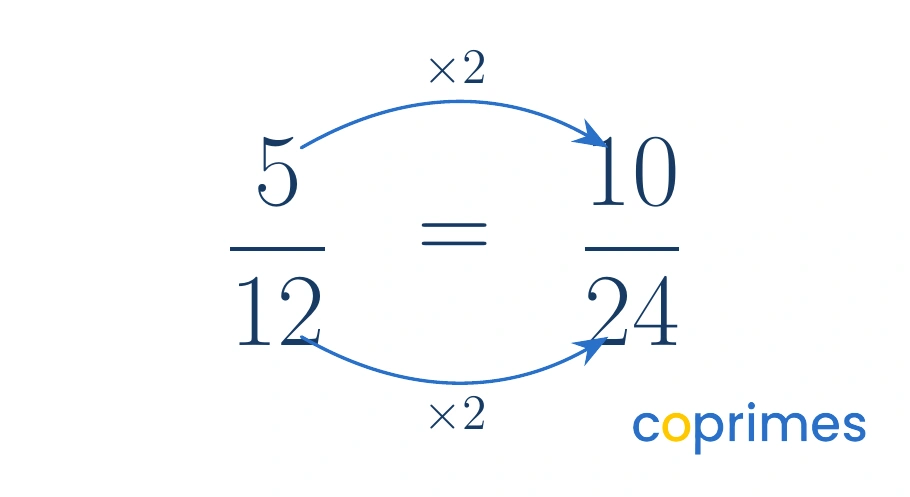
Repeating this step for every fraction allows you to combine or compare them accurately.
Worked examples
Review these least common denominator examples to see how the method is used in practice.
Example 1: Comparing fractions using the LCD
Question: Which fraction is larger: or ?
Method:
- Find the LCD for and . Multiples of are . Multiples of include . The LCD is .
- Rewrite each fraction with a denominator of .
- Multiply the numerator and denominator of by to get .
- Multiply the numerator and denominator of by to get .
- When comparing fractions with the same denominator, you only need to compare the numerators.
Answer: Because is larger than , is larger. This means is the larger fraction.
Check: Cross-multiply: and . Since , the fraction is indeed larger.
Example 2: Adding fractions with different denominators
Question: Calculate .
Method:
- Find the LCD of and . By listing multiples, the least common multiple is .
- Rewrite with a denominator of . Multiply the numerator and denominator by to get .
- Rewrite with a denominator of . Multiply the numerator and denominator by to get .
- Add the numerators together and keep the denominator exactly the same.
Answer: .
Check: Ensure the fraction is in its simplest form. The number is a prime number and does not divide evenly into , so the answer is fully simplified.
Example 3: Ordering three fractions
Question: Arrange , , and from least to greatest.
Method:
- Find the LCD of , , and . Using prime factors, is prime, , and . The LCD is .
- Convert each fraction to an equivalent fraction with a denominator of .
- For , multiply the numerator and denominator by to get .
- For , multiply the numerator and denominator by to get .
- For , multiply the numerator and denominator by to get .
- Compare the numerators: . This technique works perfectly for ordering fractions.
Answer: The correct order is , , .
Check: Convert each original fraction to a decimal. , , and . The decimal values confirm the correct order.

Common mistakes
It is easy to make calculation errors when working with denominators. Watch out for these common traps.
Multiplying the denominators
A frequent error is always multiplying the denominators together to find the LCD. While multiplying provides a valid common denominator, the least common denominator of and is actually . Always check for smaller shared multiples first.
Forgetting the numerator
Students sometimes change the denominator to the LCD but forget to multiply the numerator by the same amount. The entire fraction must be multiplied by the same value to remain equivalent.
Adding the denominators
When adding fractions, never add the denominators together. Once the denominators are exactly the same, only the numerators are added.
Frequently asked questions
Here are short answers to common questions about finding and using the least common denominator.
Can the LCD be one of the original denominators?
Yes. If one denominator is a multiple of the other, the larger denominator is the least common denominator. For example, the LCD of and is .
Do I need the LCD to multiply fractions?
No. Common denominators are only required for addition, subtraction, and comparison. To multiply fractions, you simply multiply straight across.
What if the fractions have variables in the denominator?
The same rules apply. The least common denominator will be the simplest algebraic expression that includes all factors from each individual denominator.
Practice questions
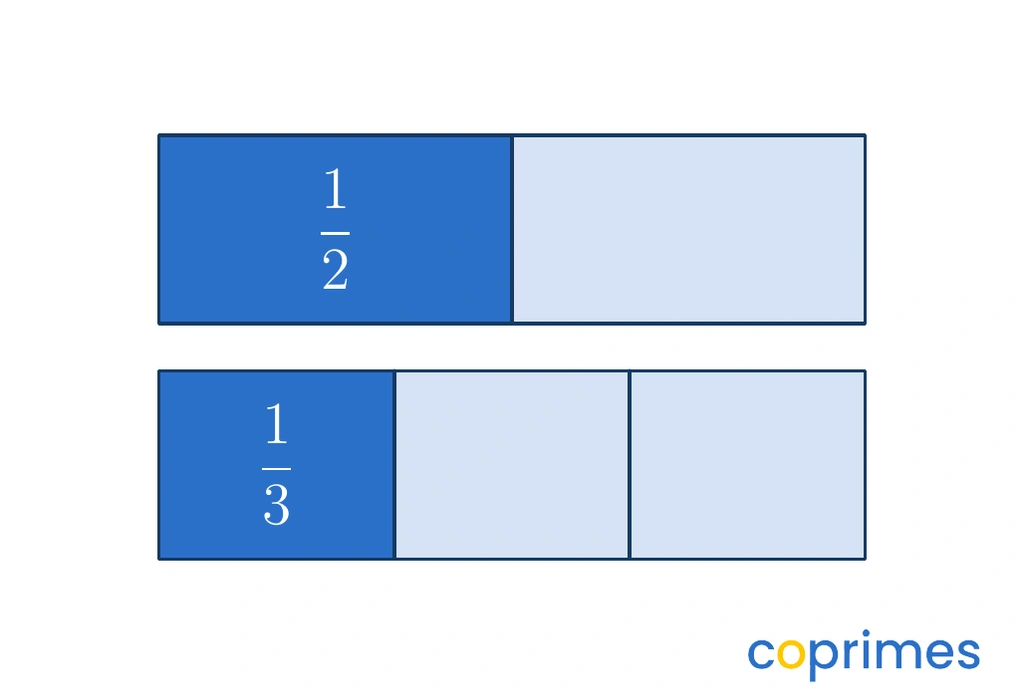
What is the least common denominator for the two fractions represented by the shaded areas?
What is the least common denominator for and ?
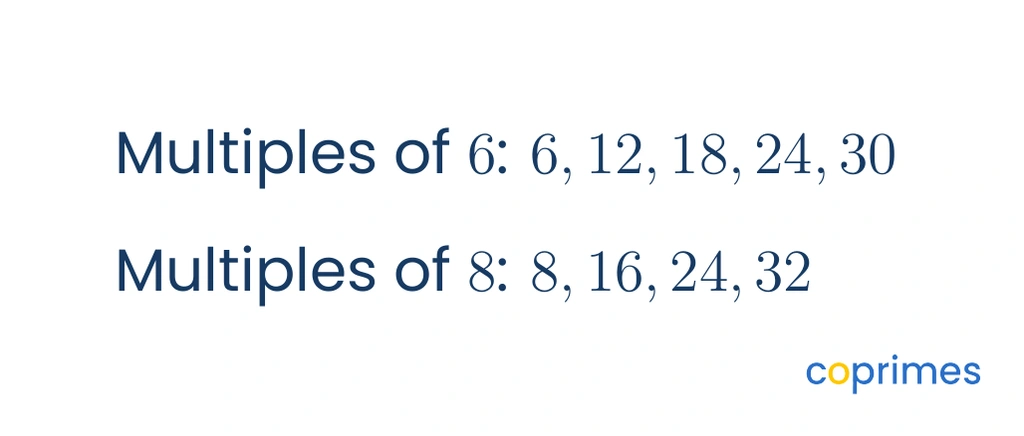
A student lists multiples to find the least common denominator for and . Based on the table, what is the equivalent fraction for using the least common denominator?
What is the least common denominator for the fractions , , and ?
Which pair of equivalent fractions correctly uses the least common denominator to prepare and for addition?
and
and
and
and
and