
Multiplying Mixed Numbers
To multiply mixed numbers, convert each mixed number to an improper fraction, multiply the numerators and denominators, simplify the result, and convert it back to a mixed number when that form is required.
Learning how to multiply a mixed fraction by another fraction or whole number is a vital arithmetic skill. Before multiplying, we must identify mixed numbers and rewrite them in a format that makes multiplication straightforward.
How do you multiply mixed numbers?
Multiplying mixed numbers requires three essential steps.
- Convert all mixed numbers and whole numbers into improper fractions.
- Multiply the numerators together and the denominators together.
- Simplify the resulting fraction and convert it back into a mixed number if necessary.
This process ensures that the fractional parts and whole parts are multiplied together accurately. Once the numbers are written as improper fractions, this uses the exact same rules as multiplying fractions.
Convert mixed numbers first
We cannot simply multiply the whole numbers together and the fractions together. Instead, we convert mixed numbers to improper fractions first.
To convert a mixed number, multiply the whole number by the denominator, add the numerator, and place that sum over the original denominator.
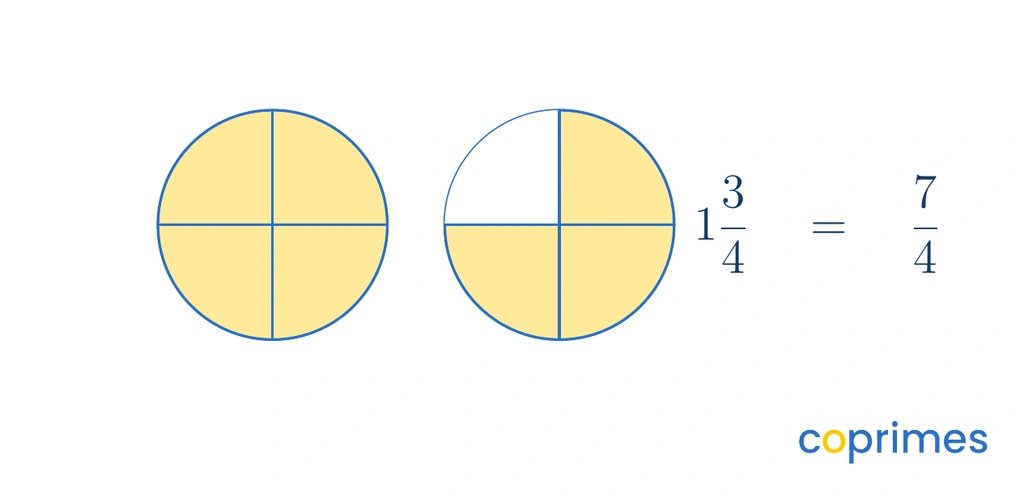
For example, to convert , multiply , then add to get . The improper fraction is .
Multiply and simplify
Once you have improper fractions, multiply the top numbers (numerators) together to get the new numerator, and multiply the bottom numbers (denominators) together to get the new denominator.
By simplifying fractions before multiplying, we can often make the calculation easier. Look for common factors between any numerator and any denominator, and divide them out before finding the product.
Cross-simplify factors before multiplying to avoid working with large numbers.

Convert the product back
After multiplying, your result will usually be an improper fraction. To convert it back to a mixed number, divide the numerator by the denominator.
The quotient becomes the whole number part, the remainder becomes the new numerator, and the denominator stays exactly the same.
Visual interpretation
An area model is an excellent way to see why mixed number multiplication works. When we multiply by , we are finding the total area of a rectangle with those side lengths.
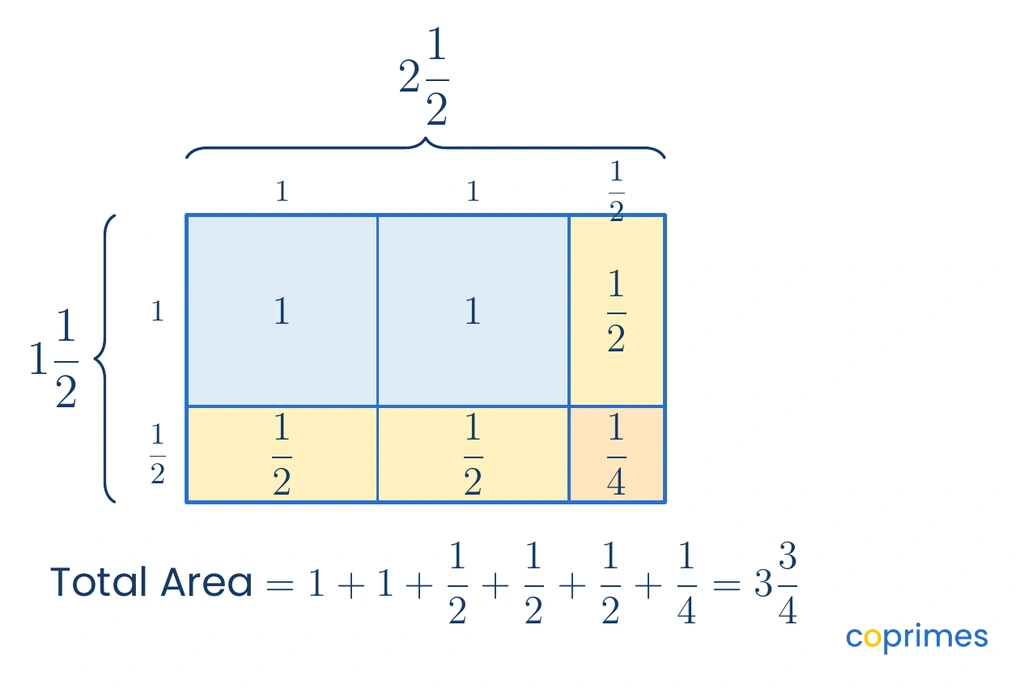
The entire rectangle consists of all the whole parts and fractional pieces combined, proving that the product is .
Worked examples
Applying the method to different multiplication scenarios builds confidence, such as in fraction word problems.
Example 1: Multiplying a mixed number by a whole number
Question: What is ?
Method:
- Write the whole number as a fraction: .
- Convert the mixed number to an improper fraction: .
- Multiply the numerators and denominators: .
- Simplify the fraction: .
- Convert back to a mixed number: .
Answer: .
Check: Using addition, .
Example 2: Multiplying two mixed numbers
Question: Evaluate .
Method:
- Convert both mixed numbers to improper fractions: and .
- Multiply the numerators: .
- Multiply the denominators: .
- Simplify the result: .
- Convert back to a mixed number: .
Answer: .
Check: Estimate the product: . The exact result is reasonable.
Example 3: Solving a geometric word problem
Question: A rectangular garden is meters long and meters wide. What is the area of the garden?
Method:
- Set up the multiplication for area: .
- Convert to improper fractions: and .
- Cross-simplify before multiplying: divide and by , and divide and by .
- Multiply the simplified fractions: .
Answer: The area is square meters.
Check: Converting to a mixed number confirms it is exactly wholes.
A learning plan shaped by your child, not the class
State-aligned Math plus our own Logic and English curriculum. An adaptive baseline test finds the gaps and fills them.
Common mistakes
A frequent error is multiplying the whole numbers together and then multiplying the fractions together separately. This ignores the cross-multiplication of the whole parts with the fractional parts.
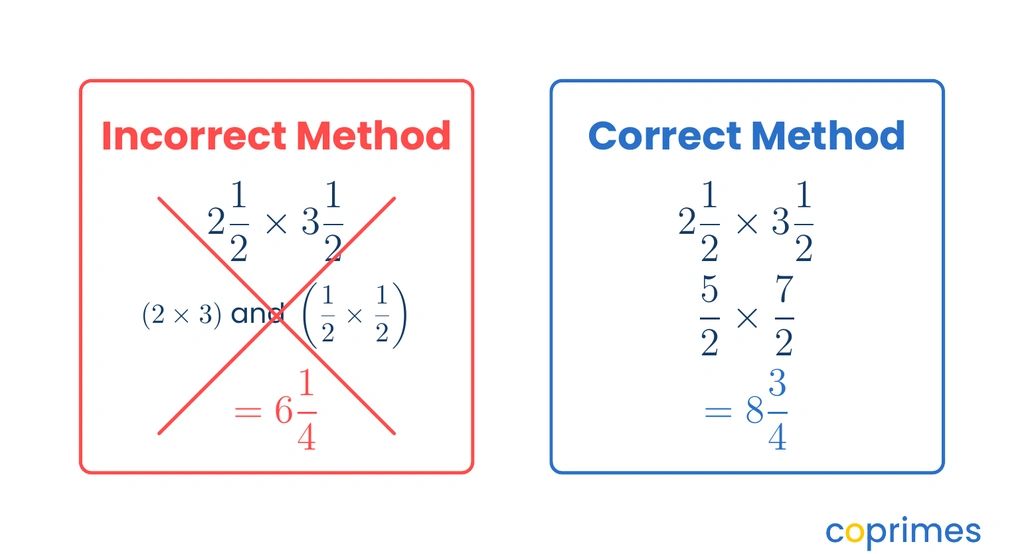
Always remember to convert to improper fractions first. Bypassing this step guarantees an incorrect mathematical result.
Frequently asked questions
Can you cross-simplify mixed numbers before converting them?
No. You must convert mixed numbers into improper fractions before you can search for common factors to cross-simplify.
Does the order of multiplication matter?
No. Multiplication is commutative, meaning yields the exact same product as .
Practice questions
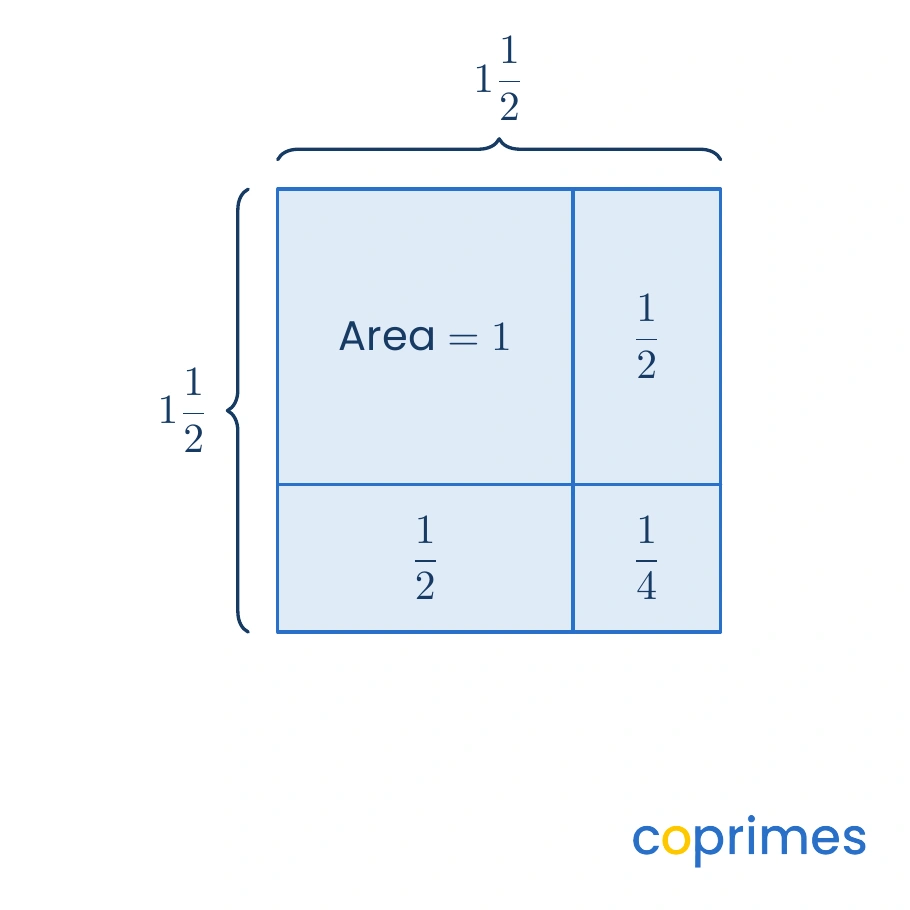
Which multiplication sentence matches the area model shown above?
What is the product of and ?
A student calculated by multiplying the whole numbers () and then multiplying the fractions (), giving a final answer of . Why is this incorrect?
The fraction addition was ignored; the answer should be .
Mixed numbers must be converted to improper fractions first; the correct answer is .
The whole numbers should be added instead of multiplied; the answer is .
The fractions should be divided instead of multiplied; the answer is .
Mixed numbers must be converted to improper fractions first; the correct answer is .
Which expression is equivalent to ?
A recipe calls for cups of sugar. If you want to make batches of the recipe, how many cups of sugar will you need?
cups
cups
cups
cups
cups