
Understanding Improper Fractions
An improper fraction has a numerator greater than or equal to its denominator, so it represents a value greater than or equal to when the denominator is positive. Before exploring these values, it helps to understand how fractions describe parts of a whole.
What is an improper fraction?
An improper fraction is a fraction that represents one whole or more than one whole. It occurs when you have enough equal parts to make up at least one complete unit, and possibly some extra parts.
An improper fraction has a numerator that is greater than or equal to its denominator.
The numerator is the top number, which tells you how many parts you have. It is written above the fraction bar, while the denominator is the bottom number, showing how many parts make up one whole unit.
For example, in the fraction , the denominator is , meaning one whole is divided into equal pieces. The numerator is , meaning you have of those pieces. Because you have more pieces than are needed to make one whole, the fraction is improper.
How to identify an improper fraction
To identify an improper fraction, compare the top number to the bottom number.
If the numerator is greater than or equal to the denominator, the fraction is improper. If the numerator is strictly less than the denominator, it is one of the proper fractions and represents a value less than .
Look at the models below comparing a proper fraction to an improper fraction.
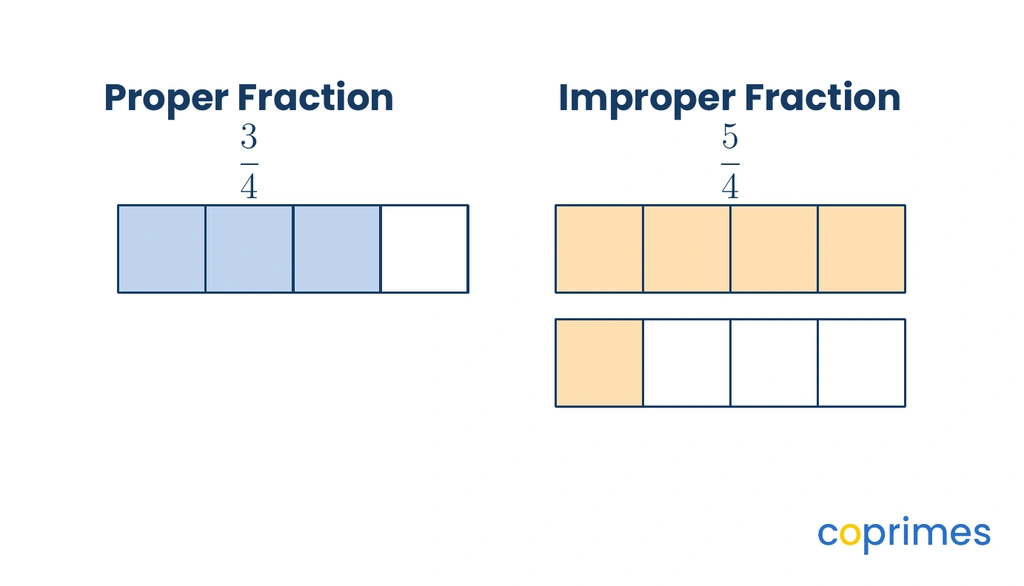
Because is greater than , the fraction represents more than one whole, making it an improper fraction.
Improper fractions equal to one
When the numerator and denominator of a fraction are exactly the same, the fraction is equal to exactly .
Even though this fraction does not represent a value strictly greater than , it is still classified mathematically as an improper fraction because the numerator is equal to the denominator.
For example, , , and are all improper fractions that equal .
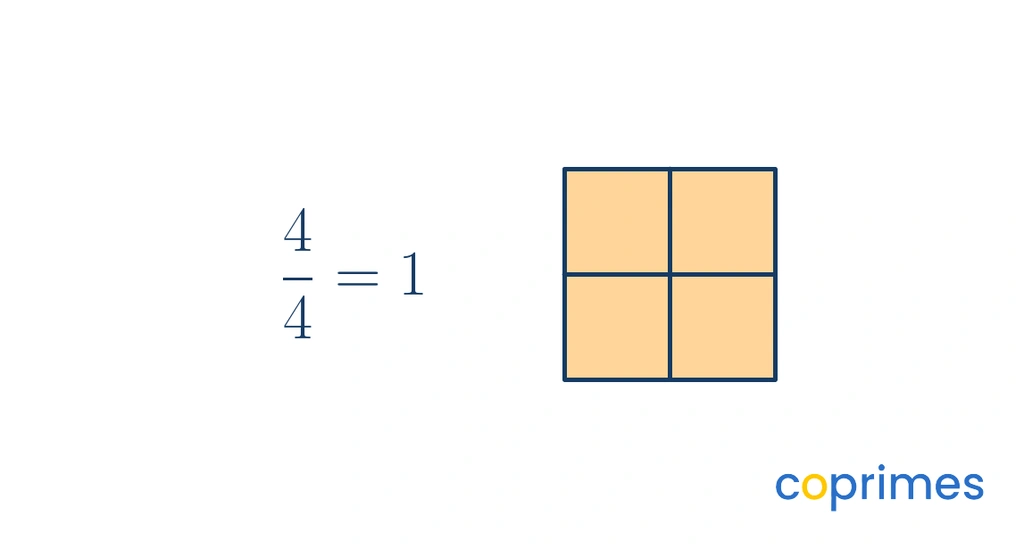
If you slice a pizza into pieces and you have all pieces, you have one whole pizza. The amount is a whole number, but writing it in a fractional form like means it follows the rule for improper fractions.
A learning plan shaped by your child, not the class
State-aligned Math plus our own Logic and English curriculum. An adaptive baseline test finds the gaps and fills them.
Improper fractions on a number line
Plotting fractions on a number line is a clear way to see the difference between proper and improper fractions.
Proper fractions are always located between and . Improper fractions begin at and continue to the right along the number line.
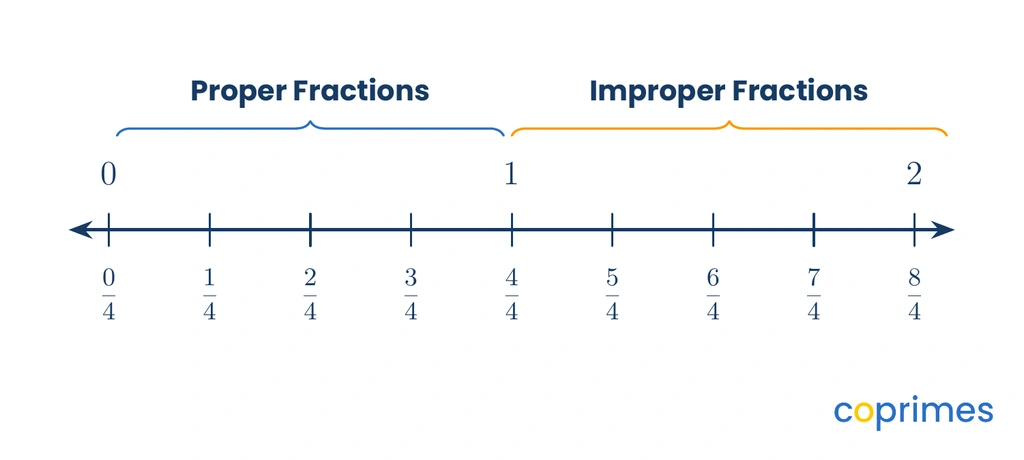
As you count up by fourths (, , ), you eventually reach the whole (). Every fraction equal to or greater than that whole represents an improper fraction.
Improper fractions and mixed numbers
An improper fraction and a mixed number are two different ways of writing the same amount. While an improper fraction keeps all parts in the numerator, mixed numbers show the amount as whole units combined with a leftover proper fraction.
If you have of a pizza, you have quarter-slices. Because quarters make a whole pizza, you can group them together to form exactly whole pizza, leaving quarters remaining.
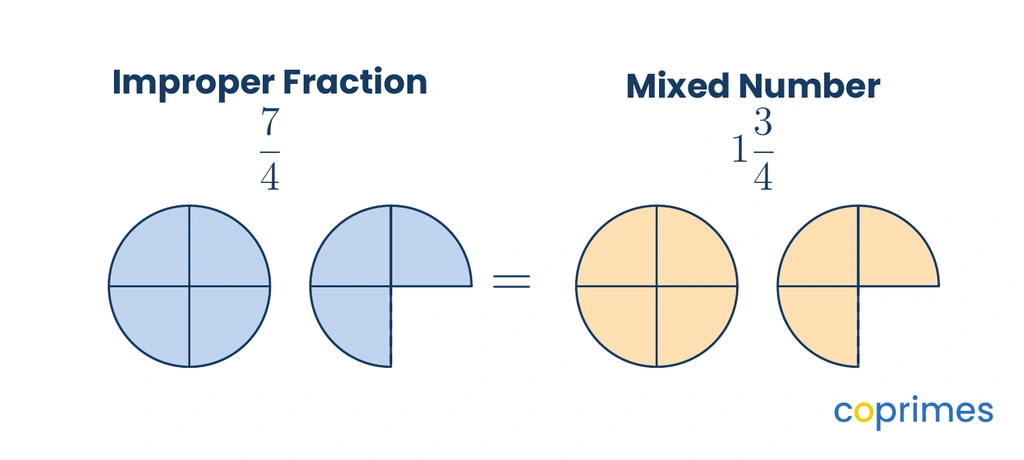
We can convert an improper fraction to a mixed number by dividing the numerator by the denominator. The result is the whole number, and the remainder becomes the new numerator over the original denominator.
Because they both represent the exact same amount, you can choose whichever form is most useful. Improper fractions are highly useful when solving equations or multiplying, while mixed numbers are easier to visualize in everyday life.
Worked examples
Review the examples below to see how to identify improper fractions and match them to visual models.
Example 1: Identifying the type of fraction
Question: Determine whether is a proper fraction or an improper fraction.
Method:
- Identify the numerator (top number) and denominator (bottom number). The numerator is and the denominator is .
- Compare the two numbers. Because is greater than , the numerator is greater than the denominator.
- Apply the definition. A fraction with a numerator greater than or equal to its denominator is improper.
Answer: is an improper fraction.
Check: A whole is divided into equal parts. Having parts means you have more than one whole, which confirms it is an improper fraction.
Example 2: Writing an improper fraction from a model
Question: A visual model shows separate hexagons. Each hexagon is divided into equal triangles. The first two hexagons are completely shaded, and triangle in the third hexagon is shaded. What improper fraction describes the shaded area?
Method:
- Find the denominator by counting how many parts make up one single whole shape. One hexagon contains equal triangles, so the denominator is .
- Find the numerator by counting the total number of shaded parts across all shapes.
- The first hexagon provides parts, the second provides parts, and the third provides part.
- Add them together: shaded parts.
- Write the fraction with the total number of parts as the numerator and the parts per whole as the denominator.
Answer: The improper fraction is .
Check: There are full wholes and left over, which equals . Converting to an improper fraction gives , confirming the count is correct.

Common mistakes
It is easy to misinterpret the term "improper." Avoid these common errors when working with fractions greater than one.
Assuming improper fractions are wrong or "bad"
The word "improper" can sound like a mistake, but mathematically, these fractions are perfectly correct. In algebra and higher-level mathematics, improper fractions are actually preferred over mixed numbers because they are easier to multiply, divide, and substitute into formulas.
Failing to count a fraction equal to one as improper
Learners sometimes forget that a fraction like is an improper fraction. Even though it equals exactly whole, it meets the rule that the numerator is greater than or equal to the denominator.
Using the total number of parts as the denominator
When a model shows two shapes divided into parts each, a common mistake is to write as the denominator. The denominator is strictly the number of parts in just one whole unit, not the total number of parts drawn on the page.
Frequently asked questions
Are improper fractions always greater than ?
No, they are greater than or equal to . A fraction where the numerator equals the denominator, like , is equal to , but it is still an improper fraction.
Why are they called improper fractions?
The term originates from an old view that a "true" or "proper" fraction should represent only a part of a single whole. Numbers representing a whole or more were seen as mixed quantities, making their fractional form "improper," though the mathematical usage is entirely valid today.
Can an improper fraction have a negative value?
Yes. The rule compares the absolute size of the numerator and denominator. For example, is a negative improper fraction because the top value represents more parts than make up one whole.
Practice questions
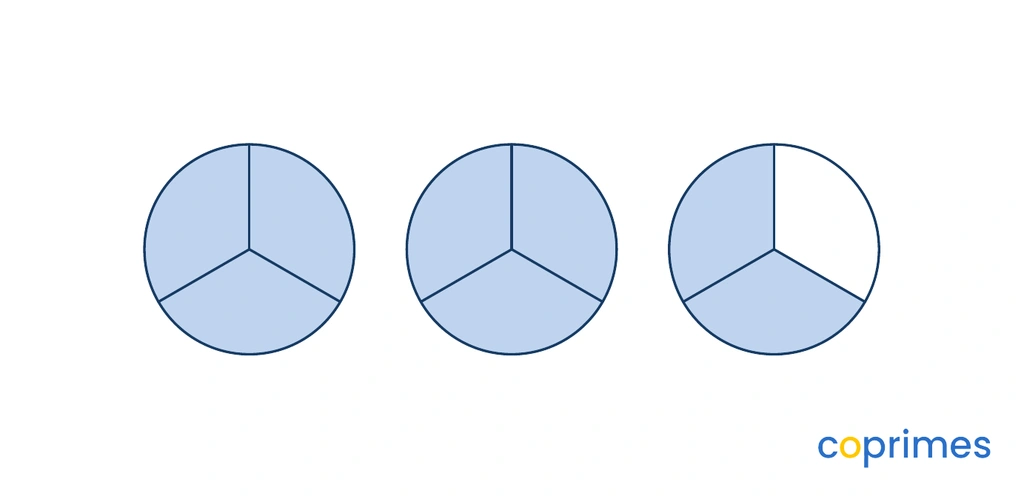
Which improper fraction represents the shaded parts in the model?
Which of the following fractions is an improper fraction?
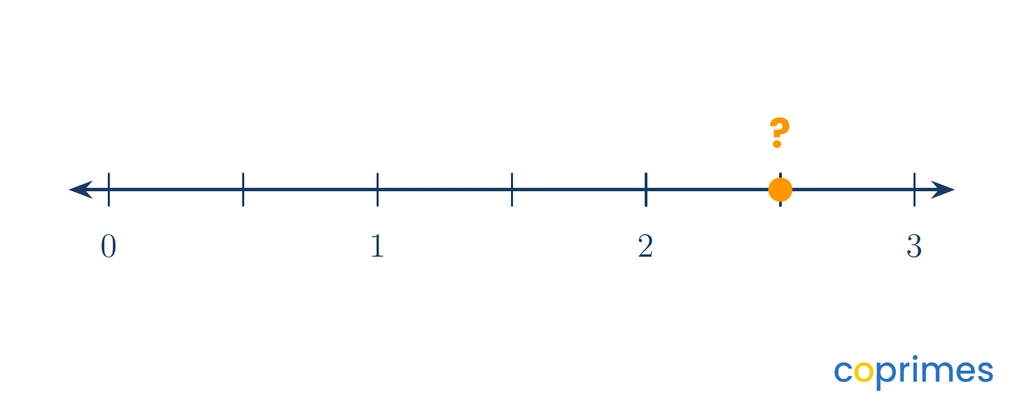
What improper fraction is located at the point on the number line?
Why is classified as an improper fraction?
Its numerator, , is greater than its denominator, .
Its numerator, , is an even number.
Its denominator, , is an odd number.
It represents a value that is less than .
Its numerator, , is greater than its denominator, .
A recipe calls for cups of flour. If you only have a measuring cup that holds exactly of a cup, how many times will you need to fill it?
times
times
times
times
times