
Convert Mixed Numbers to Improper Fractions
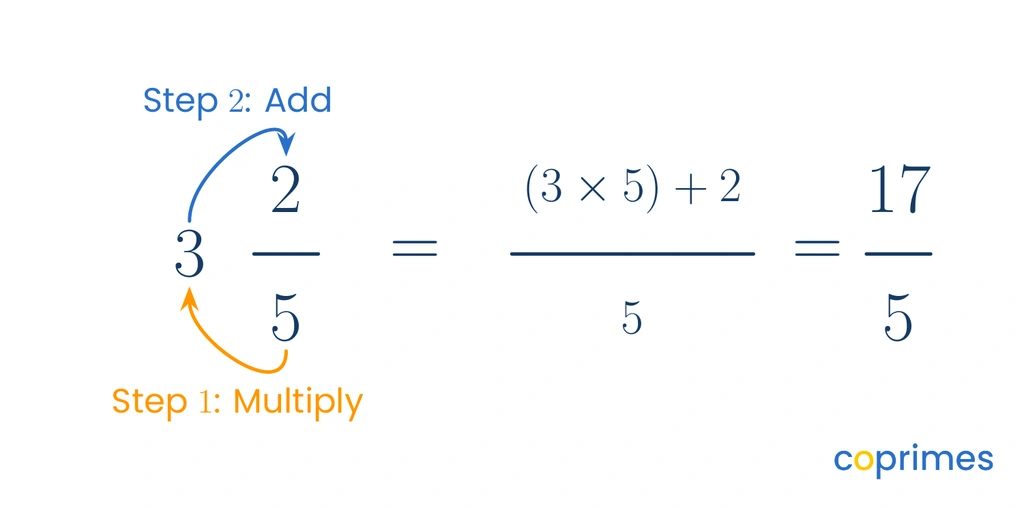
To convert a mixed number to an improper fraction, multiply the whole number by the denominator, add the numerator, and write that total as the new numerator while keeping the denominator the same. This method transforms a mixed number into a single mathematical ratio.
Both mixed numbers and improper fractions can represent the identical mathematical value. The mixed form separates the wholes from the parts, while the improper form groups all parts together.
Why convert a mixed number?
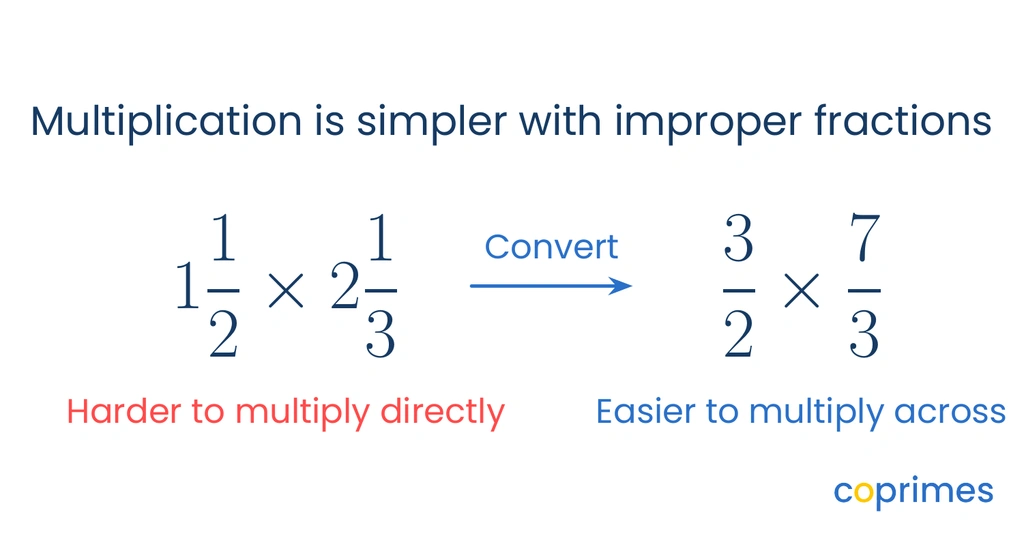
Changing a mixed number to an improper fraction simplifies advanced mathematics.
While mixed numbers make it easy to understand the physical size of a measurement, they are difficult to use in complex calculations. You must change a mixed number to an improper fraction before you can multiply, divide, or solve algebraic equations accurately.
See the conversion with models
We can visualize this mixed fractions conversion using area models. Every whole number can be divided into equal fractional parts that match the denominator.
For example, to convert , picture two complete circles and a third circle that is only three-quarters full.
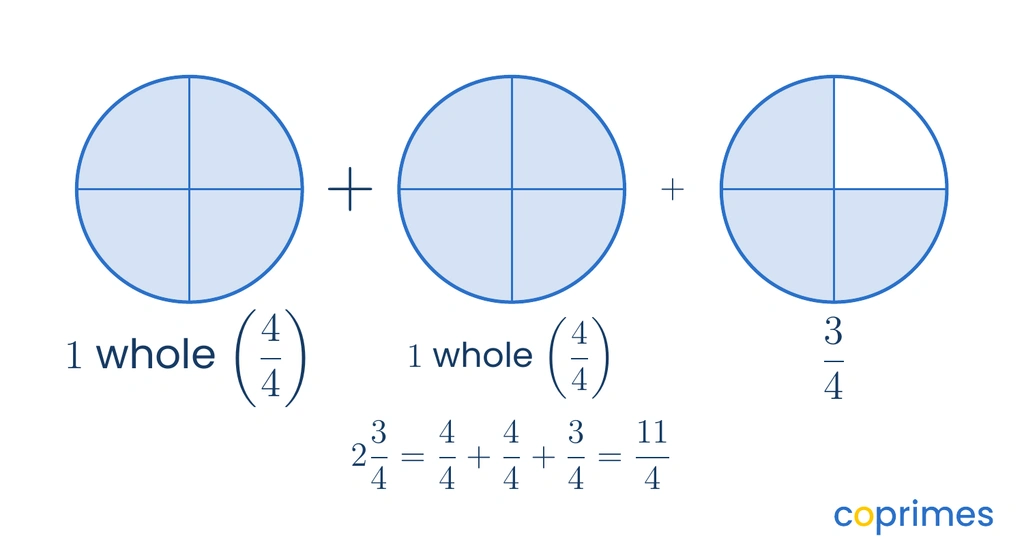
By counting the highlighted quarters, we see that two wholes provide eight total quarters. Adding the remaining three quarters gives a total of eleven quarters.
Conversion steps
Follow this direct method to change a mixed number to an improper fraction without drawing models.
- Multiply the whole number by the fraction's denominator.
- Add the fraction's numerator to that product.
- Write this final sum as the new numerator.
- Keep the original denominator unchanged.
A learning plan shaped by your child, not the class
State-aligned Math plus our own Logic and English curriculum. An adaptive baseline test finds the gaps and fills them.
Keep the denominator unchanged
When converting, the denominator remains the exact same number because the physical size of the fractional pieces has not changed.
The denominator identifies how many equal pieces make up one whole. The multiplication and addition steps calculate how many of those pieces we have in total. Because the physical pieces themselves do not become larger or smaller, the denominator must remain constant.
Check by converting back
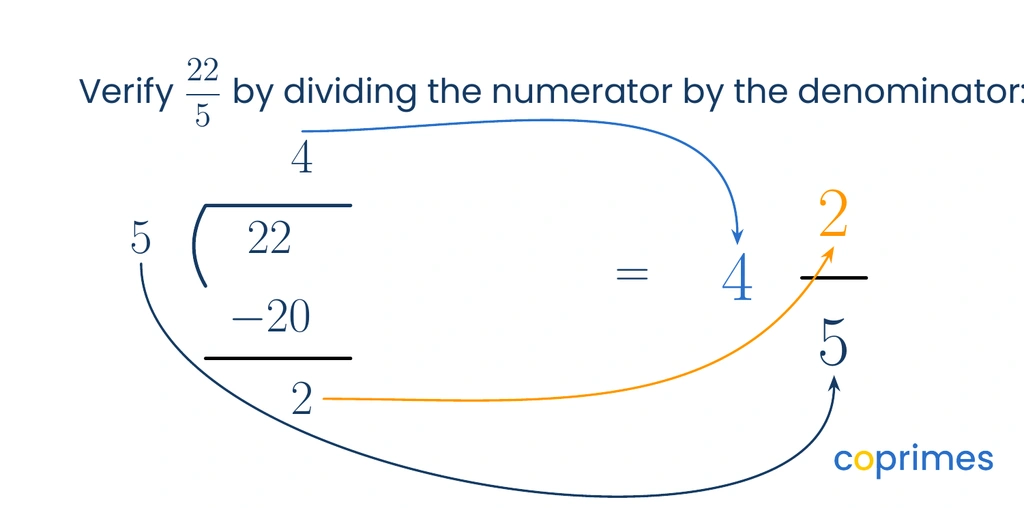
You can verify your improper fraction by reversing the conversion.
Divide the new numerator by the denominator. The quotient becomes the whole number, the remainder becomes the new numerator, and the denominator remains the same. If this matches your original mixed number, your conversion is mathematically correct. If you need a more detailed refresher, read how to convert improper fractions to mixed numbers.
Worked examples
Review these three examples showing how to change a mixed number to an improper fraction, including a case with a zero fractional part.
Example 1: Converting a standard mixed fraction
Question: Convert to an improper fraction.
Method:
- Multiply the whole number by the denominator: .
- Add the original numerator: .
- Write this sum over the unchanged denominator.
Answer:
Check: with a remainder of , returning .
Example 2: Using a larger denominator
Question: Convert to an improper fraction.
Method:
- Multiply the whole number by the denominator: .
- Add the numerator: .
- Write the final sum over the original denominator.
Answer:
Check: with a remainder of , returning .
Example 3: Converting a zero fractional part
Question: Convert the whole number to an improper fraction with a denominator of .
Method:
- Write the whole number as a mixed fraction with a zero fractional part: .
- Multiply the whole number by the denominator: .
- Add the numerator: .
- Write the sum over the chosen denominator.
Answer:
Check: , confirming the fraction equals the original whole number.

Common mistakes
When performing a mixed to improper conversion, watch out for these frequent calculation errors.
- Adding instead of multiplying: A common error is adding the whole number to the denominator before adding the numerator. Always multiply the whole number by the denominator first.
- Forgetting the original numerator: Sometimes learners multiply the whole number by the denominator and place only that product over the denominator. You must remember to add the existing numerator to the product.
- Changing the denominator: The denominator must remain unchanged unless you are later instructed to find equivalent fractions or practice simplifying fractions.
Frequently asked questions
What happens to the numerical value during conversion?
The value remains identical. The conversion changes only the format of the number, shifting all wholes into pieces, but it does not alter the total mathematical quantity.
Can a negative mixed number be converted?
Yes. When converting a negative mixed number, temporarily ignore the negative sign during the multiplication and addition steps. Once the improper fraction is formed, place the negative sign in front. For example, becomes .
When should I use an improper fraction instead of a mixed number?
You should switch to an improper fraction form whenever you need to multiply fractions, divide fractions, or solve algebraic equations. Mixed numbers are better reserved for final real-world measurements.
Practice questions
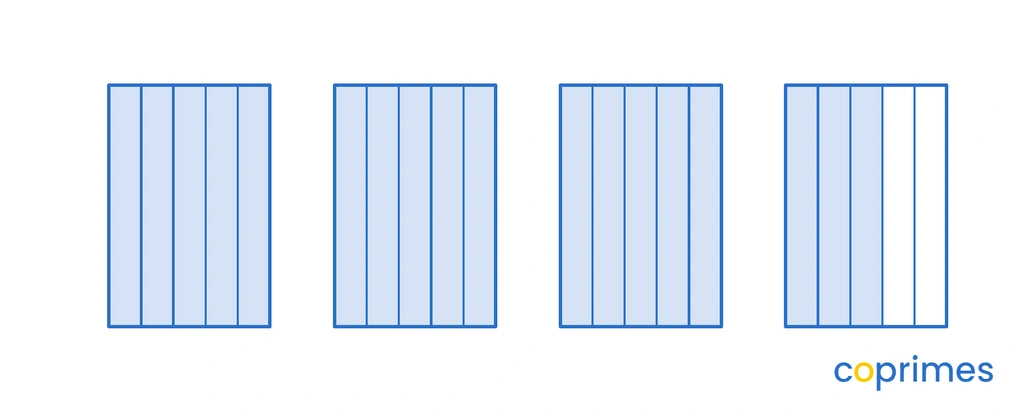
Which improper fraction is represented by the shaded models?
Convert to an improper fraction.
A student converted to an improper fraction and got . What common mistake did the student make?
They forgot to add the numerator to the product.
They multiplied the numerator instead of adding it.
They added the whole number to the denominator.
They changed the denominator to match the numerator.
They forgot to add the numerator to the product.
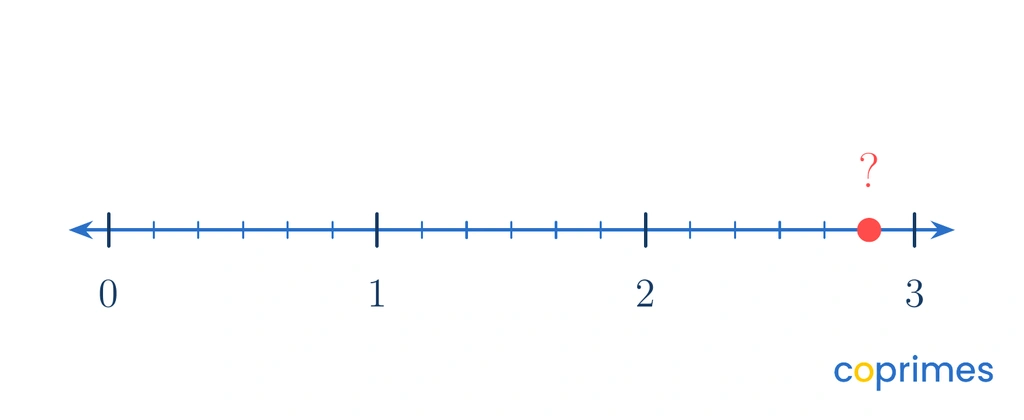
What improper fraction identifies the red point on the number line?
Which mixed number correctly converts to the improper fraction ?