
Mixed Numbers: Definition, Representation, and Examples
A mixed number combines a whole number and a proper fractions part into a single value. For example, is a mixed number because it has a whole number part () and a fractional part (). Mixed numbers are used to represent quantities that are greater than one whole, using terms that are often easier to visualize than single fractions.
What is a mixed number?
A mixed number is a numerical representation that adds a whole amount and a partial amount together. It is sometimes called a mixed fraction or a mixed numeral.
A mixed number represents the exact sum of its whole number and its fraction.
Even though there is no addition sign written between the two parts, the relationship is always addition.
For example, the mixed number means . It consists of four complete wholes and an additional three-fifths of a whole.
Understanding how fractions function is essential here, because the fractional part of a mixed number must always be a proper fraction. If the fractional part has a numerator equal to or greater than its denominator, the representation should be regrouped to form a new whole.
Read a mixed number
When you read a mixed number aloud, you read the whole number first, say the word "and", and then read the fraction. The word "and" signifies the hidden addition between the two parts.
For example, the mixed number is read as "five and one-fourth".
The mixed number is read as "eight and two-thirds".
By stating "and", you acknowledge that the value is the total of both quantities combined.
Visual models for mixed numbers
Because a mixed number represents wholes and a remaining portion, visual fraction models are an excellent way to see the value.
To model a mixed number, draw a series of identical shapes. Each shape represents one whole. Completely shade the number of shapes that match the whole number. Then, divide the final shape into equal parts according to the denominator, and shade the number of parts indicated by the numerator.
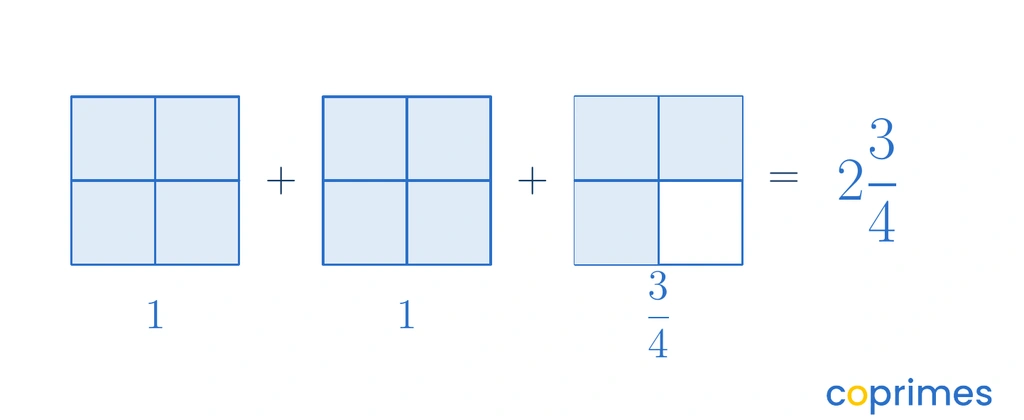
The diagram confirms that the value occupies more space than two wholes but less space than three wholes.
A learning plan shaped by your child, not the class
State-aligned Math plus our own Logic and English curriculum. An adaptive baseline test finds the gaps and fills them.
Mixed numbers on a number line
Placing fractions on a number line allows you to see their exact magnitude and order. Mixed numbers always fall between two consecutive whole numbers.
To locate a mixed number, identify the whole number part first. The mixed number will sit between this whole number and the next highest whole number. Then, divide the space between those two whole numbers into equal intervals matching the denominator, and move forward by the number of steps shown in the numerator.
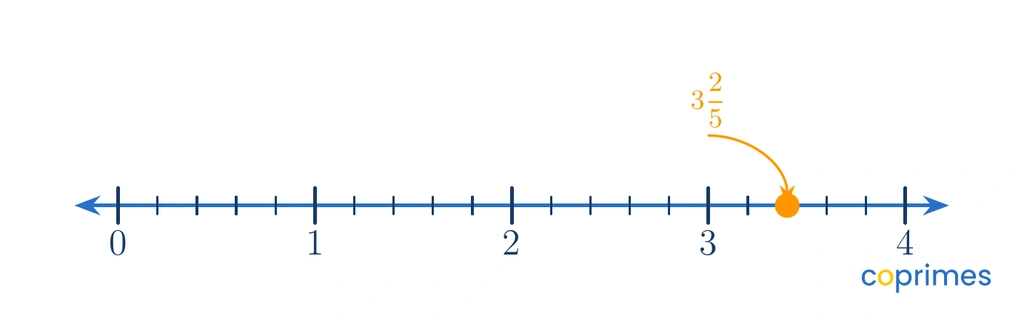
The mixed number is located past , moving two marks forward along the fifths scale toward .
Mixed numbers and improper fractions
A mixed number can always be written as a single fraction where the numerator is greater than the denominator. These are known as improper fractions. Both forms represent the exact same value, but they are useful in different situations. Mixed numbers are easier to estimate, while improper fractions are easier to multiply and divide.
To convert a mixed number into an improper fraction:
- Multiply the whole number by the denominator of the fraction.
- Add the numerator of the fraction to that product.
- Write the resulting sum over the original denominator.
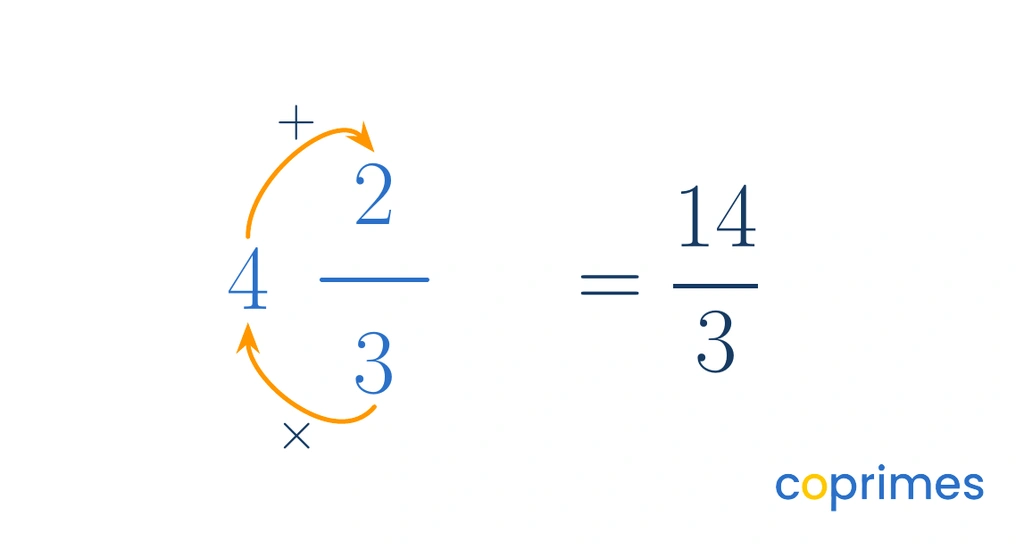
In this example, , which represents how many thirds are inside the four whole units. Adding the extra thirds gives a total of thirds.
Worked examples
Example 1: Identifying a mixed number from a model
Question: A baker bakes round pies. If there are complete pies and one additional pie that has of its slices remaining, what mixed number represents the total amount of pie?
Method:
- Identify the whole number of complete items. There are complete pies.
- Identify the fraction of the remaining item. The remaining pie is .
- Combine the whole number and the proper fraction.
Answer: The mixed number is .
Check: The total value is , which matches the visual description perfectly.
Example 2: Converting an improper fraction to a mixed number
Question: Convert the improper fraction into a mixed number.
Method:
- Treat the fraction bar as division. Divide the numerator by the denominator: .
- Find the whole number quotient. goes into exactly times, because .
- Find the remainder. Subtract from to get . This remainder becomes the new numerator.
- Keep the original denominator, which is .
Answer: The mixed number is .
Check: Convert back to an improper fraction: . The fraction is correct.
Example 3: Converting a mixed number to an improper fraction
Question: Write as an improper fraction.
Method:
- Multiply the whole number () by the denominator (): .
- Add the numerator () to the result: .
- Write the sum over the original denominator ().
Answer: The improper fraction is .
Check: Divide by . The result is with a remainder of , which matches .

Common mistakes
Confusing mixed numbers with multiplication
Because numbers placed next to variables indicate multiplication in algebra (like ), it is common to mistakenly assume that means . This is incorrect. A mixed number always implies addition: .
Mishandling negative mixed numbers
When a negative sign is attached to a mixed number, it applies to the entire quantity, not just the whole number. For example, means , which distributes to . Students sometimes mistakenly write , which produces the wrong value.
Frequently asked questions
Can a mixed number have an improper fraction part?
Standard mathematical notation requires the fractional part of a mixed number to be a proper fraction. If you calculate an answer like , you should regroup the fraction. Since is , the true standard form is .
Are whole numbers considered mixed numbers?
A whole number is not a mixed number because it lacks a fractional part. However, any whole number can technically be written as a mixed number with a zero numerator, such as , though this is rarely useful.
Is it better to use mixed numbers or improper fractions?
Neither form is universally better. Mixed numbers are superior for estimating size, measuring physical quantities, and visualizing real-world amounts. Improper fractions are superior for performing algebraic operations, particularly multiplication and division.
Practice questions
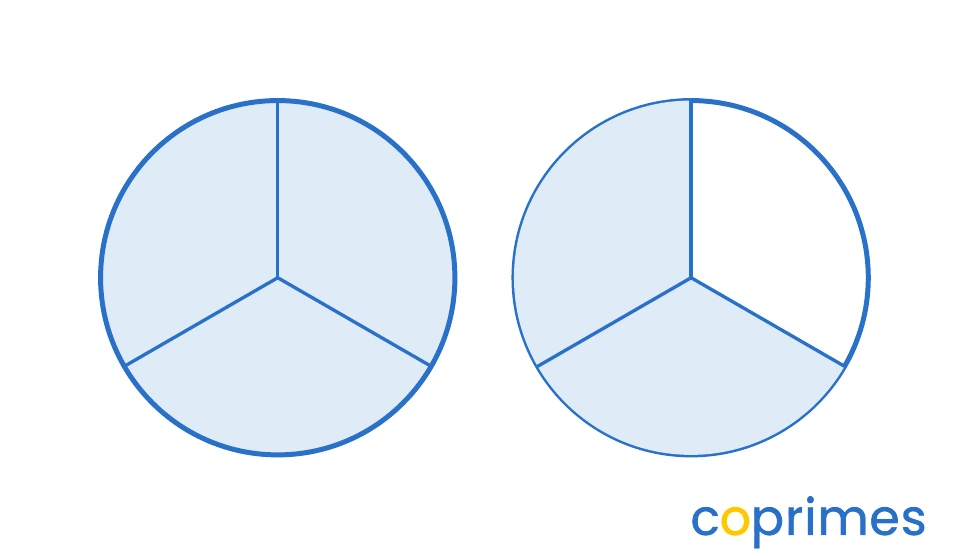
Which mixed number represents the shaded regions in the visual model?
Which expression correctly converts the mixed number into an improper fraction?
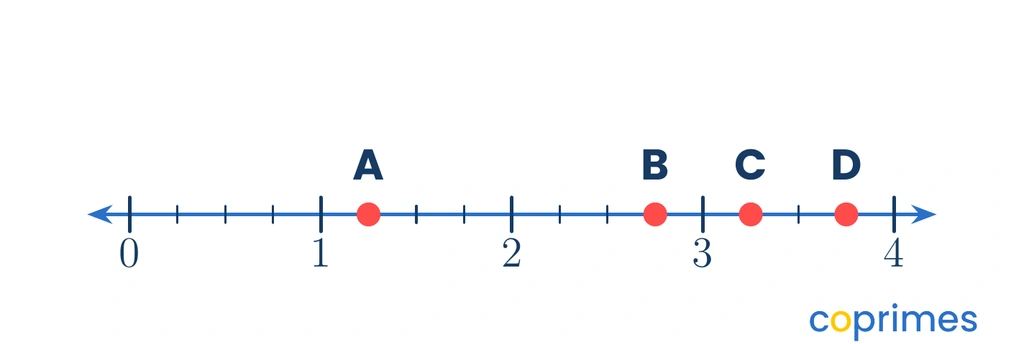
Which point on the number line represents the mixed number ?
Point A
Point B
Point C
Point D
Point B
What is the mathematical meaning of the negative mixed number ?
It means , which equals .
It means , which equals .
It means , which equals .
It means , which equals .
It means , which equals .
A large container holds exactly liters of water. If you want to scoop out all the water using a small jug that holds exactly of a liter, how many full jugs will you scoop?
jugs
jugs
jugs
jugs
jugs