
Percent Error: Definition, Method, and Examples
Percent error measures the size of the difference between an experimental or estimated value and an accepted value relative to the accepted value, expressed as a percent. It reveals how inaccurate a measurement or estimate is compared to the true value, which is crucial for evaluating accuracy in scientific experiments and statistics.
What is percent error?
When conducting an experiment or making a prediction, your result is rarely perfect. The percentage error, commonly called percent error, tells you how far off your measurement is from the exact, real value.
It compares the size of your mistake to the true size of what you are measuring. Expressing the error as a percent makes it easier to understand whether the mistake is minor or significant.
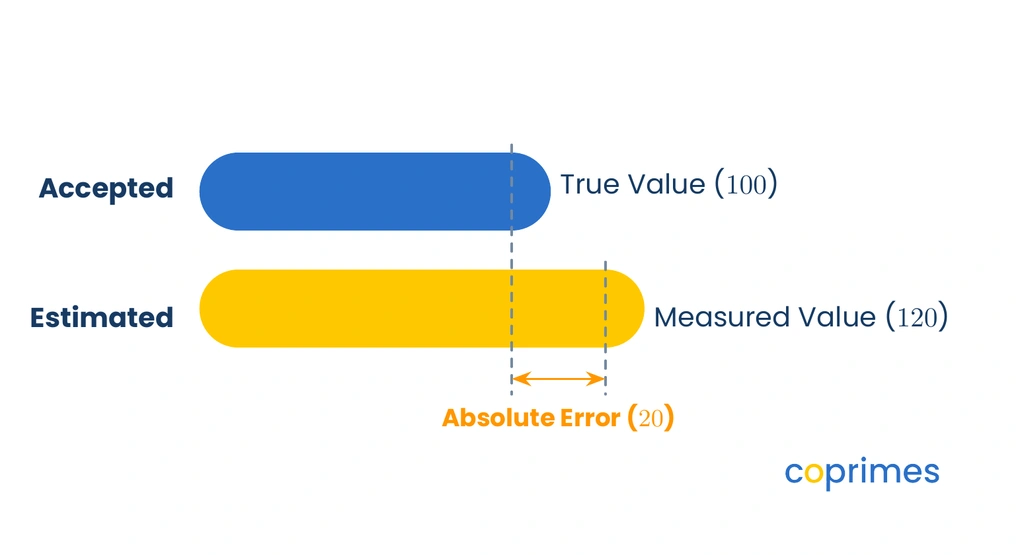
Identify experimental and accepted values
Before you can calculate percent error, you must identify two distinct numbers from your problem. The terminology can vary depending on the context.
- Accepted value: The true, exact, theoretical, or real value. This acts as the baseline standard for your comparison.
- Experimental value: The observed, measured, or estimated value. This is the result obtained from your experiment or when estimating calculations.
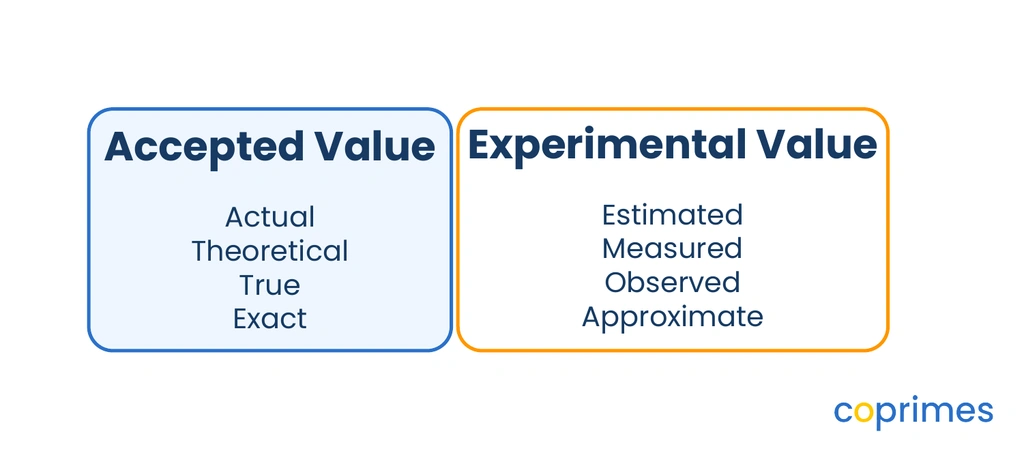
Find absolute error
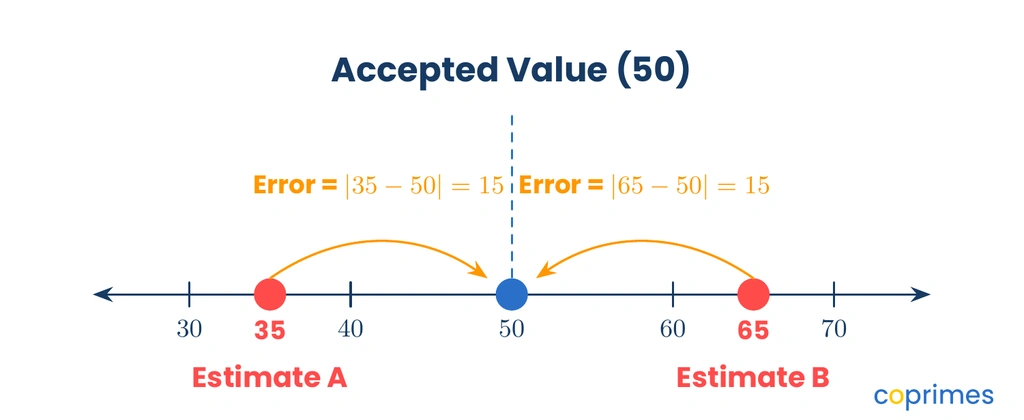
The first mathematical step is finding the absolute error, which is the positive difference between your experimental value and the accepted value.
Because we use the mathematical absolute value, the direction of the error does not matter. An overestimate of units and an underestimate of units both result in an absolute error of .
A learning plan shaped by your child, not the class
State-aligned Math plus our own Logic and English curriculum. An adaptive baseline test finds the gaps and fills them.
Use the percent error formula
Once you have the absolute error, you compare it to the accepted value to find the relative error percent. This logic is very similar to calculating percent change, but the denominator must always be the accepted true value.
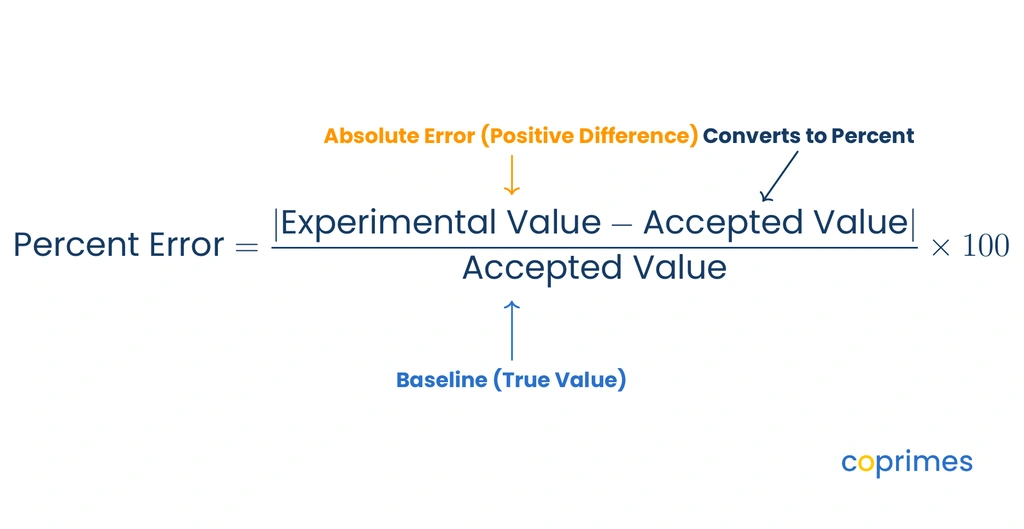
To find the final percent error, you simply divide the absolute error by the accepted value to get a decimal, and then multiply by . This process converts the relative error fraction into standard percentages.
Interpret accuracy and size
A small percent error means your experimental value was very close to the accepted value, indicating high accuracy. A large percent error indicates lower accuracy.
Because percent error is relative, the same absolute mistake can produce very different percent errors depending on the size of the accepted value.
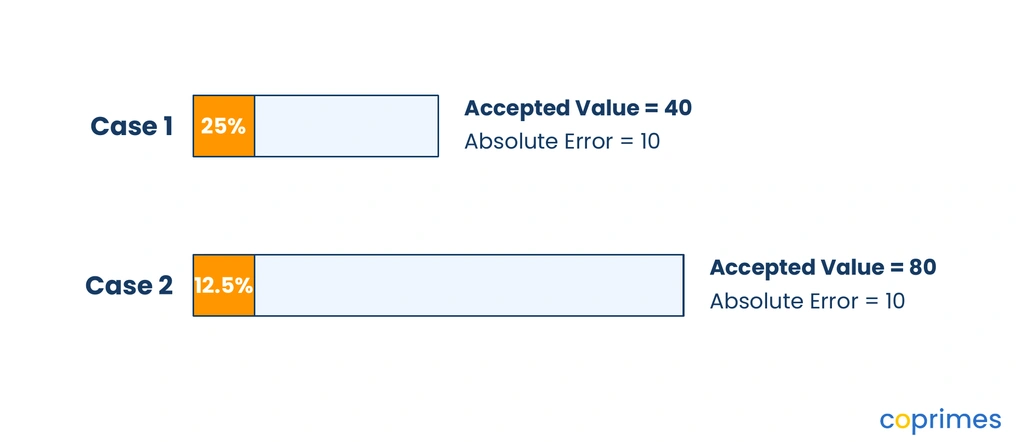
An error of units is a substantial mistake if the accepted value is only , but that same unit error is much less significant if the accepted value is .
Worked examples
Let's apply the percent error formula to standard percentage word problems.
Example 1: Measuring liquid volume
Question: A scientist measures the volume of a liquid to be milliliters. The accepted true volume is milliliters. What is the percent error?
Method:
- Identify the estimated experimental value () and the accepted value ().
- Calculate the absolute error by finding the positive difference: .
- Divide the absolute error by the accepted value: .
- Multiply by to convert the relative error to a percent: .
Answer: The percent error is .
Check: A error on milliliters is milliliters. Subtracting from gives , which matches the measured volume perfectly.
Example 2: Estimating event attendance
Question: A concert organizer estimates that people will attend an event. The actual attendance is people. What is the percent error of the estimate?
Method:
- Identify the estimated value () and the actual accepted value ().
- Find the absolute error: .
- Divide the absolute error by the actual accepted value: .
- Multiply by to find the percent: .
Answer: The percent error is .
Check: of is . Adding this overestimation to the actual value gives , which matches the organizer's estimate.
Example 3: Finding the actual cost
Question: A contractor estimates the cost of materials to be dollars. If his estimate is higher than the actual cost and has a percent error of , what is the actual cost?
Method:
- Set up the percent error formula using a variable, , for the unknown actual cost: .
- Divide both sides by to isolate the fraction: .
- Multiply both sides by : .
- Add to both sides to group the variables: .
- Divide by to solve for : .
Answer: The actual cost is dollars.
Check: The absolute error between and is . Dividing by the actual cost of gives , which is exactly .

Common mistakes
When practicing percent error, avoid these frequent errors that lead to incorrect answers:
- Forgetting to multiply by 100: Dividing the absolute error by the accepted value gives a relative error decimal, such as . You must multiply by to report the answer as .
- Dividing by the experimental value: The denominator must always be the true accepted value. Using your estimate as the denominator distorts the size of the error.
- Reporting a negative percent: Because you use the absolute value to find the positive difference, standard percent error is always expressed as a positive number.
Frequently asked questions
Can a decimal number be a percent error?
Yes. You will often calculate a decimal relative error before multiplying by . Additionally, the final percent error itself can be a decimal, such as .
Can a percent error be negative?
Generally, percent error is reported as a positive value because the formula uses absolute value. In specific advanced scientific fields, a negative sign is occasionally kept to indicate an underestimate, but in standard mathematics, you should report a positive percent.
Is a 5% error good?
The smaller the percent error, the more accurate the estimate. A error suggests the estimate was very close to the true value, which is highly acceptable in most classrooms, though the acceptable tolerance depends entirely on the context.
Practice questions
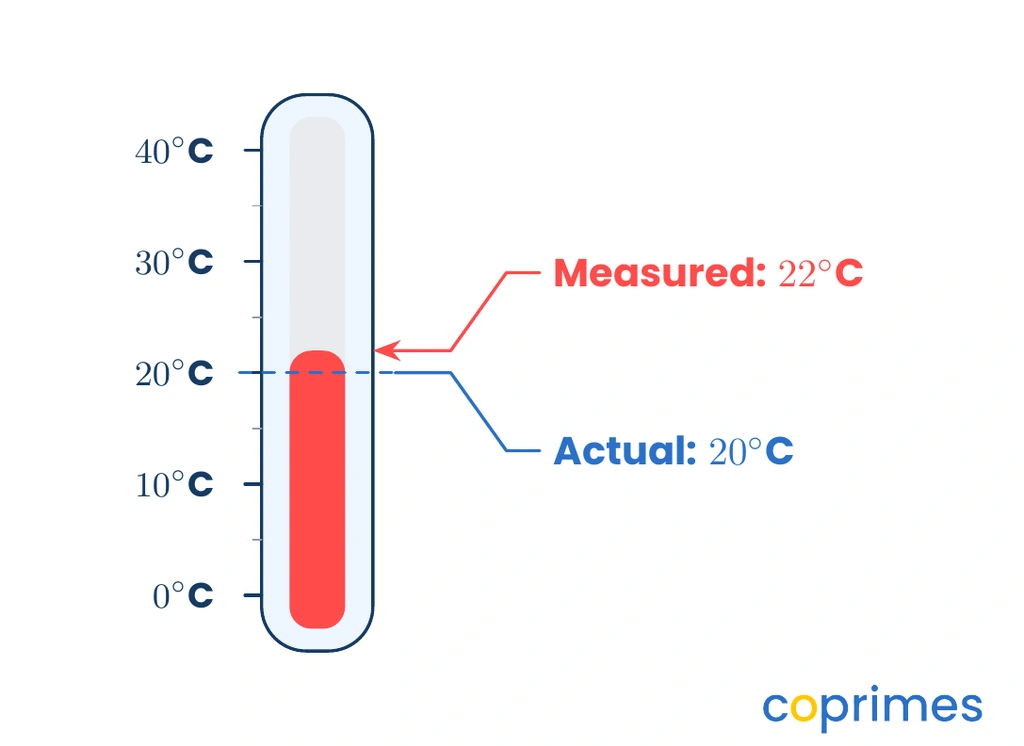
A student reads the thermometer in the laboratory as shown. What is the percent error of the student's measurement?
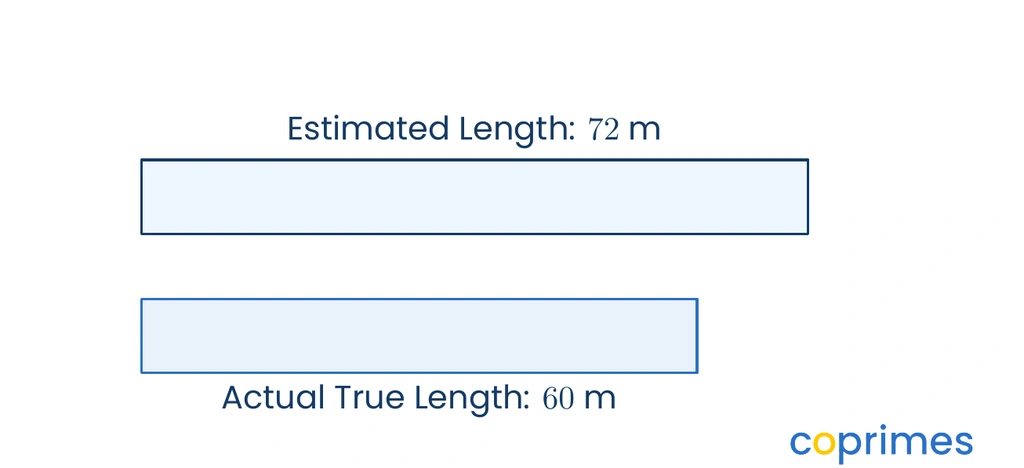
The diagram compares the estimated dimensions of a rectangular garden boundary to its actual dimensions. What is the percent error for the length?
An event organizer expects guests to arrive, but only guests actually attend. What is the percent error of the organizer's estimate?
A scientist measures a chemical reaction time as seconds. The accepted true time is seconds. To find the percent error, which mathematical calculation should the scientist use?
A student has a percent error of on a measurement. If the accepted true distance is meters and the student's estimate was too low, what was the student's estimated distance?