
Percent Change: Formula, Calculation, and Examples
To calculate percent change, subtract the original value from the new value, divide the size of that change by the original value and multiply by 100, then label the result as an increase or decrease.
Percent change describes how much a quantity has grown or shrunk compared to its starting amount. It is widely used to analyze data, track price adjustments, and measure population shifts over time.
What is percent change?
Percent change is a relative measure that expresses the absolute change in a value as a fraction of its starting value, scaled to a percentage.
The percent change formula compares the difference to the original amount.
The standard formula is:
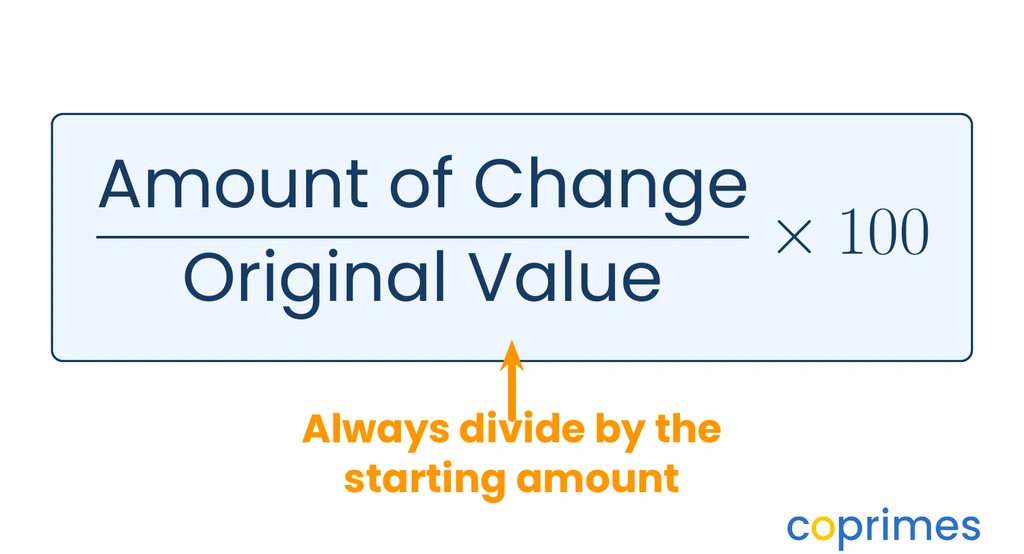
This ratio shows the size of the change relative to the initial size of the object, population, or price. A change of units is highly significant if the starting amount was , but almost unnoticeable if the starting amount was .
Find the amount of change
The first step in calculating a percentage difference from original amounts is finding the exact size of the change. This is the absolute difference between the two values.
Subtract the original value and the new value. The order of subtraction does not matter as long as you take the positive difference.
If the original value is and the new value is , the amount of change is . If the original value is and the new value is , the amount of change is also .
Use the original value as the base
The most important rule of calculating relative change is that the original value is always the denominator.
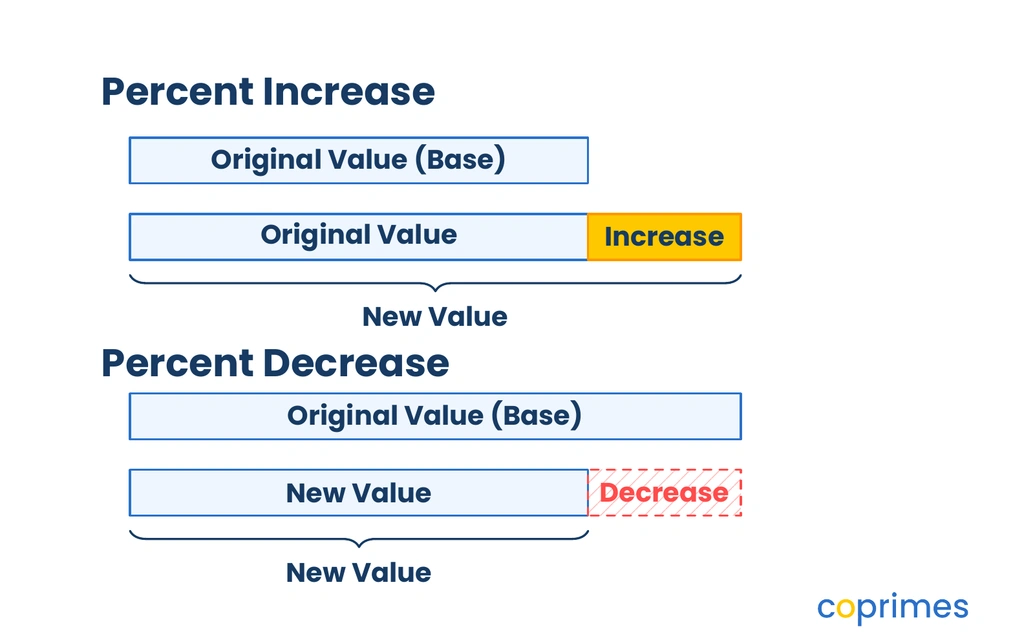
The original value represents of the starting conditions. If you divide by the new value instead, the resulting percentage will describe the size of the change relative to the end state, which is mathematically incorrect for calculating growth or reduction over time.
A learning plan shaped by your child, not the class
State-aligned Math plus our own Logic and English curriculum. An adaptive baseline test finds the gaps and fills them.
Calculate percent increase and decrease
Once you divide the amount of change by the original value, you will have a decimal. Multiply this decimal by to convert it into a percentage.
When a value grows, it is a percent increase, and when a value shrinks, it is a percent decrease. It is essential to state the direction of the change in your final answer so the meaning of the percentage is clear.
For example, a change from to is a increase, while a change from to is a decrease. The amounts are the same, but the percentages differ because the starting values differ.
Interpret repeated changes
When multiple percentage changes happen in sequence, they are applied to the new accumulated value each time, not the original starting value.
Because the base value changes after the first step, you cannot simply add or subtract the percentages to find the total change.
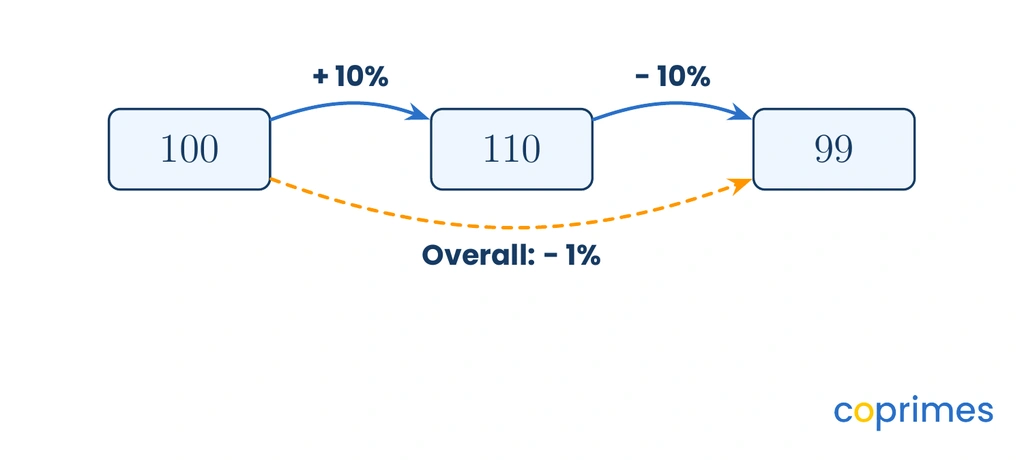
If a price increases by and then decreases by , the overall change is not zero. The decrease acts on the new, larger amount, pulling the final value lower than the original starting point.
Worked examples
Applying the method to percentage word problems helps to solidify the core steps of identifying the starting value and tracking the difference.
Example 1: Calculating a population increase
Question: A town's population grows from to . What is the percent change?
Method:
- Find the amount of change by subtracting the original value from the new value.
2. Divide the change by the original value ().
3. Multiply by to convert to a percentage.
Answer: The percent change is a increase.
Check: Finding of yields . Adding this to confirms the new population is .
Example 2: Calculating a price decrease with decimals
Question: A jacket's price drops from dollars to dollars. What is the percent change?
Method:
- Find the amount of change.
2. Divide the change by the original price ().
3. Multiply by and state the direction.
Answer: The percent change is a decrease.
Check: Subtracting of from the original gives exactly .
Example 3: Interpreting consecutive changes
Question: A stock's value rises by in year one, then falls by in year two. What is the overall percent change from the original value?
Method:
- Assume an original value of dollars to make calculation simple.
- Calculate the year one increase.
of dollars is dollars.
New value = dollars.
3. Calculate the year two decrease based on the new value.
of dollars is dollars.
Final value = dollars.
4. Find the overall percent change from the original dollars.
Change = dollars.
Answer: The overall percent change is a decrease.
Check: The repeated multipliers are . A multiplier of represents a decrease from the starting value of .

Common mistakes
The most common error is dividing the amount of change by the new value instead of the original value. Always establish which value came first in time or which value is the established baseline before substituting numbers into the formula.
Another frequent mistake is ignoring the direction of the change. Writing "" as an answer is incomplete if the context requires knowing whether the quantity went up or down. Always label your final answer as an increase or a decrease.
Related to this is percent error, which measures the inaccuracy of an estimate rather than a chronological change over time. Percent error uses the exact accepted value as the denominator, whereas percent change uses the original starting value.
Frequently asked questions
Can percent change be over ?
Yes. A percent increase is over if the new value is more than double the original value. For example, an increase from to is a change of , which is a increase. A percent decrease, however, cannot exceed unless negative values are allowed in the specific context.
Is percent change the same as a multiplier?
They are closely related but not identical. A percent change tells you how much was added or subtracted. A multiplier tells you what to multiply the original by to find the new value directly. A increase corresponds to a multiplier of . Finding the original value before a change occurred is a process known as reverse percentages.
Practice questions
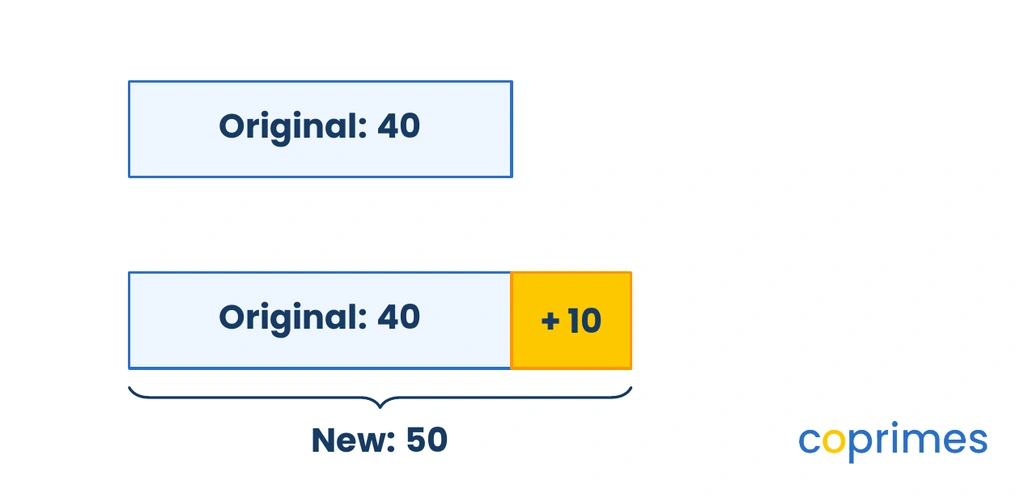
What is the percent change shown in the model?
increase
increase
increase
increase
increase
A school's enrollment drops from students to students. What is the percent change?
decrease
decrease
decrease
decrease
decrease
A video game's price is increased by . During a sale, the new price is then decreased by . What is the overall percent change from the original price?
No overall change ()
A increase
A decrease
A decrease
A decrease
A tree grows from a height of millimeters to millimeters. A student incorrectly calculates the growth as a increase. What mistake did the student make?
They forgot to multiply their decimal by .
They divided the change by the new value instead of the original value.
They subtracted the original value from the new value incorrectly.
They divided the new value by the original value.
They divided the change by the new value instead of the original value.
The monthly rainfall in a city drops from millimeters in June to millimeters in July. What is the percent change?
decrease
decrease
decrease
decrease
decrease