
Percent to Fraction: Procedure, Examples and Practice
To convert a percent to a fraction, remove the percent sign, write the value as a numerator over a denominator of , and simplify. For a decimal percent, first clear its decimal using an equivalent fraction before simplifying the final result.
Because percentages represent parts per hundred, placing the given value over creates an immediate fraction equivalent. This mathematical process allows you to use percentages in complex calculations that require standard fractional forms.
Converting a percentage to a fraction changes its representation but keeps its mathematical value exactly the same.
How do you convert a percent to a fraction?
You can change any percentage into a fraction by following three straightforward steps. The method relies on the definition of a percentage and the rules for equivalent fractions.
- Remove the percent symbol and write the number as a numerator over a denominator of .
- If the numerator is a decimal, multiply both the numerator and the denominator by a power of to make the numerator a whole number.
- Simplify the fraction to its lowest terms.
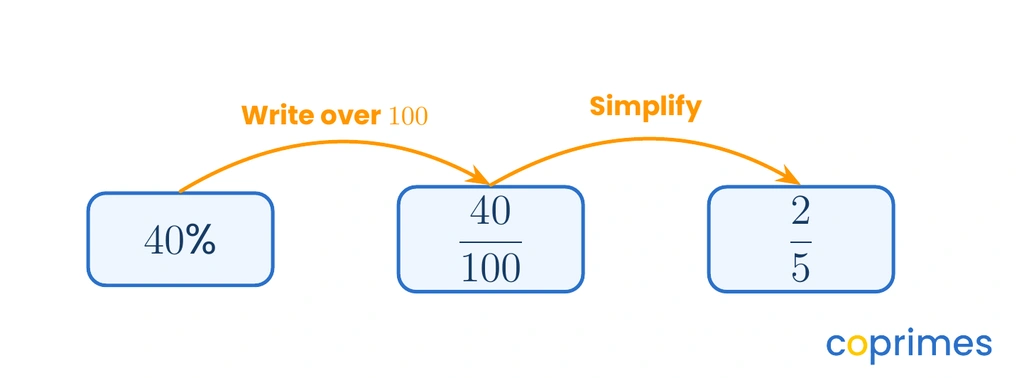
Following these exact steps guarantees an accurate conversion, whether the percentage is a whole number, a decimal, or a value greater than .
Write percent over one hundred
The word percent translates directly to "per one hundred" or "out of one hundred." Because of this definition, a percentage is naturally represented as a fraction with a denominator of .
To begin the conversion process, strip away the percent symbol and place the number in the numerator position. For example, means parts out of , which is written exactly as .
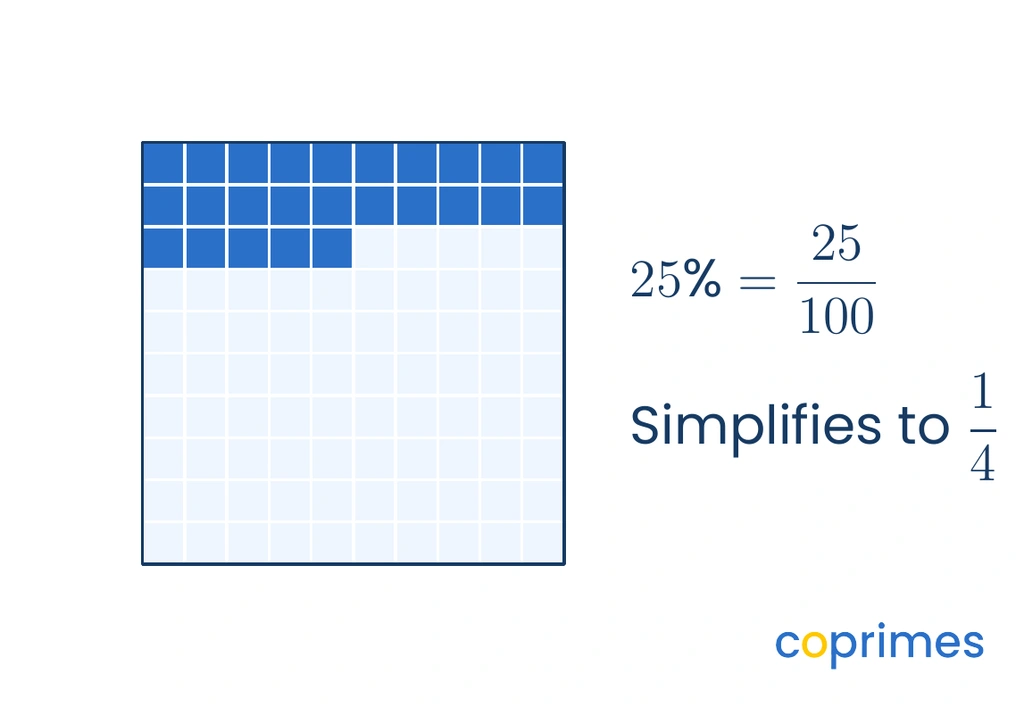
Writing the value over one hundred establishes the mathematical ratio. From this foundational form, the value is ready to be transformed into its simplest state.
Simplify to lowest terms
Once the percentage is written over , finalize the result by simplifying fractions whenever possible. This makes the fraction easier to interpret and use in subsequent calculations.
To find the simplest form, identify the greatest common factor (GCF) that divides cleanly into both the numerator and the denominator. For example, if you start with , writing it over one hundred yields . Both and share a greatest common factor of . Dividing the numerator and the denominator by produces .
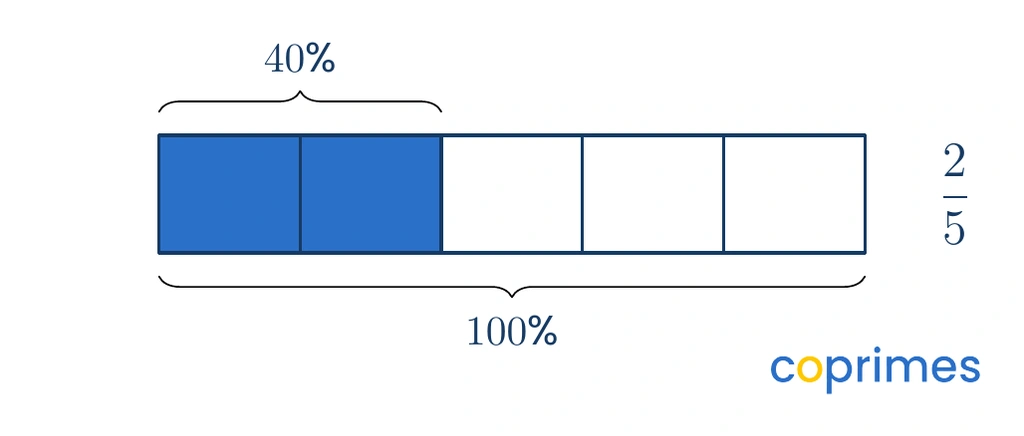
Simplifying does not change the ratio; it only changes the size of the pieces representing that ratio.
A learning plan shaped by your child, not the class
State-aligned Math plus our own Logic and English curriculum. An adaptive baseline test finds the gaps and fills them.
Convert decimal percentages
When a percentage contains a decimal point, placing it over creates a fraction with a decimal numerator. To clear the decimal, multiply both the numerator and the denominator by an appropriate power of .
For example, converting to a fraction initially gives . A standard fraction cannot contain a decimal. Because has one decimal place, multiply the numerator and the denominator by to shift the decimal point one place to the right, similar to when you change a percent to decimal.
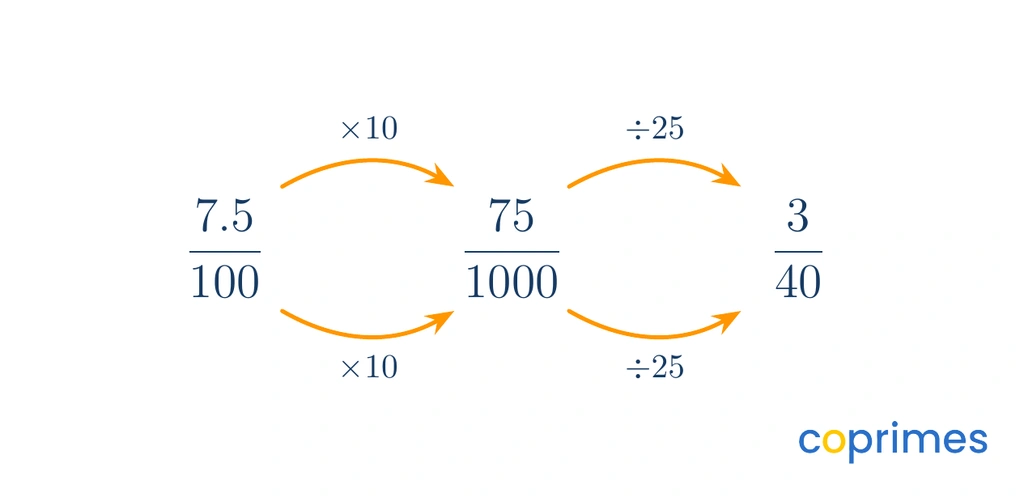
Always multiply both the numerator and the denominator by the same power of ten to keep the fraction equivalent.
If the percentage had two decimal places, such as , you would multiply the numerator and the denominator by to clear both digits.
Convert percentages above one hundred
A percentage greater than represents a value larger than one whole. Converting these percentages follows the exact same procedure, but the resulting fraction will be an improper fraction.
For example, is written as . Simplifying this fraction by dividing both parts by yields . Because the numerator is larger than the denominator, this improper fraction can then be written as the mixed number .
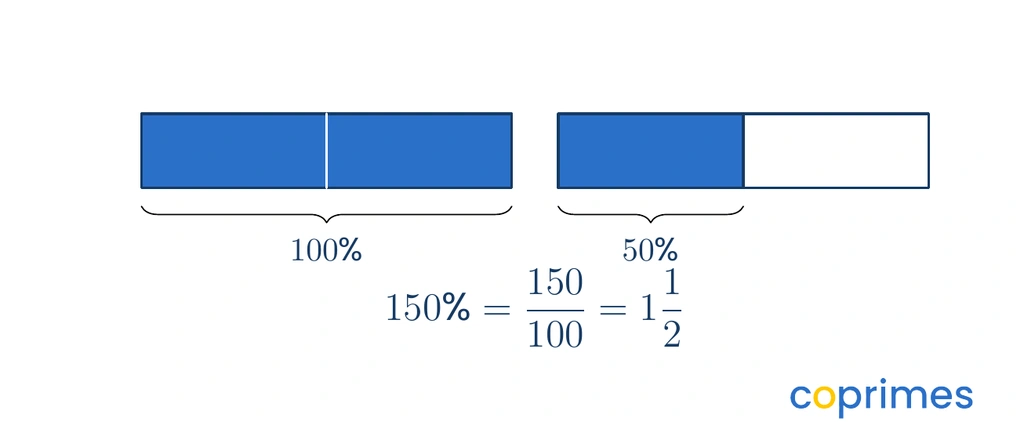
Whether represented as an improper fraction or a mixed number, the mathematical value remains correct.
Worked examples
Practicing with whole numbers, decimals, and values above one hundred ensures you can confidently convert any percentage you encounter.
Example 1: Converting a whole-number percentage
Question: Convert to a fraction in its simplest form.
Method:
- Write the percentage over to get .
- Simplify the fraction by identifying common factors. The greatest common factor of and is .
- Divide the numerator and the denominator by .
Answer:
Check: Verify the result by reversing the process and changing the fraction to percent. Since , and , the calculation is correct.
Example 2: Converting a decimal percentage
Question: Convert to a fraction in its simplest form.
Method:
- Write the percentage over to get .
- The numerator has one decimal place. Multiply both the numerator and the denominator by to clear the decimal, giving .
- Find the greatest common factor of and , which is .
- Divide the numerator and the denominator by .
Answer:
Check: Divide by to evaluate the fraction as a decimal. , which equals .
Example 3: Converting a percentage above one hundred
Question: Convert to a mixed number in its simplest form.
Method:
- Write the percentage over to get the improper fraction .
- Simplify the fraction by dividing the numerator and the denominator by their greatest common factor of , leaving .
- Convert the improper fraction to a mixed number by dividing the numerator by the denominator. equals with a remainder of .
Answer:
Check: Convert back to a decimal. It equals . Multiplying by gives , confirming the result.

Common mistakes
A frequent error occurs when multiplying by an incorrect power of ten while trying to clear a decimal percentage. For example, if a student converts and multiplies the numerator by , they get . The numerator is still a decimal. You must multiply by to clear two decimal places, producing .
Another common mistake is forgetting to multiply the denominator when clearing a decimal. Changing to completely changes the mathematical value of the fraction. The denominator must also be multiplied by ten to create the equivalent fraction .
Finally, many students stop simplifying before reaching the lowest terms. An answer of is mathematically correct, but it is not in its simplest form. Always check the final numerator and denominator one last time to confirm they share no common factors other than .
Frequently asked questions
Do I always have to simplify the fraction to its lowest terms?
In most academic settings, answers must be given in simplest form unless otherwise stated. However, in specific contexts like comparing probabilities or interpreting financial rates, leaving the fraction out of may be more useful because it clearly preserves the original percentage base.
How does this connect to other forms of measurement?
Converting from a percentage to a fraction is a core part of mathematics. A strong understanding of fractions decimals and percents conversion helps you seamlessly move between different representations depending on what a specific problem requires.
Is the method the same for repeating decimal percentages?
A repeating decimal percent, such as , cannot be easily cleared by multiplying by a power of ten because the decimal never ends. Instead, you must recognize the repeating decimal's equivalent fraction base, converting directly to .
Practice questions
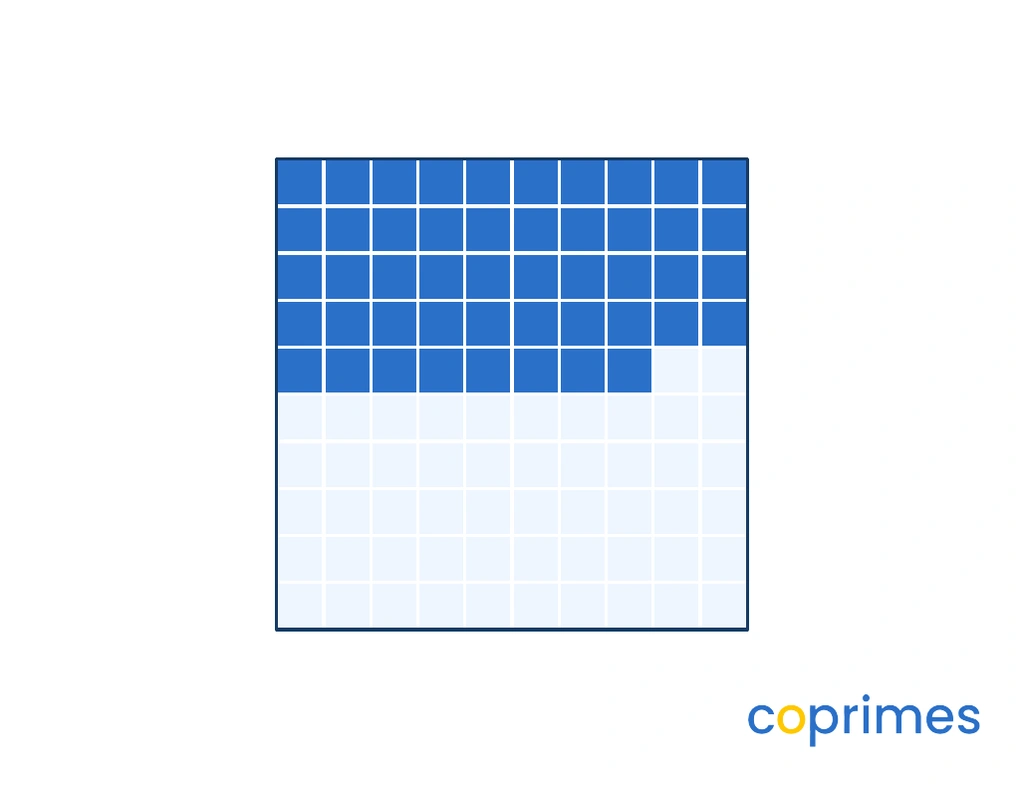
Which fraction in its simplest form represents the percentage shaded in this hundreds grid?
Convert to a fraction in its simplest form.
A student wants to convert to a fraction. Which step correctly creates an equivalent fraction with a whole-number numerator?
Multiply both the numerator and the denominator by to get .
Multiply the numerator by to get .
Divide the numerator and the denominator by to get .
Multiply both the numerator and the denominator by to get .
Multiply both the numerator and the denominator by to get .
What is the correct fraction in simplest form for ?
Convert to a mixed number in its simplest form.