
Understanding Pressure, Force and Area
Pressure depends on force and area. With area fixed, greater force gives greater pressure; with force fixed, greater area gives lower pressure. The relationship is modelled by .
Understanding pressure force and area allows you to calculate how weight or impact is distributed across different surfaces.
How are pressure, force and area related?
Pressure measures how much force is concentrated on a specific area. It represents the intensity of a force acting on a surface.
When a force is spread out over a large surface, the pressure is low. When the same force is concentrated on a tiny point, the pressure is very high. This relationship is mathematically described by dividing the total force by the area over which it is applied.
Pressure is the force exerted per unit of area.
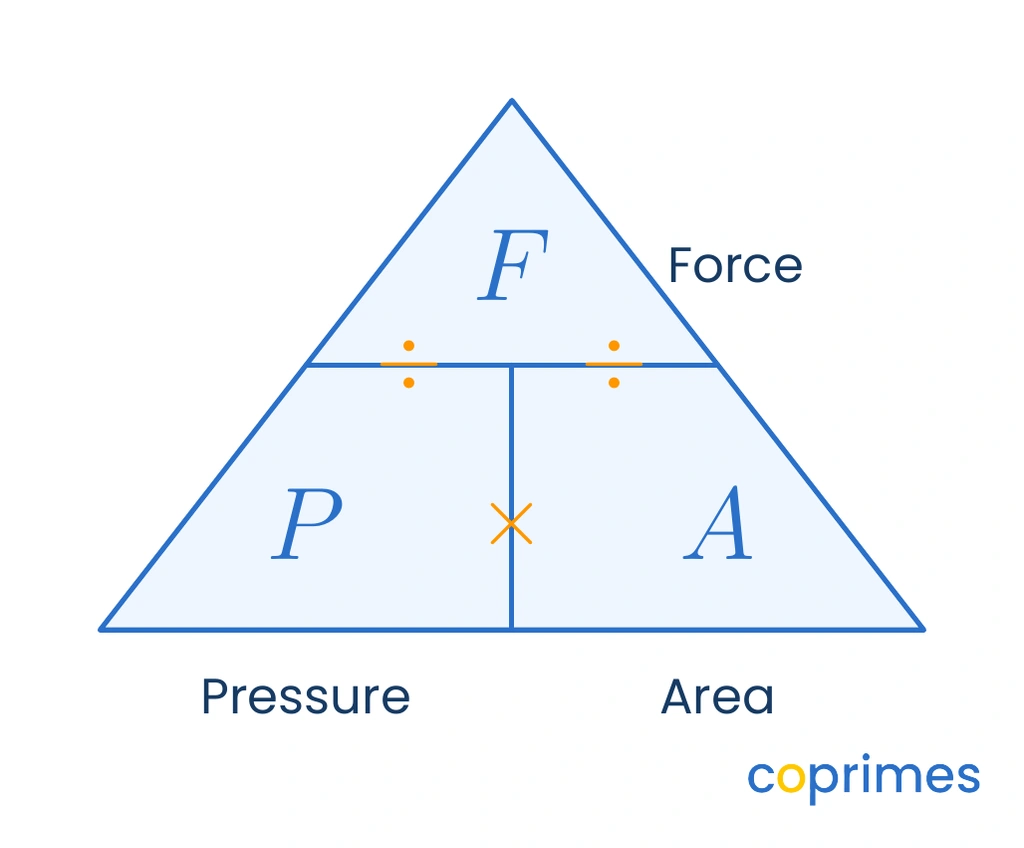
The triangle model helps visualize how to isolate a missing variable. Covering the value you want to find reveals the operation needed to calculate it using the other two variables.
Hold area constant
When the surface area remains exactly the same, applying more force directly increases the pressure.
Because the area is not changing, every additional unit of force adds more stress to that specific surface. In this situation, pressure is directly proportional to force. If you double the weight pushing down on a table top, the pressure on the table top doubles.
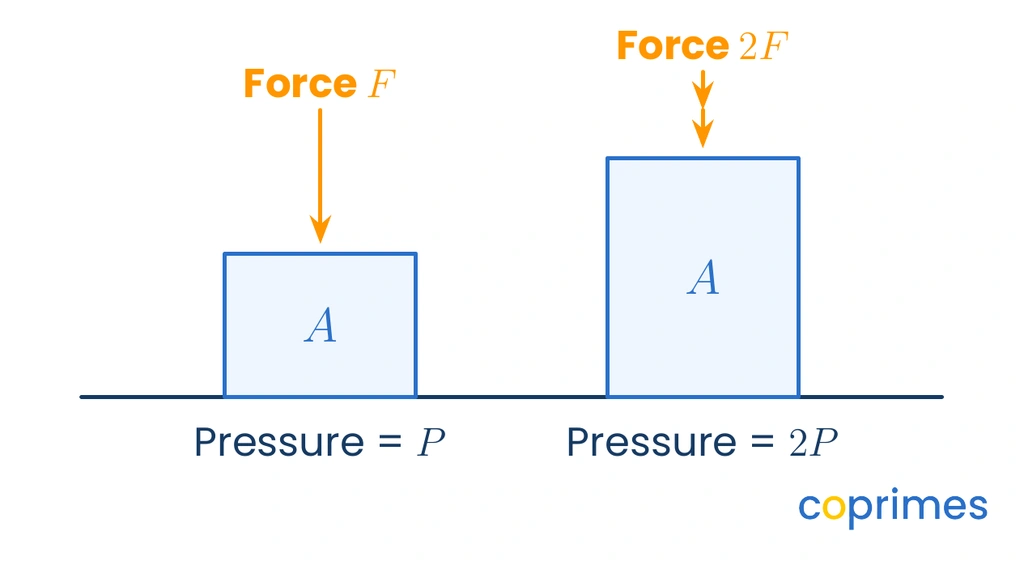
The force arrows demonstrate that increasing the applied force on a constant area results in a proportional increase in pressure.
Hold force constant
When the total force is fixed, changing the surface area changes the pressure in the opposite direction.
Spreading a constant weight over a larger area reduces the pressure on any single point. Conversely, resting the same weight on a tiny point creates massive pressure. Under a constant force, pressure is inversely proportional to area. This is why wide tires prevent tractors from sinking into soft ground, while sharp blades easily cut through materials.
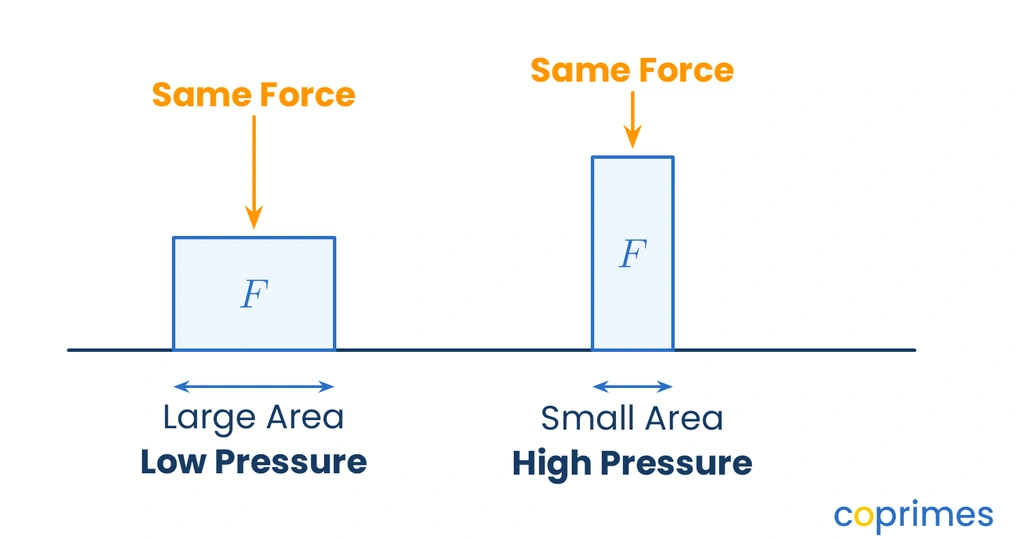
The visual shows that orienting an object to rest on a smaller surface concentrates its weight, resulting in significantly higher pressure.
A learning plan shaped by your child, not the class
State-aligned Math plus our own Logic and English curriculum. An adaptive baseline test finds the gaps and fills them.
Model direct and inverse change
Variables that govern pressure are connected through proportion.
When reasoning about changing conditions, determine which variables are shifting and which remain constant. If the force decreases while the area stays the same, the pressure decreases at the same rate. If the force is kept constant while the area decreases, the pressure must increase.
Halving the area under a constant force doubles the pressure.
Apply the relationship
To solve numerical problems, you must select the correct arrangement of the pressure formula.
Follow these steps for calculations:
- Identify the two known values from the problem statement.
- Select the correct formula based on the variable you need to find.
- Substitute the known values and perform the operation.
- Apply the correct units to the final answer.
The three forms of the relationship are:
- To find Pressure:
- To find Force:
- To find Area:
Worked examples
These examples demonstrate how to calculate pressure, force, and area using different versions of the relationship formula.
Example 1: Calculating pressure from force and area
Question: A box exerts a downward force of Newtons over a base area of square meters. What is the pressure exerted by the box?
Method:
- Identify the given values: Force and Area .
- Select the correct formula for pressure: .
- Substitute the values and divide: .
Answer: The pressure is Newtons per square meter.
Check: Since , the calculation is correct.
Example 2: Calculating force from pressure and area
Question: A machine applies a pressure of Newtons per square meter over a surface area of square meters. What is the total force applied?
Method:
- Identify the given values: Pressure and Area .
- Select the correct formula for force: .
- Substitute the values and multiply: .
Answer: The total force is Newtons.
Check: Dividing the force by the area gives , which matches the given pressure.
Example 3: Calculating area from force and pressure
Question: An object exerts a force of Newtons and creates a pressure of Newtons per square meter. What is the contact area?
Method:
- Identify the given values: Force and Pressure .
- Select the correct formula for area: .
- Substitute the values and divide: .
Answer: The contact area is square meters.
Check: Finding the pressure using this area yields , confirming the area is correct.

Common mistakes
Mistakes often occur during rearrangement or variable identification.
- Reversing division: The formula for pressure is . A common error is dividing the area by the force instead. Always ensure force is the numerator when calculating pressure.
- Choosing the wrong formula: It is easy to accidentally divide when you need to multiply. If calculating total force, you must multiply pressure by area, never divide them.
- Confusing proportion relationships: Students sometimes assume that a larger area creates a larger pressure. Remember the inverse rule: if the weight is constant, spreading it out over more space lowers the pressure.
Frequently asked questions
What is the difference between force and pressure?
Force is a push or pull acting on an object, measured in Newtons. Pressure is how that push or pull is distributed over a given surface. The same push creates different pressures depending on the size of the surface it acts upon.
Why is it easier to cut food with a sharp knife?
A sharp knife has a tiny surface area at its edge. When you apply even a modest pushing force, dividing that force by a very small area results in massive pressure, allowing the edge to slice through material easily.
Can pressure be zero?
If absolutely no force is applied to a surface, the numerator in is zero, which means the pressure is zero.
Practice questions
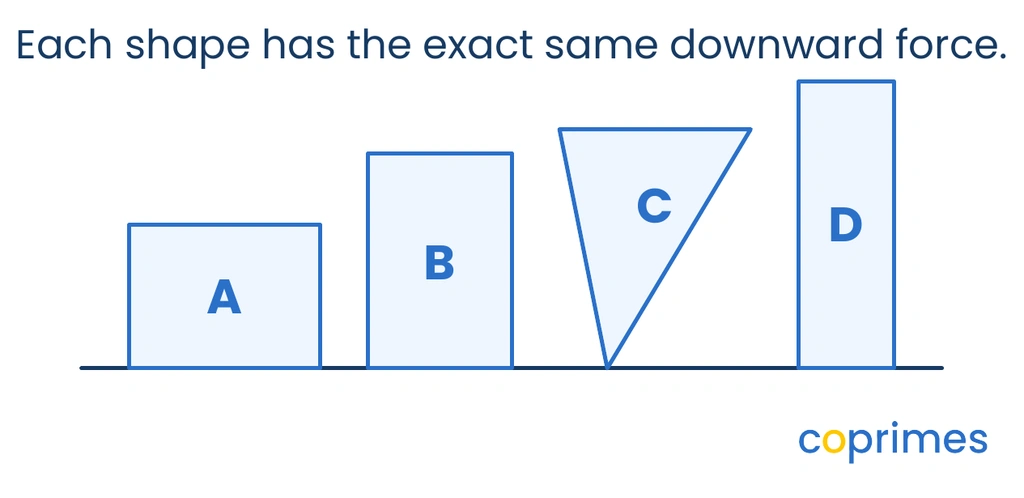
Which shape exerts the greatest downward pressure on the surface?
Shape A
Shape B
Shape C
Shape D
Shape C
A force of Newtons is applied evenly over an area of square meters. What is the pressure?
If a pressure of Pascals acts on a surface area of square meters, what is the total force applied?
A heavy crate applies a total force of Newtons and creates a pressure of Pascals. What is the contact area of the crate?
If you hold the applied force constant but triple the surface area, what happens to the pressure?
The pressure triples.
The pressure becomes one third of its original value.
The pressure remains completely unchanged.
The pressure becomes one ninth of its original value.
The pressure becomes one third of its original value.