
Converting a Ratio to a Percent
To convert a part-to-whole ratio to a percent, add the ratio parts to find the whole, write the requested part as a fraction of that whole, then multiply by or convert its decimal value to a percent. This process allows you to compare proportional amounts out of .
What does ratio to percent mean?
Converting a ratio to a percent means calculating the percentage of the total that each part of a ratio represents.
A ratio tells us how much of one quantity exists compared to another. Because percentages represent a part out of , we must first find the total number of parts in the ratio.
Changing a ratio to fraction makes this possible because a fraction compares a part directly to the total whole. From there, the fraction is converted into a percentage.
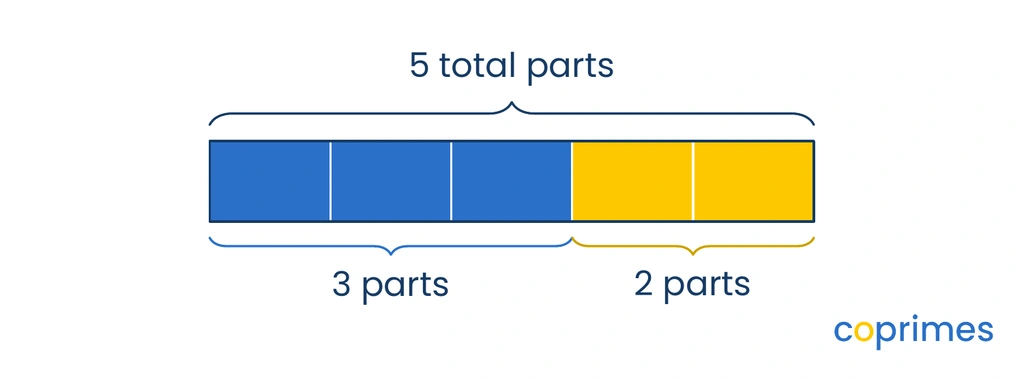
Find the total ratio parts
The first step in a ratio percent conversion is to add the parts of the ratio together. This sum represents the denominator, or the total number of parts in the whole.
Always add the ratio parts to find the total whole before converting.
For example, if paint is mixed in a ratio of , representing three parts blue paint to one part white paint, add the parts to find the total:
The total mixture consists of equal parts.
Convert ratio parts to fractions
Next, write each individual part of the ratio as a numerator over the total number of parts as the denominator.
Using the ratio with total parts, the fraction of blue paint is and the fraction of white paint is .
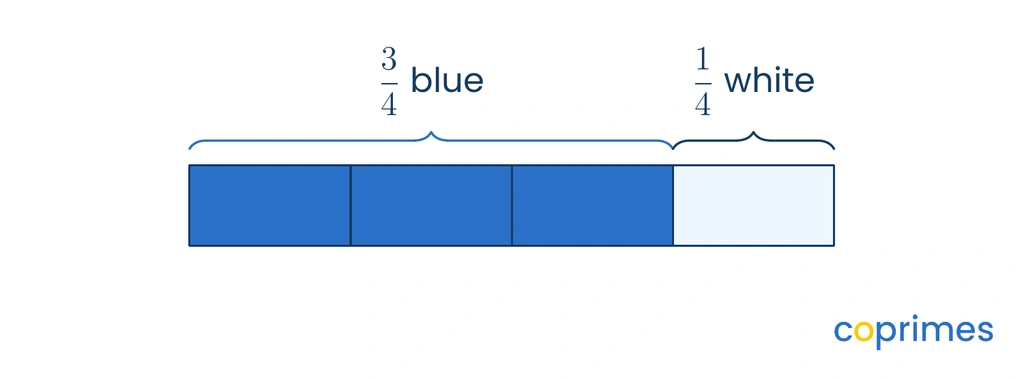

Convert fractions to percents
Finally, change each fraction into a percentage. To convert a fraction to percent, divide the numerator by the denominator to get a decimal, then multiply by .
For the blue paint fraction :
For the white paint fraction :
The ratio written as a percentage is to .
Check that parts total 100 percent
Because a complete whole is always percent, the sum of all the percentage parts must equal exactly .
If your percentages add up to less or more than , check the calculations. When working with repeating decimals, such as thirds or ninths, rounding can cause the total to be very slightly off, but the exact values will always sum to .
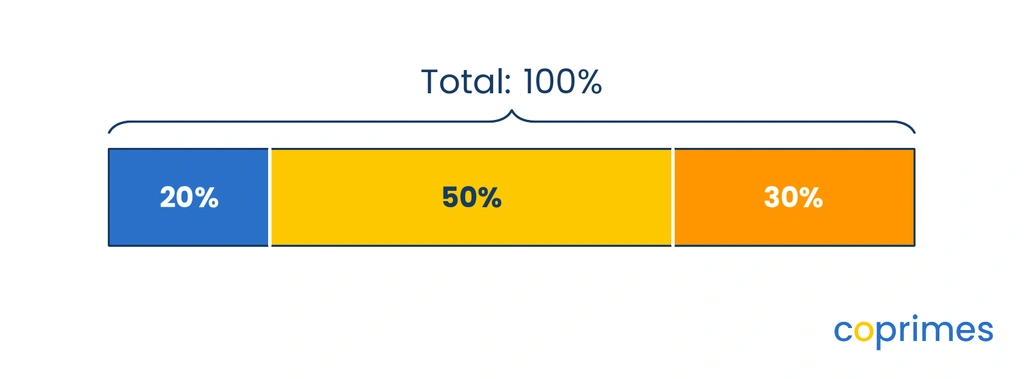
Worked examples
These examples show how to convert ratio to percentage in different scenarios.
Example 1: Converting a two-part ratio to percents
Question: A bag contains green and yellow marbles in the ratio . What percent of the marbles are green?
Method:
- Find the total number of parts: .
- Write the green part as a fraction of the total: .
- Convert the fraction to a percent: .
Answer: of the marbles are green.
Check: The yellow marbles are . Checking the sum: .
Example 2: Converting a three-part ratio to percents
Question: A recipe calls for flour, sugar, and butter in the ratio . What percent of the mixture is butter?
Method:
- Add all three parts together to find the denominator: .
- Identify the butter value. Butter is the third item in the ratio, which is . Write this as a fraction of the total: .
- Convert the fraction to a decimal, then to a percentage: , which equals .
Answer: Butter makes up of the mixture.
Check: Flour is and sugar is . The sum is .
Example 3: Ratio word problem with percentages
Question: A company splits its budget between marketing and research in the ratio . If of the marketing budget is spent on digital advertising, what percent of the total budget is spent on digital advertising?
Method:
- Use ratio problem solving steps to find the total parts: .
- Find the percentage of the budget dedicated to marketing: .
- Calculate of that share by finding a percent of a number: .
Answer: Digital advertising accounts for of the total budget.
A learning plan shaped by your child, not the class
State-aligned Math plus our own Logic and English curriculum. An adaptive baseline test finds the gaps and fills them.
Common mistakes
Confusing ratio parts with fractions
It is a mistake to transform each ratio number directly into a percentage without finding the overall total first. For example, if a ratio is , it is incorrect to write the fractions as and . The total is , so the correct fractions are and .
Writing the percentage ratio in the wrong order
Ratios are strictly ordered. If a question gives a ratio of dogs to cats as , the first number relates to dogs and the second to cats. Reversing the percentages to dogs and cats would be incorrect.
Frequently asked questions
How do you convert a ratio to a percent?
To convert a ratio to a percentage, add the ratio parts to find the total, write the desired part as a numerator over the total, and multiply the resulting fraction by .
Can a ratio have more than two parts?
Yes, a ratio can compare three or more parts, such as . The method remains the same: add all parts to find the whole, then convert each part into a fraction over that total.
How are ratios and percents similar?
Both ratios and percents represent a relationship between amounts. A percent is a specific type of ratio where the total is always normalized to .
Practice questions
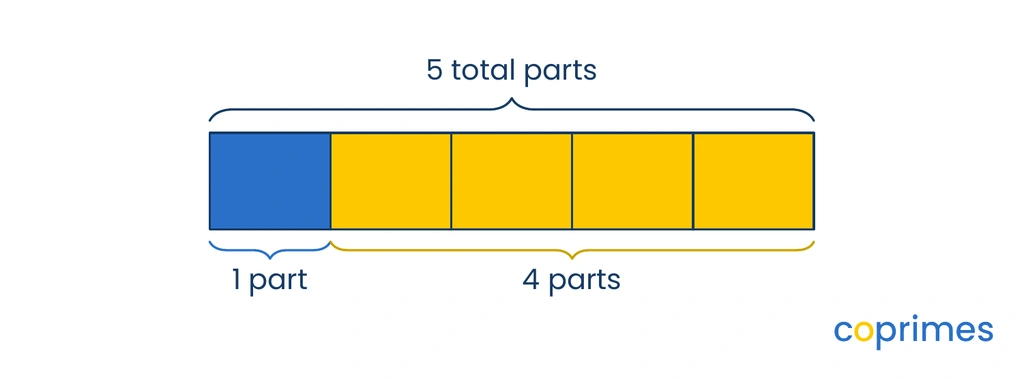
The tape diagram above shows a ratio of blue squares to yellow squares. What percent of the total squares are blue?
What is the ratio expressed as percentages?
and
and
and
and
and
A gardener plants rose, tulip, and daisy bulbs in the ratio . What percent of the bulbs are tulips?
A bag contains apples and oranges in the ratio . What percent of the fruit are apples?
A local club has tennis and squash players in the ratio . Exactly of the tennis players are left-handed. What percent of the entire club are left-handed tennis players?