
Reading and Writing Decimals
To read and write a decimal precisely, identify the whole-number part, read the digits to the right as a single number, and name the place value of the final digit. Knowing how to read decimal numbers ensures clear communication in mathematics, science, and everyday measurement.
decimal numbers use a dot to separate the whole amount from the fractional part. Whether using formal word form or informal point notation, understanding decimal notation is the foundation for working with these values accurately.
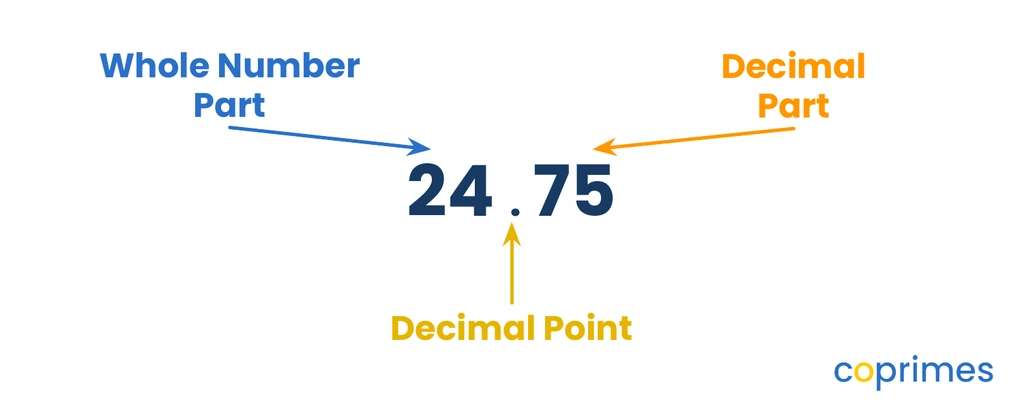
Every decimal has three components: the whole number part to the left, the decimal point in the middle, and the fractional part to the right.
How do you read decimals?
You can read decimals in two standard ways: using formal place-value names or using informal point notation. The formal method is called decimal word form and expresses the mathematical value of the number, while the informal method is often used in fast verbal communication.
For example, the number can be read formally as "three and fourteen hundredths" or informally as "three point one four". Both methods are correct, but formal word form is essential for writing mathematics accurately and connecting decimals to fractions.
Read decimals using place-value names
To read a decimal using place-value names, you state the exact decimal place value of the final digit on the right. This method clearly communicates the fractional size of the number.
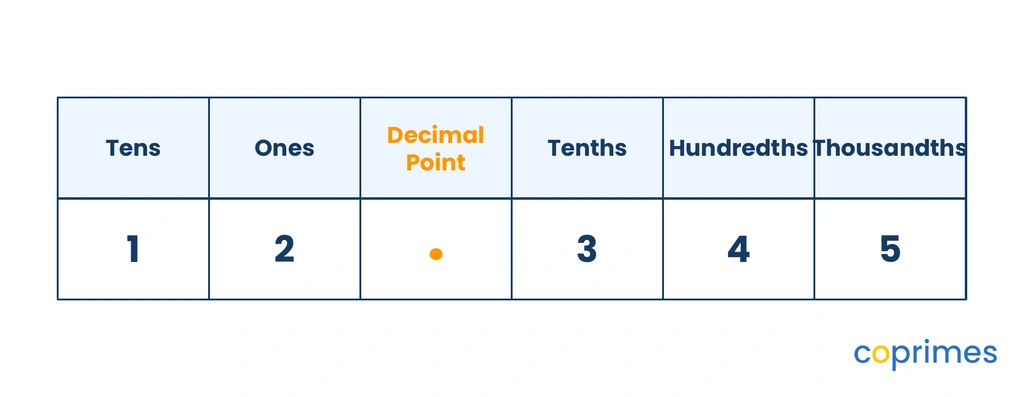
Follow these three steps to read a decimal formally:
- Read the digits to the left of the decimal point as a normal whole number.
- Say the word "and" when you reach the decimal point.
- Read the digits to the right of the decimal point as a normal number, and finish by saying the place value name of the very last digit.
For the number , the whole number is twelve. The decimal point is "and". The decimal part is read as "three hundred forty-five", and the last digit () is in the thousandths place. The complete word form is "twelve and three hundred forty-five thousandths".
The word "and" is strictly used to represent the decimal point separating the whole number from the fraction.
If a decimal has a zero in the ones place, such as , skip the whole number and the word "and". Simply read the decimal part: "eighty-three hundredths".
Read decimals using point notation
Point notation is a fast, conversational way to read decimals aloud without naming place values. To read a decimal this way, read the whole number, say the word "point", and then read each individual digit to the right of the decimal point one by one.
Using point notation, the number is read as "forty-five point six two".
Never read the digits after the decimal point as a whole number when using point notation.
It is incorrect to say "forty-five point sixty-two". The digits after the point do not represent tens and ones; they represent tenths and hundredths. Reading them individually avoids this mathematical confusion.

Write decimals from words
To translate a decimal from word form into standard numerical form, look for the word "and". The word "and" tells you exactly where to place the decimal point.
- Write the whole number that appears before the word "and".
- Place a decimal point for the word "and".
- Write the fractional part, ensuring the final digit lands in the correct place value. Use zeros as placeholders if necessary.
Writing a number in word form is closely related to writing decimals in expanded form, as both rely on the exact value of each digit. If you need to write "six and four thousandths", the whole number is . The final digit must land in the thousandths place (three spaces to the right of the point). You must fill the empty tenths and hundredths places with zeros, resulting in .
Write decimals from models
Visual models, such as grids and blocks, help demonstrate the relationship between the written decimal and its physical size. A square divided into equal pieces represents one whole. Each small square is one hundredth, and one full column of ten squares is one tenth.
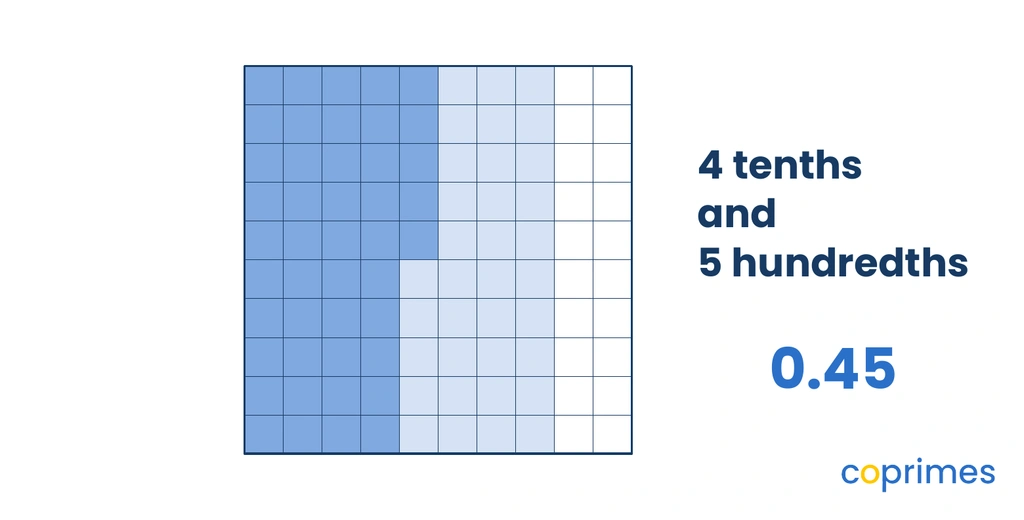
To write a decimal from a hundredths grid, count the fully shaded columns to find the tenths digit. Then, count the remaining shaded single squares to find the hundredths digit. In the model shown, four full columns and five additional squares are shaded. The decimal is , which is read formally as "forty-five hundredths".
Worked examples
Practicing translations between standard form and word form solidifies your understanding of decimal place values.
Example 1: Reading tenths
Question: Write in word form.
Method:
- Identify the whole number. There is a zero before the decimal point, so there is no whole number and the word "and" is not used.
- Read the digits after the decimal point as a number: six.
- Identify the place value of the final digit. The digit is one space to the right of the decimal point, which is the tenths place.
Answer: Six tenths.
Check: The decimal is equivalent to the fraction . Reading the fraction aloud gives "six tenths", confirming the answer.
Example 2: Reading hundredths
Question: Write in word form.
Method:
- Read the whole number before the decimal point: two.
- Use the word "and" for the decimal point.
- Read the decimal part as a normal number: forty-five.
- Identify the place value of the last digit. The is two spaces to the right of the point, which is the hundredths place.
Answer: Two and forty-five hundredths.
Check: Combine the parts: two + and + forty-five + hundredths. The result perfectly matches the place-value steps.
Example 3: Reading thousandths
Question: Write in word form.
Method:
- Read the whole number before the decimal point: seven.
- Use the word "and" for the decimal point.
- Read the digits after the point as a single number: eight.
- Identify the place value of the last digit. The is three spaces to the right of the point, which is the thousandths place.
Answer: Seven and eight thousandths.
Check: You can verify this by placing decimals on a number line between and . The value is a tiny fraction past , specifically eight out of a thousand divisions.
A learning plan shaped by your child, not the class
State-aligned Math plus our own Logic and English curriculum. An adaptive baseline test finds the gaps and fills them.
Common mistakes
One common mistake is reading the decimal part as a standard whole number without saying "point" or naming the fractional place value. If you read as "four and thirty-five", you are incorrect. The word "and" was used, but the fractional size was ignored. You must finish the phrase by saying "hundredths".
Another frequent error is confusing the tens place with the tenths place. The tens place is to the left of the decimal point and represents groups of ten wholes. The tenths place is immediately to the right of the decimal point and represents pieces that are one-tenth of a whole. Spelling is critical when writing decimals from words.
Frequently asked questions
What is decimal word form?
Decimal word form is the method of writing a decimal entirely in words, using place-value names to describe the fractional part instead of using a dot. For example, "nine and two tenths" is the word form of .
How do you write a decimal without a whole number in words?
When there is no whole number (the number begins with zero, like ), you do not write "zero and". You simply read the digits after the decimal point as a number and end with the correct place value. The decimal is written directly as "fifteen hundredths".
Practice questions
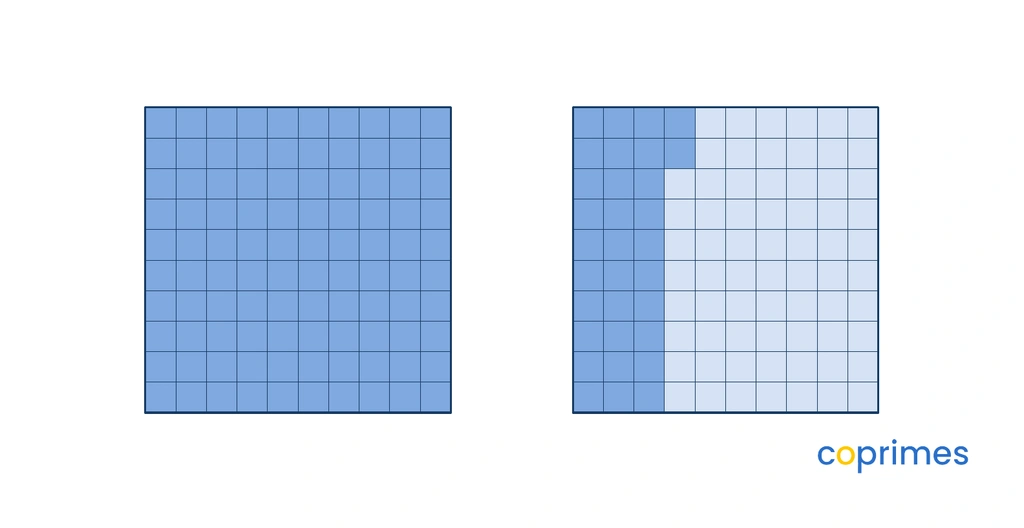
Which word form correctly describes the decimal shown by the shaded models?
One and thirty-two tenths
One and thirty-two hundredths
One point thirty-two
One hundred thirty-two
One and thirty-two hundredths
How is the decimal written in formal word form?
Fourteen and seven tenths
Fourteen point zero seven
Fourteen and seven hundredths
Fourteen and seventy hundredths
Fourteen and seven hundredths
Which standard decimal number represents "five and twelve thousandths"?
A student reads aloud as "eight point forty-five". What is mathematically incorrect about this statement?
Digits after the point should be read individually in point notation.
The student should have used the word "and" instead of "point".
The student forgot to say "tenths" at the very end.
There is no mistake; this is the correct formal word form.
Digits after the point should be read individually in point notation.
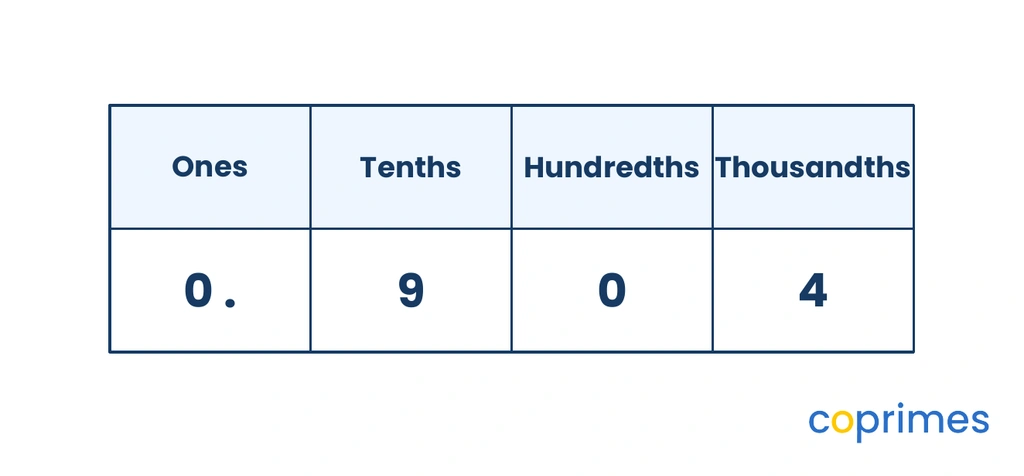
Which of the following represents the decimal shown in the chart?
Nine hundred four hundredths
Nine hundred four thousandths
Zero and nine hundred four thousandths
Nine and four thousandths
Nine hundred four thousandths