
Simple Interest: Definition, Method and Examples
Simple interest is a method for calculating growth or decay where the added or subtracted amount remains completely constant. It is calculated only on the starting value. Because the change is always the same amount, simple interest is sometimes called linear interest.
What is simple interest?
Simple interest is an amount of interest calculated strictly on the original starting value. Unlike other financial calculations where interest might grow over time, simple interest adds the exact same amount during every single time period.
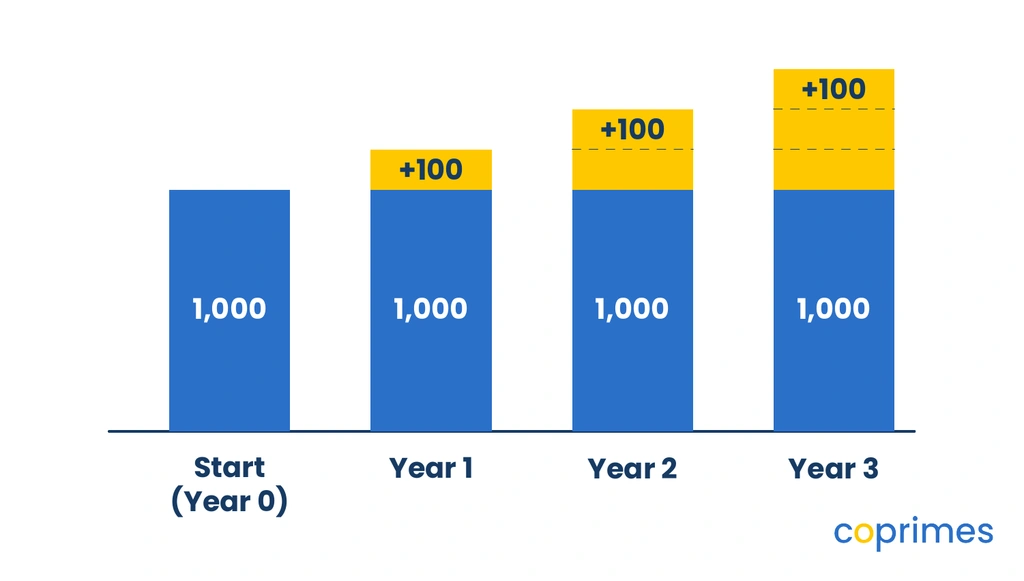
Simple interest is calculated only on the original amount and remains constant every time period.
For example, if you start with an initial deposit of dollars and earn a simple interest rate per year, you will earn exactly dollars each year. The interest never increases, even as your total account balance grows.
Year | Principal | Interest Added | Final Amount |
1 | dollars | dollars | dollars |
2 | dollars | dollars | dollars |
3 | dollars | dollars | dollars |
Identify principal, rate and time
To calculate simple interest, you must identify three specific variables from your scenario.
- Principal (): The original amount of money or the starting value. Understanding baseline amounts is essential because other topics, including exchange rates, also scale directly from a known starting value.
- Rate (): The percentage of the principal that is added or subtracted per period. To use this in a formula, always rewrite the percentage as a decimal. Finding this value relies on knowing how to find a percent of a number.
- Time (): The total number of time periods the rate is applied.
Use I equals Prt
The fundamental formula for calculating the interest amount is . This is commonly called the principal rate time formula.
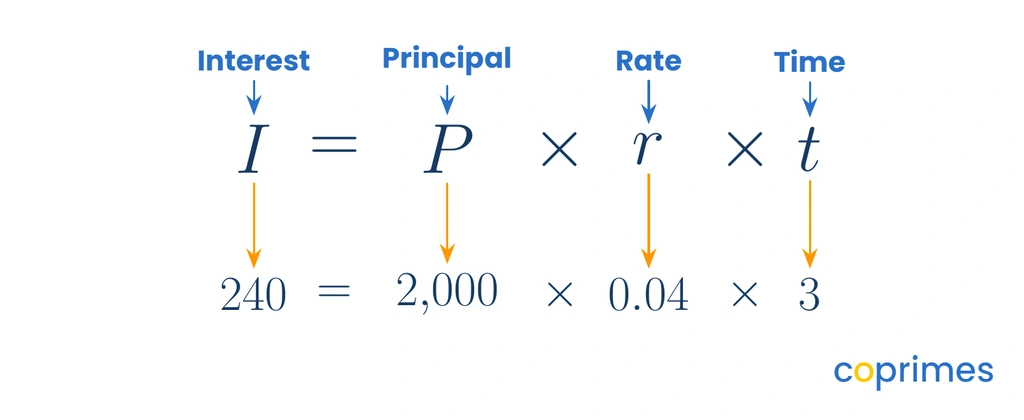
Understanding how multiplying the starting amount by a fixed percentage yields an absolute change builds a strong foundation for measuring percent change across different scenarios.
A learning plan shaped by your child, not the class
State-aligned Math plus our own Logic and English curriculum. An adaptive baseline test finds the gaps and fills them.
Find the final amount
The basic simple interest formula only outputs the interest portion. It does not output the total final amount on its own.
To find the total final amount, add the calculated interest to the starting principal.
To find the final amount after an increase, you evaluate . Alternatively, you can calculate the final amount directly in a single step using the factored formula . If the scenario involves a decreasing value over time, use subtraction instead: .
Keep rate and time periods aligned
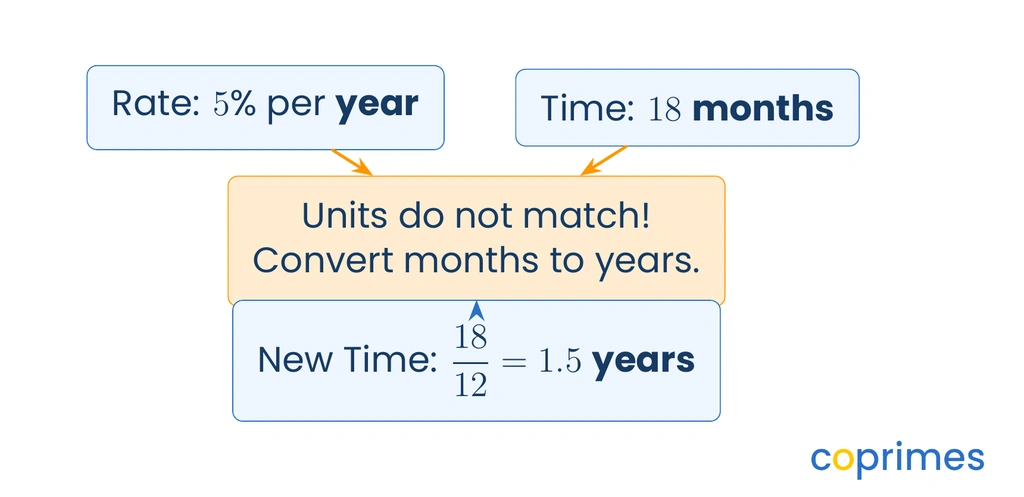
A frequent source of errors occurs when the time unit of the interest rate does not match the time duration given in the problem.
Always verify that your interest rate and your time period share the exact same measurement unit.
If a loan charges an annual rate but the time duration is given in months, you must convert the months into years before multiplying. For example, months must be written as years.
Worked examples
These examples show how to combine definitions, formulas, and conversions.
Example 1: Finding interest and the final amount
Question: An investor deposits dollars into an account earning an annual simple interest rate of . What is the final amount in the account after years?
Method:
- Identify the given values: principal , rate , and time .
- Convert the percentage rate to a decimal: .
- Substitute the values into the simple interest formula to find the interest: .
- Calculate the product to find the interest: dollars.
- Add the interest to the principal to find the final amount: .
Answer: The final amount is dollars.
Check: Use the combined formula . Substitute the values to get dollars. The matching result confirms the calculation.
Example 2: Decreasing value and time conversion
Question: A business buys a specialized machine for dollars. It depreciates (loses value) by a simple interest rate of per year. What is its value after months?
Method:
- Identify the given values: principal , and rate . Note that the value is decreasing.
- Convert the time to years so it matches the annual rate: years.
- Substitute the values into the decay formula .
- Evaluate the expression inside the parentheses: .
- Multiply by the principal: .
Answer: The value of the machine is dollars.
Check: Calculate the total interest lost first: dollars. Subtract this from the original cost: dollars.
Example 3: Simple interest in a non-money context
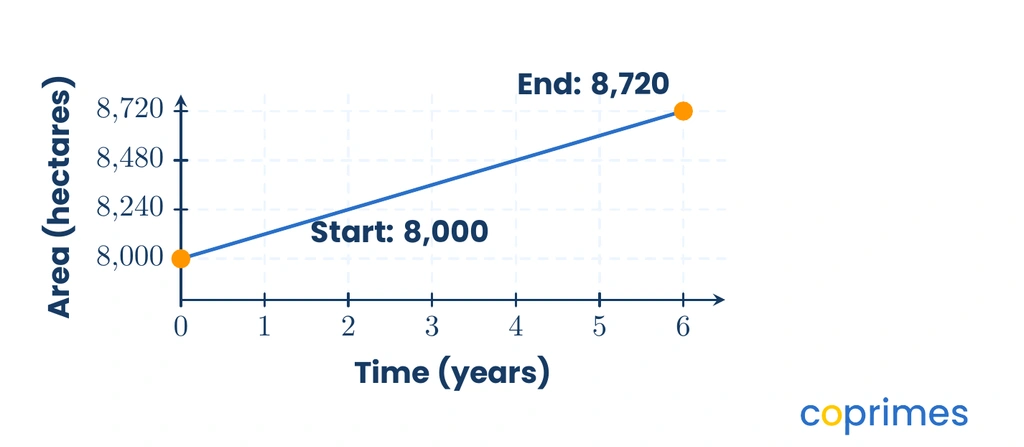
Question: A forest currently covers hectares. A conservation program increases the forest area by a simple interest rate of of its original area every year. What is the total area of the forest after years?
Method:
- Identify the values: principal , rate , time .
- Convert the percentage rate to a decimal: .
- Calculate the total growth area: .
- Evaluate the multiplication: . Multiply by years to get hectares.
- Add the growth to the starting area: .
Answer: The forest will cover hectares.
Check: Use the combined formula hectares.

Common mistakes
- Not converting the percentage to a decimal. Using instead of will make your calculated interest times larger than it should be.
- Using mismatched time scales. Always ensure the duration of your loan or investment is written in the exact same time unit as your interest rate.
- Applying simple interest when compound is required. In simple interest, the principal never changes. Recognizing this fixed base is the key to understanding simple interest vs compound interest applications.
Frequently asked questions
Can simple interest decrease a value?
Yes. Simple interest is frequently used to model constant linear decay. If a piece of equipment loses a fixed percentage of its original value every year, you calculate the simple interest and subtract it from the principal.
How does simple interest differ from compound interest?
Simple interest adds a fixed amount based solely on the original starting principal. In contrast, compound interest calculates interest on the new total at the end of every period, which means the interest itself generates additional interest as time passes.
Practice questions
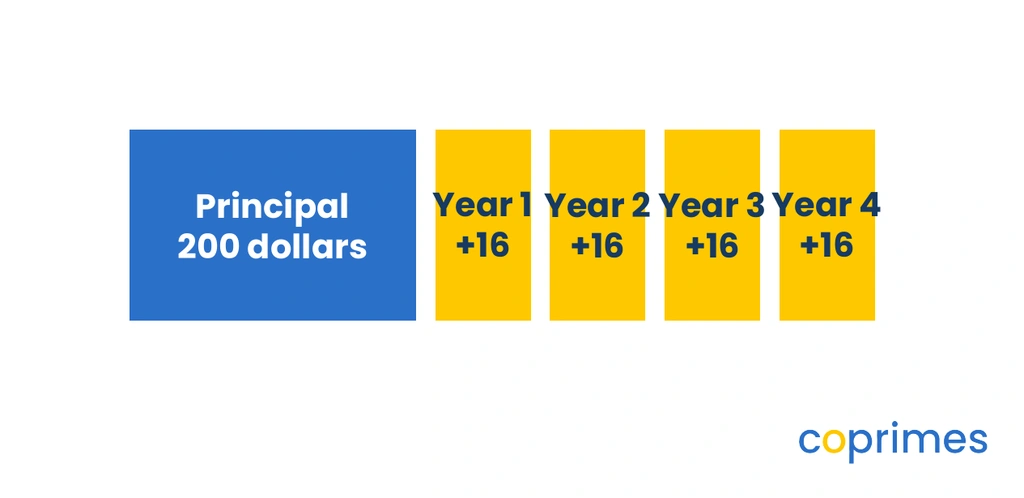
The visual shows a principal amount earning simple interest over years. What is the total final amount after the years?
264 dollars
216 dollars
64 dollars
800 dollars
264 dollars
Calculate the simple interest earned on an dollar investment at a annual rate for years.
12,000 dollars
120 dollars
12 dollars
920 dollars
120 dollars
A student calculates the final amount of a dollar loan with a annual simple interest rate after years by evaluating . What mistake did they make?
They calculated the interest but forgot to add the principal.
They used the formula for compound interest.
They did not convert the percentage to a decimal.
They multiplied the rate and time instead of adding them.
They did not convert the percentage to a decimal.
What is the final amount of a dollar investment that earns a annual simple interest rate for months?
3,180 dollars
4,440 dollars
120 dollars
3,120 dollars
3,120 dollars
A piece of equipment costs dollars. It loses value by a simple interest rate of per year. How many years will it take for the equipment's value to reach exactly dollars?
5 years
40 years
20 years
80 years
20 years