
Subtracting Decimals: Method and Examples
To subtract decimals, align the decimal points and place values of the numbers, add zero placeholders where needed to make the numbers the same length, and subtract each column from right to left, regrouping when necessary. Finally, place the decimal point in the answer directly below the aligned decimal points.
How do you subtract decimals?
Decimal subtraction follows the same standard algorithm as subtracting whole numbers, with special attention paid to the decimal point. The place values must match exactly so that you subtract tenths from tenths and hundredths from hundredths.
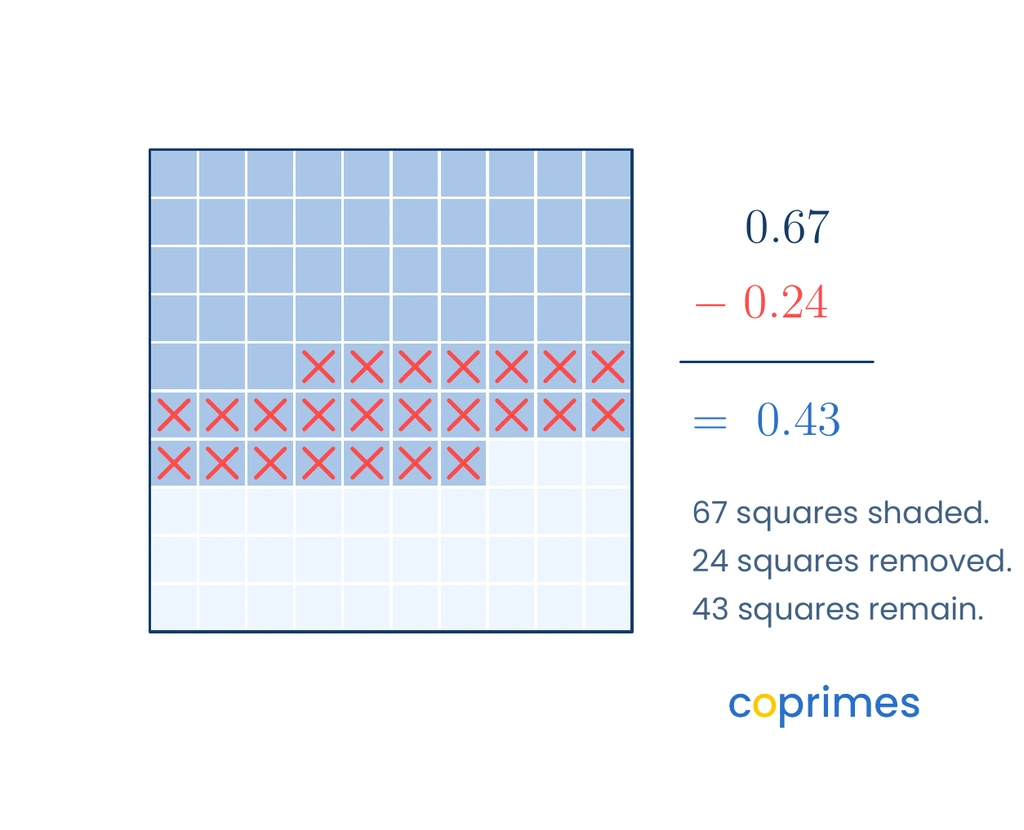
Just like whole numbers, organizing the values visually is the key to accuracy. Every digit is bound to its decimal place value, which tells you the precise size of the number being subtracted.
Align decimal points and place values
The most critical step when subtracting decimals is aligning the decimal points vertically. This guarantees that you are subtracting hundredths from hundredths, tenths from tenths, and ones from ones.
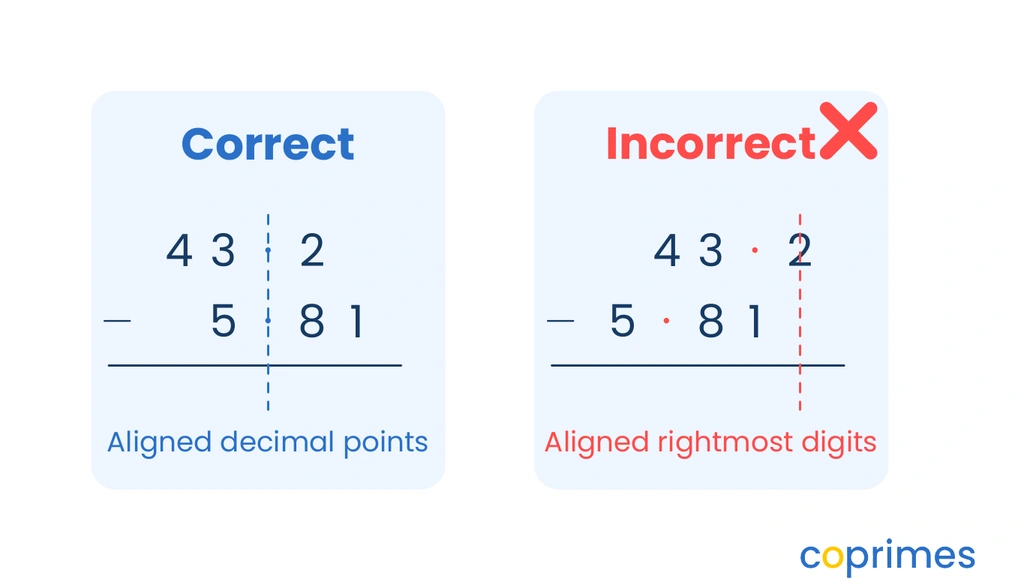
Aligning numbers on the right edge is a common mistake carried over from whole numbers. When working with decimals, the lengths of the numbers do not matter; keeping the decimal points directly stacked above each other is the only way to maintain the correct mathematical values. This is the exact same rule used when adding decimals.
Use zero placeholders
When the decimals have a different number of digits, append zeros to the right of the shorter decimal until both have the same length.
Adding a zero to the right of a decimal does not change its mathematical value.
For example, is exactly the same as . Using a zero placeholder ensures that every digit in the bottom number has a digit above it to subtract from. Finding matching decimal lengths is very similar to finding common denominators when subtracting fractions.
A learning plan shaped by your child, not the class
State-aligned Math plus our own Logic and English curriculum. An adaptive baseline test finds the gaps and fills them.
Regroup across decimal places
Once the decimals are aligned and zero placeholders are added, subtract column by column, moving from right to left. When a top digit is smaller than the bottom digit in the same column, you must regroup (borrow) from the column to the left.
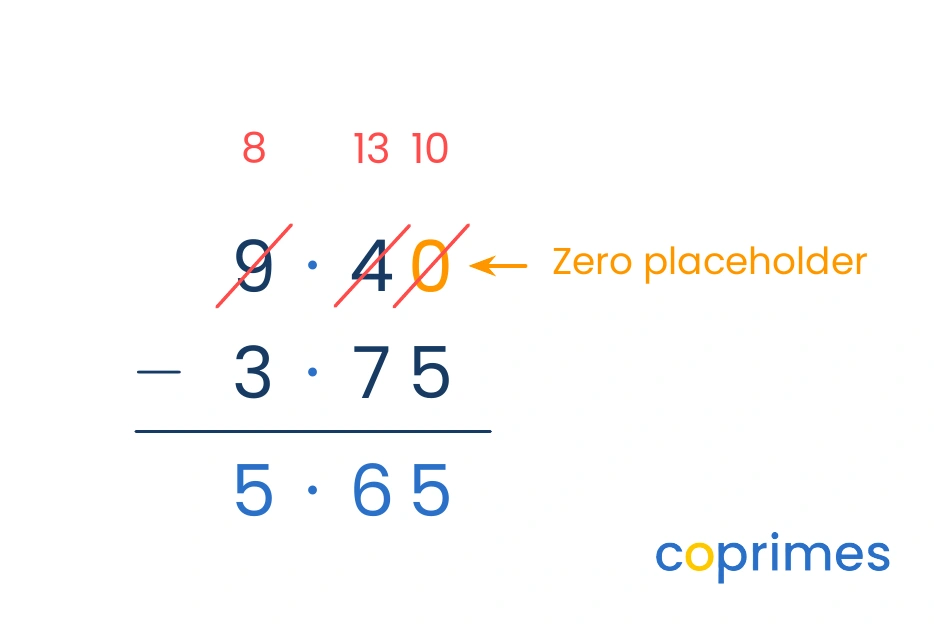
Regrouping works seamlessly across the decimal point. If you need to borrow for the tenths column, you can borrow one whole number from the ones column and turn it into ten tenths.
Check the size of the difference
Using estimation helps you quickly confirm that your decimal subtraction is correct and that the decimal point is placed correctly. You can estimate the result by rounding decimals to the nearest whole number before subtracting.
If you subtract , you can estimate it as . If your calculated answer is or , the estimation immediately reveals that the decimal point is misplaced or the calculation is wrong.
Worked examples
Reviewing a variety of calculations and word problems builds confidence. Pay close attention to inserting zero placeholders and placing the decimal point in the final answer.
Example 1: Subtracting with zero placeholders
Question: Calculate
Method:
- Align the numbers vertically by the decimal point.
- Add a zero placeholder to so it becomes . This ensures both numbers have digits in the hundredths place.
- Subtract from right to left. In the hundredths column, requires regrouping. Borrow from the tenths place so becomes , and becomes .
- Subtract the hundredths: .
- In the tenths column, requires regrouping. Borrow from the ones place so becomes , and the tenths become .
- Subtract the tenths: .
- Bring the decimal point down.
- In the ones column, requires regrouping from the tens place. The becomes , and the ones become .
- Subtract the ones: .
- Subtract the tens: .
Answer: .
Check: Estimate by rounding: . The answer is very close to .
Example 2: Subtracting from a whole number
Question: Calculate
Method:
- Give the whole number a decimal point and add two zero placeholders so both numbers reach the hundredths place: .
- Align and vertically.
- Regroup across the columns to subtract. The zeroes must borrow from the tens place. The becomes , the ones become , the tenths become , and the hundredths become .
- Subtract hundredths: .
- Subtract tenths: .
- Subtract ones: .
Answer: .
Check: Add the answer to the subtracted amount: . The result is correct.
Example 3: Applying subtraction in a word problem
Question: A baker buys kilograms of flour. After baking, there are kilograms left. How much flour did the baker use?
Method:
- Identify the calculation required for decimal word problems asking for a difference: .
- Set up the vertical subtraction and add a zero placeholder to so it reads .
- Borrow from the tenths to subtract the hundredths: . The tenths digit becomes .
- Borrow from the ones to subtract the tenths: . The ones digit becomes .
- Bring the decimal down.
- Borrow from the tens to subtract the ones: .
Answer: The baker used kilograms of flour.
Check: Estimate using rounding: . The result is reasonable.

Common mistakes
Recognizing common traps will make decimal subtraction much more reliable.
- Aligning the rightmost digits instead of the decimal points: This forces you to subtract tenths from hundredths, destroying the place-value structure. Always stack the decimal points vertically before writing out the digits.
- Forgetting zero placeholders: When a top number lacks a digit, students often drop the bottom digit directly into the answer. For example, in , they may mistakenly write in the hundredths place instead of correctly regrouping .
- Forgetting the decimal point in the answer: A perfectly calculated subtraction is mathematically incorrect if the final decimal point is omitted. Bring it straight down into the answer row as part of your initial setup.
Frequently asked questions
Can you subtract a decimal from a whole number?
Yes. You can place a decimal point at the end of any whole number and add zero placeholders. For instance, becomes or , allowing you to align and subtract exactly like you would with two decimals.
Does subtracting decimals work like normal subtraction?
Yes. Once the decimal points are aligned and the zero placeholders are added, the regrouping and column-by-column subtraction process is identical to standard whole-number subtraction.
Practice questions
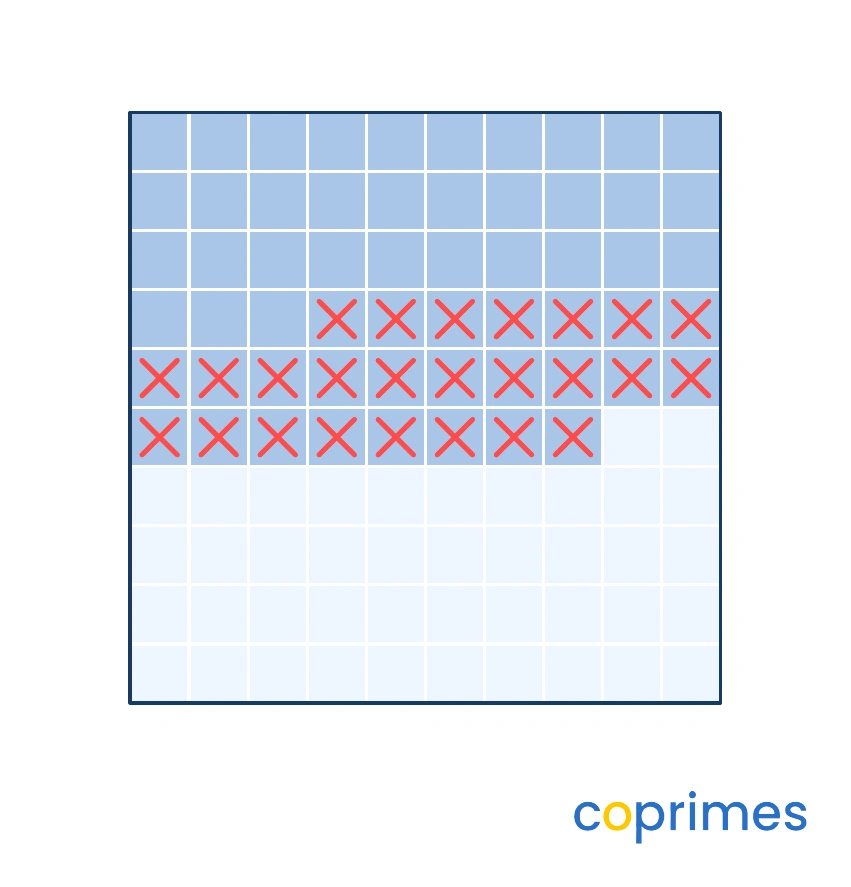
Which subtraction calculation is represented by the shaded and crossed-out regions on this hundredths grid?
Calculate the difference:
A student calculates . They write the from the second number directly into their answer and get a result of . What mistake did the student make?
They aligned the rightmost digits instead of stacking the decimal points.
They placed the decimal point in the wrong position in their final answer.
They forgot to use a zero placeholder and did not regroup from the tenths place.
They regrouped correctly, but subtracted the whole numbers incorrectly.
They forgot to use a zero placeholder and did not regroup from the tenths place.
What is the difference of ?
A piece of rope is meters long. If a section measuring meters is cut off, what is the length of the remaining rope?
meters
meters
meters
meters
meters