
Comparing Ratios: Methods, Models, and Examples
Compare ratios by representing them with a common form, such as equivalent ratios with a shared second term, a common fraction denominator, a unit rate, or a diagram, then compare the corresponding values.
A ratio compares two quantities. When you need to decide which relationship is stronger, larger, or faster, you are comparing ratios.
What does comparing ratios mean?
Comparing ratios means determining whether one relationship is less than, greater than, or equal to another relationship.
When two ratios share a common part, you can compare them directly by looking at the remaining values. If they do not share a common part, you must rewrite them so they share a common basis before comparing their corresponding parts.
Compare with equivalent ratios
You can compare two ratios by converting them into equivalent ratios that share the same second term.
Once the second terms match, you compare the first terms. The ratio with the larger first term is the greater ratio.
To compare ratios using equivalent forms, find a common multiple for the second terms and scale both ratios.
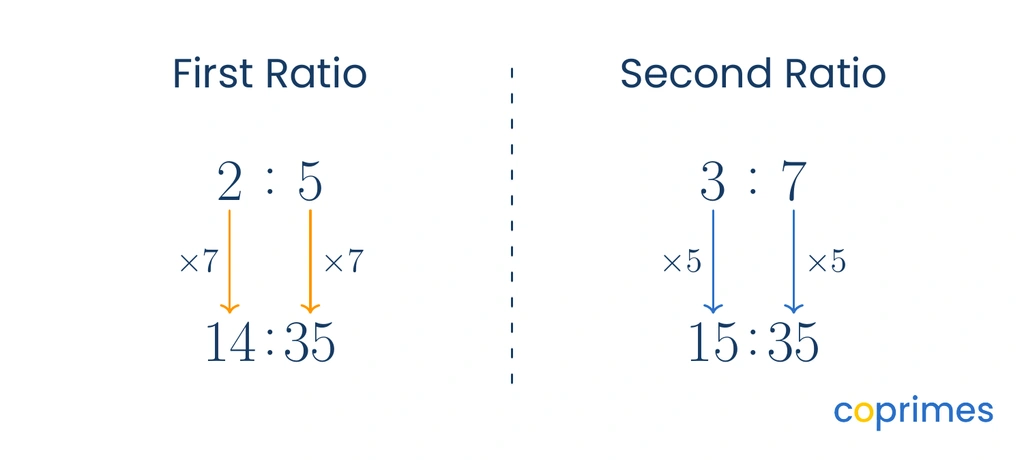
For example, compare the ratios and .
The second terms are and . Their lowest common multiple is .
Scale the first ratio by multiplying both terms by to get .
Scale the second ratio by multiplying both terms by to get .
Because is greater than , the ratio is greater than .
Compare using fractions
Writing ratios as fractions allows you to use standard rules for comparing fractions.
Convert each ratio into the fractional form .
Find a common denominator, rewrite the fractions, and compare the numerators.
For example, compare and .
Write them as the fractions and .
The lowest common denominator for and is .
Multiply the numerator and denominator of by to get .
Multiply the numerator and denominator of by to get .
Because is greater than , the ratio is greater than .

Compare using a table or model
When dealing with complex contexts, organizing data into ratio tables helps track proportional relationships visually.
A table allows you to list multiples of each ratio side by side until you find a matching value in one of the columns.
Alternatively, a bar model represents the quantities as physical blocks. Models are especially useful when comparing parts to a whole or when the total amounts in both ratios share a clear relationship. By aligning the bars, you can identify the greater ratio without calculating large multiples.
Choose an efficient method
The best method for a ratio comparison depends on the given numbers.
- Use mental scaling if one second term is a simple multiple of the other, such as comparing and .
- Use fractions with a common denominator when the numbers are small and share easy multiples.
- Use a unit rate, dividing the first term by the second, when finding a per-unit cost or determining speed.
- Use models when a visual representation helps clarify the relationships in a word problem.
Worked examples
Applying these methods to math word problems requires identifying the given information and selecting an appropriate strategy based on the numbers.
Example 1: Comparing ratios with the same second term
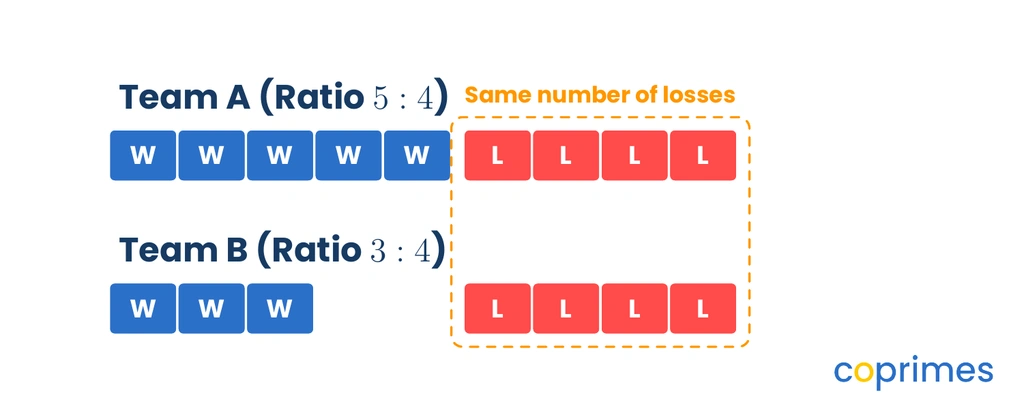
Question: Team A has a win-to-loss ratio of . Team B has a win-to-loss ratio of . Which team has the greater ratio of wins to losses?
Method:
- Identify that both ratios already share the same second term, which is losses.
- Draw a bar model for each team comparing their wins against the common losses.
- Compare the first terms directly.
Answer: Team A has the greater ratio because wins is greater than wins for the same number of losses.
Check: Since , the fraction is greater than .
Example 2: Comparing by scaling fractions
Question: Recipe A uses a sugar-to-flour ratio of . Recipe B uses a sugar-to-flour ratio of . Which recipe has a higher ratio of sugar to flour?
Method:
- Write the ratios as fractions: and .
- Find a common denominator. The lowest common multiple of and is .
- Scale the first fraction to match the common denominator by multiplying the numerator and denominator by .
- Compare the new numerators.
Answer: becomes . Because is greater than , Recipe B has the higher ratio.
Check: Converting to decimals, and . Since , the comparison holds.
Example 3: Analyzing rates with a ratio table
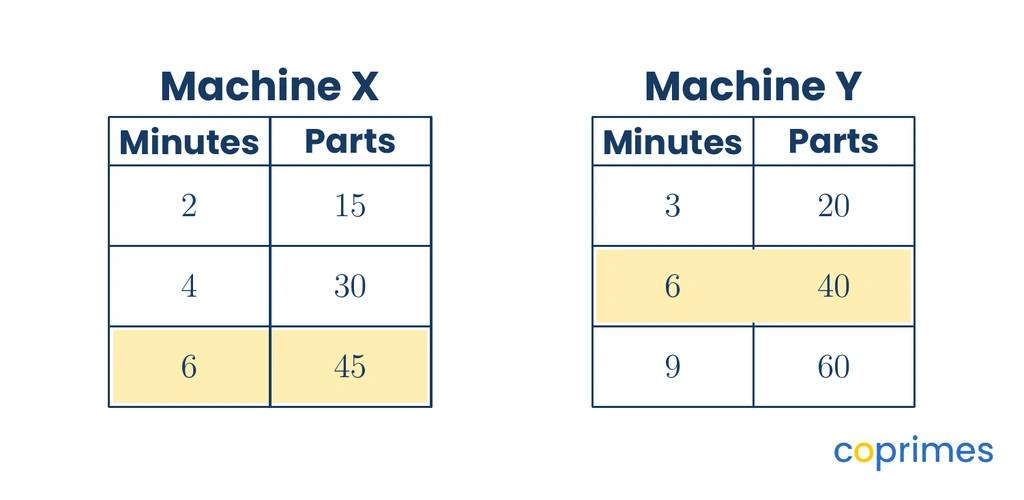
Question: Machine X produces parts in minutes. Machine Y produces parts in minutes. Which machine is faster?
Method:
- Note the order of comparison: parts to minutes.
- Set up a ratio table to list multiples of each machine's production until the minutes match.
- For Machine X, list the multiples of the ratio .
- For Machine Y, list the multiples of the ratio .
- Compare the number of parts produced at the common time of minutes.
Answer: Machine X produces parts in minutes. Machine Y produces parts in minutes. Machine X is faster.
Check: Calculate the unit rates. Machine X produces parts per minute. Machine Y produces approximately parts per minute.
A learning plan shaped by your child, not the class
State-aligned Math plus our own Logic and English curriculum. An adaptive baseline test finds the gaps and fills them.
Common mistakes
Comparing ratios requires attention to proportional relationships, not just absolute values.
A common error is comparing only the first terms without ensuring the second terms match. A ratio of is not automatically greater than simply because is greater than . You must establish a common basis first.
Pay attention to the order of the ratio. A ratio of is entirely different from a ratio of . Reversing the order changes the meaning of the relationship and will result in an incorrect comparison.
Do not add the same value to both terms of a ratio. Adding to both parts of creates , which is not an equivalent ratio. Always use multiplication or division to scale ratios.
Frequently asked questions
Can you compare ratios with different units?
No, standard ratios must compare quantities using the same units. If a problem involves different units, such as meters and centimeters, convert them to a single common unit before creating and comparing the ratios.
What is the fastest way to compare two ratios?
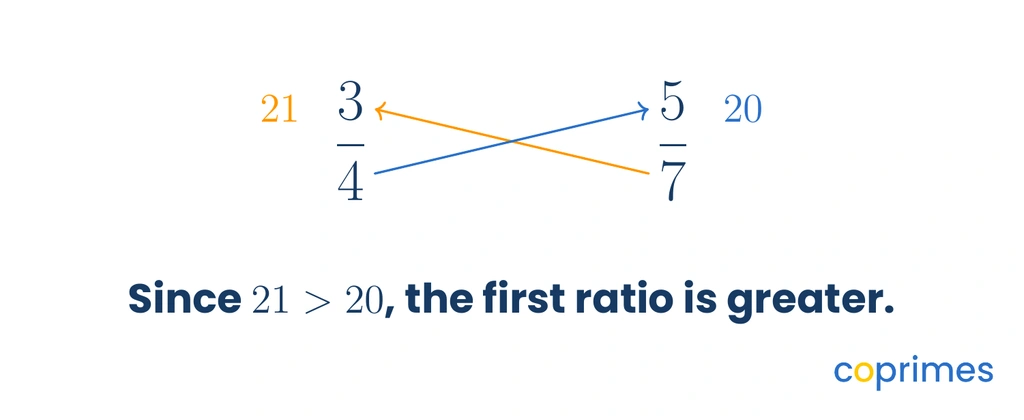
Converting ratios into fractions and using cross-multiplication is often the fastest method. Multiply the first term of the first ratio by the second term of the second ratio, then multiply the second term of the first ratio by the first term of the second ratio. Compare the products.
How do you compare three or more ratios?
To compare three or more ratios, write them as fractions and find a common denominator for all of them. Once all ratios are scaled to this common denominator, you can easily order them by comparing their numerators.
Practice questions
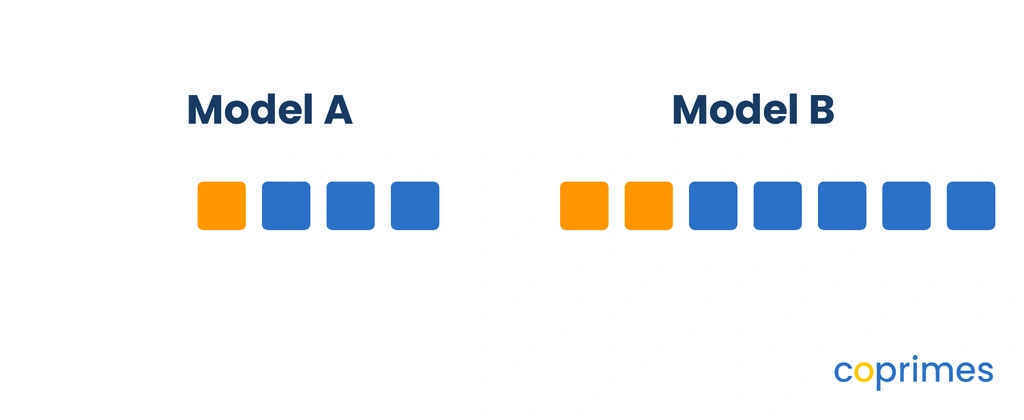
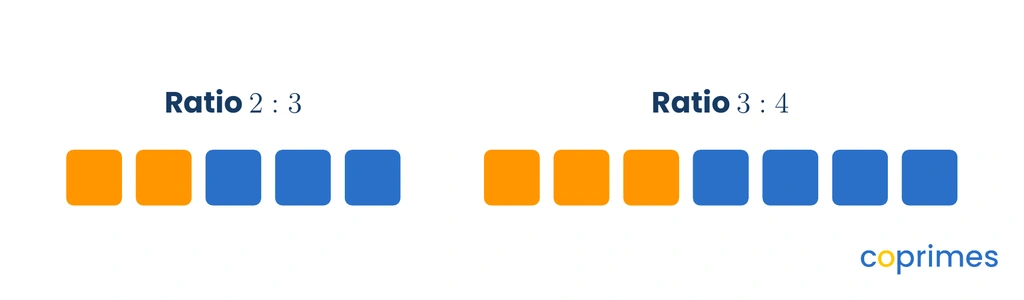
Which statement correctly compares the ratio of orange squares to blue squares in Model A and Model B?
Model A has a greater ratio of orange to blue squares because is greater than .
Model B has a greater ratio of orange to blue squares because is greater than .
They have equal ratios because Model B just adds orange and blue squares to Model A.
Model A has a greater ratio because it has fewer blue squares overall.
Model B has a greater ratio of orange to blue squares because is greater than .
To compare the ratios and by writing them as fractions, which common denominator should you use to find the greater ratio?
A bookstore sells fiction books for every non-fiction books. A library checks out fiction books for every non-fiction books. Which location has a higher ratio of fiction to non-fiction books?
The bookstore, because is equivalent to , which is greater than .
The library, because is greater than .
The library, because is equivalent to , which is greater than .
They are equal, because the difference between the terms in both ratios is .
The bookstore, because is equivalent to , which is greater than .
A student compares the ratios and and concludes that is greater because is greater than , and is greater than . What is the correct comparison and reasoning?
is greater because adding to both terms of gives , which is less than .
is greater because is , which is greater than .
is greater because equals and equals .
is greater because subtracting the terms gives for the first ratio and for the second.
is greater because equals and equals .
Car A travels kilometers in hours. Car B travels kilometers in hours. By comparing their ratios of distance to time, which car travels at a faster rate?
Car A is faster at kilometers per hour.
Car B is faster at kilometers per hour.
Car A is faster at kilometers per hour.
Car B is faster at kilometers per hour.
Car A is faster at kilometers per hour.