
Convert Improper Fractions to Mixed Numbers
To convert an improper fraction to a mixed number, divide the numerator by the denominator; the quotient becomes the whole number, the remainder becomes the numerator, and the denominator stays the same.
Understanding how to convert improper fractions to mixed numbers helps clarify exactly how many whole units and partial units a fraction represents. This fundamental skill makes working with large fractions much more intuitive.
Why convert an improper fraction?
Converting an improper fraction reveals the true size of a number by separating its whole units from its leftover parts.
When the numerator (top number) is greater than or equal to the denominator (bottom number), the fraction represents a value of one or more. While improper fractions are highly useful for multiplication and division, they can be difficult to visualize in real-world contexts. For instance, picturing pizzas is much harder than visualizing pizzas.
Performing an improper to mixed conversion is also essential when comparing or ordering fractions on a number line, as it clearly identifies which whole numbers the fraction sits between.
Improper fractions as wholes and parts
Every improper fraction contains at least one hidden whole number within its fractional pieces.
By definition, improper fractions represent parts that add up to one or more complete wholes. When we group these parts into full sets, we can write the number as a combination of an integer and a proper fraction. These combinations are called mixed numbers.
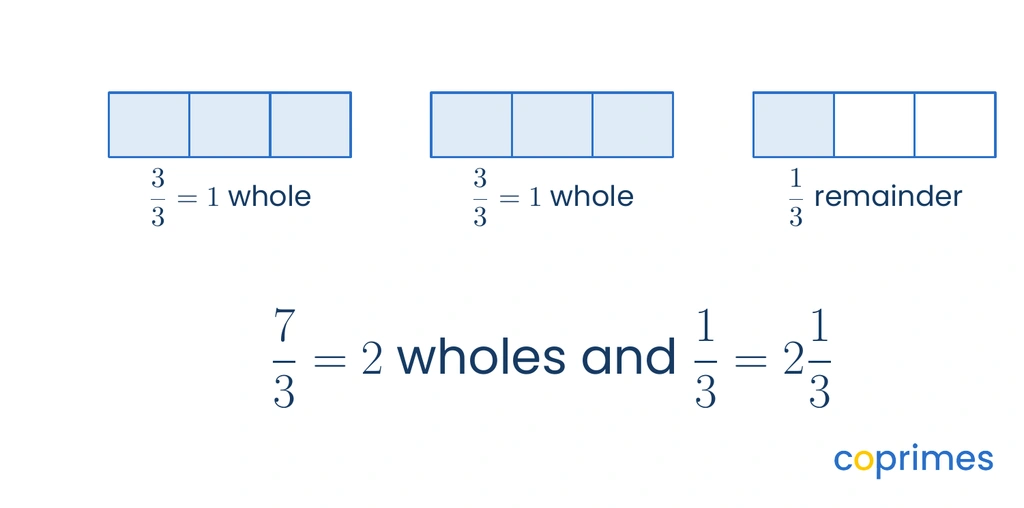
This fraction-strip regrouping visual demonstrates that is composed of two complete wholes () and one additional third.
Conversion steps
To systematically convert top-heavy fractions into mixed numbers, use standard division.
Follow these steps for any mixed number conversion:
- Identify the numerator (the dividend) and the denominator (the divisor).
- Divide the numerator by the denominator.
- Record the resulting quotient as the large whole number.
- Record the remainder as the new numerator for the fractional part.
- Keep the original denominator exactly as it was.
A learning plan shaped by your child, not the class
State-aligned Math plus our own Logic and English curriculum. An adaptive baseline test finds the gaps and fills them.
Use division with remainder
The division algorithm directly maps the components of an improper fraction to the components of a mixed number.
Because a fraction bar represents division, calculating the whole number and remainder is the most efficient conversion method. For example, converting requires dividing by .
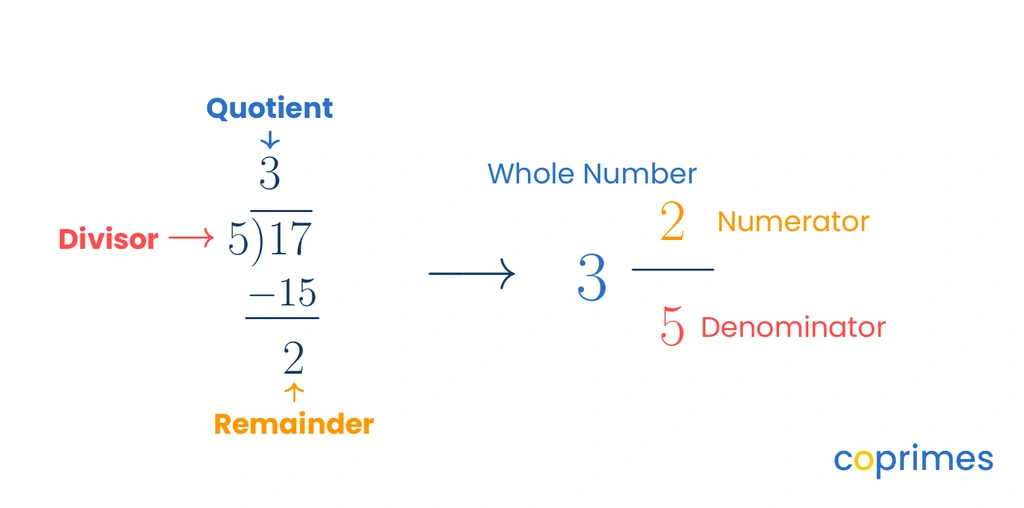
The denominator remains exactly the same because the size of the original fractional pieces has not changed.
Visual conversion method
You can also use a number line to convert fractions visually by jumping forward in groups of whole numbers.
Mark the number line with intervals matching the denominator. Start at zero and jump forward by fractions equal to one whole (such as ) until the next full jump would exceed your target fraction.
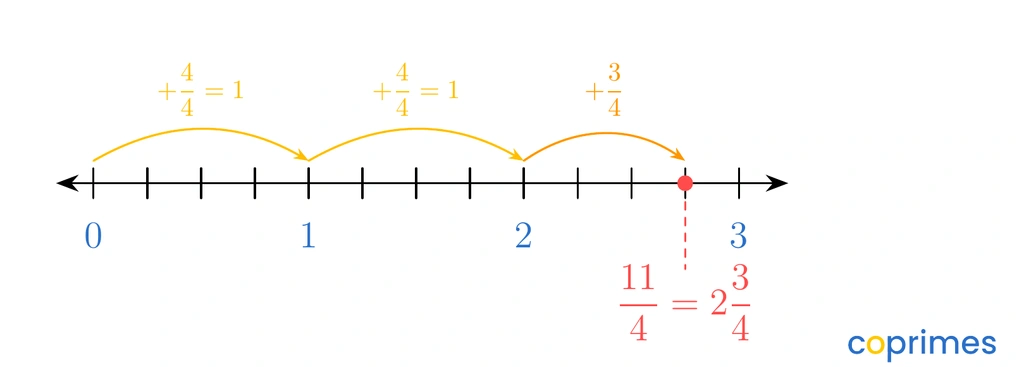
The number of complete jumps tells you the whole number, and the remaining smaller steps provide the final proper fraction.
Worked examples
Review these examples to see how the division method applies to different types of fractions.
Example 1: Converting to an exact whole
Question: Convert to a mixed or whole number.
Method:
- Divide the numerator () by the denominator ().
- Calculate the quotient and remainder. with a remainder of .
- Because there is no remainder, the fraction represents exactly wholes.
Answer: The converted number is .
Check: Multiply the whole number by the denominator: . This matches the original numerator.
Example 2: Converting with a remainder
Question: Convert to a mixed number.
Method:
- Divide the numerator () by the denominator ().
- Calculate the quotient and remainder. with a remainder of .
- Write the quotient () as the whole number.
- Write the remainder () as the new numerator over the original denominator ().
Answer: The mixed number is .
Check: Multiply the whole number by the denominator and add the numerator: . The result is .
Example 3: Converting and simplifying
Question: Convert to a mixed number and fully simplify the result.
Method:
- Divide by . The quotient is with a remainder of .
- Write the initial mixed number as .
- Notice that the fractional part, , is not in simplest form.
- Apply the rules for simplifying fractions by dividing both and by their greatest common factor, which is .
- The fraction simplifies to .
Answer: The simplified mixed number is .
Check: Convert back to an improper fraction: . Multiply both terms by to verify it equals .

Common mistakes
Avoid simple calculation errors by consistently checking the denominator and the final fractional part.
A frequent mistake is accidentally changing the denominator during the division step. The denominator must always remain the same as in the original improper fraction.
Another common error is forgetting to simplify the proper fraction at the end of the process. Always check if the new numerator and denominator share a common factor. Finally, ensure you do not mix up the quotient and the remainder; the quotient is always the large whole number, and the remainder is the small top number.
Frequently asked questions
Can every improper fraction be converted?
Yes. Any improper fraction can be converted into either a mixed number (if there is a remainder) or a whole number (if the numerator divides evenly by the denominator).
How do I convert mixed numbers to improper fractions?
To reverse the process, multiply the denominator by the whole number, then add the numerator. Place this final sum over the original denominator.
Is a whole number considered an improper fraction?
Whole numbers can be written as improper fractions by placing them over a denominator of . For example, the number is equivalent to the improper fraction .
Practice questions
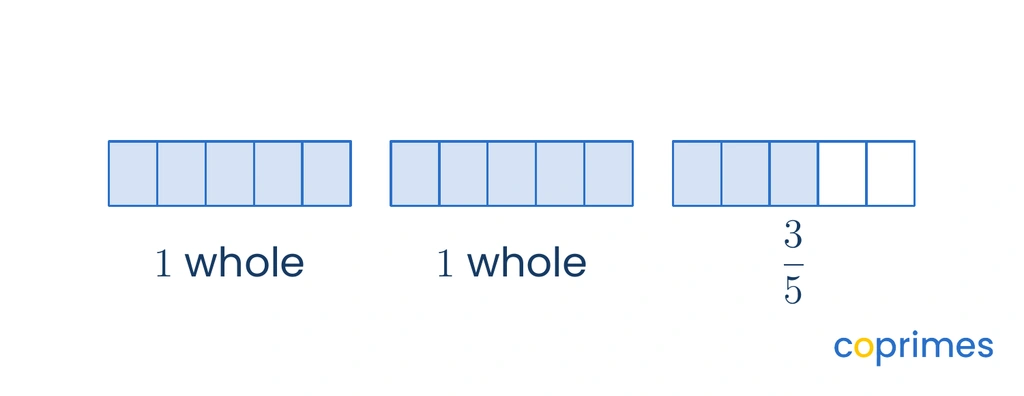
The visual above represents the improper fraction . Which mixed number does it represent?
Convert the improper fraction to a mixed number.
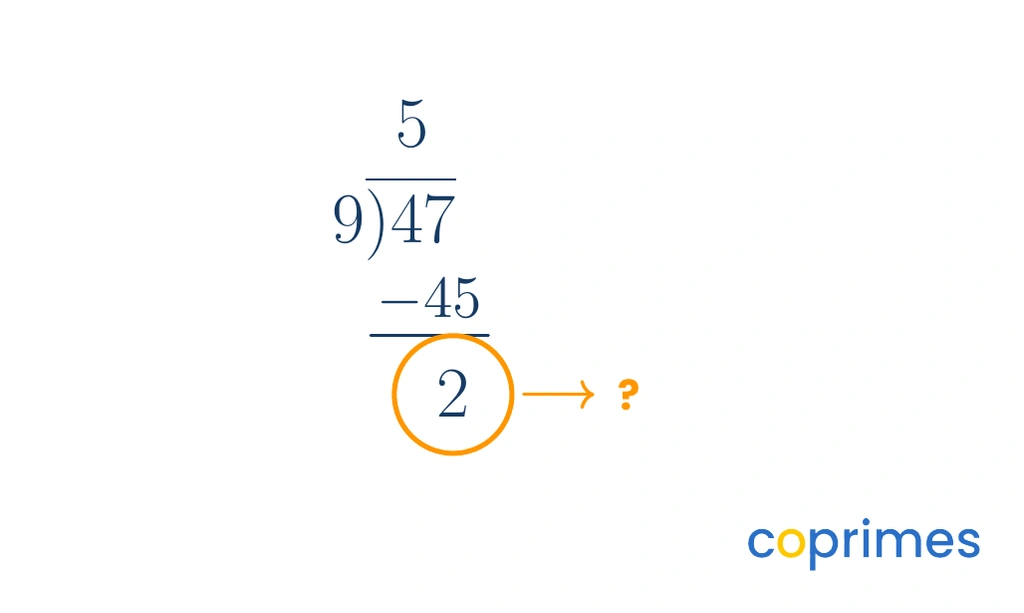
The division above shows the first step of converting to a mixed number. What does the circled remainder () represent in the final mixed number?
The new numerator of the fractional part.
The whole number part of the mixed number.
The denominator of the fractional part.
The total number of wholes removed.
The new numerator of the fractional part.
Convert the improper fraction to a mixed number and fully simplify your answer.
A bakery uses cups of sugar for a batch of cookies. How many full cups and parts of a cup is this?